The unchosen word
Emily Dickinson, sam sax, and an experiment in close reading with language models
The Poet Doctor · October 2026
Abstract
Remix Mode places a small set of model-generated alternatives beside selected words in Jenelle Jindal’s poems. A reader can substitute a word, observe how the model’s relative weighting of other choices changes, sample a complete reading, and restore the published text. The experiment uses substitution to direct attention to the effects of diction.
Dickinson’s manuscript variants are historical evidence. sam sax’s bracketed alternatives are a poet’s composed form. A language model’s candidates are computational proposals. Their different origins determine what a comparison can establish. Remix Mode identifies the published text, the model’s suggestions, and the reader’s selections separately.
The displayed percentages normalize scores of complete readings within fixed menus. They measure relative model likelihood within that set; they estimate neither poetic merit nor unrestricted word probability. Comparing alternatives may sharpen attention to a word’s effects, but the educational value of this interface remains to be tested.
Dickinson’s manuscripts preserve alternative words
Dickinson marked words with small crosses and recorded alternatives in the margins or below the poem. Such marks preserve choices that a single printed text may conceal.
During 1858–1864 she copied more than eight hundred poems into forty handmade booklets, now called fascicles. Other poems circulated in letters or survived on separate sheets and scraps; some exist in more than one copy. Their physical form and circulation help establish the relation between surviving texts.[1] Early publication frequently regularized her capitalization, punctuation, and rhyme, making editorial choice part of the poem that later readers received.[2]
An alternative may record a working possibility, an unresolved revision, or a deliberate suspension of choice. Sharon Cameron’s Choosing Not Choosing treats the fascicles’ suspension of choice as a central textual and philosophical problem.[3] Her account proposes an interpretation of the fascicles; particular manuscripts still require examination on their own terms.
A surviving alternative establishes that Dickinson wrote a word. Interpreting its relation to the line requires further evidence: was it a replacement, a possibility under consideration, or an alternative she intended to retain?
Emily Dickinson: manuscripts, circulation, and editions
Reading “He showed me Hights”
Dickinson’s writing circulated through relationships as well as through the booklets she retained. The Emily Dickinson Museum [1] records that she shared roughly five hundred poems with more than forty correspondents. A retained copy, a poem sent to Susan Dickinson, and a later printed text may be different documents with different histories.
A manuscript alternative
the +steadier, as my
face withdrew,
+ Larger
Excerpt from the transcription of “He showed me Hights” in Kris Comment’s comparison in the Dickinson Electronic Archives. The cross connects a word in the line to an alternative; the case follows that transcription.
“Larger” emphasizes magnitude; “steadier” emphasizes constancy. Comparing their effects is an interpretive exercise. Both words are attested in the manuscript, but their survival alone does not establish an instruction to replace one with the other.
The archive’s account explains that a missing ending led Thomas H. Johnson to reconstruct lines from the related “I showed her Hights.” A recovered piece later corrected the reconstruction. The two first lines identify different witnesses. Compare the page’s transcriptions and editorial texts to examine changes in wording and lineation.
R. W. Franklin’s The Manuscript Books of Emily Dickinson (1981) reconstructs the fascicles in facsimile using physical evidence including stains, paper, and binding holes. Cristanne Miller’s Emily Dickinson’s Poems: As She Preserved Them (2016) foregrounds retained copies and includes their alternate words and phrases. Jen Bervin and Marta Werner’s The Gorgeous Nothings (2013) pairs full-scale color reproductions of envelope writings with transcriptions. These editions provide access to the arrangement of the booklets, the retained textual record, and the material forms of the writings.
Sharon Cameron [3] makes suspended choice central to her account of the fascicles. John Shoptaw’s “Listening to Dickinson” (Representations 86, 2004, 20–52) questions approaches that turn every surviving inscription into a finished poetic effect, emphasizing revision, meter, and clean recipient copies. The disagreement concerns how textual states relate to composition and intention; particular manuscripts provide the evidence on which to assess those accounts.
What a variorum preserves
A variorum brings together variant readings, scholarly commentary, or both. In a textual edition, its apparatus makes textual differences available for comparison. A witness is a document or other source that attests a reading; a lemma may designate the base reading at a particular location. Editors need not agree on a single privileged text for comparison to be valuable.
Thomas H. Johnson’s 1955 variorum edition and R. W. Franklin’s later editorial work made manuscript variation central to scholarly access. Franklin’s 1998 three-volume variorum and the Emily Dickinson Archive, launched in 2013, provide access to this variation. The Archive gathers manuscript images and editorial transcriptions across institutional collections. Harvard’s account of its launch also records disagreement over whether an archive can be a neutral container, since selection and arrangement affect interpretation.[4]
The Text Encoding Initiative’s critical-apparatus model distinguishes readings, their witnesses, a possible base text, and responsibility for editorial intervention.[5] These distinctions inform how Remix Mode labels the poet’s words and the model’s proposals.
| Kind | What supports it | What it establishes |
|---|---|---|
| Documentary variant | A manuscript or other textual witness | An attested textual state |
| Model alternative | A specified computational procedure | A candidate within that procedure |
| Reader’s selection | An interaction with the menus | The reading the reader assembled |
Remix Mode adapts the comparative presentation of a variorum. Its alternatives have computational provenance and provide no evidence of Jindal’s drafts or intentions. Displaying them beside the published words requires that distinction to remain visible.
Reading an edition and its apparatus
The document, the transcription, and the edited text
A variant is a difference in relation to something: another document, another textual state, or an editor’s reference text. Before comparing two words, establish what is being compared and who is responsible for each inscription. A copy sent in a letter, a printer’s correction, and a later authorial revision may all differ without belonging to the same compositional moment.
- Witness and reading
- A witness is a source attesting text; a reading is the text it supplies at a particular place. Two readings can occur in one manuscript through addition or cancellation. Two witnesses can agree on the same reading. Counting documents therefore does not count distinct texts.
- Facsimile and transcription
- A facsimile reproduces the document visually. A transcription represents selected features in another form. It may preserve spelling, lineation, cancellations, or spatial relations, but its conventions must be declared. Searchable words do not exhaust what the image can show.
- Diplomatic and normalized transcription
- A diplomatic transcription aims to preserve specified documentary features. A normalized transcription regularizes specified features to help reading or comparison. Neither label explains every decision: check the edition’s policy on spelling, punctuation, layout, and uncertain letters.
- Collation and apparatus
- Collation aligns comparable passages and identifies agreements and differences. An apparatus records selected differences and their sources. Interpreting an alignment requires judgment about whether a moved line is a revision, an omission, or a new structural unit.
- Lemma, base text, and emendation
- A lemma gives a reference reading at a locus; a base text provides a comparison surface. Neither necessarily claims final authority. An emendation is an editorial intervention: its reasoning and responsibility should be distinguishable from a reading attested in a witness.
- Genetic, reading, and variorum editions
- A genetic edition studies composition and revision; a reading edition prioritizes a usable text; a variorum assembles variants, commentary, or both. These purposes can overlap. A digital archive supplies documents and descriptions, but its selections and organization still shape interpretation.
These working distinctions follow the TEI’s chapters on primary-source transcription and critical apparatus [5]; individual editions define their own policies. To examine an edition:
- Identify the object, repository, date, and page that support a reading.
- Read the transcription policy to establish what has been preserved, expanded, normalized, or left uncertain.
- Check which versions are included and whether the apparatus records all differences or a declared selection.
- Attribute choices to the author, scribe, printer, editor, encoder, or present reader where the evidence permits.
- Assess what a difference changes in sound, sense, structure, or historical understanding.
Shakespeare’s King Lear: Quarto, Folio, and conflation
Combining witnesses produces an edited text
The 1608 quarto and 1623 Folio of King Lear differ substantially. The Folger Shakespeare Library identifies about 300 lines present only in the quarto and about 100 only in the Folio, alongside many verbal differences. A conflated edition combines material from both and consequently gives readers a text identical to neither surviving version.
In their introduction, Folger editors Barbara Mowat and Paul Werstine explain that their edition follows the Folio, supplements passages absent there with quarto material, and occasionally substitutes quarto readings. Different brackets identify the sources of passages and editorial emendations. Other editions can keep the versions separate. The editors’ account explains these choices.
Combining surviving passages into one continuous text creates an edited reading that no single witness attests. Source markings allow readers to distinguish that construction from either the quarto or the Folio and to examine the editor’s decisions.
The New Variorum Shakespeare, whose print series began with Furness’s Romeo and Juliet in 1871, collects a history of scholarly responses as well as textual variation. Its editorial handbook sets out how to assemble this apparatus. A variorum can therefore let readers compare interpretations of passages whose wording remains the same.
Choose a passage in Folger’s Lear containing editorial brackets. Explain what each mark lets you know. Then imagine the marks removed and identify which editorial decisions would become difficult to detect.
sam sax makes alternatives part of the poem
This project’s immediate inspiration was the Brooklyn Poets feature on sam sax and the poem “IT’S A LITTLE ANXIOUS TO BE A VERY SMALL ANIMAL ENTIRELY SURROUNDED BY WATER,” from PIG (2023). In the interview, sax connects its bracketed alternatives to Dickinson and Choose Your Own Adventure books.[6]
sax locates reader participation within the poem’s diction. The poet composed the alternatives and their relations. In Remix Mode, a computational procedure proposes and scores the menus around Jindal’s published words. Readers participate in both works, under different conditions of authorship.
sam sax: branching choices and distinct texts
Counting paths through the poem
sam sax is a queer Jewish writer and educator working in poetry and fiction. PIG (Scribner, 2023) explores bodily life, religion, ecology, desire, and power through its central animal. Its branching poem uses alternative wording within that broader inquiry.
In the Brooklyn Poets interview [6], sax offers readers the possibility of attending to all the alternatives together, as well as selecting a path through them.
Our count of the published text finds eighteen bracketed triplets and one unbracketed line. Choosing one item per bracket gives 318 labeled selection paths. But one triplet repeats a single word:
[weather|weather|weather]
All three choices print the same word.
- Labeled assignments
- 318 = 387,420,489
- Distinct rendered texts under this rule
- 317 = 129,140,163
We calculated these counts using the stated selection rule. Reading all alternatives together describes another way of attending to the poem; adding it as a fourth value at each position would require a different counting rule.
Repetition can direct a reader’s attention even when the selected word remains unchanged. The duplicate choices therefore deserve interpretation as well as an adjustment to the count of distinct texts.
Read the complete poem and interview, then listen to the author’s recording linked there. Compare what the page makes simultaneously visible with what a performance presents over time. A performance can be evidence for one reading without exhausting the printed work’s possibilities.
Combinatorial literature supplies another connection. Raymond Queneau’s Cent mille milliards de poèmes offers ten choices at each of fourteen sonnet lines: 1014 combinations.[7] The rules determine which combinations a reader can encounter and make selection part of the work’s form.
Remix Mode assigns unequal weights to the available readings. The model’s scores define a distribution over this finite combinatorial space. Readers can examine where those weights agree with their judgments about a word’s effects and where they differ.
Revision, recombination, and performance
The following cases distinguish revision across documents, variation within a poem, and composition through rules. Each links to a text, archive, or documented procedure that readers can examine.
Walt Whitman: revising “Song of Myself”
The opening line in successive editions
An undated Duke manuscript, assigned to 1850–1855 by the Walt Whitman Archive, records additions and deletions around the opening of what became “Song of Myself.” The archive’s transcription preserves marks that document changes to the act of self-celebration and its addressee.
Opening line in two printed witnesses
1855: I celebrate myself,
1891–1892: I celebrate myself, and sing myself,
Public-domain text. 1855 Leaves of Grass · 1891–1892 “Song of Myself”. Typeset excerpts from the printed witnesses.
The added phrase was already present in the 1881 edition: Duke’s annotated printer’s proof shows Whitman adding it in his own hand. The 1891–1892 line displayed here is a later witness to that revision.
The added act of song lengthens the opening and repeats the reflexive pronoun. How does this alter the speaker’s presentation of poetic action? The two lines document different historical states of the work.
Dates and witness labels preserve that history in a comparison. An editor combining language from different editions would need to identify the resulting text as a new construction and name its sources.
Read both openings aloud before consulting a preferred edition. Then inspect the manuscript’s actual insertions. What can the draft establish that a comparison of the two printed lines cannot?
Marianne Moore: versions of “Poetry”
Authorial selection and editorial completeness
Moore’s “Poetry” changes form as well as length. Editor Heather Cass White traces these states:
- 1919
- Thirty lines; five rhymed, syllabic stanzas.
- 1925
- Thirteen lines of free verse.
- 1932
- Three rhymed, syllabic stanzas.
- 1967
- Three lines in Complete Poems.
The 1967 volume places the three-line “Poetry” in the main text but preserves a revised five-stanza version in its notes. Bonnie Honigsblum’s and Jeffrey D. Peterson’s accounts discuss this arrangement and Moore’s explanation. The shorter text receives prominence while the apparatus preserves access to the longer version.
Moore’s collected volume presents her retrospective selection. White’s New Collected Poems adopts a different editorial principle: early versions in the main text, later changes documented in notes. Readers can value a writer’s revisions while also needing access to work encountered by earlier readers.
Open the identified early printed text from Others for 1919, published in 1920. Notice the long lines, indented units, and concrete examples. Then consider what a three-line presentation permits a reader to know about the poem’s earlier forms. Each editorial arrangement gives readers a different basis for interpretation.
For further documentary work, The Rosenbach’s Moore collection links finding aids and the Marianne Moore Digital Archive. The finding aids describe the holdings; digitized access varies by object.
Elizabeth Bishop: drafts and changing refrains
Archival revisions and variation within a poem
Vassar’s Bishop finding aid, folder 60.2, catalogs seventeen manuscript and typescript drafts of “One Art.” That count identifies material for study. Establishing the order of inscriptions, the duration of composition, or the reasons for a revision requires examination of the documents and other evidence.
The published villanelle offers another kind of variation. A recurring claim about mastery comes under pressure; near the ending, “isn’t hard” becomes “not too hard.” The qualification alters how confidently we can hear the assertion. This difference occurs within the published poem, rather than between two drafts.
A revision in “Homesickness”
thwocked → thumped
Vassar’s Bishop exhibition, items 9–11, describes this change to a dog’s tail movement in “Homesickness.” The arrow represents the revision documented by the exhibition.
Read the pair aloud. What changes in the imagined impact, vowel, and consonant sequence? The attested revision supports the fact of a change; our account of its sound is an interpretation that other readers can assess.
Raymond Queneau and Jean Lescure: rules for recombination
Compatible lines and dictionary substitutions
Queneau constructed his ten sonnets with compatible rhyme and syntax, as Oulipo’s account [7] explains. The lines were written for recombination: each can occupy its corresponding position in a sonnet assembled from the set.
Fourteen positions, with ten choices at each
The product of fourteen factors of ten gives 1014 arrangements.
Free selection at each position defines a product space for counting. The lines can still affect one another’s meanings: formal compatibility allows recombination while interpretation considers the resulting relationships.
Jean Lescure’s S+7 performs a different operation: replace each noun in a source text with the seventh following noun in a chosen dictionary. The dictionary and traversal rule determine the substitutions.
Specify a source sentence and two different dictionaries before attempting the rule. Which choices have you made before any replacement occurs? Bring that question back to the model’s candidate filter: words excluded from its inventory cannot be recovered by adjusting a probability slider.
Nick Montfort and Stephanie Strickland: Sea and Spar Between
Generating stanzas from Dickinson and Melville
Sea and Spar Between, by Nick Montfort and Stephanie Strickland, draws language from Dickinson’s poems and Melville’s Moby-Dick. It generates two-line stanzas in a field the authors describe as approximately 225 trillion stanzas. Coordinates let a reader return to a particular position.
The authors’ reading guide and linked code make the construction inspectable. Corpus counts informed the work, but the authors selected small vocabularies and composed line-generating rules through attention to the writers’ rhythms and rhetorical habits. The procedure combines statistical observations with literary decisions about which material to use and how to arrange it.
- Sea and Spar Between
- Source writings → selected vocabulary and authored rules → coordinate-addressable stanzas.
- Remix Mode
- Published poem → restricted substitution inventory → model scores → a reader’s comparison.
The first procedure constructs a new work. Ours holds most of an identified poem fixed while inviting substitutions. Comparing the procedures identifies decisions about the source language, the selected inventory, the compositional rules, and the reader’s choices. The resulting texts have computational provenance rather than documentary status as a poet’s drafts.
Visit a coordinate, record it, and inspect one rule in the source. Which effect can you attribute to the inventory, which to the rule, and which to your interpretation of the resulting stanza?
Alison Knowles and James Tenney: The House of Dust
Representing a house through four variables
The House of Dust connects computational composition to imagined habitation. The MAMC+ museum’s account of the work describes Knowles’s four inventories—materials, locations, lighting, and inhabitants—and Tenney’s 1967 implementation in Fortran IV. Selected entries form quatrains describing possible houses.
These variables determine which aspects of a dwelling the poem can describe. Inhabitants appear as a formal component alongside material and light. The choice of categories therefore shapes the range of possible houses before the program selects any entries.
For our reader, the comparable question is which aspects of a poem become changeable. A lexical menu foregrounds words while leaving punctuation, line breaks, stanza order, and most syntax fixed. That restriction makes one comparison manageable and leaves other poetic interventions outside the interface.
Propose one additional variable and one you would hold fixed. Explain how the altered representation would change what a reader can investigate.
Translation, oral performance, and material form
Translation, performance, and material interpretation
Wang Wei through translators’ decisions
Eliot Weinberger’s Nineteen Ways of Looking at Wang Wei, with an afterword by Octavio Paz, compares renderings of the short Chinese poem commonly called “Deer Park.” The expanded edition includes transliteration as well as translations: its title does not mean nineteen English translations. The linked publisher’s page describes the book; comparison of the full texts requires consulting the volume.
These differences arise from translators’ decisions about the source poem. Ask what a rendering makes explicit, where its syntax places the observer, and how its sounds organize attention. Identifying the translator and edition beside each text attributes those decisions and distinguishes them from variants in Wang Wei’s own wording.
Avdo Međedović: a song across occasions
The Milman Parry Collection’s presentation of Albert Lord’s lectures explains composition in performance through inherited formulas and metrical practice. The account describes the skills and conventions of a particular oral tradition.
Mirsad Kunić compares two identified records of Međedović’s song about Mustaj Beg’s death: a text dictated on 28 June 1935 (PN 6807), and a performance on 16 August 1951 (LN 203). The article presents parallel passages and translation. Dictation and performance produce different kinds of records; their collection conditions belong in the comparison. The song’s continuity across occasions accommodates differences in expression and narrative development.
Jen Bervin: making the marks visible
Bervin’s Dickinson Composites transforms variant marks into large embroideries. Her illustrated account of the 2010 Granary Books edition shows a boxed work of sewn samples, prints, and a booklet. This edition is a separate object from the quilt series. Both give manuscript features a different scale and material presence.
This artistic reinterpretation directs attention to graphic marks and material form. It also invites examination of a digital interface: when words become selectable, which features of writing become visible, and which disappear?
Digital editions and computational reading tools
Resources for further study
- Versioning Machine
- Compare TEI-encoded witnesses, manuscript images, and editorial notes in parallel panels. The alternatives come from encoded documentary versions.
- Frankenstein Variorum
- Inspect a five-version edition and its account of alignment, normalization, and apparatus. It shows why keeping one readable text in view can be more useful than squeezing every witness into a narrow column.
- Ely Green Digital Variorum
- Examine autobiographical manuscript material and transcription alongside two published editions. The project makes editorial alteration and source relationships available for scrutiny.
- Princeton Prosody Archive
- Study the changing vocabulary and history of prosody. Its 2025 account of annotating poetry for an LLM project describes decisions about what counts as poetry when constructing an annotated corpus.
- Phraselette · Calderwood and colleagues (2025)
- A writing-support system lets poets explore word and phrase alternatives, including sound and grammatical constraints. Its study evaluates that compositional tool; any educational use of Remix Mode would require its own evaluation.
- Lexical substitution · McCarthy & Navigli (2007)
- The SemEval task asks for contextual substitutes without supplying the candidate inventory. Its evaluation lineage is useful, but finding a contextual synonym differs from exploring what a deliberately non-equivalent word changes.
- The Word Tree · Wattenberg & Viégas (2008)
- The original visual concordance branches through occurrences in a body of text. Our tree branches through sampled possible readings; its counts are frequencies within that sample.
- Transformer Explainer
- Explore a running GPT-2 model’s tokens, attention, probabilities, and sampling. Its 2024 paper documents the explanatory interface. Comparing it with our exhibit distinguishes inspection of a model’s internal operations from calculation with stored scores.
Language models assign probabilities to token sequences
An autoregressive language model assigns a conditional distribution to the next token given a preceding token sequence. A token may be a word, a fragment of a word, punctuation, or text that includes whitespace. Visible words and model tokens are different units. Consequently, comparing only the first token of two candidate words can compare incomplete objects.
In a Transformer, learned representations and attention operations transform the available context into scores for vocabulary items.[8] A softmax converts those scores, or logits, into nonnegative values that sum to one. Training makes the model’s predictions reflect patterns in its training data and objectives; subsequent tuning can alter them. The resulting distribution belongs to a particular model and context.
Next-token probability
θ identifies the model; h is the preceding context; z is the vector of vocabulary logits. This equation defines the model’s predictive distribution over its vocabulary.
A complete token sequence is scored through the chain rule: multiply the probability of each successive token conditional on its predecessors, or add their logarithms.[9] The log form is numerically convenient and preserves the ordering of sequence probabilities. Natural logarithms give scores in nats.
Here that sequence is the poem body, including its line breaks, followed by an end-of-turn marker, scored as the model’s response to a fixed frame asking it to write a poem. The scorer evaluates supplied text under that frame using the model’s token probabilities.
Derivation · from tokens to a complete reading
c denotes the fixed framing tokens, including the leading token (ID 2) and the model’s reply opener. t<j denotes all tokens before position j; N(r) includes the end-of-turn token. Each candidate reading is tokenized as a complete string; candidates can have different token counts. The score sums log probabilities across those tokens without length normalization.
A replacement can alter the likelihood of later tokens as well as its own. Scoring the entire reading incorporates those suffix effects without turning the autoregressive model into a bidirectional masked model. Tokenization, the frame, sequence length, and the end marker all remain part of the measurement.
How Remix Mode scores alternative readings
The implementation separates proposing words from scoring readings. Candidate generation supplies a tractable set of alternatives; complete-sequence scoring then compares what those alternatives do to the model’s likelihood of the poem. All model computation takes place before publication. The browser reads the stored results.
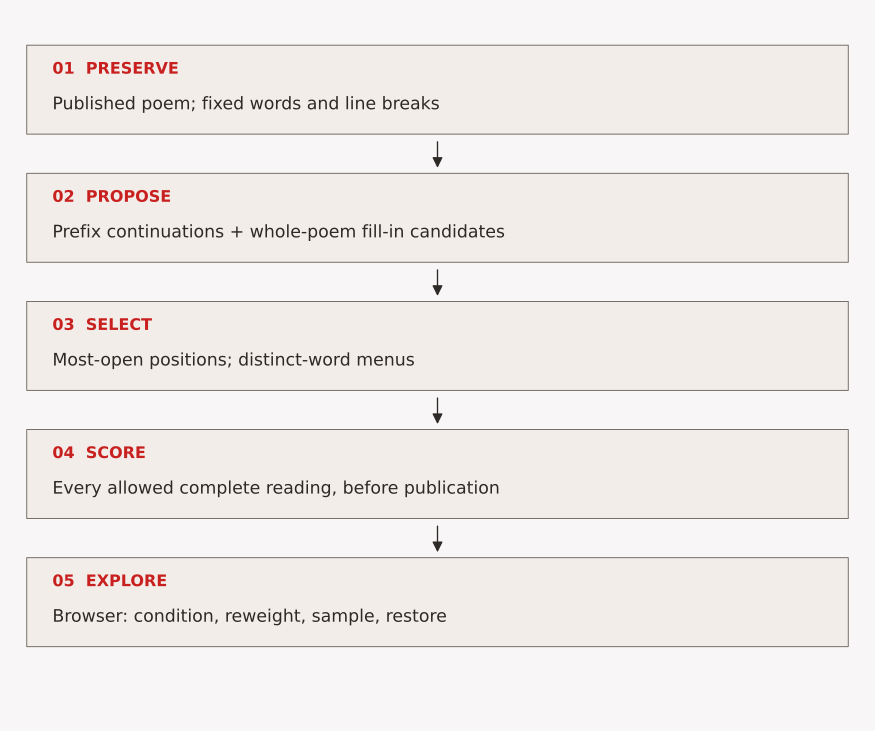
- Preserve the text. The published poem supplies the words, case, and line structure. Substitutions inherit the original word’s case: replacing Calling produces Breath, not lowercase breath. Titles are excluded from scoring: the collection’s titles were added after the poems were written. The result records a checksum so an edited poem does not silently inherit obsolete alternatives.
- Propose from two contexts. One pool starts from the model’s leading next tokens after the text before a candidate position. Another starts from its answers to a whole-poem fill-in question. Candidate tokens are extended to complete words. The fill-in prompt proposes candidates; its answer probabilities do not become the displayed percentages.
- Select positions and menus. Candidate substitutions are scored in the complete poem. A deterministic rule favors positions whose candidate distributions are most spread out. Menus preserve the poet’s word and retain up to four distinct alternatives, taking the highest-scoring eligible candidates in the otherwise unchanged poem. The original word therefore competes against a deliberately selected set of strong model preferences.
- Score every allowed combination. For menus A₁, …, Aₘ, the reading space is R = A₁ × … × Aₘ. Each member receives a complete-sequence log score. Five positions with five choices yield at most 5⁵ = 3,125 readings.
- Make the result inspectable. The browser conditions on the current selections, applies the requested reweighting, and renders the result. A printed remix identifies its substitutions and retains attribution to the original poem.
Method detail · candidate filters and the selection rule
The current scorer considers the leading 64 next tokens and proposes up to 32 whole words from each of the prefix and fill-in routes, in addition to the poet’s word. Apple’s English spell checker filters candidates. Apple’s NaturalLanguage lemmatizer and an order-reversed pairwise model check screen out forms or spellings of the same word; near-synonyms are permitted. Greedy token extension, dictionary coverage, and this filtering all constrain what can reach a menu. The resulting inventory depends on these operational definitions of word form and equivalence.
For a candidate distribution p, openness is exp(H(p)), where H(p) = −Σ pᵢ ln pᵢ. This is the effective number of equally weighted candidates. Positions are ranked by this quantity, with n = min(5, ceil(C/3)) for C eligible content-word positions, preferring one per line before taking additional positions on a line. Openness depends on the proposed candidate pool and therefore measures a property of the procedure. A pool of similarly improbable candidates can have high normalized entropy. The project’s scorer documentation reports that opening words are nearly always selected when they are eligible content words, an artifact of the model’s reply-opening preference. A Calling, which begins “She,” is not such a case.
Every permitted combination is subsequently scored, so the browser can retrieve a multiple-swap result directly. Adding independent single-swap effects would miss interactions among replacements. Coverage remains limited to words admitted to the menus.
The menu percentage
Hold the other marked words fixed, substitute each candidate at this position, and normalize the corresponding complete-reading scores. At temperature 1 with all menu options retained, these are the shares shown. Numerical implementation subtracts the largest log score before exponentiating, an equivalent calculation that avoids underflow.
A 70% menu share thus means 70% of the relative weight among these candidates under these conditions. This restricted denominator excludes other vocabulary items. Human preference and authorial intention would require separate evidence.
A Calling: comparing twenty-five readings
In Jindal’s A Calling, the marked words are choice and Calling. Each has five options, so the stored table contains twenty-five complete readings. Figure 3 normalizes all twenty-five scores together. A single cell is a complete poem with one selection from each menu. The page carries the title A Calling in its breadcrumb and browser tab during Remix Mode. The scoring model receives only the body, so its context differs from the reader’s when interpreting the final noun.
How the final word changes the poem
Hold “Not a choice / It is / a …” fixed and compare Calling, Breath, and Way. Describe a difference before asking which the model favors.
Calling ordinarily has a stressed syllable followed by an unstressed one; Breath and Way end on a single syllable. Listen to that altered cadence alongside the repeated “It is,” the isolated question “Write?”, and the stanza break between question and answer. The menu leaves those features fixed.
In her note accompanying the poem, Jindal describes writing as “not a conscious choice.” That is authorial commentary. The readings of vocation, bodily necessity, and cadence below are our interpretations of the language.
Meredith Martin’s “How to Teach Prosody” begins with what readers hear and situates metrical categories historically. Her approach supports listening to these alternatives while allowing for different performances.
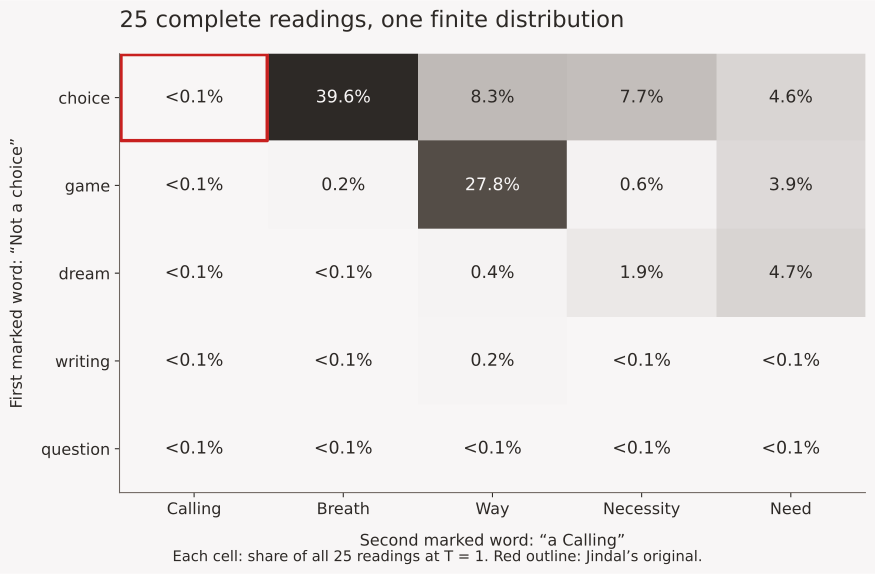
Figure data · all twenty-five readings
| First word ↓ / second word → | Calling | Breath | Way | Necessity | Need |
|---|---|---|---|---|---|
| choice | <0.1% | 39.6% | 8.3% | 7.7% | 4.6% |
| game | <0.1% | 0.2% | 27.8% | 0.6% | 3.9% |
| dream | <0.1% | <0.1% | 0.4% | 1.9% | 4.7% |
| writing | <0.1% | <0.1% | 0.2% | <0.1% | <0.1% |
| question | <0.1% | <0.1% | <0.1% | <0.1% | <0.1% |
A word menu answers a narrower question. With choice held fixed, it compares only the five cells in that row and normalizes that row to 100%. Changing choice to game selects a different row. The second menu can change because the complete poems in the two rows receive different relative scores.
How changing one word changes the other menu
Not a choice
It is
a …
Before revealing the numbers, compare Calling, Breath, and Way. Predict which connection the model will favor, then consider how each alternative changes your reading of the poem.
Model shares for five complete readings
With “choice” fixed, these five readings sum to 100% before rounding. T = 1; top-p = 1.
The denominator is this row’s five complete readings. It excludes the other twenty readings and every word outside these menus. The chart order stays fixed so a changing rank cannot move a label.
Calculation from stored log scores
The stored log scores for this row, in chart order:
-166.723, -157.347, -158.913, -158.988, -159.501
const maximum = Math.max(...scores);
const weights = scores.map(s => Math.exp(s - maximum));
const total = weights.reduce((a, b) => a + b, 0);
const shares = weights.map(w => w / total);
Subtracting the maximum preserves every ratio while avoiding very small exponentials. All five shares sum to one. Each raw score sums token log probabilities across the complete poem, including the supplied replacement.
Among all twenty-five readings, choice / Breath has the largest joint share, about 40%, followed by game / Way, about 28%. Holding choice fixed instead gives Breath about 66% of that row; Calling receives less than 0.1%. Way and Necessity are close in the stored calculation: about 14% and 13%, separated by 0.075 nats. These describe the released scores under a frame that excludes the title. Their stability under higher-precision arithmetic has not been established.
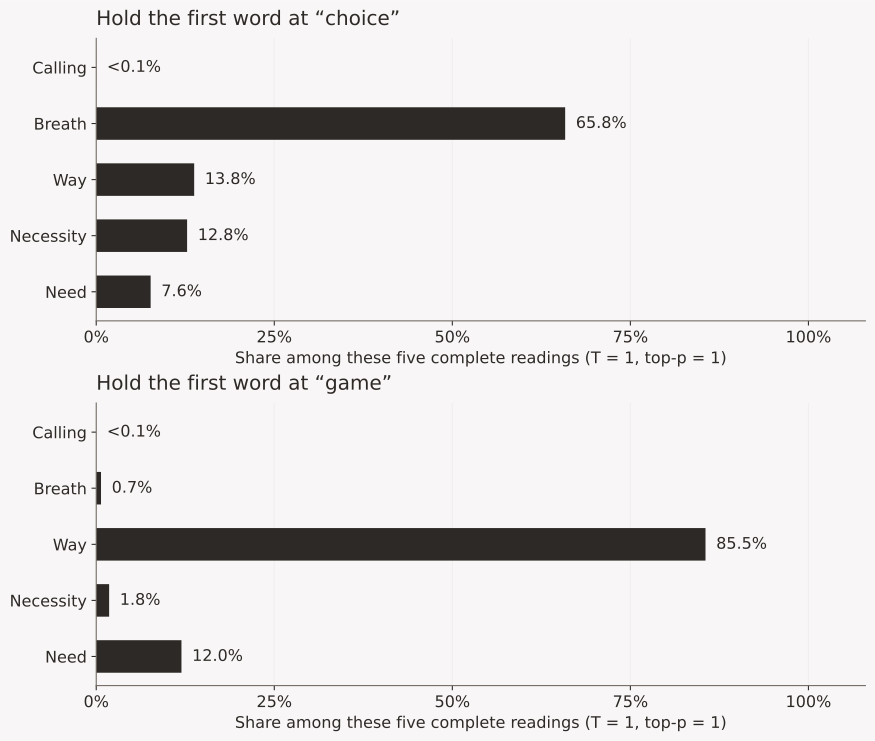
Figure data · inspect both menus as a table
| Second word | With “choice” | With “game” |
|---|---|---|
| Calling (poet) | <0.1% | <0.1% |
| Breath | 65.8% | 0.7% |
| Way | 13.8% | 85.5% |
| Necessity | 12.8% | 1.8% |
| Need | 7.6% | 12.0% |
Vocation and bodily necessity
In the published poem, “Not a choice” prepares “a Calling”: writing answers to something beyond a freely selected activity. Calling can suggest vocation, summons, or an inward demand. A medical reader may hear a professional calling among these possibilities.
Replace Calling with Breath, the highest-weighted alternative in that row, and necessity becomes bodily. Replace it with Way and the ending opens toward a path or manner of living. These interpretations draw on the changed diction; capitalization remains constant across the substitutions.
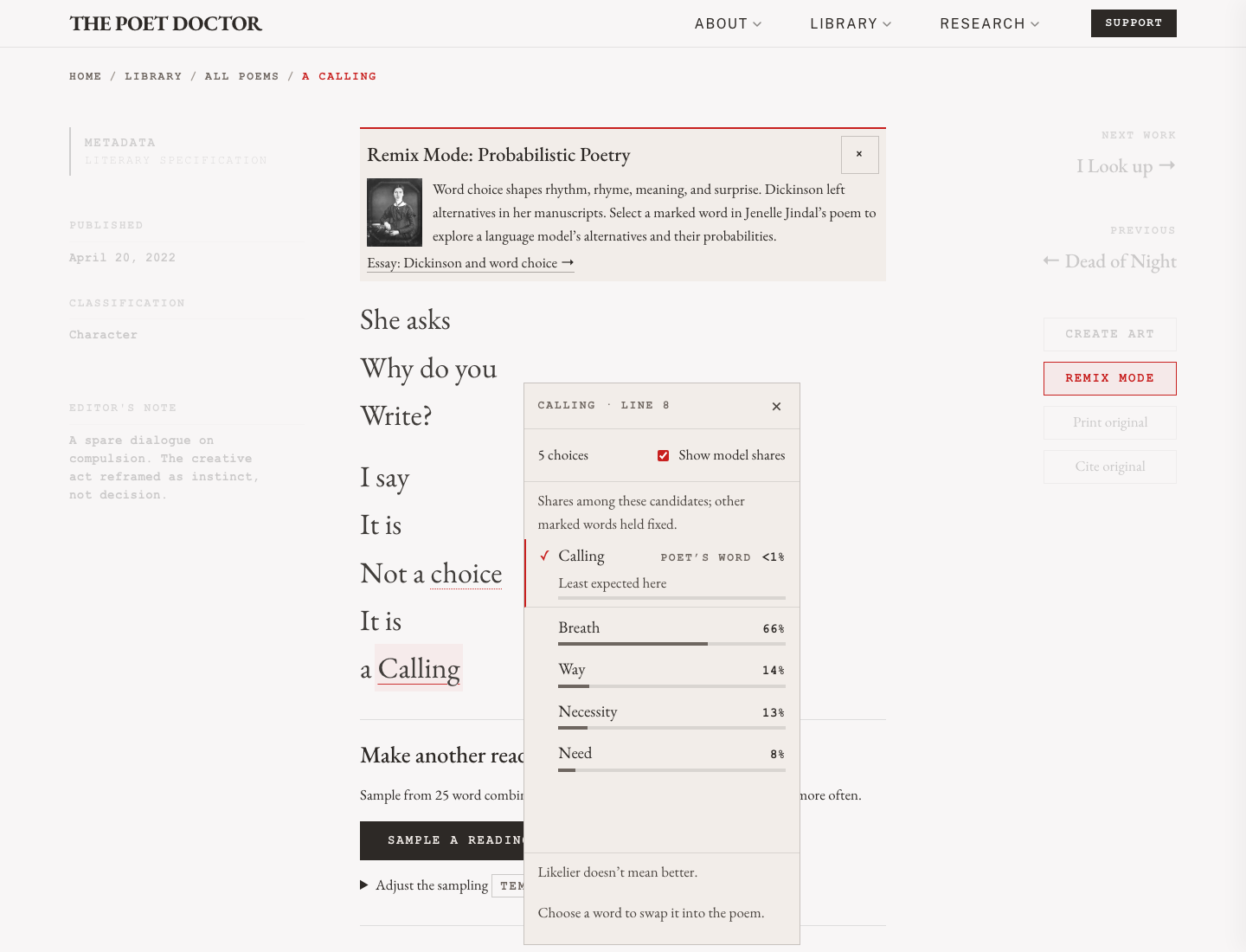
Choosing a different word in an open menu leaves that menu’s own percentages unchanged because the other positions are still held fixed. It can change the percentages at other positions. A wavy underline signals a sufficiently large change in that other menu, measured by total variation distance at the default top-p of 1. The cue measures the change in shares; readers must assess its literary significance.
Temperature, sampling, and the word tree
Temperature changes the concentration of the stored distribution. Remix Mode divides complete-reading log scores by T before normalization. A lower positive T sharpens differences; a higher T flattens them. At T = 1, the stored scores receive no temperature adjustment. The finite candidate set stays fixed: turning up temperature does not invent new words.
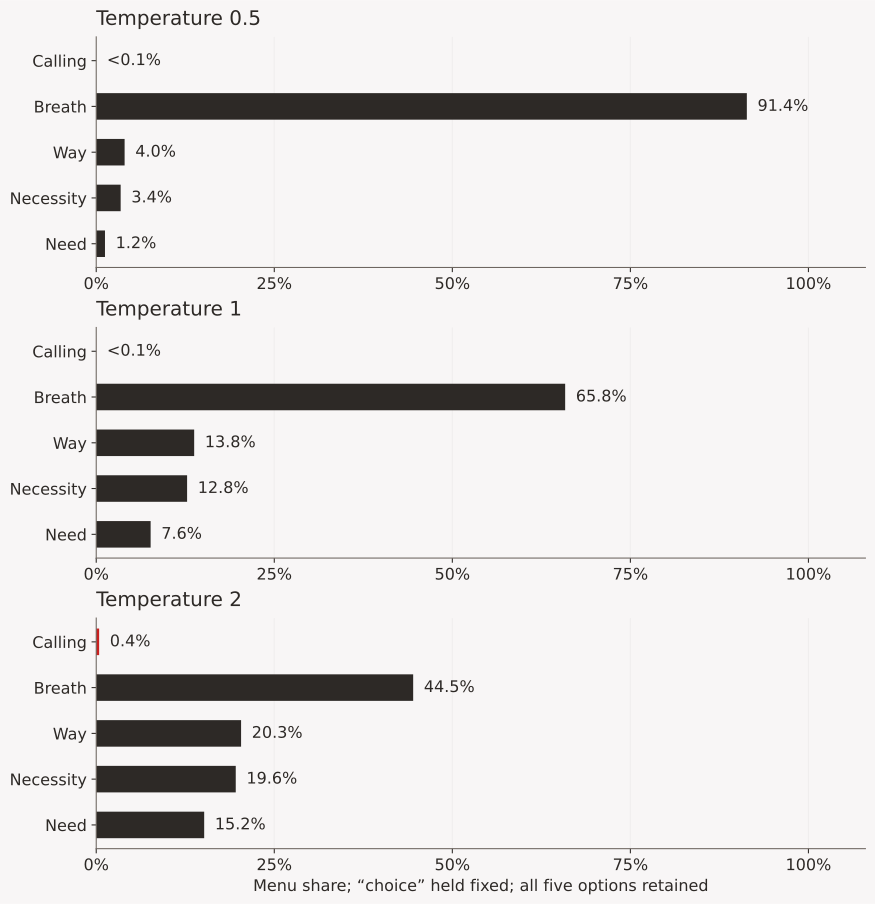
Figure data · the three temperatures
| Second word | T = 0.5 | T = 1 | T = 2 |
|---|---|---|---|
| Calling | <0.1% | <0.1% | 0.4% |
| Breath | 91.4% | 65.8% | 44.5% |
| Way | 4.0% | 13.8% | 20.3% |
| Necessity | 3.4% | 12.8% | 19.6% |
| Need | 1.2% | 7.6% | 15.2% |
Top-p retains the leading options until their cumulative share reaches the selected threshold. This takes its name from nucleus sampling.[10] On this site the cutoff applies inside the retained reading space, not across the model’s entire vocabulary. The visible menu additionally keeps the poet’s word and the current selection available even if they fall outside the cutoff. Its percentages remain the pre-cutoff shares, so visible rows need not sum to 100% when some options are hidden.
Sample a Reading draws choices in poem order. At each step it sums over the possible choices still to come, conditioned on the choices already drawn. At T = 1 and top-p = 1, this samples the normalized joint distribution of complete readings. With a lower top-p, successive truncations change that distribution; preserving an original word in the visible menu does not force it into the sampling nucleus.
Derivation · conditionals, marginals, and temperature
A menu fixes all other marked words and compares the remaining candidates. Sampling fixes only the choices already drawn and sums Qᵀ over future choices. These are different conditional distributions. The implementation uses this distinction to sample without assuming the words are independent.
Dividing a complete-sequence log score by T is not generally equivalent to generating new text by applying temperature to the model’s next-token logits at every step. Per-step normalizing constants depend on the prefix. The slider is correctly understood as a reweighting of this finite distribution.
For nucleus sampling, candidates are sorted by share and retained through the first cumulative sum reaching top-p. The retained mass is renormalized for the draw. In the visible menu, by contrast, the original pre-cutoff shares are displayed and protected words may remain outside the nucleus.
The word tree displays paths through 300 independently sampled readings at the current settings. Branch width represents an observed sample count, which can vary between samples. The tree varies other marked words across readings, whereas an open word menu holds them fixed. These branches represent readings sampled from the stored distribution; they have no documentary status as drafts.
Readers’ expectations depend on context
A model’s preferred alternative may clarify syntax, flatten an ambiguity, or weaken an image. A word with a low share may be distinctive, or ordinary in a context the model did not receive. Assessing either result requires an account of the poem and the context supplied to the model.
Surprisal gives this discussion a technical vocabulary. For a probability p, information-theoretic surprisal is −log p; smaller probabilities yield larger values. The logarithm’s base determines the unit. Surprisal is always relative to a specified distribution. The surprisal of a next token, the score of a complete poem, and the negative log share within a restricted menu are not interchangeable measurements.
Human expectation has its own experimental methods. A cloze task asks participants to supply missing language, yielding an empirical completion frequency for a particular sample and context. Kutas and Hillyard’s 1984 study recorded scalp potentials while people read meaningful sentences. Less expected final words elicited larger N400 responses; semantic association with an expected word also affected the response. The N400 is a negative-going component that peaks around 400 milliseconds after word onset under these experimental conditions.[11] This physiological measurement depends on the task and experimental conditions. Its approximate timing and amplitude cannot be read as a general timetable for comprehension or as a direct measurement of this interface’s probabilities.
Expectation-based accounts such as Levy’s use surprisal to explain aspects of processing difficulty.[12] Such accounts motivate experiments on processing effort. Establishing a relation to aesthetic judgment or clinical benefit would require studies designed to measure those outcomes.
What different methods can establish
Remix Mode supplies the model scores in the first row. The remaining rows describe methods from literary study, cognitive science, and medicine, with their respective evidence and limits of inference.
| Practice | What we observe | Supported inference | What does not follow |
|---|---|---|---|
| Model menu | Stored scores, normalized within selected candidates. | Relative weights under this scoring procedure. | Poetic merit, authorial intention, or a human preference rate. |
| Human cloze task | A participant sample’s completions under a specified prompt. | A completion frequency for that task and sample. | The precise distribution inside an individual brain. |
| N400 experiment | Scalp-potential differences across controlled conditions. | Evidence that context modulates a measured response. | A direct probability readout or a measure of literary value. |
| Close reading | Words, sounds, syntax, layout, history, and reasons offered. | An interpretation others can examine and contest. | That all interpretations are equally supported, or rank settles their value. |
| Clinical inquiry | A patient’s account, examinations, tests, history, and course. | A revisable explanation that can guide action. | That action always waits for certainty, or model menu shares are clinical evidence. |
The model row follows our published record; the cloze and N400 rows follow Kutas and Hillyard [11]. The clinical row draws on the National Academies’ account of the diagnostic process (2015), which describes iterative inquiry and care decisions under uncertainty. The comparison is our methodological synthesis; this project has not collected human or clinical measurements.
Oliver Wendell Holmes Sr.: medical instruments and interpretive error
A diagnostic error in The Stethoscope Song
Oliver Wendell Holmes Sr. (1809–1894), the physician and poet, taught anatomy at Harvard and served as a medical-school dean. In The Stethoscope Song: A Professional Ballad, physicians mistake flies buzzing inside a stethoscope for signs in their patients. Professional agreement amplifies the error. The poem ends by asking physicians to compare what they hear with what they can see:
Now use your ears, all you that can,
But don’t forget to mind your eyes,
Public-domain text in Holmes’s collected Medical Poems. An 1887 journal reprint survives as a scan; that date identifies the reprint, not the first publication.
The poem raises a question relevant to Remix Mode: how does an instrument shape the observations made through it? A menu share depends on the supplied language, the scoring frame, and the admitted alternatives. The current frame favors certain opening words. Comparing frames and candidate-selection rules would help establish how much of a word’s low share can be attributed to those choices.
Holmes’s flies cause an instrument to malfunction. A finite candidate set and a scoring frame, by comparison, define the computational question. Changing them may change that question as well as the result.
Holmes initially supported admitting three Black students in 1850. After white students protested, he joined the faculty majority voting to exclude them from further study after the current course. Harvard documents this history and its archival sources. His participation in their exclusion belongs alongside his medical and literary work in an account of his career.
Give two explanations for one numerical observation: one about the text and one about its measurement. Name a comparison that could distinguish them. Which part would remain a literary judgment?
Studies of rhythm, expectation, and reading time
Predictability and aesthetic response
A surprising image can occur inside an expected rhythm. A familiar phrase can become unsettling through repetition or a line break. Different features of a poem can produce different expectations.
In a controlled study of German stanza variants, Obermeier and colleagues (2013) found that regular meter and rhyme increased nonexpert listeners’ liking and emotional-intensity ratings. The result is specific to the study’s texts, listeners, and conditions. It shows that predictable form can contribute to an aesthetic response.
Miall and Kuiken (1994) studied stylistic foregrounding in literary stories through reading time, strikingness, and affect. Longer reading can reflect attention, difficulty, or confusion; determining its relation to the quality of an interpretation requires a separate measure of that outcome.
Smith and Levy (2013) examined a logarithmic relation between predictability and reading time; Shain and colleagues (2024) tested this relation across six reading datasets and multiple probability estimators. Their results supported a logarithmic relation between predictability and processing difficulty.
Oh and Schuler (2023) found that larger variants in the Transformer families they studied could fit human reading times less well. This result qualifies the use of predictive performance as a proxy for cognitive modeling. Its scope is the studied models and measurements.
An evaluation of Remix Mode could test whether readers can distinguish provenance, explain a menu’s denominator, and support a comparison with specific features of the poem. An evaluation would need stated rubrics, controlled presentation order, independent assessment, and reported disagreement. None of the studies above establishes that this interface improves learning or clinical care.
Limitations and further research
Exhaustive scoring represents interactions between substitutions in the stored table. Interpretation still depends on which candidates entered the table, the scoring frame, and the numerical method.
- Position selection and candidate filtering determine which kinds of difference become visible. The model’s “most open” positions need not be the most important positions to a critic. Alternatives are chosen in descending score order, so a low share for the poet’s word partly reflects how its competitors were selected.
- The frame, poem text, punctuation, tokenizer, model weights, and numerical engine affect scores. The title and the poet’s circumstances are absent. A known tendency of the current frame to favor “The” at the start of a reply particularly complicates interpretations of opening-word surprise.
- Most possible words never reach a menu. Shares normalize stored scores within the retained set; their denominator excludes all other words the model could generate.
- The illustrated model uses quantized NVFP4 weights and TF32 matrix arithmetic. Stored log scores are rounded to three decimals. A figure’s decimal places indicate display precision, not demonstrated numerical accuracy. Complete enumeration does not make those scores identical to an unquantized or higher-precision reference model.
- These figures demonstrate behavior on one poem. Corpus-wide benchmarking, studies of readers’ interpretations, and evaluation of any proposed therapeutic use remain separate research tasks.
Evaluating numerical stability and effects on readers
A numerical audit would compare ranks and shares across framing choices, tokenizer behavior, precision settings, and candidate-generation procedures. It would report where conclusions change, particularly at near ties, opening words, unusual spellings, and multi-token substitutions. Agreement within one frozen table establishes reproducibility. Comparisons across these interventions would assess robustness.
A reading study would distinguish the effects of seeing alternatives from the effects of seeing their numerical rankings. It could compare original-only reading, alternatives without scores, and alternatives with scores, with assignment and outcome criteria specified in advance. Candidate order would need randomization or counterbalancing across the two alternative conditions: hiding numbers while retaining score order still exposes a ranking. Appropriate outcomes might include the specificity of participants’ accounts of diction, attention to sonic or semantic changes, and susceptibility to adopting the highest-ranked word simply because it is highest-ranked. Expert and nonexpert readers should not be assumed interchangeable.
A close-reading exercise
Read the original first. Before opening a menu, name something its diction does. Try one alternative and describe the change as specifically as possible. Then restore the poet’s words and explain whether the comparison changed your reading. A printed remix records your selections and identifies the poem from which they were made.
Read A Calling in Remix Mode →Evidence and reproducibility
The method described here is implemented in Remix Mode. Drafting and source checking used AI assistance. References and archived data allow readers to check the historical claims and reproduce the calculations.
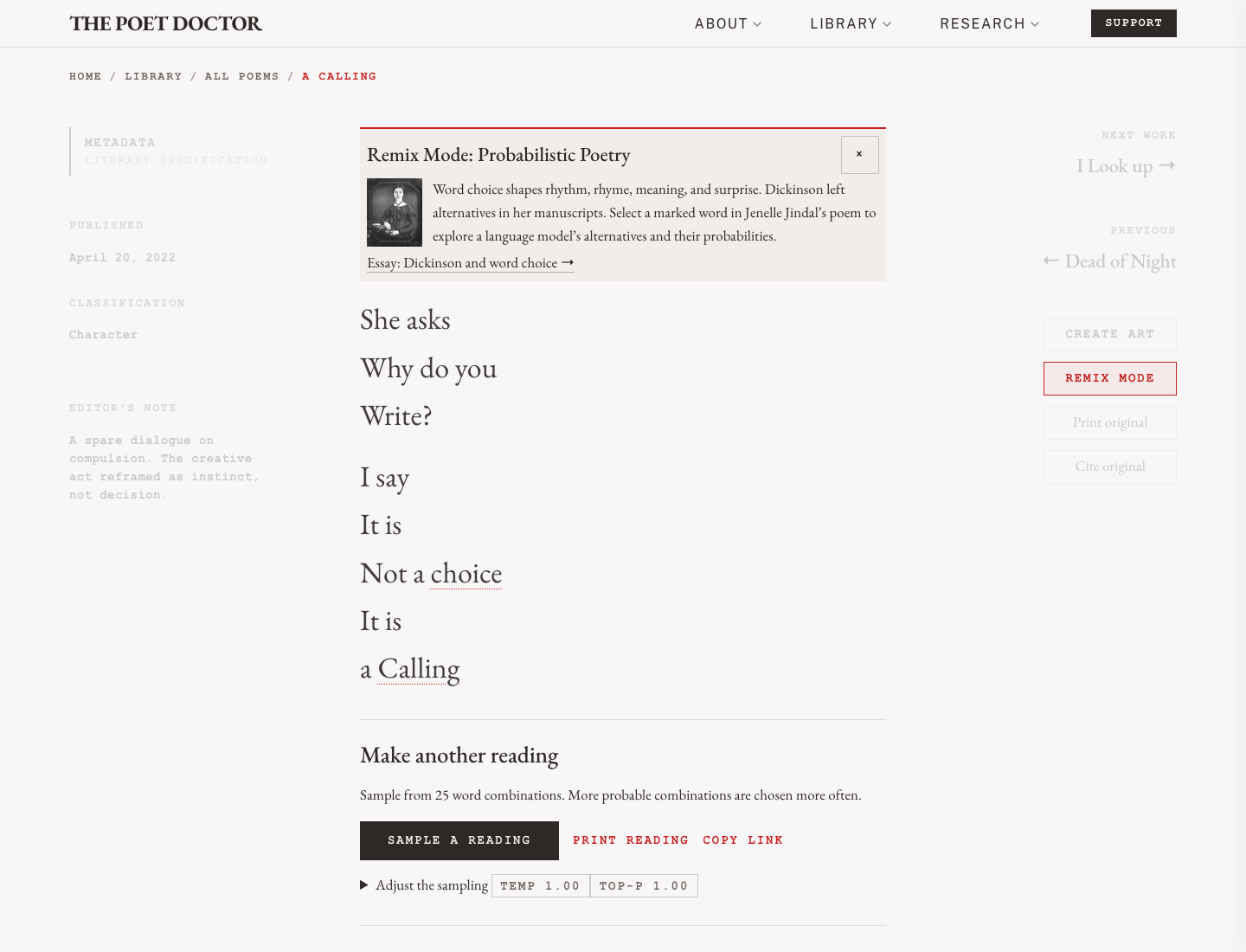
The numerical exhibits use A Calling, data format 4, generated 2026-10-01. The complete record contains all 25 scores, the poem, menus, prompts, model-file digest, source checksum, and engine settings. Candidate pools, openness rankings, and word-filter decisions are not included in this published record; the final scores alone cannot reproduce those selection stages. Figures were calculated from those stored scores without running the model again. The two screenshots document the interface; the scored record is the source for the numerical figures.
- Complete scored record (JSON)
- Twenty-five complete-reading scores and shares (CSV)
- Joint-distribution figure (SVG), conditional comparisons (SVG), and temperature comparison (SVG)
Method detail · frame selection and numerical checks
The scoring-development notes compare five framing choices on 24 of Jindal’s poems. The adopted blank-line reply had a mean per-token log score of −6.37 nats, compared with −6.39 for a reply headed “Untitled.” The median reversed that small ordering (−7.37 versus −7.33). These descriptive differences do not establish a stable advantage. Frame selection was informed by the collection itself; this comparison is not held-out validation.
An earlier five-poem check compared TF32 with full float32 under the preceding menu format. Across 352 shift menus, the development record reports changes of at most 0.18 nats in menu odds and 2.7 percentage points in a bar; six menus exchanged a near-tied final alternative. However, its separate precision table describes TF32 error of 0.9–1.3 nats as relative to the poet’s reading. The archived notes do not reconcile these measures, and the underlying pilot logs are not published. We cannot treat these observations as a verified error bound for this frozen joint table or the whole corpus. Display precision must be distinguished from demonstrated numerical stability.
Model record · exact scoring frame and identifiers
The run loaded Ollama’s gemma4:31b-mlx distribution, identified by the manifest digest below. NVFP4 describes its four-bit floating-point weight encoding. Activations were stored as float32, with MLX_ENABLE_TF32=1 allowing reduced-precision matrix operations on the Apple hardware. The pinned MLX precision documentation explains that hardware-dependent setting. Disabling it would test arithmetic differences while retaining the quantized weights; it would not recover an unquantized model.
The frame below includes literal control tokens. The scorer explicitly prepends token ID 2 to this string’s encoding. The placeholder denotes the supplied poem body; the scorer evaluates that body and its end-of-turn token.
<|turn>user
Write a poem.<turn|>
<|turn>model
<|channel>thought
<channel|>
{poem}<turn|>- Model
- gemma4:31b-mlx
- Engine
- MLX 0.32.3.dev20260928; mlx-lm 0.31.4.dev0+g3051e26; Transformers 5.17.0
- Model files
- sha256:a22a363052da770302019d5afab29bd967f9318e4377bddd297421189ea09d7d
- Poem checksum
- 3aaf7ac6c71407cc0ec620c41afe525a31805fdd3957712c574589dad38da20c