Reading Paths
Poem Sequencer
Bibliotherapy is the use of reading in care. Name a feeling you hold and one you hope to reach, and the Poem Sequencer draws a reading path between them.
How to read these axes
A 3-D UMAP of 1,536-d multilingual embeddings; proximity = semantic similarity. Nearby points have related embeddings. Coordinates describe this projection; their poles have no assigned themes. UMAP axes depend on rotation and the random seed.
About the exhibit
Poems as care
Bibliotherapy is the use of literature, often poetry, in the care of the sick and the grieving. This exhibit gathers poems written by physicians and lets you read a path through them.
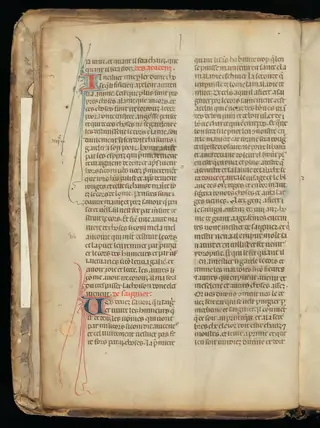
The essayist Samuel McChord Crothers coined the word bibliotherapy in “A Literary Clinic,” published in The Atlantic Monthly in 1916. In the essay, a country doctor dispenses books as a pharmacist dispenses drugs. Later writers pointed to older examples. The historian Diodorus Siculus reports that the sacred library of the pharaoh at Thebes carried the inscription a healing place for the soul. Those older practices had their own purposes and settings.
In the twentieth century the practice found a theory. The scholar Caroline Shrodes, in a 1949 study, described how a reader moves through identification with a text, to catharsis, to insight — an arc that some clinicians also hope to see at the bedside. From this grew poetry therapy, carried into practice by the poet Eli Greifer and the psychiatrist Jack J. Leedy, and formalised with the founding of the Association for Poetry Therapy in 1969.
Clinical research came later. A meta-analysis by Pim Cuijpers in 1997 found guided bibliotherapy an effective treatment for mild depression. Today, the United Kingdom’s Reading Well scheme prescribes reading formally, as part of social prescribing. A poem does not replace a medicine.
The method
How the map is drawn
The Poem Sequencer places every poem on a single map according to what it is about and how it feels. Poems that share a subject and a mood are set near one another; poems with little in common lie far apart. Nothing here is arranged by date or by author — it is a map of meaning, not of history.
Poems from many centuries sit side by side here. Nearness shows shared words, subjects, and mood. It does not show that writers in different eras felt the same way.
To chart a path is to cross that map in small steps. Rather than leaping from one feeling to a distant one, the Poem Sequencer looks for a chain of poems in which each is close kin to the next, so the feeling turns by degrees. The route you read is the gentlest passage the collection can offer between the two feelings you name.
Each mark
One poem. Its colour records the book it comes from — older books warm, newer books cool.
Distance
Nearness is likeness. Two poems close together share a subject and a feeling.
The line
Your path. Numbered stops are the poems you read, in order, from first feeling to last.
Sources & further reading
- Crothers, S. M. (1916). “A Literary Clinic.” The Atlantic Monthly, 118, 291–301.
- Shrodes, C. (1949). Bibliotherapy: A Theoretical and Clinical-Experimental Study. University of California, Berkeley.
- Leedy, J. J., ed. (1969). Poetry Therapy: The Use of Poetry in the Treatment of Emotional Disorders. Philadelphia: J. B. Lippincott.
- Cuijpers, P. (1997). “Bibliotherapy in unipolar depression: A meta-analysis.” Journal of Behavior Therapy and Experimental Psychiatry, 28(2), 139–147.
Principal Axes
The map above is a UMAP projection: it preserves which poems sit near which, but its three axes carry no fixed meaning. Below, the same 2,232 poems on their three principal components — genuine orthogonal axes of variation, ranked by how much each explains, at the cost of cleaner separation.
How to read these axes
The same 1,536-d embeddings projected onto their top-3 principal components: orthogonal, variance-ranked, seed-stable axes (unlike UMAP). The three hold 17.4% of total variance (PC1 8.9%, PC2 4.7%, PC3 3.8%), so clusters separate less cleanly in this reduced view.
These coordinates show variance in the rebuilt corpus. Their poles have no assigned themes, and proximity in three dimensions captures only part of the relationships in the original embeddings.