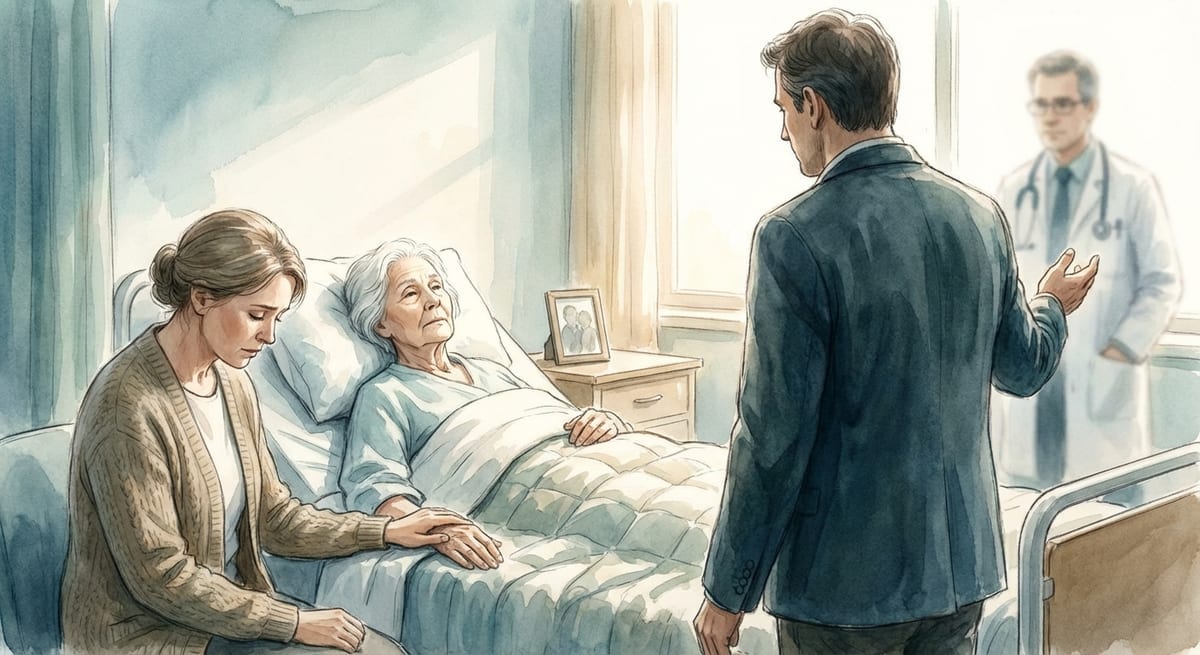
SCENARIO: An 84-year-old woman with advanced Alzheimer's disease is admitted from her nursing facility with aspiration pneumonia. She no longer recognizes her family, is non-verbal, and requires total assistance with ADLs. Her daughter, who holds medical power of attorney, wants comfort care only. Her son, who lives out of state and has not visited in a year, arrives and demands 'everything be done,' including intubation and ICU transfer. There is no advance directive.
Before You Read
What to Look For
- •
A Number as Accusation: The SOAP note records '42 kg (documented 58 kg 2 yrs ago)' as a parenthetical delta. The poem places the same weight against 'what was once a woman / who said don't let me live like that' — making the kilograms not a data point but an indictment.
- •
Three Ethics of Disclosure: The SOAP note must document the grasp reflex as involuntary. The prose delays: 'I will tell him, but not now, not while his face holds this expression of desperate hope.' The poem never corrects it at all — 'older than language, / older than the lobe / that held her children's names.' Each form makes a different choice about when to take the son's hope away.
- •
Conflict or Geometry: The SOAP note frames the siblings' disagreement as a conflict requiring resolution. The poem sees it differently — 'opposite sides / of the same bed / of the same loss / arrived at / different speeds.' Both are expressions of grief, separated only by proximity.
Lens I
SOAP Note (EHR)
SUBJECTIVE:
Patient is non-verbal and unable to provide history. Per daughter (medical power of attorney, primary caregiver): 'She's been in memory care for two years. She stopped recognizing us about six months ago. She hasn't spoken in four months.' On a pureed diet with increasing coughing and pocketing food. Daughter recalls her mother once said, 'Don't let me live like that,' referring to a friend with dementia — but this was never documented and no advance directive exists. Per son (arrived today from out of state): 'She squeezed my hand — she knows I'm here. You can't just give up on her.' Son requests full code, intubation, ICU transfer if needed. Son and daughter in significant conflict.
OBJECTIVE:
VS: T 38.6, HR 96, BP 104/62, RR 24, SpO2 91% on 4L NC. Gen: cachectic elderly woman, eyes open but no tracking, no purposeful movement. Intermittent moaning. Wt 42 kg (documented 58 kg 2 yrs ago). FAST stage 7c. Neuro: no verbal output, no command-following, withdraws to deep pain only, no eye contact. Oropharyngeal exam: poor dentition, weak cough reflex. Lungs: R base crackles and bronchial breath sounds. CXR: R lower lobe consolidation. Labs: WBC 14.2, Na 148 (dry), albumin 1.9, prealbumin 6 (severe malnutrition). Lactate 2.1. Blood cx pending.
ASSESSMENT:
84-year-old woman with advanced Alzheimer's disease (FAST 7c), admitted from nursing facility with aspiration pneumonia. 1. Aspiration pneumonia, likely recurrent given dysphagia and advanced dementia. 2. Advanced Alzheimer's disease, FAST 7c - prognosis: median survival at this stage is 6-12 months with or without aggressive treatment. 3. Severe protein-calorie malnutrition. 4. Code status conflict - MPOA (daughter) requesting comfort-focused care; son demanding full code status. MPOA has legal decision-making authority. 5. No advance directive on file.
PLAN:
1. Antibiotics: ceftriaxone 1g IV daily for aspiration PNA - treatment of acute infection is appropriate even in comfort-focused framework, as untreated PNA causes dyspnea and suffering. 2. Palliative care consult for goals-of-care family meeting - include daughter, son, and nursing facility staff who know pt. 3. Ethics committee consult given family conflict and absent advance directive. 4. Discussed with son: validated his distress, explained FAST staging, explained that hand squeeze is a reflex at this stage and does not indicate recognition or volition. Explained MPOA's legal authority. Son tearful, angry. 5. Discussed with daughter: affirmed her role as MPOA, discussed that we will hold a family meeting with palliative care and ethics to ensure process is thorough and transparent. 6. Comfort measures: mouth care q2h, repositioning, morphine 2 mg SC q4h PRN dyspnea/distress. 7. Maintain current code status (full code) until family meeting and ethics review completed - will not unilaterally change. 8. Social work and chaplaincy consulted.
Lens II
Narrative Medicine: Prose
Code Status and the Son Who Came Late
The son arrived an hour ago with a rolling suitcase and the particular energy of someone who has come to fix something. He stands on one side of the bed and his sister stands on the other, and between them their mother lies in a posture that dementia has shaped over years: knees drawn up, hands curled, head turned to a fixed point on the ceiling. She weighs forty-two kilograms. The son says she squeezed his hand and I do not tell him yet that this is a grasp reflex, that her brain is not choosing to hold him but that his finger against her palm triggers a circuit laid down before she was born. I will tell him, but not now, not while his face holds this expression of desperate hope.
The daughter has been here for two years. She has watched the slow subtraction: first the names, then the words, then the swallowing, then the eyes. She has the exhausted authority of someone who has made a hundred small decisions about pureed food and bed rails and when to call the nurse at night, and she has earned the right to make this decision too. But the son sees a mother who looks alive, whose chest rises and falls, whose hand grips his, and he cannot reconcile this evidence with the word dying.
I have learned that the hardest family meetings are not the ones where everyone agrees to let go, but the ones where someone arrives late to a grief that has been accumulating without them. The son's anger is not at his sister, not really. It is at the year he missed, the visits he didn't make, the progression he saw in photographs but did not stand beside. I schedule the family meeting for tomorrow morning and I ask the chaplain to sit with them tonight. Their mother moans softly and both children reach for her at the same time.
Lens III
Narrative Medicine: Poetry
The grasp reflex:
older than language,
older than the lobe
that held her children's names
her son says she knows me
and I let this stand
the way you let a candle stand
in a room with no wind
forty-two kilograms
of what was once a woman
who said don't let me live like that
to a room that didn't write it down
her daughter and her son
stand on opposite sides
of the same bed
of the same loss
arrived at
different speeds