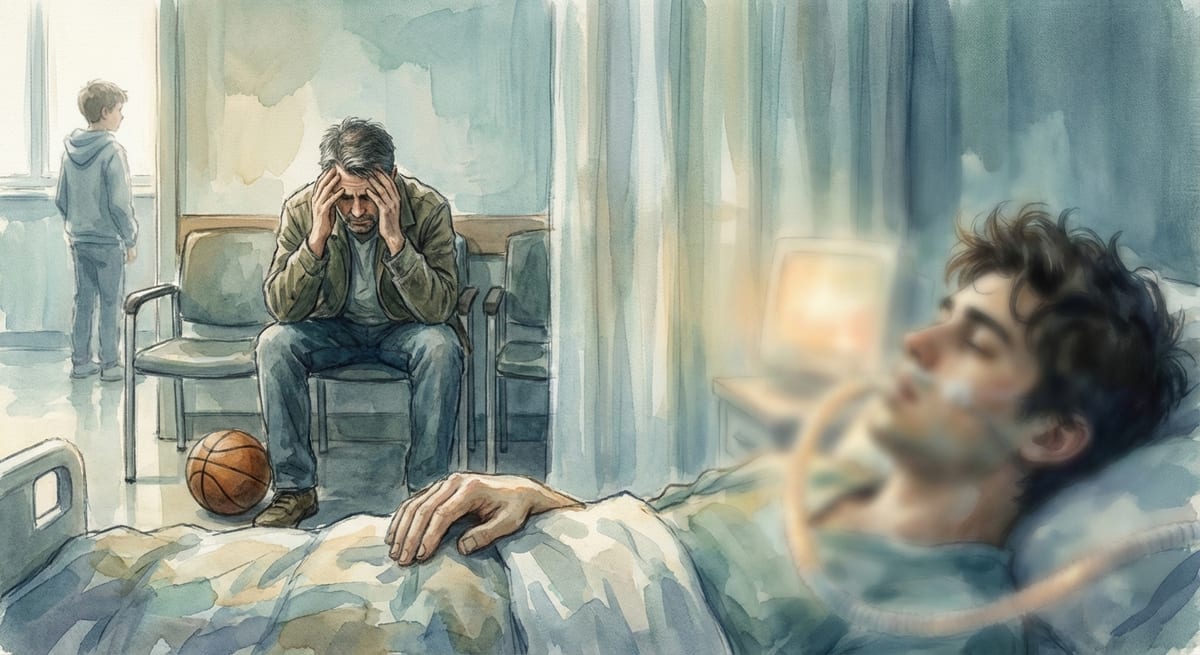
SCENARIO: A 19-year-old male college basketball player collapses during a preseason scrimmage and is found in ventricular fibrillation. An AED on-site delivers two shocks before EMS arrival. He is resuscitated and intubated in the field. In the ED, echocardiogram shows asymmetric septal hypertrophy of 22 mm with systolic anterior motion of the mitral valve, confirming hypertrophic cardiomyopathy. His father, a former college athlete himself, is in the waiting room. The patient's younger brother plays high school basketball.
Before You Read
What to Look For
- •
When One Crisis Becomes Two: The SOAP note lists 'first-degree relatives require HCM screening' — a task. The prose watches the father process the word 'genetic' and realize his own body may have built the thing that nearly killed his child, and that his younger son may carry 'the same silent architecture in his chest.'
- •
What Inexactness Can Reach: The poem calls each QRS complex 'a number / subtracted from the total / we are never told' — medically imprecise, but it captures what 'NSR, no ectopy' cannot: the sudden end of a nineteen-year-old's assumption that his heartbeat is inexhaustible.
- •
The Witnesses Without Charts: The athletic trainer sits on the hallway floor, staring at her hands. She appears only in the prose — not the SOAP note (she is not the patient), not the poem (compressed to essentials). Only the prose can hold the people changed by a medical event who have no chart of their own.
Lens I
SOAP Note (EHR)
SUBJECTIVE:
Unable to obtain history from patient (intubated, sedated). Per athletic trainer on scene: collapsed during full-court scrimmage, unresponsive, no pulse. AED applied within 90 seconds — initial rhythm ventricular fibrillation, shocked twice with return of spontaneous circulation after second shock, total downtime approximately 4 minutes. Per EMS: GCS 3 in field, intubated for airway protection, received amiodarone 300 mg IV. Per father: 'He's never had any heart problems. Never fainted, never complained about chest pain during games.' Passed preparticipation physical 3 months ago (ECG not performed). No family history of sudden cardiac death. Father adds that patient's 16-year-old brother also plays competitive basketball.
OBJECTIVE:
VS: T 35.8 (cooling protocol initiated by EMS), HR 92 (NSR, no ectopy), BP 108/72 on norepi 0.05 mcg/kg/min, SpO2 99% on vent (FiO2 40%). Intubated, sedated on propofol/fentanyl. Pupils 3 mm bilat, reactive. No focal neuro deficits assessable at this time. ECG: NSR, LVH by voltage criteria, deep T-wave inversions V1-V4, prominent Q waves II/III/aVF. TTE (bedside): asymmetric septal hypertrophy, IVSd 22 mm, LVOT gradient 48 mmHg at rest with SAM of MV, moderate MR, LVEF 65%. Troponin I 0.84 (H). Lactate 3.2 (trending down from 6.8 in field). BMP, CBC unremarkable.
ASSESSMENT:
19-year-old male college basketball player, status post sudden cardiac arrest during scrimmage with VF and successful resuscitation. 1. Sudden cardiac arrest 2/2 VF, resuscitated - total downtime ~4 min with bystander AED, favorable for neurologic prognosis. 2. Hypertrophic cardiomyopathy, newly diagnosed - asymmetric septal hypertrophy with LVOT obstruction and SAM, classic phenotype. This is the cause of the arrest. 3. Status post therapeutic hypothermia initiation - will complete 24-hr protocol. 4. Neurologic prognosis: short downtime favorable but cannot assess until sedation lifted. 5. First-degree relatives (brother, father) require HCM screening.
PLAN:
1. Targeted temperature management protocol: maintain 33-36 C x 24 hrs, then controlled rewarming. 2. Admit cardiac ICU. Continuous telemetry. 3. Cardiology/electrophysiology consult - will need ICD placement once stabilized. Amiodarone gtt 1 mg/min x 6 hrs then 0.5 mg/min x 18 hrs. 4. Cardiac MRI once extubated for fibrosis assessment and risk stratification. 5. Genetics consult for HCM gene panel - results will guide family screening. 6. Discussed with father: explained HCM diagnosis, that this is genetic, that his younger son and he himself need echocardiography and likely genetic testing. Father appropriately distressed. Social work and chaplaincy at bedside. 7. Neuroprognostication: plan to assess after rewarming and sedation holiday at 72 hrs. NSE and SSEP if exam concerning.
Lens II
Narrative Medicine: Prose
Sudden Arrest in a College Athlete
The athletic trainer who performed the first AED shock is still in the hallway when I come out to speak to the father. She is sitting on the floor with her back against the wall, her polo shirt still damp with sweat, and she is staring at her hands. She saved his life. She does not look like someone who has saved a life. I make a note to have someone check on her before she leaves.
The father stands when he sees me and I recognize the posture: a large man trying to make himself ready for whatever comes next. I tell him his son is alive, that his heart is beating on its own, that we are cooling his body to protect his brain. I tell him the echo shows something called hypertrophic cardiomyopathy, that the muscular wall of his son's heart is dangerously thick, that this is almost certainly what caused the arrest. I watch him process the word genetic. I watch him think about his younger son. There it is, on his face, the moment the crisis becomes two crises: the son in the bed and the son at home who may be carrying the same silent architecture in his chest.
I do not tell him yet about competitive sports, about the ICD his son will need, about the career-ending conversation that is coming. That is a conversation for a different day, when his son is awake and the question is no longer whether he will survive but what his survival will look like. For now, the father asks if he can sit with him. I bring him to the bedside and he takes his son's hand, and the monitor draws the QRS complexes in their steady green procession, each one a small miracle that was almost not.
Lens III
Narrative Medicine: Poetry
Nineteen and the septum
twenty-two millimeters thick,
a wall he was born with,
a wall no physical found
the AED speaks in its calm
recorded voice: shock advised
as if advice were the word
for this
his father holds the hand
that yesterday palmed a basketball,
that tomorrow will learn
the weight of the word
permanent
the monitor keeps its green count
each peak a number
subtracted from the total
we are never told