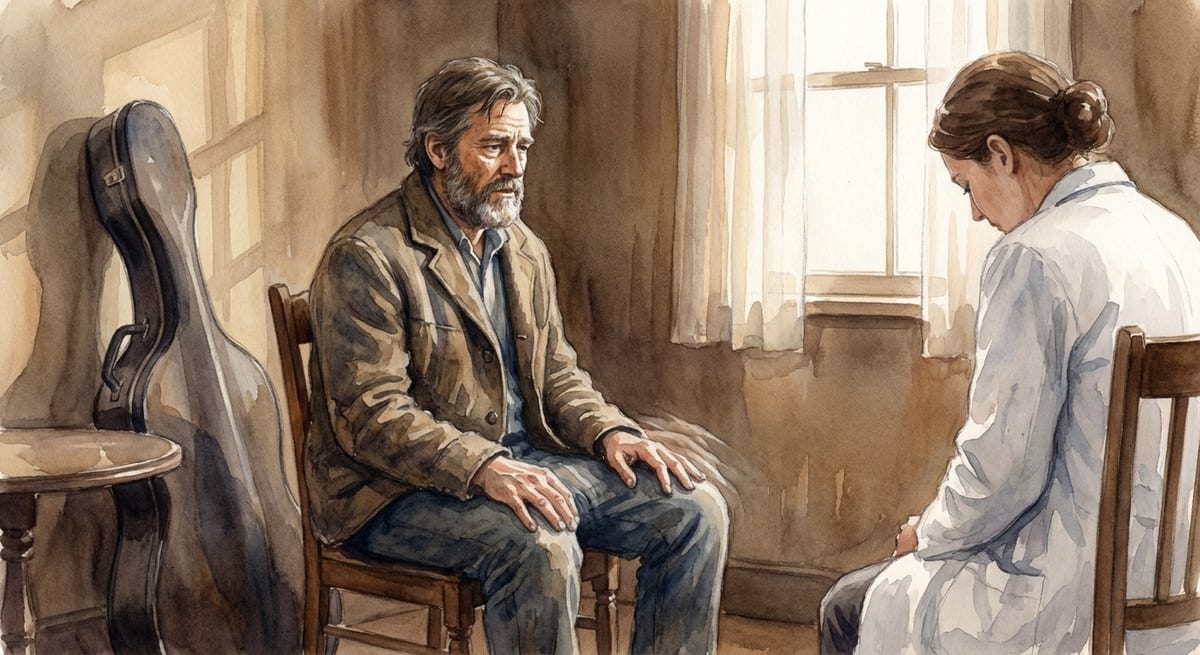
SCENARIO: A 61-year-old man, a professional cellist with the city symphony for 33 years, is referred to neurology for a six-month history of progressive right hand tremor and difficulty with fine motor passages. His wife first noticed a change in his gait. DaTscan confirms dopaminergic deficit. He sits in the exam room with his instrument case beside him, as if he has brought a witness.
Before You Read
What to Look For
- •
The Person Is More Specific Than the Diagnosis: The SOAP note records 'decrement in amplitude and speed by rep 8-10' — standard bradykinesia. The prose finds the same finding in this patient: 'the amplitude shrinking like a phrase losing its voice.' The standardized exam cannot hold what the metaphor can.
- •
The Detail That Does Double Work: 'He picks up the case / with his other hand' — the poem's last line is a clinical observation (lateralized functional impairment) disguised as an emotional one. The SOAP note records 'Hoehn & Yahr stage 1-2' but cannot record the stage the cellist assigns to himself.
- •
What Counts as Clinically Relevant: The cello case appears in the prose and poem but not the SOAP note — it is not a billable finding. Yet it is the most important object in the room: his identity made physical, brought to bear witness to the diagnosis that will separate him from it.
Lens I
SOAP Note (EHR)
SUBJECTIVE:
'I first noticed it about eight months ago — I was having trouble with tremolo passages and rapid string crossings. I thought I was just getting older.' Describes a progressive right hand tremor over the past 6 months, initially intermittent, now present daily. Right hand stiffness worse in the morning, mild difficulty with buttons. Wife adds that she has noticed a shuffling gait and decreased right arm swing over the past 3 months. Denies falls or difficulty swallowing. Sleep has been poor — attributes it to anxiety about playing. 'The cello is not just what I do, it's who I am.' Wife notes he has been constipated, though he initially denied it. No family history of Parkinson's disease. No exposure to pesticides, well water, or head trauma.
OBJECTIVE:
VS: T 36.9, HR 68, BP 132/78 sitting, 118/72 standing (orthostatic, asymptomatic). Neuro: Resting tremor R hand 4-5 Hz, pill-rolling character, re-emergent with posture. Mild R UE cogwheel rigidity at wrist and elbow. Bradykinesia R hand: finger taps show decrement in amplitude and speed by rep 8-10. Gait: decreased R arm swing, mildly shortened stride, no festination. Postural reflexes intact. MMSE 29/30 (missed date). MoCA 27/30. DaTscan (reviewed): markedly reduced L putaminal uptake, comma-to-period sign. Cranial nerves intact. Hypomimia noted. Micrographia on writing sample.
ASSESSMENT:
61-year-old male professional cellist presenting with 6-month progressive right hand tremor and fine motor difficulty. 1. Parkinson's disease, Hoehn & Yahr stage 1-2 - R-sided onset, confirmed by DaTscan showing L putaminal dopaminergic deficit. Tremor-dominant phenotype, which carries relatively better long-term prognosis. 2. Functional impairment specific to fine motor demands of professional cello performance. 3. Adjustment disorder with depressed mood in context of new diagnosis.
PLAN:
1. Discussed diagnosis at length. Pt emotional but asking detailed questions - good engagement. Emphasized tremor-dominant PD often progresses slowly; many patients maintain high function for years with treatment. 2. Start carbidopa-levodopa 25/100 TID - discussed motor benefit typically seen in 2-4 wks. Reviewed common SEs (nausea, orthostasis, somnolence). 3. Referral to OT specializing in performing arts medicine for hand function optimization and adaptive technique. 4. PT referral for gait training and LSVT-BIG. 5. Discussed that some PD patients continue performing professionally for years with medication optimization; will connect with performing arts neurology literature. 6. Psychiatry/psychology referral for adjustment support. 7. RTC 6 wks to assess medication response, adjust dosing. Will consider MAO-B inhibitor adjunct. 8. Discussed support resources: PDF Foundation, local PD support group.
Lens II
Narrative Medicine: Prose
The Cellist with a New Tremor
He has placed the cello case against the wall beside my desk, upright, the way you might seat a companion. It is a beautiful case, worn at the edges where decades of hands have lifted it. I find myself glancing at it while I examine him, as if the instrument might have something to add to the history.
The tremor is subtle at rest but I can see it when his hand lies on his thigh: a fine rhythmic oscillation of the thumb and forefinger, four to five cycles per second, the brain's own metronome now set to the wrong tempo. When I ask him to tap his fingers rapidly, the decrement is there by the eighth repetition, the amplitude shrinking like a phrase losing its voice. He watches his own hand with the critical attention of someone who has spent a lifetime listening to what his fingers do, and I can see that he already knows. He knew before the scan. He may have known before the referral. Musicians, I think, are the first to notice when the body betrays the intention.
I tell him the diagnosis and he nods. He does not cry, not yet. He asks me how long he can keep playing, and I tell him honestly that I don't know, but that many people with tremor-dominant Parkinson's maintain fine motor function for years with good treatment. This is true. It is also true that his particular fine motor demands are among the most exacting that a human nervous system can be asked to perform, and that the margin between concert-level cello and not-quite-concert-level cello is a margin I cannot measure with my reflex hammer. He knows this too. When he leaves, he picks up the cello case with his left hand. I am almost certain he used to carry it with his right.
Lens III
Narrative Medicine: Poetry
Four to five hertz, the thumb against
the forefinger, keeping time
to a tempo no one set
he watches his own hand
the way a conductor watches
a musician who has come in
half a beat too late
thirty-three years of Bach suites
stored in the myelin
and now this counter-rhythm
this uninvited voice
I write the prescription
he picks up the case
with his other hand