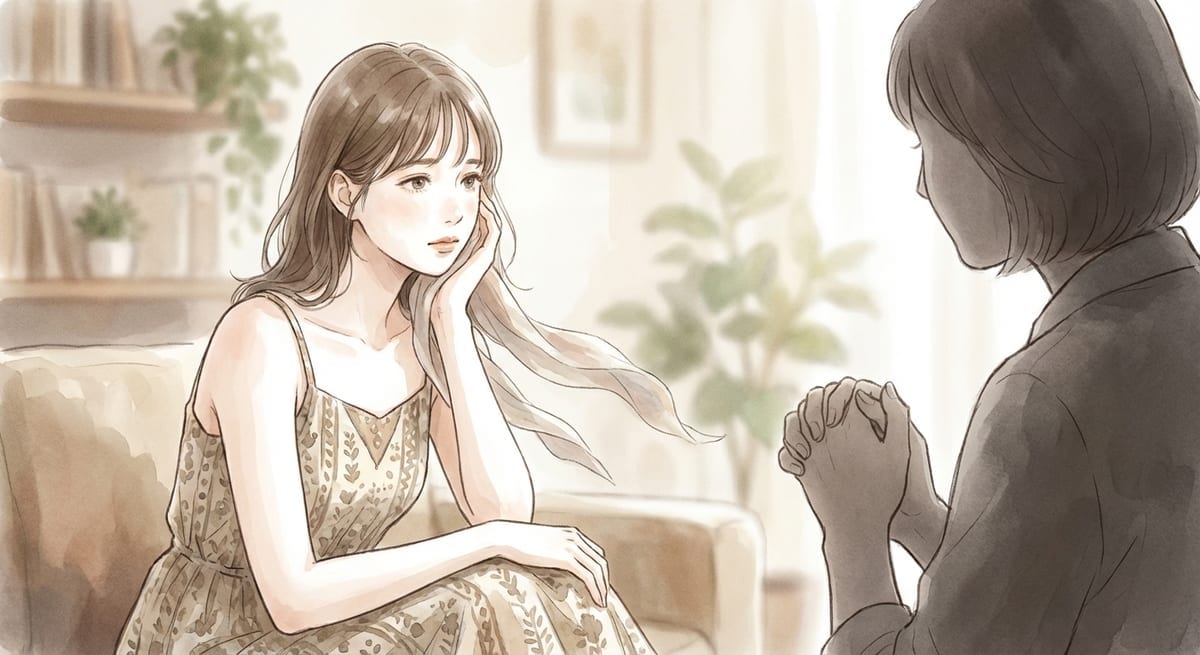
SCENARIO: A 26-year-old woman presents to rheumatology after a two-month workup for fatigue, joint pain, oral ulcers, and a malar rash that worsened after a weekend at the lake. She has just started her first teaching job at an elementary school. ANA is positive at 1:640, anti-dsDNA is elevated, and complement levels are low. She arrived in a sundress that she keeps adjusting to cover her cheeks. She asks if the rash will ever go away.
Before You Read
What to Look For
- •
Visibility as Symptom and Sentence: The SOAP note records 'erythematous malar rash, butterfly distribution, sparing nasolabial folds' as diagnostic data. The poem finds in that same sparing a bitter irony: the rash spares 'the folds / where laughter lives,' as if the disease has mapped itself around the parts of her face that express joy.
- •
The Weight of a Single Word: The plan lists hydroxychloroquine, prednisone, nephrology referral — actionable steps. The prose lingers on something the plan cannot hold: 'I am handing a twenty-six-year-old a word she will carry for the rest of her life.' Diagnosis as prognosis, as identity, as permanent address.
- •
What Six-Year-Olds See: The children's questions never appear in the SOAP note — they are socially relevant, not clinically. The prose makes them central because they are the daily cost of a visible disease in a public-facing life. The mask she wears is both adaptive coping and a measure of what the rash has already taken.
Lens I
SOAP Note (EHR)
SUBJECTIVE:
Referred by PCP for 2-month history of worsening fatigue, hand and wrist pain, mouth sores, and a facial rash. 'The rash showed up about three weeks ago and got much worse after I spent a day at the lake last weekend.' Describes bilateral hand and wrist stiffness lasting about 90 minutes each morning, two episodes of painful mouth sores, and hair thinning at the temples over the past month. Sharp chest pain for the past week, worse when taking a deep breath. Has had episodes of fingers turning white in the cold since college — was told it was 'poor circulation.' Started her first job as a 2nd grade teacher 6 weeks ago: 'I can barely grip the whiteboard markers, and I'm so tired I nap in my car at lunch.' Asks repeatedly about the rash: 'My students keep asking what's wrong with my face.' Says she feels 'like an old woman at 26.' Not on oral contraceptives. Last period 2 weeks ago, regular. No family history of autoimmune disease. No known allergies.
OBJECTIVE:
VS: T 37.6, HR 88, BP 118/72, RR 18, SpO2 98% RA. Gen: young woman, appears tired, frequently touches cheeks. Skin: erythematous malar rash, butterfly distribution, sparing nasolabial folds, blanching, slightly raised, extending to bridge of nose. Discoid-appearing lesion behind L ear. Two 5 mm aphthous ulcers on hard palate. Hair: diffuse thinning, no scarring alopecia. MSK: MCP joints 2-5 bilateral with synovitis, tender, no deformity. Bilateral wrist effusions. Grip strength reduced bilat. Lungs: diminished at L base with friction rub. CXR: small L pleural effusion. Labs: ANA 1:640 homogeneous pattern, anti-dsDNA 248 IU/mL (H), anti-Smith positive, C3 54 (L), C4 8 (L), ESR 62, CRP 18. CBC: WBC 3.2 (L), lymphocytes 0.8 (L), Hgb 10.8, plt 132 (low-normal). UA: 1+ protein, 5-10 RBC/hpf - concerning for early nephritis. BMP: Cr 0.9.
ASSESSMENT:
26-year-old woman presenting with 2-month history of fatigue, polyarthralgia, malar rash, oral ulcers, and pleuritic chest pain. 1. Systemic lupus erythematosus, new diagnosis - meets ACR/EULAR criteria (malar rash, oral ulcers, serositis, hematologic involvement, ANA, anti-dsDNA, anti-Smith, low complement). SLEDAI score ~14 (moderate-high activity). 2. Lupus nephritis - must rule out given proteinuria and hematuria on UA; nephrology referral for consideration of renal biopsy. 3. Pleuritis with small effusion - lupus serositis. 4. Significant psychosocial impact - new career, body image distress, functional limitations.
PLAN:
1. Hydroxychloroquine 200 mg BID - discussed as cornerstone therapy, reduces flares, organ damage, mortality. Ophthalmology baseline exam within 3 mo. 2. Prednisone 20 mg daily x 2 wks, then taper to 10 mg x 2 wks, then 5 mg with plan to discontinue - for acute control of serositis and synovitis. 3. Nephrology referral for UA findings - will need 24-hr urine protein and likely biopsy to stage. If confirmed nephritis, will add mycophenolate. 4. Sun protection counseling: SPF 50+ daily, reapply q2h, sun-protective clothing, avoid peak UV hours. Discussed this is not cosmetic but disease management - UV triggers flares. 5. Labs q4wks: CBC, BMP, UA, C3/C4, anti-dsDNA to monitor activity. 6. Discussed diagnosis at length. Used Lupus Foundation materials. Emphasized that SLE is manageable, that many patients live full active lives, that her career is not over. Pt tearful but engaged. 7. Discussed pregnancy planning: hydroxychloroquine is pregnancy-safe, but need disease quiescence 6+ mo before conception; refer to MFM when ready. 8. Counseling referral for adjustment to chronic illness diagnosis. 9. RTC 4 wks.
Lens II
Narrative Medicine: Prose
The Butterfly Rash and the First Day of School
She keeps touching her face. It is an unconscious gesture, a hand rising to the cheek and then pulling away, as if she has forgotten the rash is there and then remembered it again. She is twenty-six years old and she arrived in a sundress and concealer and neither is doing what she needs it to do. The butterfly sits across her cheeks and the bridge of her nose with the symmetry that makes the textbooks call it classic, and I can feel her flinch when I lean in to examine it.
She tells me that her second-graders ask her every morning what happened to her face. She has tried saying sunburn, allergies, a skin condition. None of these explanations satisfy a six-year-old. She tells me she has started wearing a mask again, pretending it is for cold season. She tells me this with a small laugh that is not a laugh. I am looking at her joints while she talks — the MCPs are swollen, warm, the grip strength diminished — and I am thinking about what it means to be a new teacher who cannot hold a marker firmly, who naps in her car at lunch because the fatigue is a gravity she cannot explain to anyone.
I tell her the name of what she has. Lupus. She nods as if she already suspected. I show her the labs: the antibodies, the complements, the protein in her urine that means we need to look at her kidneys. I tell her the hydroxychloroquine will help, and the prednisone will help faster, and the sun protection is not optional anymore. I tell her this is manageable. I tell her people live full lives. And all of this is true. But I also know that I am handing a twenty-six-year-old a word she will carry for the rest of her life, a word that will follow her into every future doctor's office, every insurance form, every pregnancy. She asks me if the rash will go away and I tell her it usually improves with treatment and sun avoidance. She asks again, differently: will it ever go away completely. I say I hope so, and she hears what I have not said.
Lens III
Narrative Medicine: Poetry
The butterfly lands
where it wants to —
across the cheeks,
the bridge of the nose,
sparing the folds
where laughter lives
she covers it with her hand
the way you cover a page
you are not ready
to let someone read
twenty-six and the word
chronic enters the lexicon
like a tenant
who will not leave
who rearranges the furniture
who answers the door
before she can