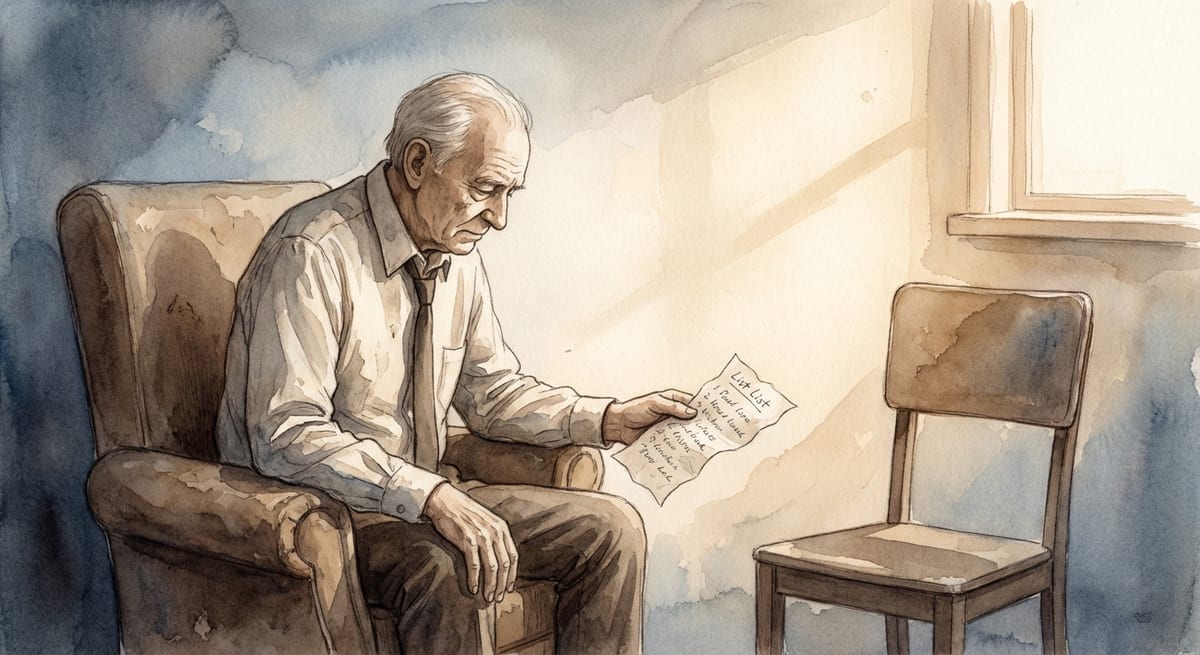
SCENARIO: A 79-year-old man presents for a routine follow-up three weeks after his wife of 54 years died from pancreatic cancer. He was her primary caregiver during the final six months. He comes in wearing a pressed shirt and tie, as he always has for his appointments. He has lost eight pounds. He hands the nurse a neatly handwritten list of questions, all of which are about his wife's medications and whether he should continue refilling them. He does not yet know she is gone from his pharmacy account.
Before You Read
What to Look For
- •
Three Theories of Forgetting: The SOAP note reads the medication list as cognitive disorganization. The prose offers: 'perhaps he does know, and asking about them is the only way he has found to say her name in this room.' The poem doesn't interpret at all — it lets 'the room shifts / the way a house shifts / when the furnace stops.'
- •
What the Chart Cannot Wear: The SOAP note records '8 lb weight loss' as a percentage; the prose finds the same fact in his belt, 'cinched two notches tighter than the hole that is worn smooth.' One gives you a delta. The other remembers that a belt is an object worn by a particular person.
- •
The Limits of the Apparatus: The SOAP plan lists ten numbered action items. The poem confesses what those items work to obscure: 'I say come back in two weeks / which is the only medicine / I have.' Both are honest; they are honest about different things.
Lens I
SOAP Note (EHR)
SUBJECTIVE:
Presents for routine follow-up, 3 weeks after his wife Margaret's death from pancreatic cancer (diagnosed 8 months ago, home hospice for the final 2 months). He was her primary caregiver. Arrives with a handwritten list of questions about her medications — asks whether her ondansetron and oxycodone prescriptions need to be refilled. When gently reminded these were his wife's medications, he pauses: 'Of course. I know that.' Describes poor appetite and 8-pound weight loss in 3 weeks. Says he sleeps 'on his side of the bed' but wakes at 3 AM and cannot fall back asleep. Still sets two places at the table. Says he is 'managing fine,' but daughter (called prior to visit) reports concern: he is not answering the phone, mail is piling up, and she found expired food in the refrigerator. When asked about thoughts of self-harm: 'Margaret wouldn't want that.' Denies alcohol use. Describes chest tightness 'like a weight' that he attributes to grief. PMH: hypertension, hyperlipidemia, BPH, bilateral knee osteoarthritis. Meds: lisinopril 20 mg daily, atorvastatin 40 mg daily, tamsulosin 0.4 mg daily, acetaminophen PRN.
OBJECTIVE:
VS: T 36.5, HR 72, BP 148/88 (baseline 128/76), RR 16, SpO2 97% RA. Wt 68 kg (76 kg 3 mo ago). Gen: elderly man in pressed shirt and tie, groomed, thin. Affect: controlled, eyes redden when wife mentioned, quickly composes himself. Hands steady. Cardiac: RRR, no murmur, no rub. Lungs: CTA bilat. ECG: NSR, no ST changes (new baseline for chest tightness complaint). BMP: Na 146 (mildly elevated - dehydration), K 4.1, Cr 1.2 (baseline 1.0), glucose 98. CBC: wnl. TSH: 2.4 (normal). PHQ-9: 12 (moderate depression range - but several items overlap with normal acute grief).
ASSESSMENT:
79-year-old man with HTN, hyperlipidemia, presenting 3 weeks after death of wife of 54 years with weight loss, functional decline, and features concerning for complicated grief. 1. Acute bereavement with complicated grief features - weight loss, functional decline, disorientation to wife's death (medication list), social withdrawal per daughter's report. 3 wks is early to diagnose PGD formally (requires 6+ mo) but trajectory is concerning. 2. Weight loss 8 lbs/3 wks (10.5%) - multifactorial: grief-related anorexia, possible dehydration, caregiver burnout recovery. Needs monitoring. 3. Mild dehydration per Na and Cr. 4. HTN - poorly controlled, likely grief/stress-related. 5. Chest tightness - low suspicion for ACS given normal ECG and clinical context, but will monitor given age and stress cardiomyopathy risk.
PLAN:
1. Grief: normalize his experience. Discussed that disorientation, sleep disruption, appetite loss, and waves of forgetting are part of early bereavement, not signs of failure or 'losing his mind.' Pt visibly relieved. 2. Referred to hospice bereavement program (available to caregivers for 13 mo post-death, already enrolled). Also provided info for spousal loss support group at senior center. 3. Nutrition: encouraged small frequent meals, Ensure supplements. Daughter will help with meal prep and grocery shopping. Pt reluctant to 'be a burden' - discussed reframing as letting his daughter help. 4. Hydration: increase oral fluid intake, recheck BMP in 2 wks. 5. Activity: daily walk, even 10 min, for mood and appetite. 6. Not starting antidepressant at this time - acute grief, not yet meeting duration criteria for MDD or PGD. Will reassess at 6 wks. 7. Daughter given permission to call me directly with concerns. 8. Discussed removing wife's medications from home - offered to help coordinate with pharmacy. Pt became tearful: 'Not yet.' Respected this. Will revisit. 9. BP recheck 2 wks - if still elevated, will adjust lisinopril. 10. RTC 2 wks, sooner PRN.
Lens II
Narrative Medicine: Prose
Three Weeks After Margaret
He arrives in a pressed shirt and tie, as he always does, and I realize I have never seen this man dressed any other way. Fifty-four years of marriage, six months of watching her die in their living room, and still he irons his collar before driving to the clinic. The list he hands the nurse is written in the careful cursive of a generation that was graded on penmanship. It asks about ondansetron and oxycodone — her medications, the ones that kept her comfortable at the end. He does not seem to know they are hers. Or perhaps he does know, and asking about them is the only way he has found to say her name in this room.
I sit with this for a moment before I speak. The PHQ-9 scores him at twelve, which the textbook calls moderate depression, but I am not sure the instrument was designed for a man whose wife died three weeks ago. Every question it asks — appetite, sleep, concentration, energy, interest — describes the normal physiology of early grief. The number tells me nothing that his belt, cinched two notches tighter than the hole that is worn smooth, does not already say. His daughter called me yesterday, worried. The mail is piling up. There is expired milk in the refrigerator. He sets two places at the table every evening and eats at neither.
What I want to do is sit here longer. What I want to do is ask him to tell me about Margaret — not her cancer, not her death, but the ordinary Tuesday of their life. What did they eat for breakfast. Who drove. Whether she laughed at his jokes or just tolerated them. But we have fifteen minutes, and his blood pressure is up, and I need to check a sodium level to make sure his grief has not become dehydration. So I do the things the visit requires. I order the labs. I mention the bereavement group. I say come back in two weeks. And when he asks about her medications and I have to tell him, gently, that she no longer needs them, something in his face rearranges itself — not into sadness exactly, but into the particular stillness of a man who has just remembered, again, the thing he keeps forgetting.
Lens III
Narrative Medicine: Poetry
He brings a list
in the handwriting of a man
who was taught that penmanship matters,
each letter upright
as a pressed shirt
ondansetron, oxycodone:
her medications.
He asks should I refill them
and the room shifts
the way a house shifts
when the furnace stops
fifty-four years
is not a number.
It is the width of a bed.
It is two places set
at a table where one chair
holds only light.
I do not say the word
adjust.
I say come back in two weeks
which is the only medicine
I have.