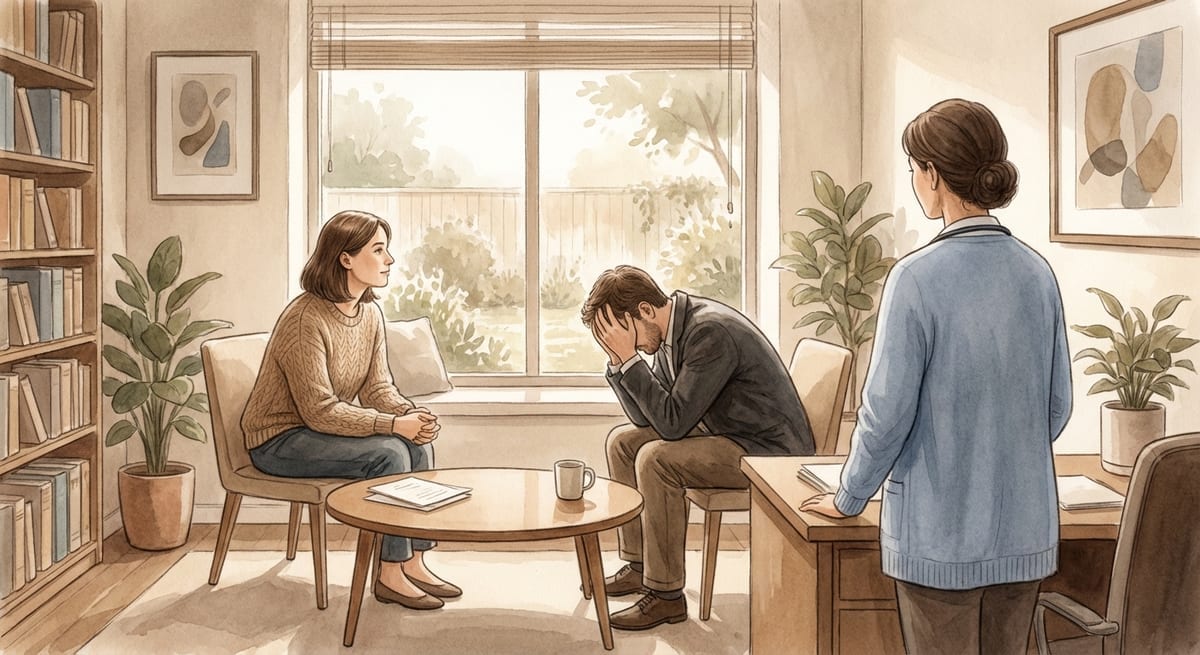
SCENARIO: A couple at 16 weeks gestation receives a confirmed prenatal diagnosis of trisomy 21 after amniocentesis. The mother, a 34-year-old elementary school teacher who works with children with disabilities, is quiet but calm. The father, a 36-year-old software engineer, is visibly distressed and asks immediately about 'options.' They are processing the news on different timelines and in different directions. The genetic counselor has left the room, and the MFM specialist is now with them.
Before You Read
What to Look For
- •
Two Epistemologies of Disability: The mother knows Down syndrome from IEP meetings and classroom breakthroughs. The father knows it from late-night phone searches. The SOAP note records 'couple is processing at different speeds.' The prose names the deeper difference: 'She has watched her students learn to read, slowly, with repetition and patience.' Her knowledge is embodied; his is algorithmic. Neither is wrong.
- •
Nondirective as Active Practice: The SOAP plan states 'presented options without recommendation' — one clause. The prose shows what nondirective counseling actually costs: 'The most important thing I can do in this room is not to fill the silence between them.' Restraint is clinical work. The poem holds that restraint structurally — it ends in silence, refusing to resolve.
- •
What the Karyotype Cannot Name: '47,XX,+21' is the SOAP note's complete genetic description. The poem finds the limit of that notation: 'a surplus the karyotype / cannot call gift or grief.' The same extra chromosome is, depending on who is reading it, a diagnosis, a destiny, or a daughter. The form determines which.
Lens I
SOAP Note (EHR)
SUBJECTIVE:
Couple presents for amniocentesis results. First pregnancy, 16 weeks and 3 days. Amnio performed at 15+4 weeks after positive cell-free DNA screen (trisomy 21 high risk). Karyotype confirmed: 47,XX,+21 — trisomy 21 (Down syndrome). Mother (34, elementary school teacher who works with children with intellectual disabilities): initially quiet after receiving the news, then: 'I know what this looks like. I work with these kids every day. They are wonderful.' Says she is 'not ready to talk about options.' Father (36, software engineer): visibly distressed, tearful, asks immediately: 'What are our options?' and 'What would the quality of life be?' Says his only exposure to Down syndrome is 'what I've seen online.' The couple does not agree on next steps — both acknowledge this. Mother: 'I need time. He needs time. We're not in the same place right now.' Father: 'I'm not saying I want to end the pregnancy. I'm saying I need to understand everything.' No fetal echo yet. No structural anomalies on anatomy scan at 15 weeks (limited; will repeat at 20 weeks).
OBJECTIVE:
Amniocentesis result: 47,XX,+21. All cells with trisomy 21, no mosaicism. Fetal anatomy US at 15+4: no major structural anomaly identified, mild echogenic bowel (will follow), nasal bone present, NT was 3.2 mm (elevated, prompted cfDNA). Fetal echo not yet performed. Maternal vitals: BP 116/72, wt 68 kg, fundal ht appropriate for dates. Prior prenatal labs unremarkable. Maternal health: uncomplicated pregnancy to date.
ASSESSMENT:
34-year-old G1P0 at 16+3 weeks with confirmed fetal trisomy 21 on amniocentesis. 1. Confirmed fetal trisomy 21 at 16+3 wks - non-mosaic per karyotype. 2. Parental counseling regarding diagnosis, prognosis, and options - couple is processing at different speeds and with different frames of reference. Nondirective counseling essential. 3. Pending fetal cardiac evaluation - 40-50% of T21 fetuses have congenital heart defects, which significantly affect prognosis and early intervention needs. 4. Limited anatomy scan - repeat at 20 wks for complete survey including GI, cardiac.
PLAN:
1. Provided balanced, nondirective counseling. Discussed: a) Natural history of trisomy 21 - range of cognitive and physical outcomes, common associated conditions (CHD, hypothyroidism, hearing loss, atlantoaxial instability). b) Discussed that DS is the most common survivable trisomy, median life expectancy now ~60 yrs, and that individuals with DS lead varied, meaningful lives with appropriate support. c) Options: continue pregnancy with early intervention planning, or pregnancy termination, which in this state is available up to 22 wks. Presented options without recommendation. 2. Fetal echocardiogram scheduled for next week - results will significantly affect counseling re: neonatal surgical needs. 3. Repeat detailed anatomy US at 20 wks. 4. Connected couple with: a) Parent support network (local Down syndrome parent group - offered contact with family willing to share experience). b) Neonatal medicine consult if desired. c) Genetic counselor available for follow-up questions. 5. Explicitly told couple: 'There is no wrong decision. There is no deadline today. You do not have to agree with each other right now.' 6. Discussed that many couples process this news at different speeds - normalized the discordance. 7. Follow-up visit in 1 wk, sooner if desired. Both have my direct line. 8. Offered individual counseling appointments if either partner wants to process separately before making a joint decision.
Lens II
Narrative Medicine: Prose
Two Parents, One Diagnosis, Two Silences
They are sitting in the same two chairs but they are not in the same room. The mother holds the ultrasound printout on her lap, face up, the way you hold a photograph of someone you have already decided to love. The father has pushed his chair back six inches from the desk, and his hands are gripping his knees, and he is staring at the amniocentesis report with the expression of a man who is trying to read his way to an answer that the numbers cannot give him.
She works with children with Down syndrome. She told me this with a steadiness that I do not think is denial. She has sat in IEP meetings. She has watched her students learn to read, slowly, with repetition and patience and a specific joy that she describes without sentimentality. She knows what this diagnosis looks like at seven years old, at twelve, at sixteen. Her husband knows what it looks like on the screen of his phone at two in the morning, which is a different kind of knowing, no less real but fed by algorithms that optimize for fear.
I give them the numbers: forty to fifty percent chance of a heart defect, which the echo next week will clarify. Median life expectancy around sixty years. Early intervention, therapies, supports. I give them the options, all of them, without leaning. I have learned that the most important thing I can do in this room is not to fill the silence between them. Their silence is not empty. It is the space where they are each building a version of the future and discovering that the versions do not match. This is not a crisis of the marriage. It is the marriage working exactly as it should — two people bringing different histories to the same moment and needing time to find a shared language for what comes next. I tell them there is no wrong decision. I tell them they do not have to agree today. The mother nods. The father exhales. Neither of them speaks, and the silence in the room is the most important thing in it.
Lens III
Narrative Medicine: Poetry
Forty-seven chromosomes
where forty-six were expected,
one extra copy of the twenty-first,
a surplus the karyotype
cannot call gift or grief
she holds the ultrasound
the way she holds
her students' papers —
with the patience of someone
who has learned
that slow is not the same
as less
he searches his phone
for a future
that hasn't happened yet
between them
the quiet
where a decision
is not yet a decision
but two people
learning to hear
differently