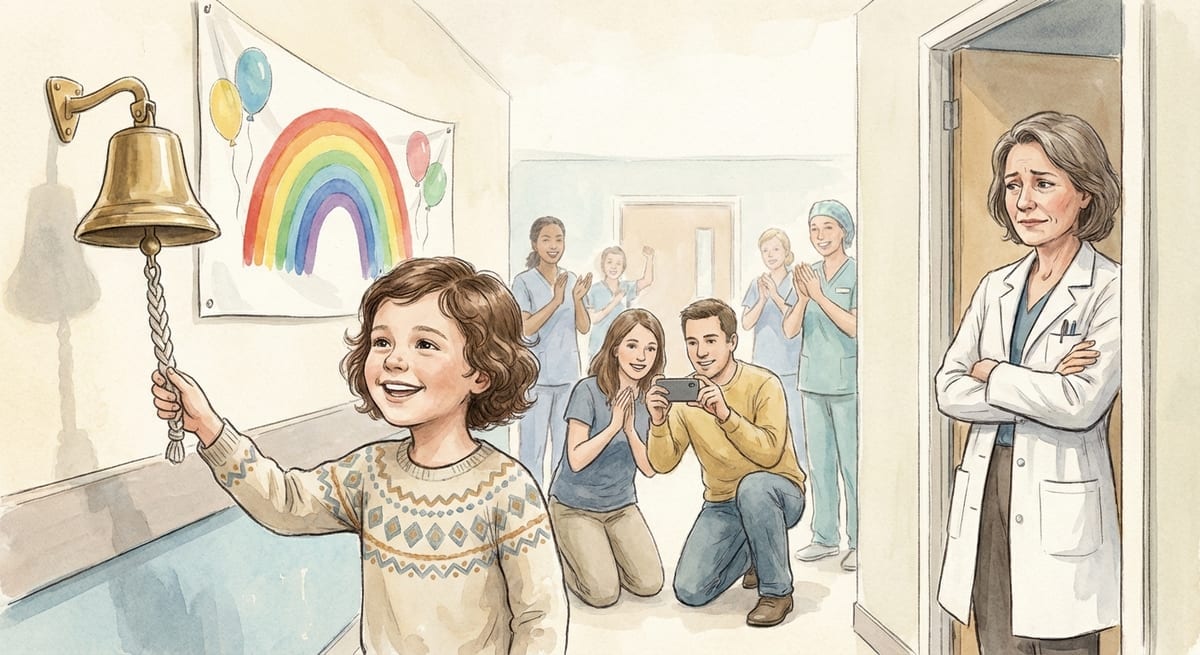
SCENARIO: A 6-year-old girl with B-cell acute lymphoblastic leukemia completes her final round of maintenance chemotherapy after two and a half years of treatment. The hospital holds a bell-ringing ceremony in the outpatient infusion center. Her parents are filming. The nurses have made a banner. The child is smiling. Her oncologist, who has treated her since diagnosis, watches from the doorway and feels something more complicated than celebration.
Before You Read
What to Look For
- •
The Arithmetic of Celebration: The SOAP note records '~90% EFS at 5 yrs' as reassuring prognosis. The poem holds both sides of that number: 'ninety percent / is also / ten percent.' The bell-ringing ceremony is structured to hold only the ninety. The physician, who has written the surveillance plan, must hold both, simultaneously, in the doorway.
- •
What 'Completed Therapy' Erases: The SOAP note records treatment as a protocol with phases — induction, consolidation, maintenance. The prose fills those clinical nouns with vincristine neuropathy, vomiting while her mother sang, screaming during port access. 'Completed therapy' compresses two and a half years of suffering into a checkbox.
- •
The Drawing in the Desk: The stick-figure drawing does not appear in the SOAP note — it is not clinically relevant. The poem makes it the emotional center: 'stethoscope like a heart / worn on the outside.' And then the final reversal: 'a child you poisoned / back to health.' Only the poem can name chemotherapy as both poison and cure in the same breath.
Lens I
SOAP Note (EHR)
SUBJECTIVE:
Child: 'I'm ringing the bell today and then I never have to come back, right?' (gently corrected that she will still come for check-ups). Mother: 'She's really bounced back over the past six months — back in kindergarten full-time, her energy is up, she's eating well. We can't believe we're finally here.' Father: 'Every bruise, every fever, I think it's back. I don't know how to stop watching for it.' Mother tearful with relief. Father tearful with something he cannot name. History per parents and chart: diagnosed at age 3 years 8 months after two weeks of fatigue, easy bruising, and refusal to walk. All treatment phases completed per COG protocol AALL0932, total duration 2 years 6 months.
OBJECTIVE:
VS: T 36.8, HR 92, BP 98/58, SpO2 99% RA. Wt 19.2 kg (25th %ile, up from 3rd %ile at nadir). Ht 112 cm (35th %ile). Gen: alert, active, animated 6 yo in pink dress with tiara (chose her outfit for today). HEENT: hair regrown, thick brown curls. No LAD. Port-a-cath site: well-healed, port removal scheduled next month. Abdomen: no HSM. Skin: no petechiae, no bruising. Neuro: age-appropriate. Labs (today): CBC - WBC 5.8, ANC 2,100, Hgb 12.1, plt 245. All normal. LFTs normal. LDH normal. Peripheral smear: no blasts. MRD by flow (last assessment 3 mo ago): negative. Bone marrow biopsy (6 mo ago): complete morphologic and molecular remission.
ASSESSMENT:
6-year-old girl with B-cell ALL, standard risk, completing final maintenance chemotherapy after 2.5 years of treatment. 1. B-ALL, standard risk, in complete remission - completed therapy per protocol. End-of-treatment labs normal, MRD negative. Prognosis: ~90% EFS at 5 yrs for standard-risk B-ALL. 2. End-of-treatment transition to survivorship surveillance. 3. Late effects monitoring needed: neurocognitive (intrathecal MTX), endocrine (growth velocity), cardiac (anthracycline exposure, cumulative doxorubicin 150 mg/m2 - below threshold but monitor), bone density (steroid exposure), secondary malignancy screening (low risk but lifelong). 4. Family psychosocial adjustment - father showing signs of persistent hypervigilance consistent with post-treatment distress.
PLAN:
1. End-of-treatment bell ceremony today - nursing staff, child life, and family present. 2. Port-a-cath removal scheduled in 4 wks under sedation. 3. Survivorship care plan provided to family and PCP: a) CBC q3mo x 1 yr, then q6mo x 2 yrs, then annually. b) Annual echocardiogram for anthracycline monitoring. c) Neuropsychological testing at age 8 (school entry) for MTX-related cognitive effects. d) Growth velocity monitoring q6mo - endocrine referral if crossing percentiles. e) Annual dermatologic screening beginning age 18. 4. Discussed with parents: end of treatment is not end of vigilance but shift in its nature. Relapse risk is real but diminishes with time - highest in first 2 yrs off therapy. 5. Father: recommended psychotherapy referral for post-treatment anxiety/hypervigilance - many parents experience increased anxiety paradoxically when treatment ends because the 'safety net' of active treatment is removed. Father receptive. 6. Child: play therapy referral for processing treatment experience as she enters school-age understanding. 7. School re-entry support letter provided. 8. Clinic schedule: RTC 1 mo (port removal), then 3 mo, then q3mo x 1 yr. 9. After-hours number reviewed with family.
Lens II
Narrative Medicine: Prose
The Bell and What Follows the Ringing
She chose the pink dress herself, and the tiara, and she walks to the bell with the certainty of a child who has been promised that this moment means something. The nurses have lined the hallway. There is a banner — 'Lily's Last Chemo Day!' — in glitter letters that will shed onto the floor for weeks. Her mother is crying and filming at the same time, the phone shaking in her hand. Her father stands behind the camera with his arms crossed and a smile that does not reach the muscles around his eyes.
I stand in the doorway because I do not trust myself in the center of the room. I have treated Lily since she was three years and eight months old — since the morning her mother carried her in because she had stopped walking, and the CBC came back with blasts, and I sat in a small room and told two people that their child had leukemia. I have watched her vomit into a basin while her mother sang to her. I have watched her learn to walk again after the vincristine neuropathy. I have held her port access needle while she screamed and then, five minutes later, asked me if I wanted to see her drawing. She drew me once. I am a stick figure with big glasses and a stethoscope. I have it in my desk drawer.
She rings the bell three times, hard, and the hallway erupts in cheering, and I cheer too because this is real, this is a child who is alive and in remission and wearing a tiara. But I am also thinking about the ten percent. I am thinking about the surveillance plan I have written, about the CBCs every three months, about the echocardiograms to check for anthracycline damage to a heart that is six years old. I am thinking about her father, who told me in the hallway that every bruise on the playground makes his chest tight, and I am thinking that I will refer him to someone who can help him hold what I am asking him to hold: the joy and the fear at the same time, for years, without putting either one down. Lily runs to me and hugs my legs. 'I did it,' she says. 'You did,' I say. And both of us are telling the truth, and neither of us is telling all of it.
Lens III
Narrative Medicine: Poetry
She rings the bell
three times
because three is the number
that means done
in every story
she has ever been told
the nurses line the hall
her mother films
her father smiles
with everything
except his eyes
I clap from the doorway
where the math lives:
ninety percent
is also
ten percent
she drew me once —
stick figure, big glasses,
stethoscope like a heart
worn on the outside
I keep it in my desk
next to the protocol
that does not have a page
for what to feel
when a child you poisoned
back to health
rings a bell
and calls it victory