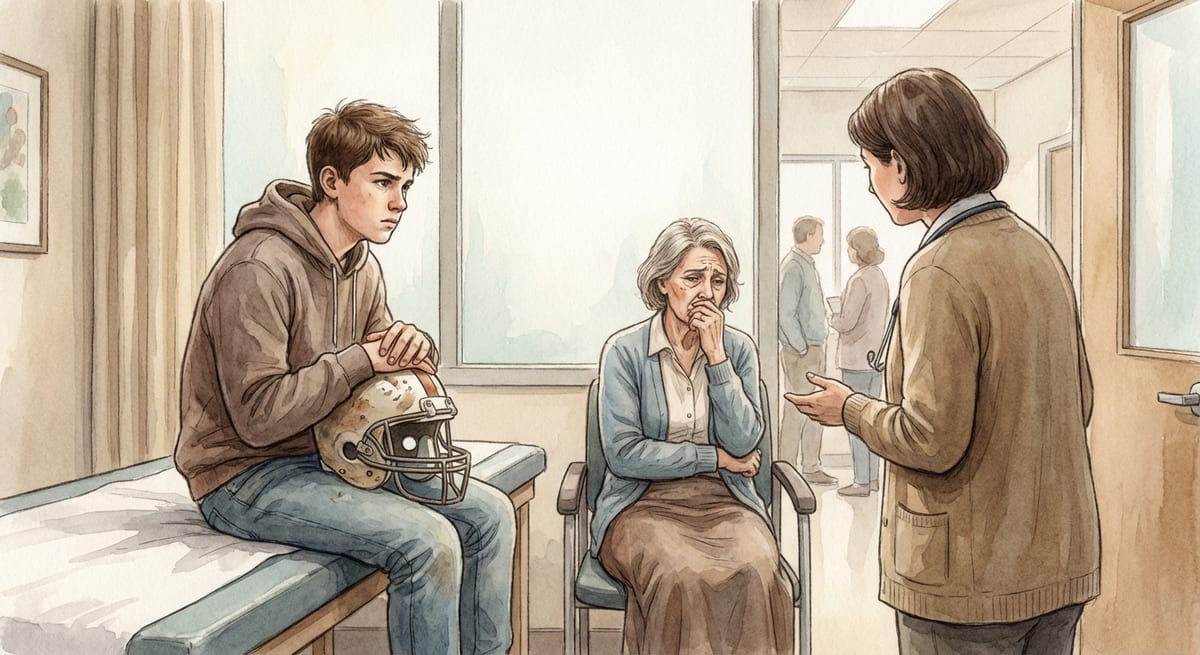
SCENARIO: A 16-year-old varsity football player is brought to the sports medicine clinic by his mother three days after sustaining his third concussion in eighteen months. He is symptomatic: headaches, light sensitivity, difficulty concentrating in class. His father and coach are outside in the waiting room; both have separately called the clinic asking when the player can return to contact. The player himself says, 'I'm fine, I just need to get cleared.' His mother says, 'I'm done watching him get hurt.'
Before You Read
What to Look For
- •
Who Speaks for the Brain: Four voices compete in this encounter: player, father, coach, mother. The SOAP note documents each position. The poem isolates the fifth voice — the brain itself — and names the paradox: 'a brain that has been hit / three times / is the last voice / a sixteen-year-old / wants to hear.' The injured organ is both the thing being protected and the thing least able to advocate for its own protection.
- •
Fine as Armor: The SOAP note records 'player states he is fine' and then documents impaired concentration, elevated SCAT-5, and below-baseline ImPACT scores. The prose reads 'fine' as a word doing structural work: 'the only word / between him / and the thing he might lose.' Clinical testing refutes the claim; the poem reveals what the claim is protecting.
- •
The Clearance Form as Architecture: The SOAP plan states 'NO return to play' — clinical authority. The poem reimagines the form as a door: 'I hold the clearance form / like a door / I will not open / until the house / is safe to enter.' The physician's refusal to clear is not a barrier but a form of shelter. The father calls football an identity. The physician holds a form that says the identity must wait until the brain is ready to carry it.
Lens I
SOAP Note (EHR)
SUBJECTIVE:
'I'm fine, doc. The headache's almost gone. I just need to get cleared for Friday.' 16-year-old varsity football player (LB/TE), third diagnosed concussion in 18 months. This one was a helmet-to-helmet collision during practice 3 days ago — no loss of consciousness, but athletic trainer noted confusion on the sideline for about 5 minutes. Current symptoms: daily headaches (6/10, frontal, worse with screens and fluorescent lights), light sensitivity, difficulty concentrating in class — 'I read the same sentence four times' — irritability, trouble falling asleep. Prior concussions: first was 14 months ago (resolved in 3 weeks), second was 7 months ago (took 5 weeks to clear). All from football. Says college scouts have been at recent games. Mother: 'I'm done watching him get hurt. This is his third one. When is it too many?' Father (not in exam room, called office separately): 'He's tough. He wants to play. We shouldn't hold him back.' Coach (called office): 'He's our best player. Is there any way to expedite clearance?'
OBJECTIVE:
VS: T 36.9, HR 68, BP 118/72. Gen: athletic adolescent, no acute distress, wearing sunglasses indoors ('the lights bother me'). Neuro: CNII-XII intact. Pupils 4 mm bilat, reactive, no afferent defect. Gait: normal, no ataxia. Romberg: mild sway (equivocal). Cervical spine: mild paraspinal tenderness bilat, FROM. Neuropsych screening (SCAT-5): symptom severity score 28 (elevated; baseline pre-season was 4). Orientation: 5/5. Concentration: impaired (4/5 digits backward, 2/5 months reversed). Delayed recall: 3/5. ImPACT testing (computerized neurocognitive): verbal memory 68th %ile (baseline 85th), visual memory 55th %ile (baseline 82nd), processing speed 60th %ile (baseline 88th), reaction time 0.68 sec (baseline 0.52 sec). All domains below individual baseline. Balance: BESS total errors 12 (baseline 4).
ASSESSMENT:
16-year-old male varsity football player presenting 3 days after his third diagnosed concussion in 18 months, currently symptomatic. 1. Concussion #3 in 18 mo, currently symptomatic at day 3 - SCAT-5 and ImPACT testing confirm cognitive deficits below baseline. Pattern of recurrent concussion with increasing recovery times (3 wks, 5 wks, current TBD). 2. Risk of prolonged recovery - prior prolonged recovery and recurrent injury are risk factors. 3. Cumulative concussion exposure concern - 3 concussions in 18 mo in a still-developing brain (age 16, prefrontal cortex development ongoing through mid-20s). 4. External pressure from father and coach to return to play prematurely - documented. 5. Family conflict regarding continued participation in contact sports.
PLAN:
1. NO return to play at this time - player is symptomatic and below neurocognitive baseline. Must complete graduated return-to-sport protocol beginning only after full symptom resolution AND cognitive return to baseline. Discussed with player directly: his symptoms are not subtle - the headaches, the light sensitivity, the concentration difficulties confirm his brain is still recovering. 'I'm fine' is contradicted by the testing. 2. Academic accommodations letter provided to school: reduced screen time, extended test time, excused from PE and band (noise exposure), permission to wear sunglasses, rest breaks PRN. 3. Called father into room with mother for joint discussion: a) Reviewed concussion science - cumulative risk, CTE research (presented cautiously, without fearmongering, with accurate caveats about current evidence). b) Explained that 3 concussions in 18 mo, with increasing recovery times, places their son in a higher-risk category. c) Recommended serious family discussion about continued contact sport participation. I cannot make this decision for them, but I can provide the data: each concussion lowers the threshold for the next, and his developing brain is the organ he will need for everything else his life will contain. d) Father resistant: 'Football is his identity. You can't take that from him.' Mother firm: 'His brain is more important than football.' Player silent during this exchange. 4. Documented external pressure from coach. Reminded family that return-to-play decision is medical, not coaching. I will not clear him until he meets criteria regardless of schedule or scout visits. 5. Repeat ImPACT testing in 2 wks. If still below baseline, neurology referral for prolonged concussion management. 6. If family decides to continue football after recovery, mandatory neck strengthening program and helmet fit reassessment. 7. Discussed with player privately (without parents): asked what HE wants. He paused, then said: 'I don't know. I'm scared it's going to happen again but I don't know who I am if I don't play.' Validated this. Counseling referral for identity and transition support if needed. 8. RTC 2 wks.
Lens II
Narrative Medicine: Prose
The Third Hit and Who Gets to Decide
He is wearing sunglasses indoors and he does not take them off. The fluorescent lights in the clinic bother him, which is itself an answer to the question he is asking me to answer differently. He is sixteen years old and he has the body of a man and the prefrontal cortex of a boy, and the distance between those two facts is where this entire conversation lives.
His mother sits beside him with her arms folded and a stillness that I recognize as the stillness of a decision already made. His father is in the waiting room. His coach called the office this morning. I have three people asking me to clear this boy and one person asking me to protect him, and the boy himself is asking me to tell him he is fine because he does not yet understand that fine is not the same as undamaged. He tells me college scouts were at the last game. He tells me this the way a sixteen-year-old tells you the most important thing in the world, which is to say with an intensity that leaves no room for the possibility that the most important thing might change.
I run the tests. His processing speed is down, his reaction time is slow, his balance is off, and he cannot reverse the months of the year without losing his place. The numbers are not subtle. I show them to him on the screen and I watch his face as he compares his baseline to today, and for a moment the bravado falters and something younger and more frightened looks out from behind it. I call his father in. I tell them both what I will tell the coach if he calls again: this boy is not cleared, will not be cleared until his brain has recovered, and that the timeline is the brain's decision, not the schedule's. The father says football is his son's identity. The mother says his brain is more important than football. The boy says nothing. Later, when his parents step out, I ask him what he wants. He is quiet for a long time. Then he says, 'I'm scared it's going to happen again but I don't know who I am if I don't play.' He is sixteen. He should not have to choose between his brain and his name.
Lens III
Narrative Medicine: Poetry
Three concussions in eighteen months
and the lights still hurt
but he says he's fine
the way a boy says fine
when fine is the only word
between him
and the thing he might lose
his mother folds her arms.
his father says identity.
his coach says Friday.
his brain says wait —
but a brain that has been hit
three times
is the last voice
a sixteen-year-old
wants to hear
I hold the clearance form
like a door
I will not open
until the house
is safe to enter