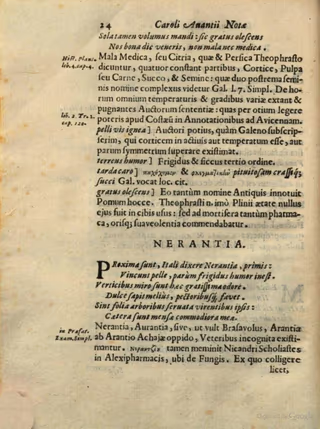
N E R A N T I A.

Poet
Baptista Fiera
Form
Elegiac couplet
Open the page in the book
The page this poem fills. Each opens in the Coena, sive De cibariorum virtutibus reader.

Hover or tap a word to see its match.

Next to the first are those the Italians have called Nerantia:

They surpass them in their rind, there is little cold humor in them.

These are most pleasing to the heads with their wondrous odor.

The sweet part tastes better, and favors the chests.

Let the leaves be kept for the green trees themselves:

The rest are more suitable for my table.

PRoxima ſunt, Itali dixere Nerantia, primis:

Vincunt pelle, parùm frigidus humor ineſt.

Verticibus miro ſunt hæc gratiſſima odore.

Dulce ſapit meliùs, pectoribuſq́; favet.

Sint folia arboribus ſeruata virentibus ipſis:

Cætera ſunt menſæ commodiora meæ.
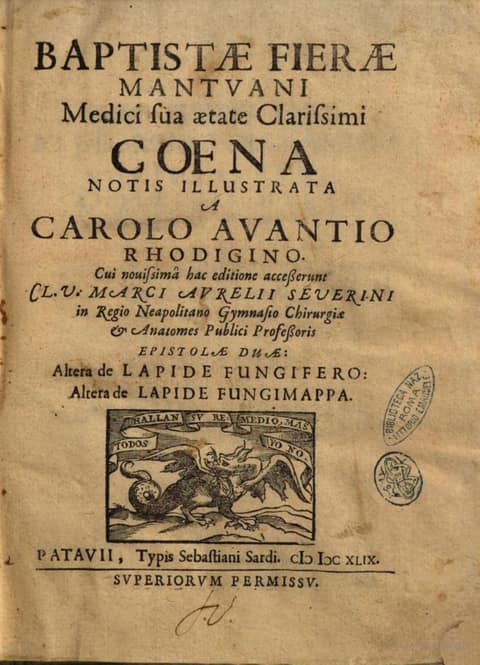
Title page of Coena, sive De cibariorum virtutibus
Title page of Coena, sive De cibariorum virtutibus , 1649

About this text

Provenance

This digital edition is derived from the Internet Archive copy of Battista Fiera's 1649 _Coena, sive De cibariorum virtutibus_, a Latin medical dinner poem with Carlo Avanzi's notes and related material.

Methodology

Each scan is treated as a page-level unit. The page image remains the authority for the edition. Local Kraken OCR used the Reichenau Latin early-print model as a reading aid, then Gemini generated scan-grounded Latin transcription and scholarly English translation from the images, the OCR aid, and the approved glossary. Word links connect the English translation to the Latin transcription and locations on the scans. 32 uncertain word-link decisions remain unlinked. Some links highlight only the text because the source word could not be located on the scan.

Rights

The Internet Archive metadata and IIIF manifest record the digital surrogate under the Creative Commons Public Domain Mark 1.0. Poet Doctor's presentation adds generated OCR, transcription, translation, navigation metadata, and editorial context.

Original scans: Internet Archive / Google Books ( Public Domain Mark 1.0 ).

Historian’s note. This text records the medicine of its own time, and later evidence has replaced most of it. It is not medical advice. We read it as history, and we ask what, if anything, connects it to medicine today. More on how we read old medical books