

Historical medical illustrations, 1350 to 1874
318 illustrations from 18 books in the Historical Medical Library . Each one opens on its page in the reader.
318 illustrations
-
 A cornucopia overflows with plants and contains a small face. The horn rests on a bed of leaves.
Aegidii Corboliensis carmina medica, 1826
-
 A decorative ornament features a face surrounded by leaves and flowers, with a ribbon curling around the composition.
Aegidii Corboliensis carmina medica, 1826
-
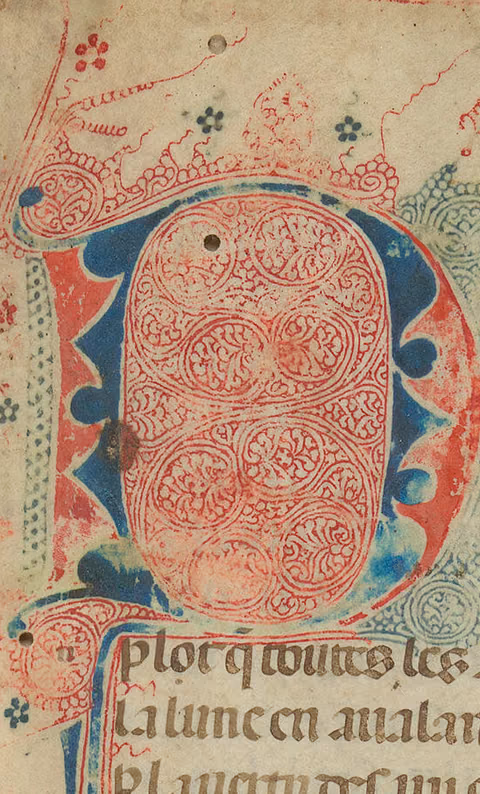 A large decorated initial letter 'D' filled with red filigree patterns and surrounded by blue and red decorative flourishes.
Le Regime du corps, 1350
-
 A red illuminated initial letter contains blue and white decorative patterns and is surrounded by blue flourishing lines.
Le Regime du corps, 1350
-
 A page of a manuscript features two columns of handwritten text with a large, ornate blue and red initial letter. Red decorative flourishes appear in the left margin.
Le Regime du corps, 1350
-
 A manuscript page contains two columns of text with two large, ornate initials in red and blue ink.
“tain young. Of medicine Since we have spoken of the science, we wish to speak of another part of medicine. Medicine is a science by which one knows all the natures of the body of man and by which one preserves the health of the body and removes diseases, and this science has two parts. One is called theoretical and the other practical. And we wish to judge that there are three manners of fevers. One occurs when the humors are corrupted, and this is called putrid fever. The other occurs in the members, which is called hectic. The third, which comes from the spirits, is called ephemera. By practice we know how one must work and preserve the body in health, and remove the disease. Now we will speak of the theoretical and will leave the practical. And we will speak first of the air. Of the air”
Le Regime du corps, 1350
-
 A red decorated initial letter 'P' features blue swirls inside and has blue decorative flourishes on its left side.
“of each person. Of drinking.”
Le Regime du corps, 1350
-
 A decorated initial letter 'V' in blue and red, featuring interior red patterns and surrounded by red linear ornaments.
“Now we will tell how you should use them. To drink water fasting is good, and when one is tired it is bad; rather it is fitting that one eat a little beforehand. And a sanguine man who has great ventricular heat, and drunk people when they are thirsty, can use it more boldly, provided they do not take too much all at once. Cold water gives the desire to sleep, and takes away the desire to eat. Hot water does harm to the stomach, and makes one go to the chamber well. Of other waters, how one should advise upon them, we will say no more right now, for we will leave it aside for now. Now we will speak of wine. Of wine.”
Le Regime du corps, 1350
-
 A decorated initial Q in blue and red ink with red pen-work flourishes extending into the margin.
“For a man to labor.”
Le Regime du corps, 1350
-
 Handwritten text with red headings and a large, ornate blue and red initial letter D fills the page.
“You must hear of sleeping: For a man to labor.”
Le Regime du corps, 1350
-
 Two columns of text on a page, featuring a large red decorated initial P at the start of the second column.
Le Regime du corps, 1350
-
 A large, decorated initial 'U' in blue and red with long red flourishes extending vertically into the left margin.
“whoever wishes to bathe in cold water should pay attention to his nature, and this is that he be hot and young and of a moist nature, and it should be in summer, for whoever does it temperately makes the natural heat return inside the body. On lying with a wo man. Every single man who has sense and discretion must put his attention and all his power to knowing how and when one should cohabit with a woman, because it can harm and help. Know that the matter which departs from the man in doing it with the woman is a superfluity of the humours which nourish the members, and therefore we will teach you that all things that nourish man are cooked first in the stomach, and medicine calls this the first digestion, and then in the liver. And this is the second digestion, and then in the veins of the body, and this is the third digestion. And when this nourishment goes out of the members and turns to the substance of flesh, and into the members, and this is the fourth digestion, and from this departs the matter which we have named. Although Hippocrates says that it departs more from the brain than from elsewhere, for he says that whoever would cut two veins which are behind the ears, the one to whom they were cut would not have the power to engender nor to lie with a woman.”
Le Regime du corps, 1350
-
 A decorative initial letter 'I' in red and blue features long blue flourishes extending down the left margin.
“be empty, and when he will be hot, than when he will be cold. Of accidents. It is not necessary to speak of a thing that the physicians call *accidentia anime*. That is, because they are things more proper to the soul than to the body. And these things are ire, wrath, gladness, fear, shame, sadness, anguish, thought; and whoever does not guard against these things, they destroy the body and the soul suddenly, so everyone must guard against them to the best of their power, first of all by the spirits which first testify inside and afterwards come outside, just as you see first that a man turns pale and afterwards becomes red, and this changes the body of a man many times. Thoughts are of another manner, and you may know that thinking and staying awake, if it is not done in moderation, destroys the body. And there is another manner of things, such as melancholy, which much destroys the body, and one can remove it by purging the body of humours and by these electuaries, such as the *leticia* of Galen, and having joy and gladness. As for the others, such as having ire and wrath, it goes hard to overcome the cause from which they come. Of bleeding.”
Le Regime du corps, 1350
-
 A large, decorated blue and red initial letter C with long, sweeping red flourishes extending along the left margin.
“It is not necessary to speak of a thing that the physicians call *accidentia anime*. That is, because they are things more proper to the soul than to the body. And these things are ire, wrath, gladness, fear, shame, sadness, anguish, thought; and whoever does not guard against these things, they destroy the body and the soul suddenly, so everyone must guard against them to the best of their power, first of all by the spirits which first testify inside and afterwards come outside, just as you see first that a man turns pale and afterwards becomes red, and this changes the body of a man many times. Thoughts are of another manner, and you may know that thinking and staying awake, if it is not done in moderation, destroys the body. And there is another manner of things, such as melancholy, which much destroys the body, and one can remove it by purging the body of humours and by these electuaries, such as the *leticia* of Galen, and having joy and gladness. As for the others, such as having ire and wrath, it goes hard to overcome the cause from which they come. Of bleeding.”
Le Regime du corps, 1350
-
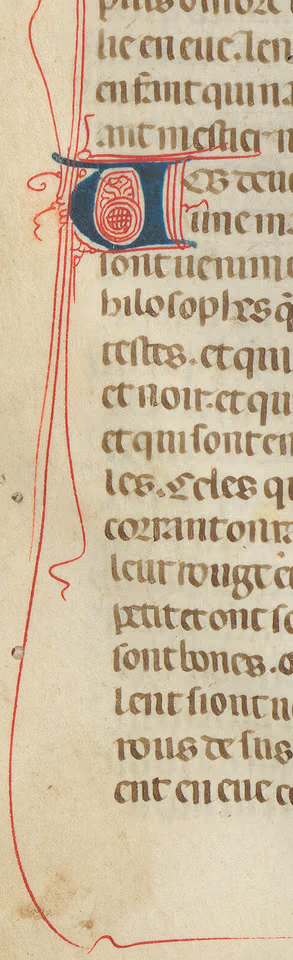
 A large, decorative initial letter 'U' is colored in red and blue with intricate white patterns inside. Long, thin blue lines extend from the letter down the left side of the text column.
Le Regime du corps, 1350
-
 An illuminated blue initial letter E features white interior patterns and is surrounded by red decorative flourishes and lines extending into the margin.
Le Regime du corps, 1350
-
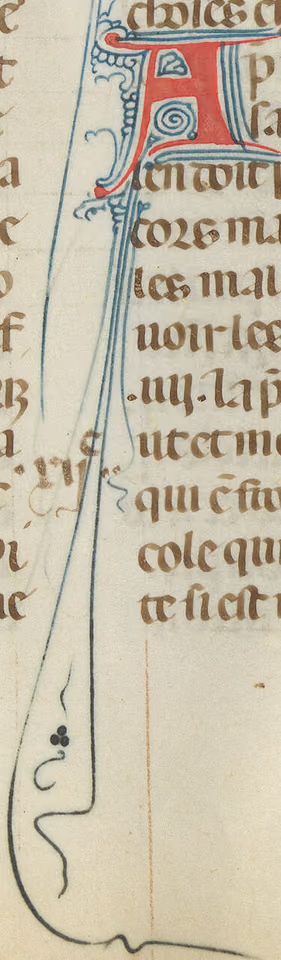 A large, decorated red initial letter 'A' with blue ornamental flourishes. A thin blue line extends downwards from the letter, ending in a small three-lobed ornament.
“And you should know that there are two kinds of leeches that are venomous, as the philosopher says, which are those that have large heads, and that have a colour between green and black, and that are born therein, and that are in swamps, these are bad. And those that dwell in running water or in fountains, and have a red and dark colour, and have a small head and resemble a mouse's tail, are good. Now those that are most valuable have a red belly and are reddish on the back, provided that they are in running water, these are the best. Now let us return to what they are good for. They are effective for freckles, and for those who have a bad colour, red and dark and pimply, and for a wound made a long time ago, provided that one has first been bled from a vein, as Avicenna says. The blood that they suck issues from deeper than that of cupping glasses. And you must keep them for one day after they have been caught, and put them in clear water. And it is a good thing to nourish them with lamb's milk, and to rub well the place where one must apply them, and to put there a little goat's blood so they attach more quickly. And when you wish to remove them, take a little ash, or vair bristle, or burnt flax, and put it on top, and they will fall off immediately. And then let the blood continue to purge through the bleedings of the cupping glasses, and if you wish to stanch it, take a cloth soaked in vinegar and put it on top, or powder of burnt mussel, or burnt gallnut, or well-frayed cloth, for these things stanch it. Of purging.”
Le Regime du corps, 1350
-
 A large red illuminated initial letter decorated with blue swirling patterns is located at the beginning of a paragraph.
“Of vomiting.”
Le Regime du corps, 1350
-
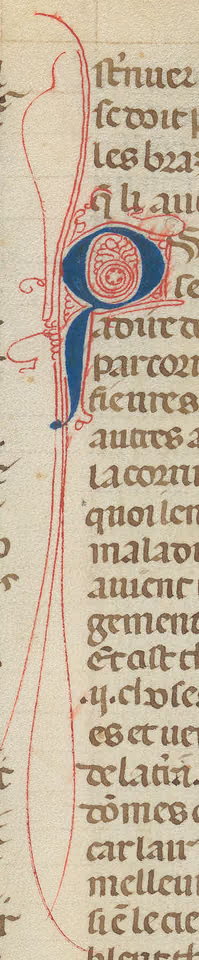 A blue decorated initial letter Q with red flourishes and a red spiral in the center.
“On guarding against pestilence.”
Le Regime du corps, 1350
-
 A brown sketch of a bird in flight is in the left margin.
Le Regime du corps, 1350
-
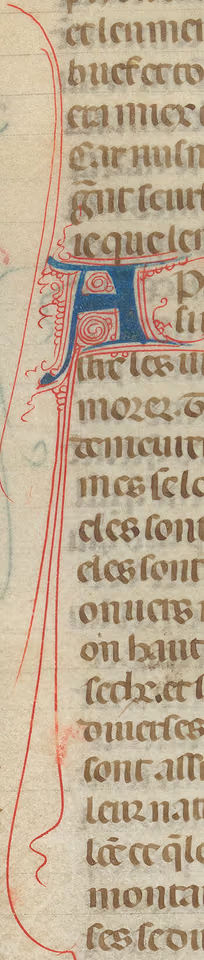 A page of a medieval manuscript featuring two columns of text and a large, blue and red decorated initial letter 'A'.
Le Regime du corps, 1350
-
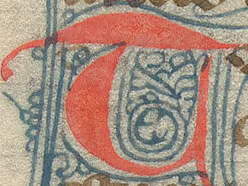 A large red illuminated letter P with blue flourishes and a floral pattern inside.
“For those travelling.”
Le Regime du corps, 1350
-
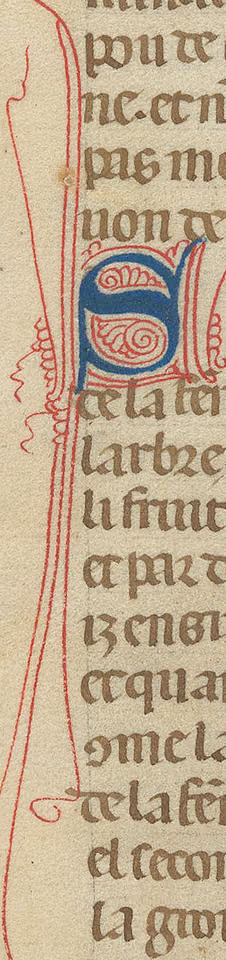 A large blue illuminated initial S with red swirls is surrounded by brown text. Thin red decorative lines extend from the initial into the left margin.
“To know about the pregnant woman”
Le Regime du corps, 1350
-
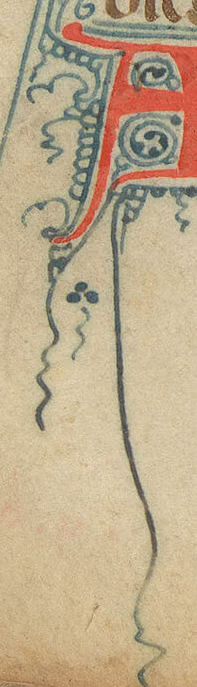 A decorated initial letter 'Q' in red and blue ink, featuring swirling patterns and a long, thin blue flourish extending downwards.
Le Regime du corps, 1350
-
 A manuscript page has two columns of handwritten text and a large, ornate blue and red initial 'C' surrounded by red flourishes.
“Concerning each age.”
Le Regime du corps, 1350
-
 A red illuminated initial D contains a blue decorative pattern, with a thin blue flourish extending down the left margin of the page.
“of wine afterwards. And one must refrain from eating until it is digested. For these things delay old age, as Avicenna says, and when one passes 70 years, one must guard against purging and bleeding unless great need causes it to be done, and they use good foods that are easily digested, and drink good wine, old and red, and guard against white and new wine, and use electuaries of *dyacinimon*, *dyacitron*, *piperion*, of ginger, and all hot electuaries. Of hair in all manners.”
Le Regime du corps, 1350
-
 A large blue initial letter 'O' with red interior decoration is surrounded by red ornamental flourishes that extend into the left margin.
Le Regime du corps, 1350
-
 An illuminated capital letter Q in red and white with decorative scrollwork.
“dregs of vinegar, and one should anoint oneself with it often; this will make the hair return. Of the eyes, we will say how, etc.”
Le Regime du corps, 1350
-
 A blue decorated initial letter 'T' with red flourishes starts a paragraph of handwritten text on a parchment page.
“Whoever wishes to preserve the health of the eyes, let him guard against dust and smoke, and from the wind, the sun, and from looking at things that are too bright and too delicate, such as small letters and all things by which the sight is strained, and from weeping, and from sleeping after eating, and from lying too much on one's back, for this is the thing that most harms the sight, and let one guard against bad foods and bad wines from which bad fumes can come, such as leeks, garlic, onions, and from things that are too salty, and from becoming drunk, and from vomiting too much, because of the humours of the head that come into the eyes. And a certain remedy to strengthen and clear the sight is to thrust one's head into clear, cold water, and to open the eyes within it. And using fennel water made in the manner of rosewater is worth much. Again, take tutty that is made into a fine powder and diluted with juice of calamint, and afterwards strain it finely, provided it has remained there for one day, and put it in the eyes, and this greatly preserves the sight and does not let any humour come there. Again, take the juice of a sweet pomegranate and the juice of another that is sour, and let them be put into two phials that are well stopped up; and one lets it stay until twenty days. Then one must remove the clear part through a cloth, and throw away the dregs, and make into powder aloe and black pepper and long pepper and sal ammoniac, of each one drachm, and let them be finely ground and equally diluted in the juice of the apples, and you will use it and strain it. And the older this medicine is, the more it will be worth. And it is a proven medicine, as Rhazes says. Of the ears.”
Le Regime du corps, 1350
-
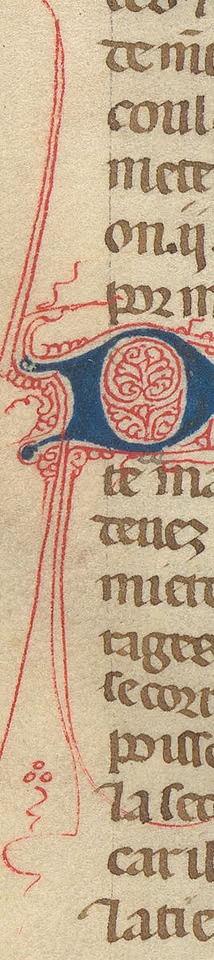 A large, blue initial letter 'P' contains red swirling patterns and is surrounded by handwritten text. Red decorative flourishes extend from the letter into the margin and between lines of text.
“the water, you can remove it in this manner. Take a small quill or silver tube and put it into the ear and pull, and sneeze and cough; it is very good, provided that the head leans towards the ears where the water entered. Again, take cotton and put it inside the ear, provided that what is outside is moistened with a little oil, and light it, for the heat of the fire will draw the water to itself. And to preserve the health of the ears, it is very good to put in two or three drops of bitter almond oil, provided that the oil is lukewarm, for hot and cold things are harmful. And to keep the ears from abscesses and swellings that willingly appear there, if you can perceive when swellings will come to the face and the head will be hot, take juice of mercerla, mix it in vinegar and strain it, and every week put a little of it into the ears once or twice; this is a proven thing for avoiding illness. Of the teeth.”
Le Regime du corps, 1350
-
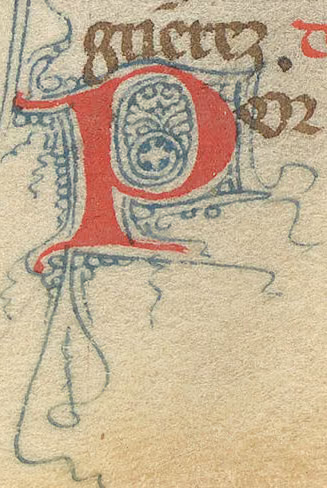 A large, red illuminated capital letter P with blue decorative flourishes and patterns.
Le Regime du corps, 1350
-
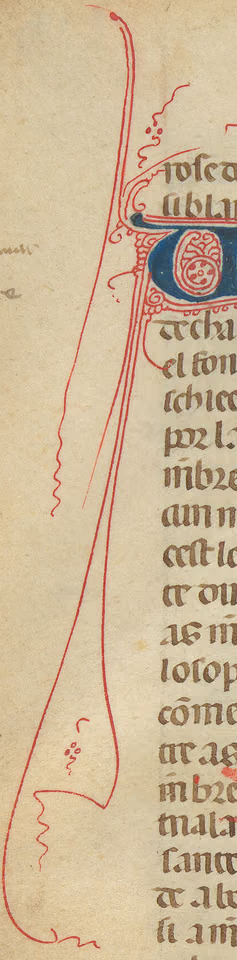 A decorated blue and red initial letter 'L' features intricate red flourishes extending into the left margin.
“Now we will tell you about the stomach.”
Le Regime du corps, 1350
-
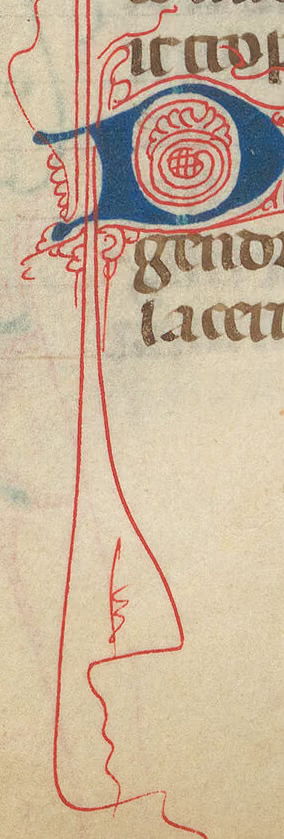 A blue decorative initial D contains red and white circular patterns. Red swirling lines extend from the letter onto the surrounding page.
“Of the heart.”
Le Regime du corps, 1350
-
 A large red initial letter S with white patterns is framed by a decorative border and flourishes in red and blue ink.
“Of the regimen of the liver.”
Le Regime du corps, 1350
-
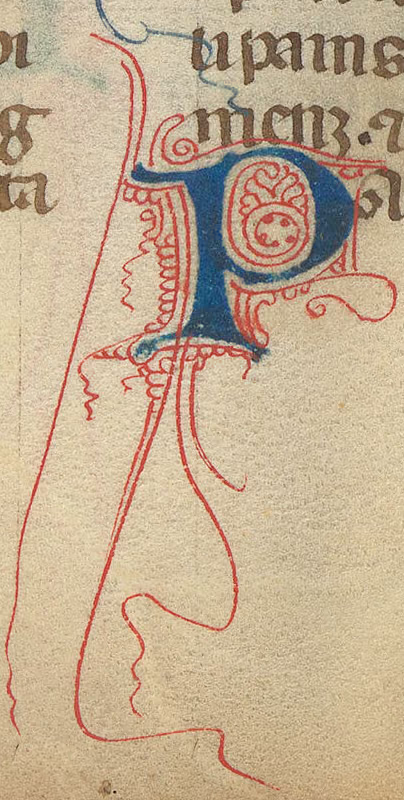 A large blue decorative initial P features red scrollwork. A red line drawing of a human profile extends from the left side of the letter.
“Wheat is a grain temperate by nature above all grains, and its nature is divided by mixing and by the earth where it grows. And one must ensure that it is grown in good earth and clean of all things, and between old and new, and kept in a house where the wind can enter. For the blood that is engendered is more temperate than the others, and the bread is hotter than the wheat, and it depends on the oven. Of bread.”
Le Regime du corps, 1350
-
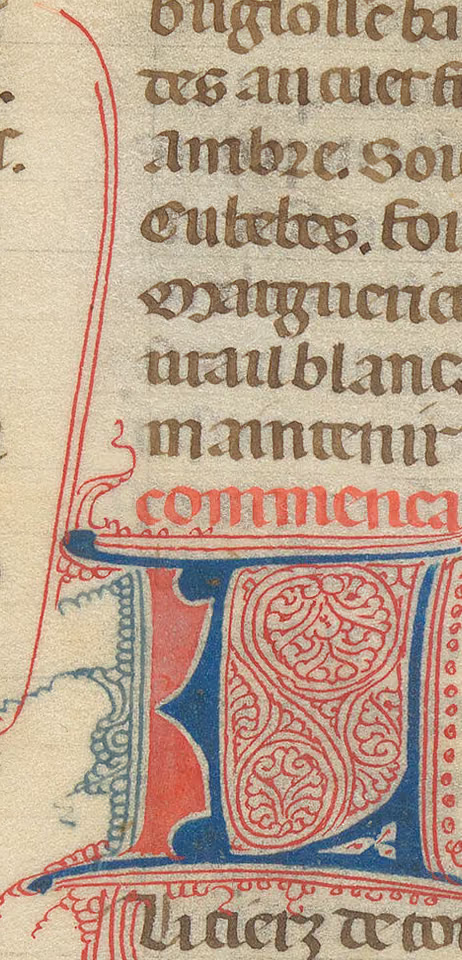 A large, decorated initial letter 'L' in blue and red with intricate scrollwork, surrounded by handwritten text.
“members by the will of our Lord, and the heart is also like a fountain to the other members, and the form of the heart is wide below and sharp above in the manner of a pinecone. And it rests in the body of man inverted. For the head rests towards the feet and the root towards the head, and although it is in the middle of the chest, the head hangs a little more towards the left. And to guard the heart and maintain the body, I will tell you the natural complexion of each. The signs of the naturally hot complexion of the heart are having a hot and hairy chest, and a strong and rapid pulse, and deep breath. And he is bold and fierce of will. They must guard against hot things. The sign of the cold complexion is having a narrow chest, if it does not have faults of other members. That is to say, the heart hot and the brain cold, so that because of the heat of the heart the chest could not be wide, but instead is narrow because of the coldness of the brain, and the pulse small and narrow, and the body slow and fearful, and he will resemble a woman in all ways. The signs of the moist complexion are similar to those of the cold. And if the complexion of the heart is hot and dry, or hot and moist, or cold and dry, or cold and moist, the signs will mix as we have said, and each shall use things according to his natural complexion. And the special medicines for the heart are jet, gold, and silver, bugloss, basil. Hot things for the cold heart are ginger, diamber, silk, saffron, cloves, cubebs, Indian leaf, pearls, marguerites, sandalwood, white coral. These are things to maintain the heart in health. Here begins the second part”
Le Regime du corps, 1350
-
 A red illuminated initial letter 'L' with blue decorative patterns inside and around it.
Le Regime du corps, 1350
-
 A profile of a human face outlined in red and blue ink.
Le Regime du corps, 1350
-
 A decorative red letter 'V' features blue flourishes on its left and a blue ornate pattern inside.
“Wine is divided in many ways according to its substance, and according to whether it is new or old. White, greenish, and clear wine is less hot and makes one urinate well, and those can use it who have a hot liver, and one should use it in summer. Clear and red wine is hotter. Black and thick [wine] is not as hot, but it swells the stomach. And for those who have diarrhea to bind, it is good to use. Sweet, thick, and new wine heats and gives nourishment above all others. Old wine swells and easily corrupts in the body. Wine of one year, or of two, has a nature contrary to that one, but”
Le Regime du corps, 1350
-
 A large blue illuminated letter B contains red decorative patterns and has red filigree extending from its left side.
“Oats and spelt are cold and have a bitter substance, and are worth more to those who are of a hot nature, and to remove illness than to preserve health, and are useful for swelling which comes about through windiness, if one puts them on top, and for those who are hectic and emaciated and wish to fatten up. In this manner, take flour of oats or of spelt and mix it with a decoction of wheat bran with hot water, and with almond milk, and with sugar, and with candy, and with penides, and two egg yolks. And have it cooked in the manner of gruel. And this is good for those who wish to fatten up and who are emaciated due to hot illnesses. Of bran.”
Le Regime du corps, 1350
-
 A decorative red and blue initial letter is surrounded by handwritten text. Blue flourishes extend from the letter into the left margin.
“...not well in the stomach and makes the belly rumble and engenders stones and blocks the pathways of the liver. And if the wheat is hot with milk it makes good blood, and the bread that is worth most is that which cooks soonest in the stomach, provided that it is well leavened and a little salted, this is the best. Of barley.”
Le Regime du corps, 1350
-
 A red illuminated capital letter 'B' with blue and white scrollwork patterns inside its loops, enclosed within a blue decorative border.
“Oats and spelt are cold and have a bitter substance, and are worth more to those who are of a hot nature, and to remove illness than to preserve health, and are useful for swelling which comes about through windiness, if one puts them on top, and for those who are hectic and emaciated and wish to fatten up. In this manner, take flour of oats or of spelt and mix it with a decoction of wheat bran with hot water, and with almond milk, and with sugar, and with candy, and with penides, and two egg yolks. And have it cooked in the manner of gruel. And this is good for those who wish to fatten up and who are emaciated due to hot illnesses. Of bran.”
Le Regime du corps, 1350
-
 An ornate initial letter decorated with red and blue colors and white floral patterns. It is surrounded by delicate blue line work on a page of handwritten text.
“Of apple wine.”
Le Regime du corps, 1350
-
 An illuminated initial letter C decorated with red and blue swirls and patterns.
“Of ale.”
Le Regime du corps, 1350
-
 A red decorative initial letter with blue interior patterns and thin blue flourishes extending to the left and top.
“Of meats.”
Le Regime du corps, 1350
-
 An illuminated red letter 'C' contains blue decorative scrolls. A thin blue flourish extends from the left side of the letter and runs vertically down the page.
“Of ale.”
Le Regime du corps, 1350
-
 A decorative blue initial letter V features red flourishes and a central red circular ornament. It is surrounded by handwritten text.
“Of meats.”
Le Regime du corps, 1350
-
 A large, blue decorated initial 'C' contains red ornate patterns and has thin red decorative lines extending from it.
“Of ale.”
Le Regime du corps, 1350
-
 A large blue initial letter 'C' features intricate red swirls inside. Long, thin red flourishes extend from the letter into the left margin.
Le Regime du corps, 1350
-
 A large, decorative initial letter 'A' in blue and red ink has flowing red and blue flourishes extending into the surrounding text and margins.
“Onions are hot and dry and cause thirst and engender thick humours, and they strengthen the nature for intercourse with a woman, and it is beneficial to make a plaster upon the bite of a rabid dog, and it is good to eat with bad foods to remove the harm. On garlic. Garlic is hot and dry in the beginning of the fourth degree, and removes ventosity and quenches thirst and makes a man lustful, and it is bad for those of a hot nature to use them, because they make the head ache; and when it is cooked and one holds it in their mouth, it assuages the pain of the teeth and clears the voice and removes a heavy cough. On scallions.”
Le Regime du corps, 1350
-
 A red decorative initial 'E' with blue patterns, accompanied by thin blue and red flourishes.
“Garlic is hot and dry in the beginning of the fourth degree, and removes ventosity and quenches thirst and makes a man lustful, and it is bad for those of a hot nature to use them, because they make the head ache; and when it is cooked and one holds it in their mouth, it assuages the pain of the teeth and clears the voice and removes a heavy cough. On scallions.”
Le Regime du corps, 1350
-
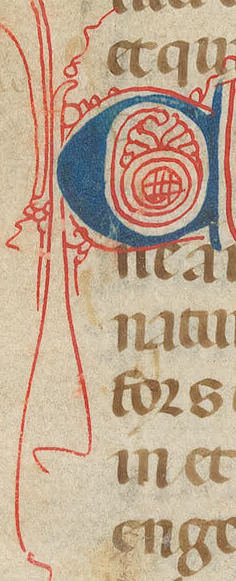 A large, decorated initial letter 'C' has a blue background with red patterns and red flourishing extending into the left margin.
“Goat's meat is cold and dry, and it is not good to use for those who are of cold natures, and one should not use it except when it is young. Meat of fallow deer and stag are cold and dry and engender thick and melancholic blood, but stag meat, when it is young, is better than all. Hare meat is dry and engenders melancholy. On geese.”
Le Regime du corps, 1350
-
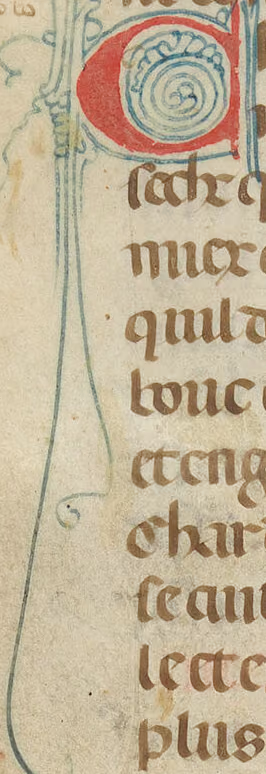 A red and blue decorative initial letter C with ornate swirling patterns on a parchment page.
Le Regime du corps, 1350
-
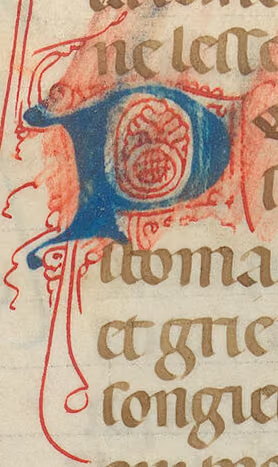 A large blue initial P features a red circular floral design inside its loop and red decorative flourishes extending from the letter.
“Geese are of diverse kinds and engender thick blood and melancholy and bad breath. And the broth, when drunk, is beneficial to those who are bitten by a rabid dog, and the dung, when it is drunk fasting, lets no one get drunk. On leeks.”
Le Regime du corps, 1350
-
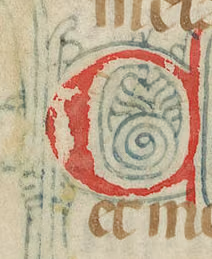 An ornamental initial letter O with a red circular outline and a blue spiral pattern inside.
“Goat's meat is cold and dry, and it is not good to use for those who are of cold natures, and one should not use it except when it is young. Meat of fallow deer and stag are cold and dry and engender thick and melancholic blood, but stag meat, when it is young, is better than all. Hare meat is dry and engenders melancholy. On geese.”
Le Regime du corps, 1350
-
 A decorated initial letter 'O' features a red body with blue stylized leaf patterns in the center and blue flourishes around the edges.
“Goat's meat is cold and dry, and it is not good to use for those who are of cold natures, and one should not use it except when it is young. Meat of fallow deer and stag are cold and dry and engender thick and melancholic blood, but stag meat, when it is young, is better than all. Hare meat is dry and engenders melancholy. On geese.”
Le Regime du corps, 1350
-
 A red initial letter M surrounded by blue swirling decorations.
Le Regime du corps, 1350
-
 An ornate blue initial letter B with red internal and external flourishes.
Le Regime du corps, 1350
-
 A red illuminated initial letter 'E' is decorated with blue swirling patterns inside and around its shape.
Le Regime du corps, 1350
-
 A large blue uppercase letter P decorated with red filigree and a red spiral pattern within its loop.
Le Regime du corps, 1350
-
 A large, decorated initial letter 'L' rendered in red and blue ink with intricate blue filigree patterns, surrounded by gothic script on parchment.
Le Regime du corps, 1350
-
 A decorative blue initial letter 'P' with red flourishes and a red spiral motif inside its loop.
“Fennel is hot and dry in the second degree, and it is valuable to use in all fevers of cold humours, and it breaks the stone of the kidneys and of the bladder. Of parsley.”
Le Regime du corps, 1350
-
 A large, blue decorative initial 'C' surrounded by red pen-flourishing.
“Hyssop is of two Of hyssop. kinds: one grows in gardens, the other in mountains. That of the gardens is hot and dry in the third degree, and it makes for good color, and it is valuable for those who cough and who have a congested chest. Especially whoever drinks waters or figs in which hyssop has been cooked. Of watercress.”
Le Regime du corps, 1350
-
 A large, illuminated blue letter B is decorated with red swirling patterns inside and around its edges. Fine red lines extend from the letter into the left margin.
Le Regime du corps, 1350
-
 A decorative red initial letter B with blue swirling patterns inside its curves.
Le Regime du corps, 1350
-
 An ornate red initial letter O with blue decorative flourishes extending into the left margin.
“nourish themselves in flowing rivers, that breathe pure and healthy air, and are of good flavor. And they should not be too fat, and should have firm flesh. And one must beware of those that are in ponds where there is mud and filth. Those that come out of the sea and go into fresh water are the best, because their flesh is not too fat. And understand generally that all sea fish are better than freshwater fish, because they have firmer flesh; and those that have thick flesh are much better than those that have none. Of eggs.”
Le Regime du corps, 1350
-
 A red illuminated letter 'F' is surrounded by blue ornamental scrollwork and decorative patterns on a parchment background.
“Cheese, according to Isaac, is generally all bad, for it engenders pain in the epigastrium and pain in the sides and stone in the kidneys; and he who eats it fresh, it has the nature of cooling the epigastrium; and the cheese that is best is between old and new, which has a good flavor. Of milk.”
Le Regime du corps, 1350
-
 A large, decorative initial letter 'L' in blue, accented with intricate red swirling patterns, appears on a parchment page with surrounding handwritten text.
“Cheese, according to Isaac, is generally all bad, for it engenders pain in the epigastrium and pain in the sides and stone in the kidneys; and he who eats it fresh, it has the nature of cooling the epigastrium; and the cheese that is best is between old and new, which has a good flavor. Of milk.”
Le Regime du corps, 1350
-
 A blue illuminated initial letter 'L' decorated with red filigree and swirling patterns, with long, thin red lines extending downward.
“Cheese, according to Isaac, is generally all bad, for it engenders pain in the epigastrium and pain in the sides and stone in the kidneys; and he who eats it fresh, it has the nature of cooling the epigastrium; and the cheese that is best is between old and new, which has a good flavor. Of milk.”
Le Regime du corps, 1350
-
 A large, stylized blue capital letter L decorated with red flourishes and fine lines that extend downwards.
“meſtier nen a . De poiure.”
Le Regime du corps, 1350
-
 A red decorated initial letter 'G' contains blue swirling patterns inside the letter and along its borders.
“Cloves are hot and dry in the third degree and have the nature of comforting the virtue of the body, and they destroy windiness and bad humors, and they are valuable to those who have lost their breath in such a manner: take gum tragacanth and have it soaked for a night in barley water, and take cloves and mastic and gum arabic, and make a powder of them, and mix it with the gum tragacanth and make pills of them, and the sick person shall hold them for a long time in his mouth, and use the wine in which cloves will be cooked. And it heats and strengthens the brain. Of galangal.”
Le Regime du corps, 1350
-
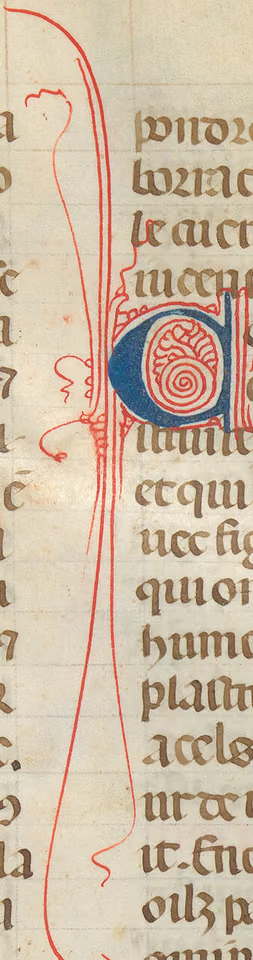 An illuminated blue letter 'C' contains red swirling patterns and is surrounded by thin red decorative flourishes.
“powder of galangal with borage juice, it is valuable to those who have a weak heart, before they eat. Of cumin.”
Le Regime du corps, 1350
-
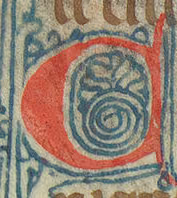 A red illuminated initial letter 'C' decorated with blue swirling patterns inside and around the letter.
Le Regime du corps, 1350
-
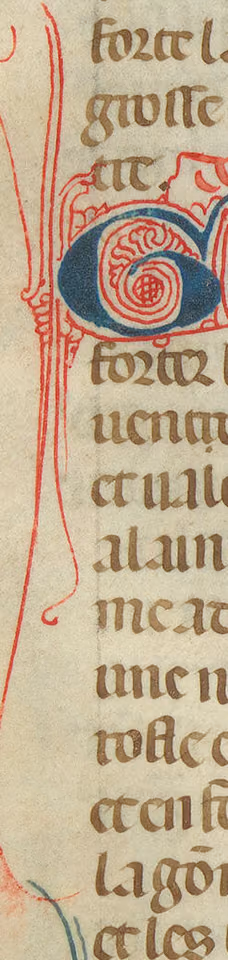 A large, decorative blue letter G containing red and white patterns, with red flourishes extending into the left margin.
“Cinnamon is hot and dry in the second degree, and there are two kinds of it. Milk should be used fasting, and one must not eat afterwards until it has departed from the stomach. Ass's milk is above all others thinner and is valuable to use for those who thick and thin. The thick is not as hot, and grows in India, and one can keep it for sixty years, and it comforts the stomach and the liver and gives the desire to eat, and it comforts the brain and makes good breath. The thick is not as good as the other. Of cloves.”
Le Regime du corps, 1350
-
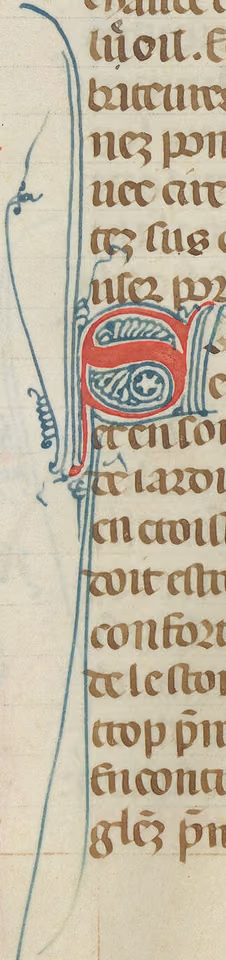 An ornate initial letter 'P' is colored in red and blue, with decorative blue flourishes extending to the left.
Le Regime du corps, 1350
-
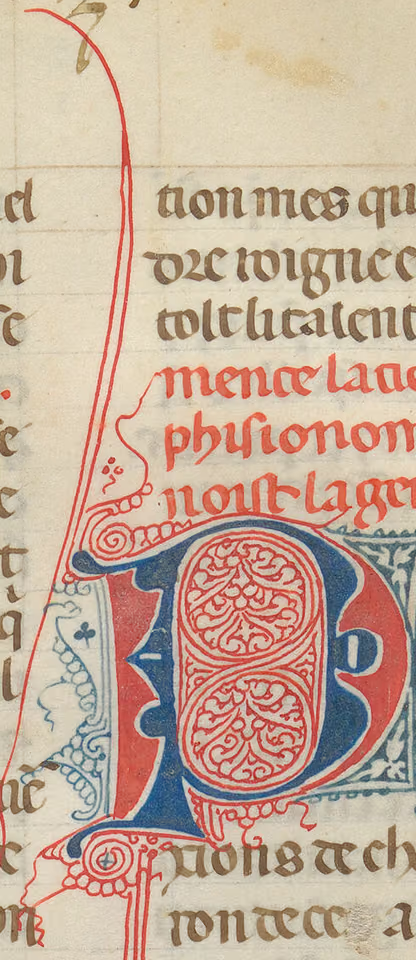 A large, ornate initial letter 'P' is colored in red and blue with intricate patterns inside. It is accompanied by red and blue decorative flourishes on the side and bottom.
“Salt is hot and dry in the first degree and in the second degree, and there are many kinds, but we only use two: that which is made from the sea and is cooked in the heat of the sun, and the other which is made from wells and from ponds, boiling in cauldrons, and in French it is called *sel delice*, and in some countries, saline. And the other must be clear and white and of stones and other things, and gives appetite to eat, and removes abomination, but whoever uses it to excess, it engenders scabies and bad colour, and takes away the desire to use a woman. Here begins the fourth part which is called physiognomy, by which one knows the complexion of man.”
Le Regime du corps, 1350
-
 A large red letter P decorated with blue flourishes.
“Salt is hot and dry in the first degree and in the second degree, and there are many kinds, but we only use two: that which is made from the sea and is cooked in the heat of the sun, and the other which is made from wells and from ponds, boiling in cauldrons, and in French it is called *sel delice*, and in some countries, saline. And the other must be clear and white and of stones and other things, and gives appetite to eat, and removes abomination, but whoever uses it to excess, it engenders scabies and bad colour, and takes away the desire to use a woman. Here begins the fourth part which is called physiognomy, by which one knows the complexion of man.”
Le Regime du corps, 1350
-
 A large, blue initial letter P contains red swirling patterns and is surrounded by red decorative flourishes.
Le Regime du corps, 1350
-
 A decorative initial P in blue and red ink with red scrollwork extending into the left margin, surrounded by brown text.
“Salt is hot and dry in the first degree and in the second degree, and there are many kinds, but we only use two: that which is made from the sea and is cooked in the heat of the sun, and the other which is made from wells and from ponds, boiling in cauldrons, and in French it is called *sel delice*, and in some countries, saline. And the other must be clear and white and of stones and other things, and gives appetite to eat, and removes abomination, but whoever uses it to excess, it engenders scabies and bad colour, and takes away the desire to use a woman. Here begins the fourth part which is called physiognomy, by which one knows the complexion of man.”
Le Regime du corps, 1350
-
 An illuminated red initial P with blue patterns inside and blue flourishes extending into the left margin.
“Salt is hot and dry in the first degree and in the second degree, and there are many kinds, but we only use two: that which is made from the sea and is cooked in the heat of the sun, and the other which is made from wells and from ponds, boiling in cauldrons, and in French it is called *sel delice*, and in some countries, saline. And the other must be clear and white and of stones and other things, and gives appetite to eat, and removes abomination, but whoever uses it to excess, it engenders scabies and bad colour, and takes away the desire to use a woman. Here begins the fourth part which is called physiognomy, by which one knows the complexion of man.”
Le Regime du corps, 1350
-
 A red decorative initial P contains blue swirling patterns.
“Salt is hot and dry in the first degree and in the second degree, and there are many kinds, but we only use two: that which is made from the sea and is cooked in the heat of the sun, and the other which is made from wells and from ponds, boiling in cauldrons, and in French it is called *sel delice*, and in some countries, saline. And the other must be clear and white and of stones and other things, and gives appetite to eat, and removes abomination, but whoever uses it to excess, it engenders scabies and bad colour, and takes away the desire to use a woman. Here begins the fourth part which is called physiognomy, by which one knows the complexion of man.”
Le Regime du corps, 1350
-
 A large, illuminated blue initial 'Q' with red internal patterns is surrounded by brown text. A thin red decorative flourish extends from the initial down the left margin.
“Whoever has dull and large eyes, he must be slow and lazy. And whoever has them swollen and small, he must be malicious and deceitful. And whoever has them strong and large, he is foolish and a great talker and does not fear shame. Whoever has very black pupils is lazy. And whoever has green eyes like a goat is foolish. And whoever has them moving and looks cunningly, he is treacherous, deceitful, and fickle. And whoever has them moving, and who looks steadily at one place, he is wise and crafty. And whoever looks just like a woman and whose eyes laugh readily and who always seems happy in the face, this one must be lecherous and modest and of a long life and of good morals. Whoever has large, big, and trembling eyes, he is slow and of a long life and a lover of women. Whoever has red and burning eyes, he is wicked and of bad habits. Whoever has trembling, small, and green eyes, he is easily angered and is a lover of women. Those who have them green and have them mixed as with the color of saffron, they are of bad habits and of a bad nature. And whoever has them small and prominent, it is a sign of foolishness and of a man who wants to do his own will. And whoever has them deep-set, small, and moving, and whose eyelids close and open readily, he is of a bad and venomous nature. Those that are black, and a little blue-grey, and are neither red nor citrine, but are clear and shining, they are of a good nature and of good habits and wise, for these are the best eyes that exist. Of the eyebrows.”
Le Regime du corps, 1350
-
 A large decorative initial letter Q, colored red with a blue swirling pattern inside. A thin blue flourish extends upwards and to the left from the letter.
Le Regime du corps, 1350
-
 A blue line drawing of a face in profile is in the margin of a page of text. A large, red decorative initial 'Q' with blue details is beside the drawing.
“He who has a large mouth is a great eater and bold. He who has large lips is foolish and sluggish. And if they are poorly colored, it is a sign of illness. He who has small and weak teeth, and they are not thick, it is a sign of weakness and a short life. He who has them long and strong must be a great eater and of an evil nature. Of faces.”
Le Regime du corps, 1350
-
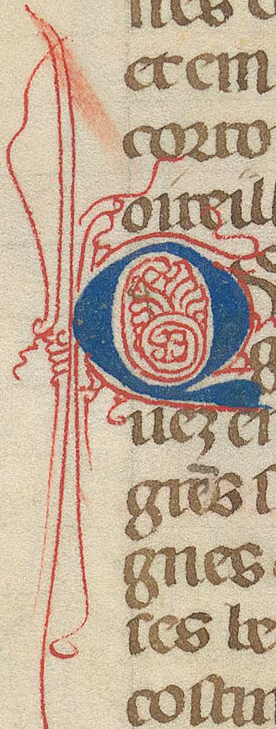 A large, blue illuminated initial letter 'Q' contains red decorative scrollwork and has red tendrils extending from its left side.
“He who laughs willingly.”
Le Regime du corps, 1350
-
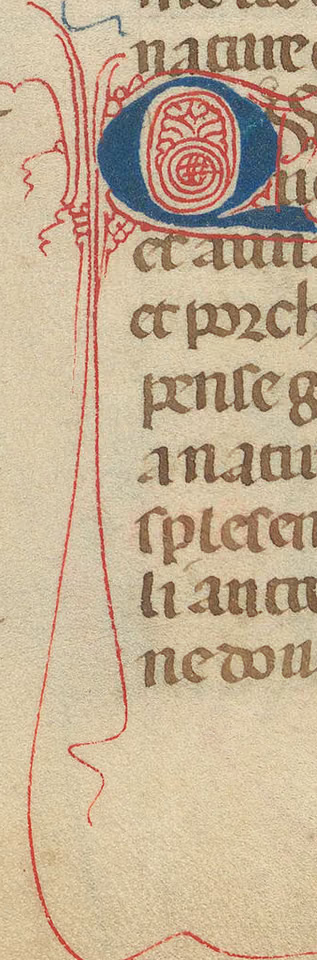 A decorative blue initial letter Q contains a red interlaced pattern and is accompanied by red pen flourishes and Gothic script.
“He who laughs willingly.”
Le Regime du corps, 1350
-
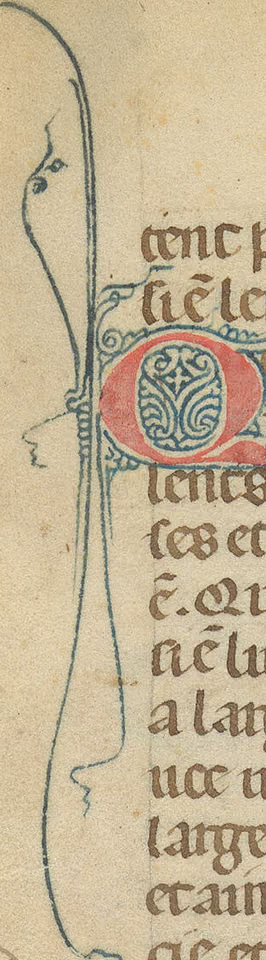 A large, decorated initial letter 'Q' in red and blue, with blue ornamental tendrils extending into the left margin.
Le Regime du corps, 1350
-
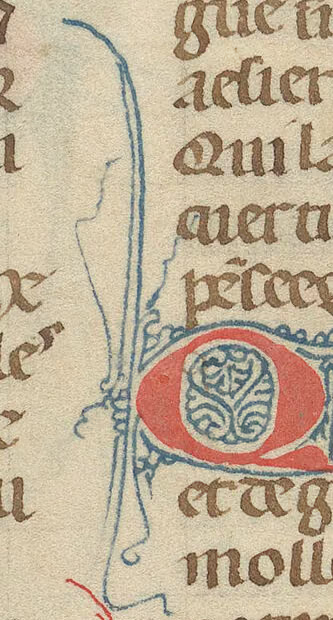 A large, red ornate initial letter 'Q' with a blue decorative pattern inside and blue flourishes extending to the left, set amidst brown text on a parchment background.
Le Regime du corps, 1350
-
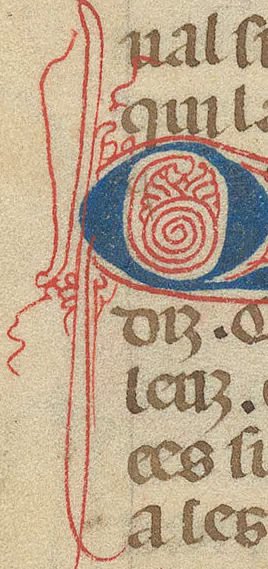 A decorated initial letter 'Q' contains a blue oval with a red spiral pattern and red flourishes extending from its stem.
“hang down toward the temples is sluggish and shameless. Of the nostrils.”
Le Regime du corps, 1350
-
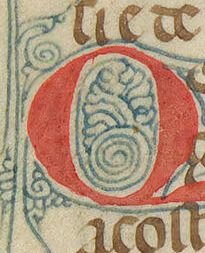 A red illuminated initial letter 'Q' containing a blue and grey spiral pattern and surrounded by blue decorative scrollwork.
Le Regime du corps, 1350
-
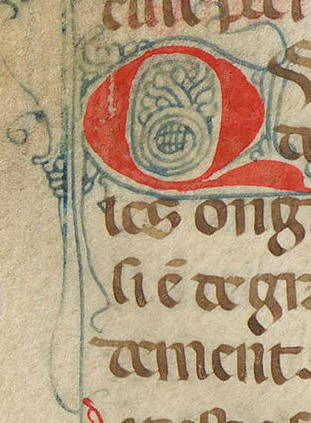 A red illuminated letter Q with blue decorative swirls is surrounded by handwritten brown text.
Le Regime du corps, 1350
-
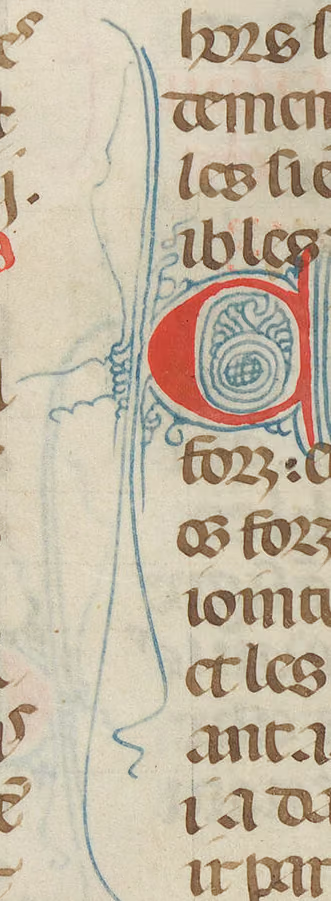 A large decorative initial letter 'Q' is rendered in red and blue ink. The interior of the letter contains a blue circular scroll pattern, and thin blue flourishes extend from its left side.
Le Regime du corps, 1350
-
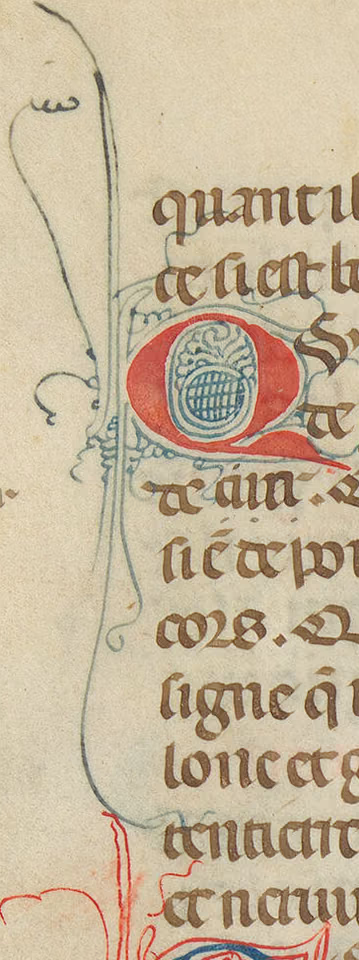 A page of a medieval manuscript features handwritten text and decorated red and blue initials. A large red letter 'Q' has a blue patterned center and decorative flourishes.
Le Regime du corps, 1350
-
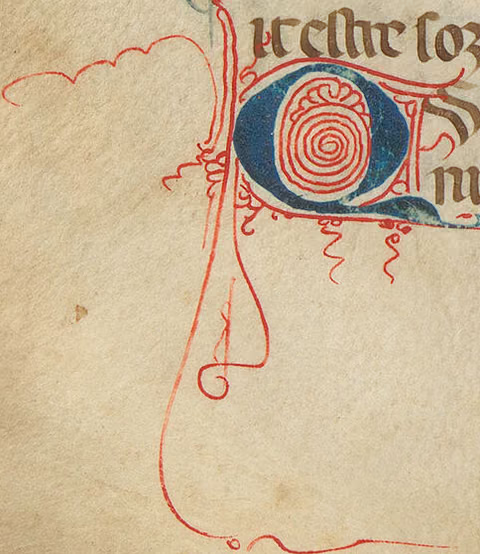 A blue illuminated initial letter Q features a red spiral in its center. Red decorative flourishes extend from the letter into the left margin of the page.
“when he laughs and forcefully catches his breath, he is boastful. Of walking.”
Le Regime du corps, 1350
-
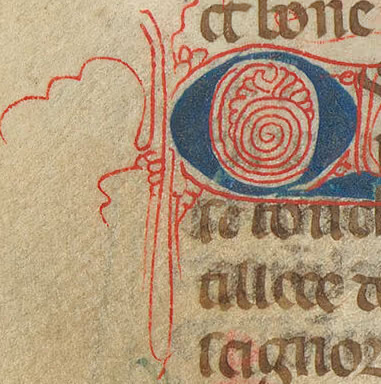 An ornate blue initial 'Q' with a red spiral pattern inside. Red flourishing extends from the left, and the initial is surrounded by handwritten Gothic text.
“when he laughs and forcefully catches his breath, he is boastful. Of walking.”
Le Regime du corps, 1350
-
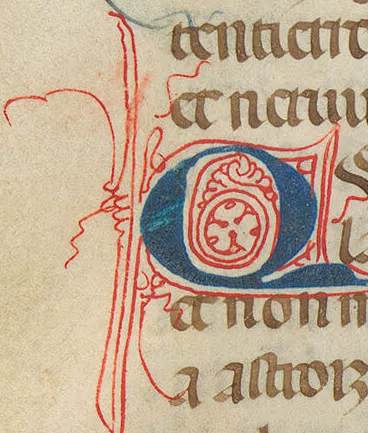 A blue illuminated initial 'Q' contains a red circular pattern and has red decorative flourishes extending into the left margin.
Le Regime du corps, 1350
-
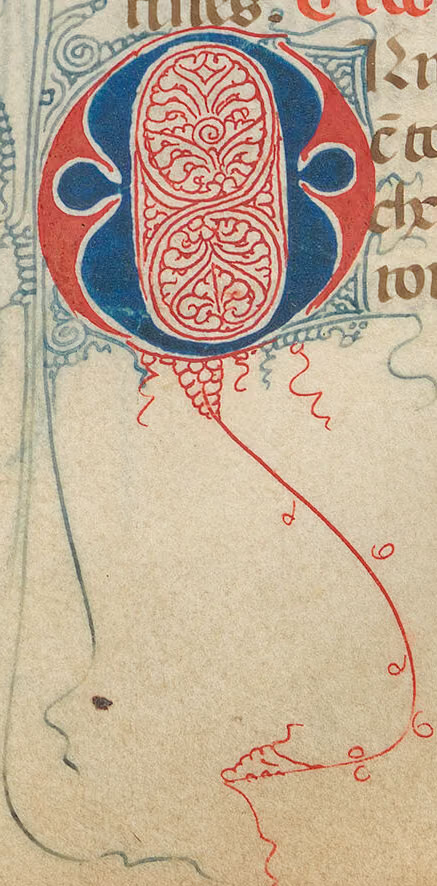 A large, decorated initial 'O' in red and blue contains intricate red scrollwork. Below the letter, a line drawing of a person's profile is connected to the 'O' by thin red lines.
“Here begin the urines.”
Le Regime du corps, 1350
-
 A large red initial letter 'C' is filled with blue swirling patterns. It is adorned with blue floral motifs and surrounded by handwritten text in brown ink.
“This is the book that Hippocrates sent to Caesar, the emperor of Rome. Rubric.”
Le Regime du corps, 1350
-
 A large blue initial letter decorated with red patterns is surrounded by red flourishes on the left and Gothic script text on the right.
Le Regime du corps, 1350
-
 A large, decorated initial letter 'C' in blue and red with red flourishes extending into the margin.
Le Regime du corps, 1350
-
 A large red initial letter 'I' is surrounded by blue and red decorative borders and light blue flourishes. Gothic script text appears around the letter.
Le Regime du corps, 1350
-
 An illuminated initial letter C, blue with red floral patterns inside and red decorative flourishes on the left.
“This is the book that Hippocrates sent to Caesar, the emperor of Rome. Rubric.”
Le Regime du corps, 1350
-
 A monogram of interlaced letters inside a wreath of leaves and flowers tied with a ribbon at the bottom.
De medicis poetis dissertatio, 1669
-
 An ornate capital letter P is filled and surrounded by decorative floral patterns and flourishes.
De medicis poetis dissertatio, 1669
-
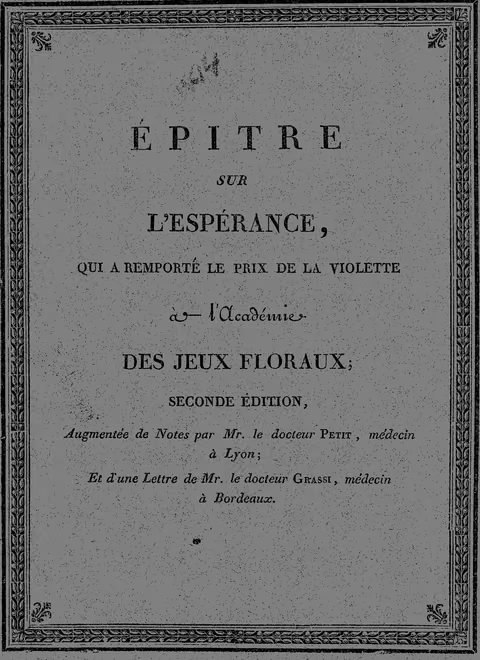 A title page with a decorative rectangular border containing French text, including the title 'ÉPITRE SUR L'ESPÉRANCE' and 'DES JEUX FLORAUX'.
“Epistle on Hope, which won the Prize of the Violet at the Academy of the Floral Games;”
Épître au docteur Alfred G***, sur l'espérance, 1811
-
 A floral ornament consisting of flowers and leaves arranged in a horizontal cluster.
Épître au docteur Alfred G***, sur l'espérance, 1811
-
 An open book is shown as a simple line drawing.
Le Parnasse médical français, 1874
-
 Two figures stand on either side of a large basin, pouring liquid from a vessel into it, all contained within a large ornamental letter Q.
In interpretationem Galeni super quatuordecim aphorismos Hippocratis dialogus, 1547
-
 A hand points its index finger upward and to the right.
In interpretationem Galeni super quatuordecim aphorismos Hippocratis dialogus, 1547
-
 A hand-drawn pointing hand points to the right.
In interpretationem Galeni super quatuordecim aphorismos Hippocratis dialogus, 1547
-
 A hand with its index finger pointing upwards and to the right.
In interpretationem Galeni super quatuordecim aphorismos Hippocratis dialogus, 1547
-
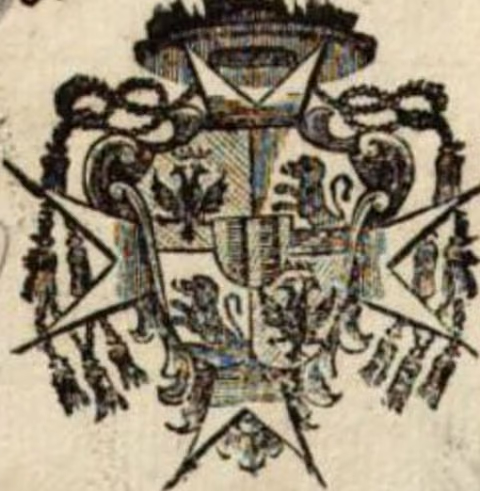 A coat of arms features a quartered shield with eagles and lions, positioned over a Maltese cross and topped with a crown.
Coena, sive De cibariorum virtutibus, 1649
-
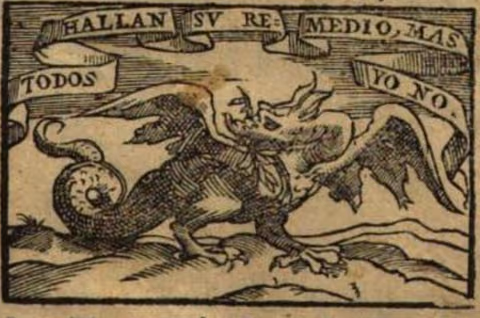 A winged creature with a coiled tail crouches on a landscape. Ribbons with the text 'HALLAN SV RE MEDIO, MAS TODOS YO NO' float around it.
“ALL FIND THEIR REMEDY, BUT I DO NOT.”
Coena, sive De cibariorum virtutibus, 1649
-
 A decorative headpiece features repeating symmetrical patterns of floral and scrollwork designs.
Coena, sive De cibariorum virtutibus, 1649
-
 A decorative initial letter N is surrounded by ornate foliage and leafy vines.
Coena, sive De cibariorum virtutibus, 1649
-
 An ornate initial letter I is surrounded by curling foliage and vines. Two birds perch on the foliage, one on each side of the letter.
Coena, sive De cibariorum virtutibus, 1649
-
 A symmetrical, black decorative ornament with ornate floral and foliate patterns arranged in a cross-like shape.
Coena, sive De cibariorum virtutibus, 1649
-
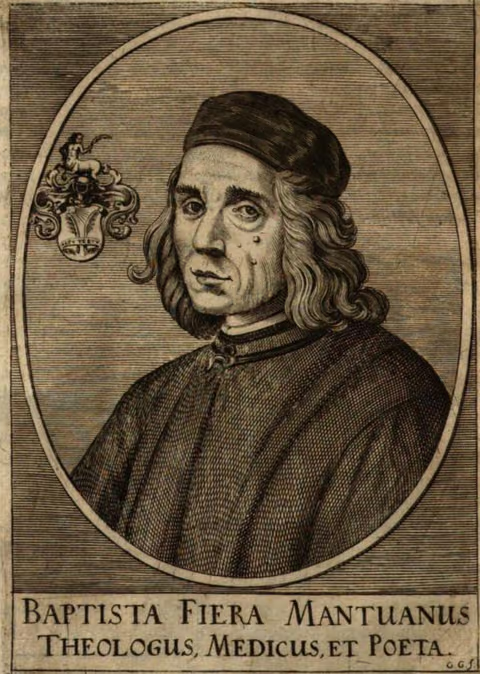 Baptista Fiera Mantuanus is depicted in an oval frame, wearing a dark cap and robe. He has shoulder-length curly hair and a coat of arms appears to his left.
“Battista Fiera of Mantua Theologian, Physician, and Poet.”
Coena, sive De cibariorum virtutibus, 1649
-
 A decorative capital letter 'A' is entwined with floral and leafy patterns.
Coena, sive De cibariorum virtutibus, 1649
-
 A large, ornate, black capital letter 'B' is printed on aged, yellowish paper.
“B. Stag. 72.”
Coena, sive De cibariorum virtutibus, 1649
-
 A symmetrical black decorative ornament consists of scrolling foliage and curved tendrils that extend from a central vertical element.
Coena, sive De cibariorum virtutibus, 1649
-
 An ornate initial letter Q surrounded by and filled with decorative foliage and swirls.
Coena, sive De cibariorum virtutibus, 1649
-
 An ornate initial letter 'V' is decorated with swirling, leaf-like patterns and flourishes.
Coena, sive De cibariorum virtutibus, 1649
-
 A symmetrical black decorative ornament features scrolling floral and leaf patterns arranged in a cross-like shape.
Coena, sive De cibariorum virtutibus, 1649
-
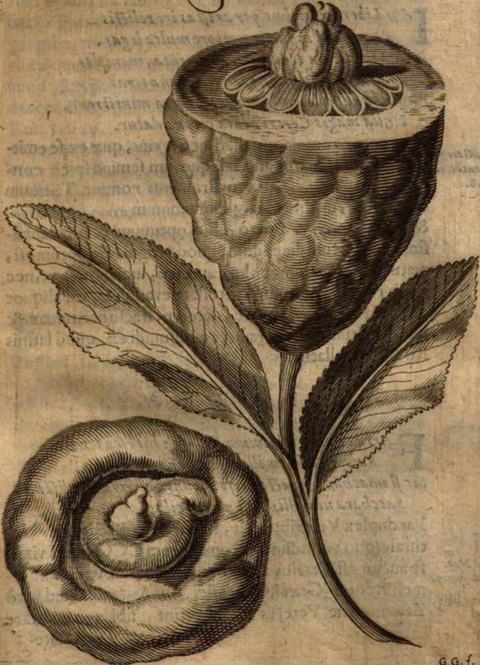 A Malum Limonium Prægnans on a stem with two leaves. A small figure rests inside the top of the fruit, and another curled figure is visible inside a section of fruit below.
“Pregnant Lemon.”
Coena, sive De cibariorum virtutibus, 1649
-
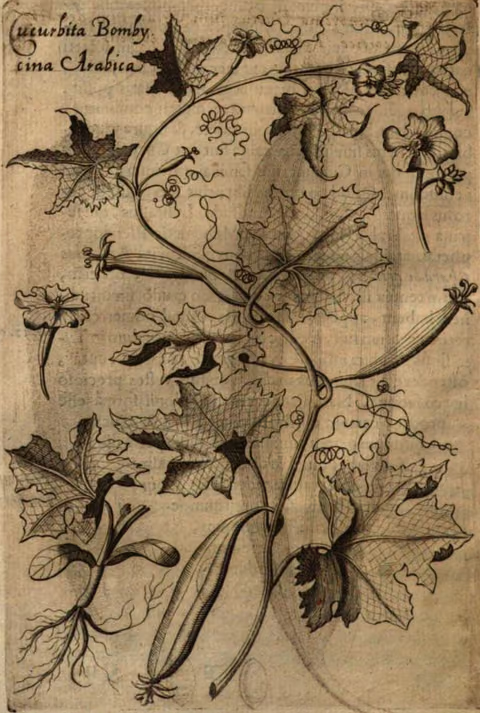 An Arabian silken gourd plant features large lobed leaves, small flowers, and long, slender gourds. The root system is visible at the base of the stem.
“Arabian silken gourd”
Coena, sive De cibariorum virtutibus, 1649
-
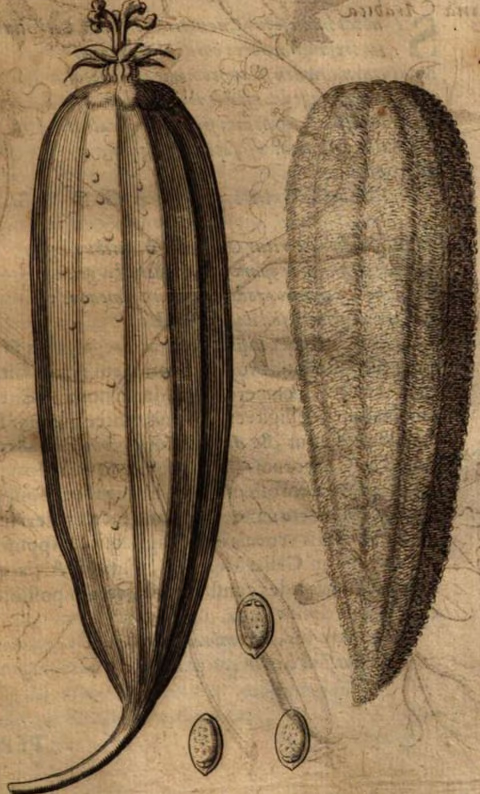 Two fruits of the silken gourd, one ribbed and one fuzzy, are shown alongside three small seeds.
“Fruit of the silken gourd, both green, and, with the rind removed, showing only the network.”
Coena, sive De cibariorum virtutibus, 1649
-
 Rounded, organic shapes surround a central ornamental flourish, with the word PANIS below.
“BREAD”
Coena, sive De cibariorum virtutibus, 1649
-
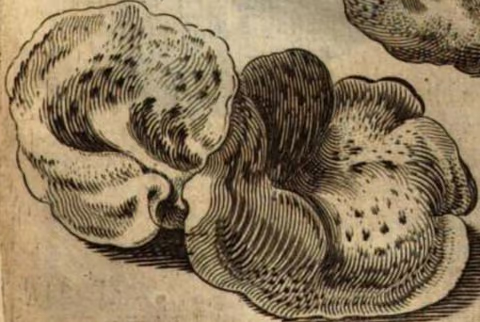 Three illustrations of Fungus Lyncurius, showing irregularly shaped, fleshy fungi with textured surfaces.
“Fungus Lyncurius”
Coena, sive De cibariorum virtutibus, 1649
-
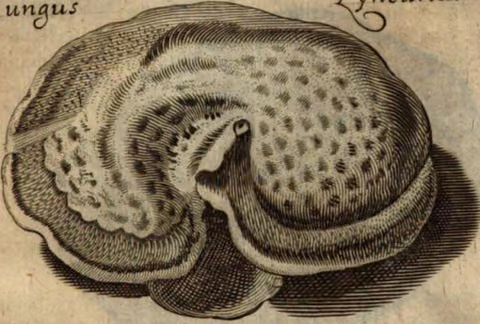 Three specimens of Fungus Lyncurius are shown with textured, irregular shapes.
“Fungus Lyncurius”
Coena, sive De cibariorum virtutibus, 1649
-
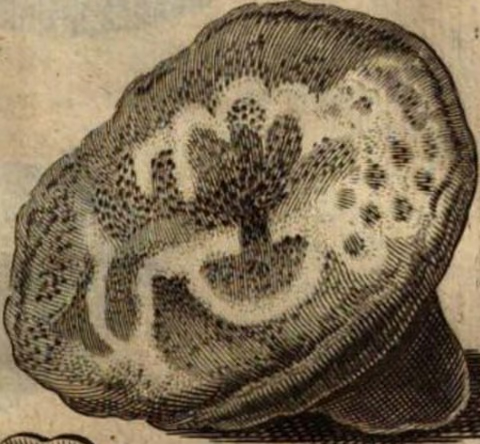 Three Fungus Lyncurius with textured, bumpy surfaces and irregular shapes.
“Fungus Lyncurius”
Coena, sive De cibariorum virtutibus, 1649
-
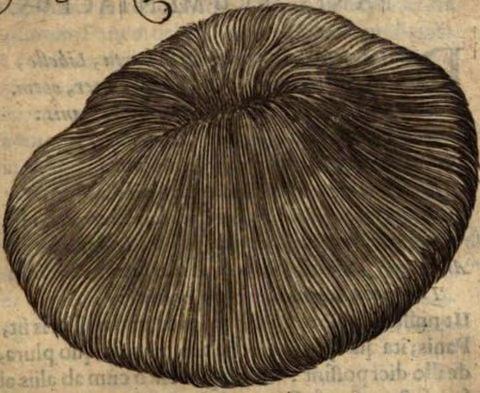 Three stony mushrooms from the Red Sea exhibit rounded shapes with fine, radiating ridges on their surfaces.
“Stony Mushroom from the Red Sea.”
Coena, sive De cibariorum virtutibus, 1649
-
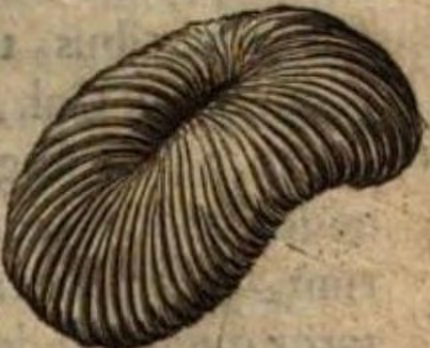 Three stony mushrooms from the Red Sea are shown with ribbed, rounded shapes.
“Stony Mushroom from the Red Sea.”
Coena, sive De cibariorum virtutibus, 1649
-
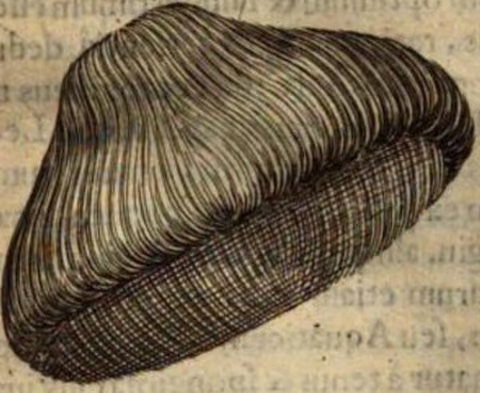 Three rounded, ribbed Stony Mushrooms from the Red Sea are shown in different sizes.
“Stony Mushroom from the Red Sea.”
Coena, sive De cibariorum virtutibus, 1649
-
 A symmetrical decorative ornament featuring swirling, foliate curves in the center and repeating curved lines and dots on each side.
Coena, sive De cibariorum virtutibus, 1649
-
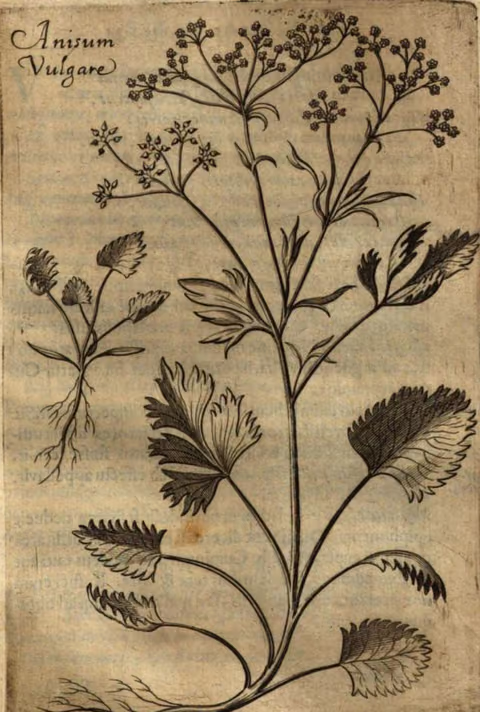 Anisum Vulgare is depicted as a plant with several stems, serrated leaves, and umbrella-like clusters of small flowers. A smaller illustration of its roots and leaves appears to the left.
“Common Anise”
Coena, sive De cibariorum virtutibus, 1649
-
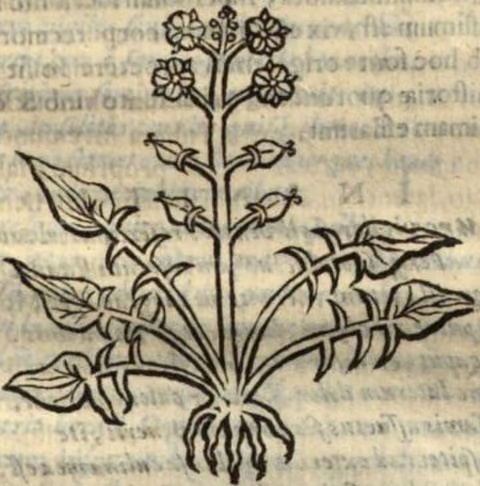 Tuberonia is a plant with a root system, leaves along its stem, and a cluster of flowers at the top.
“T U B E R O N I A.”
Coena, sive De cibariorum virtutibus, 1649
-
 An ornamental capital letter N entwined with decorative leaves and vines.
Coena, sive De cibariorum virtutibus, 1649
-
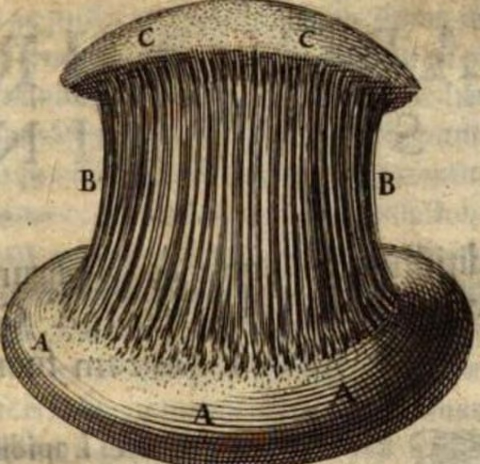 Two illustrations depict a FUNGIMAPPA, one with its cap intact and one with its cap removed.
“FUNGIMAPPA With its cap intact FUNGIMAPPA With its cap removed A A The underlying small stone, the site for the growing organism B B The rising stalks C C The superimposed cloth D D The small stone underlying the vegetation E E The stalks deprived of their cloth, and therefore leaning over.”
Coena, sive De cibariorum virtutibus, 1649
-
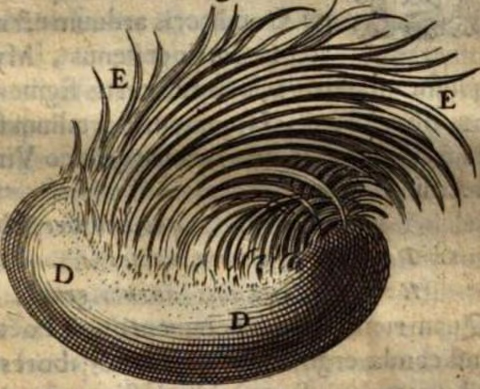 Two illustrations of a FUNGIMAPPA are shown. One depicts the object with a cap and stalks on a small stone, and the other shows stalks leaning over a small stone without a cap.
“FUNGIMAPPA With its cap intact FUNGIMAPPA With its cap removed A A The underlying small stone, the site for the growing organism B B The rising stalks C C The superimposed cloth D D The small stone underlying the vegetation E E The stalks deprived of their cloth, and therefore leaning over.”
Coena, sive De cibariorum virtutibus, 1649
-
 An ornate capital letter G is decorated with elaborate swirling leaves and floral motifs.
Coena, sive De cibariorum virtutibus, 1649
-
 A decorative floral border surrounds the word 'FINIS.'.
“THE END.”
Coena, sive De cibariorum virtutibus, 1649
-
 A decorative capital letter A is entwined with ornate floral scrolls and foliage.
“A.”
Coena, sive De cibariorum virtutibus, 1649
-
 An ornate initial letter 'A' is surrounded by intricate floral and leaf patterns.
Coena, sive De cibariorum virtutibus, 1649
-
 A small symmetrical ornament of four dolphin-like creatures curved inwards in pairs, entwined with ribbons, with floral sprigs at the corners.
Neuropathia: sive de morbis hypochondriacis et hystericis libri tres, poema medicum, 1740
-
 A symmetrical, ornate, heart-shaped decorative ornament with scrolling floral and leaf motifs.
Neuropathia: sive de morbis hypochondriacis et hystericis libri tres, poema medicum, 1740
-
 A symmetrical decorative ornament features four dolphin-like creatures curved inwards in pairs, entwined with ribbons and adorned with floral elements at the corners.
Neuropathia: sive de morbis hypochondriacis et hystericis libri tres, poema medicum, 1740
-
 A floral branch with several open flowers and leaves.
Hygieine, sive ars sanitatem conservandi, 1771
-
 A large capital letter G with a worn, mottled surface, at the start of the dedication.
Hygieine, sive ars sanitatem conservandi, 1771
-
 A horizontal ornamental band features geometric interlace patterns and symmetrical floral motifs.
Hygieine, sive ars sanitatem conservandi, 1771
-
 A symmetrical floral ornament with curved lines and leaf-like shapes.
Hygieine, sive ars sanitatem conservandi, 1771
-
 A decorative horizontal border consists of repeating ornate curved patterns.
Hygieine, sive ars sanitatem conservandi, 1771
-
 A symmetrical decorative ornament with curling stems, leaves, and small floral clusters.
Hygieine, sive ars sanitatem conservandi, 1771
-
 Symmetrical foliage, including curved fronds and leafy branches, is interwoven with winding ribbons.
“HYGIENE OR THE ART OF PRESERVING HEALTH.”
Hygieine, sive ars sanitatem conservandi, 1771
-
 A bouquet of roses and other flowers with a cluster of grapes hanging from vines and leaves.
Hygieine, sive ars sanitatem conservandi, 1771
-
 A decorative horizontal border consists of three rows of repeating black patterns. The top and bottom rows feature star-shaped motifs, and the middle row contains smaller floral patterns.
Hygieine, sive ars sanitatem conservandi, 1771
-
 A decorative horizontal border consisting of three rows of repeating geometric and floral-like patterns.
Hygieine, sive ars sanitatem conservandi, 1771
-
 A large capital letter 'N' is printed in black ink on off-white paper.
Hygieine, sive ars sanitatem conservandi, 1771
-
 A cluster of flowers, leaves, and rounded fruits is arranged in a decorative bunch.
Hygieine, sive ars sanitatem conservandi, 1771
-
 A horizontal decorative band contains repeating symmetrical foliate motifs and geometric diamond patterns.
Hygieine, sive ars sanitatem conservandi, 1771
-
 A bunch of grapes hangs from a vine with leaves. The word "Caron" is written on the stem.
Hygieine, sive ars sanitatem conservandi, 1771
-
 A rectangular decorative headpiece features repeating floral motifs on the top and bottom borders and a central band of geometric diamond patterns.
Hygieine, sive ars sanitatem conservandi, 1771
-
 A decorative branch of leaves and flowers stretches horizontally.
“End of the Fifth Book.”
Hygieine, sive ars sanitatem conservandi, 1771
-
 A horizontal decorative border consisting of three rows of repeating floral and star-like patterns.
Hygieine, sive ars sanitatem conservandi, 1771
-
 A cluster of grapes with a leaf and a winding tendril.
Hygieine, sive ars sanitatem conservandi, 1771
-
 A horizontal decorative border features meander patterns along the top and bottom edges. The center consists of two rows of small loops and a middle row of stars.
Hygieine, sive ars sanitatem conservandi, 1771
-
 A cylindrical stone tower with battlements stands on a mound. Several trees grow around the tower on the uneven terrain.
Hygieine, sive ars sanitatem conservandi, 1771
-
 An ornate initial letter C contains figures of a winged person and a winged creature amidst decorative foliage.
Nicandri Theriaca, interprete Ioannis Gorraeo parisiensi, 1622
-
 A wide decorative banner features symmetrical scrollwork entwined with various fantastical creatures, including serpents, winged animals, and small human figures.
Nicandri Theriaca, interprete Ioannis Gorraeo parisiensi, 1622
-
 A decorative frieze depicts half-human half-animal figures entwined in elaborate floral scrolls and foliage.
Nicandri Theriaca, interprete Ioannis Gorraeo parisiensi, 1622
-
 A decorative capital letter P is entwined with leaves and round flowers.
“NICANDER'S THERIACA. NICANDER'S THERIACA, Translated by Jean de Gorris of Paris.”
Nicandri Theriaca, interprete Ioannis Gorraeo parisiensi, 1622
-
 An ornate capital letter E is decorated with leaves and flowers.
Nicandri Theriaca, interprete Ioannis Gorraeo parisiensi, 1622
-
 A symmetrical decorative ornament featuring a central female face flanked by two curved swan-like necks and surrounded by elaborate foliage and floral patterns.
Nicandri Theriaca, interprete Ioannis Gorraeo parisiensi, 1622
-
 A decorative initial letter 'T' embellished with intricate floral scrolls, vines, and small berry clusters.
“ON THE THERIACA OF NICANDER Annotations of Jean de Gorris.”
Nicandri Theriaca, interprete Ioannis Gorraeo parisiensi, 1622
-
 A decorative horizontal band features symmetrical scrolling foliage and various figures, including a horse on the left, a lion on the right, and several seated human figures in the center.
“ON THE THERIACA OF NICANDER Annotations of Jean de Gorris.”
Nicandri Theriaca, interprete Ioannis Gorraeo parisiensi, 1622
-
 A symmetrical ornament features a central human face with two curved swans above it. The composition is surrounded by elaborate scrolls, foliage, and floral patterns.
Nicandri Theriaca, interprete Ioannis Gorraeo parisiensi, 1622
-
 An ornate initial letter A is surrounded by intricate floral and leaf scrollwork.
Nicandri Theriaca, interprete Ioannis Gorraeo parisiensi, 1622
-
 A symmetrical decorative border features mythical creatures, reclining human figures, and ornate swirling foliage.
Nicandri Theriaca, interprete Ioannis Gorraeo parisiensi, 1622
-
 An ornate symmetrical headpiece featuring swirling vines and foliage. It depicts mirrored faces in the center, two reclining figures, and mythical creatures on the far left and right.
Nicandri Theriaca, interprete Ioannis Gorraeo parisiensi, 1622
-
 An ornate letter S is surrounded by intricate swirling foliate patterns and contains a small star-like emblem in its lower curve.
Nicandri Theriaca, interprete Ioannis Gorraeo parisiensi, 1622
-
 A decorative letter E is surrounded by leaves and flowers.
Nicandri Theriaca, interprete Ioannis Gorraeo parisiensi, 1622
-
 A human face is centered within a symmetrical arrangement of ornate foliage and scrolling patterns. Two serpent-like creatures emerge from the top of the head and curve outwards.
Nicandri Theriaca, interprete Ioannis Gorraeo parisiensi, 1622
-
 A decorative capital letter A is surrounded by leaves and flowers.
Nicandri Theriaca, interprete Ioannis Gorraeo parisiensi, 1622
-
 An ornamental band features symmetrical floral scrolls and hybrid creatures with humanoid bodies and animal tails.
Nicandri Theriaca, interprete Ioannis Gorraeo parisiensi, 1622
-
 A female face is centered in a symmetrical, ornate design featuring scrolling leaves and floral motifs. Two swan-like heads emerge from the top, flanking a fan-shaped ornament.
Nicandri Theriaca, interprete Ioannis Gorraeo parisiensi, 1622
-
 A decorative initial letter N entwined with floral vines and leaves and featuring two small hares.
Nicandri Theriaca, interprete Ioannis Gorraeo parisiensi, 1622
-
 An ornate horizontal border features various mythological figures and creatures interspersed with swirling foliage and scrolls.
“JEAN DE GORRIS'S APOLOGY CONCERNING THE SEA HARE TO GUILLAUME RONDELET.”
Nicandri Theriaca, interprete Ioannis Gorraeo parisiensi, 1622
-
 A human head with a crown and two snakes emerging from the top is flanked by large wings and set atop a decorative floral base.
Nicandri Theriaca, interprete Ioannis Gorraeo parisiensi, 1622
-
 A rectangular decorative headpiece consisting of two rows of repeating floral motifs.
De poetis medicis S. Scripturae interpretibus commentariolus, 1743
-
 Two rows of repeating floral motifs arranged in horizontal bands.
De poetis medicis S. Scripturae interpretibus commentariolus, 1743
-
 Two rows of repeating stylized floral ornaments.
“ON PHYSICIAN POETS INTERPRETERS OF SACRED SCRIPTURE A BRIEF COMMENTARY.”
De poetis medicis S. Scripturae interpretibus commentariolus, 1743
-
 A large, decorative, calligraphic initial letter with intricate swirls and flourishes.
De poetis medicis S. Scripturae interpretibus commentariolus, 1743
-
 An ornate, swirling black decorative ornament consists of calligraphic curls and shapes.
De poetis medicis S. Scripturae interpretibus commentariolus, 1743
-
 A decorative, ornate initial letter A is rendered in black ink with complex scrolls and flourishes.
De poetis medicis S. Scripturae interpretibus commentariolus, 1743
-
 A decorative initial letter featuring ornate swirls and floral patterns.
De poetis medicis S. Scripturae interpretibus commentariolus, 1743
-
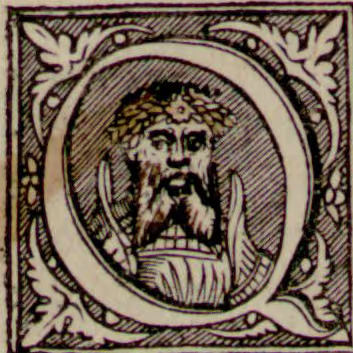 A bearded man wearing a laurel wreath and armor is pictured inside a decorative initial letter Q. The letter is surrounded by leaf patterns.
Poemata, 1561
-
 An ornate capital letter Q.
Poemata, 1561
-
 A decorative initial letter C contains a bird surrounded by leafy ornaments.
Sanitatis tuendae methodus, 1561
-
 A child wrestles a serpent inside a large letter E.
Sanitatis tuendae methodus, 1561
-
 A decorative initial letter Q contains a coiled, scaly creature with an open mouth.
Sanitatis tuendae methodus, 1561
-
 An ornate capital letter 'C' featuring floral patterns inside and surrounding it, all enclosed within a square frame.
Sanitatis tuendae methodus, 1561
-
 A large, decorative capital letter P is embellished with floral and leaf motifs.
Sanitatis tuendae methodus, 1561
-
 A complex, interlaced knot design within an oval shape consists of symmetric, weaving lines.
“F I N I S.”
Sanitatis tuendae methodus, 1561
-
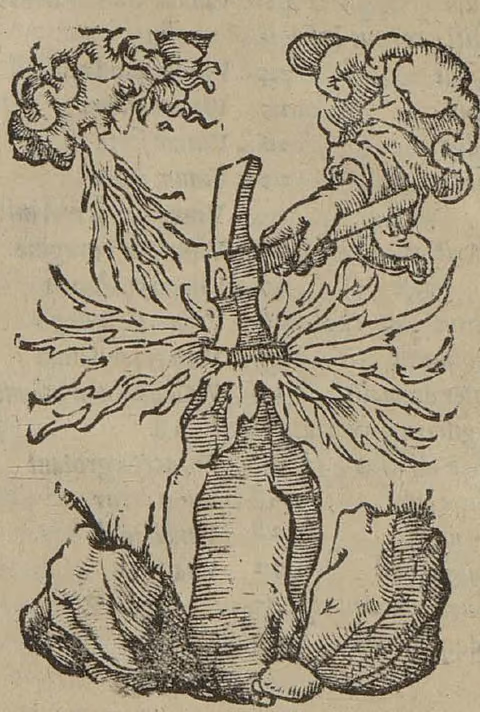 A hand emerging from a cloud strikes an anvil with a hammer. Sparks fly from the anvil, which rests on a rocky mound.
Sanitatis tuendae methodus, 1561
-
 A rose flower with several layers of petals grows from a thorny stem with two jagged leaves.
“——May she make you a parent with beautiful offspring.”
Callipaedia, seu de pulchrae prolis habendae ratione, poema didacticon, 1708
-
 A decorative uppercase letter D is enclosed in a square border. Floral motifs and scrolling patterns fill the interior and surround the letter.
Callipaedia, seu de pulchrae prolis habendae ratione, poema didacticon, 1708
-
 A horizontal decorative border features three rows of repeating patterns, with floral motifs in the middle row and scrolling designs in the top and bottom rows.
Callipaedia, seu de pulchrae prolis habendae ratione, poema didacticon, 1708
-
 A basket of flowers rests on an ornate pedestal with scrolling foliage and floral accents.
Callipaedia, seu de pulchrae prolis habendae ratione, poema didacticon, 1708
-
 A decorative horizontal banner consisting of three rows of repeating floral and leaf-like patterns.
“The Printer to the Reader.”
Callipaedia, seu de pulchrae prolis habendae ratione, poema didacticon, 1708
-
 A decorated initial letter E with scrolls and small flowers, set on a ground of fine horizontal lines within a square frame.
“The Printer to the Reader.”
Callipaedia, seu de pulchrae prolis habendae ratione, poema didacticon, 1708
-
 An ornate capital letter P is decorated with floral and scroll motifs within a square border.
Callipaedia, seu de pulchrae prolis habendae ratione, poema didacticon, 1708
-
 A horizontal band of acorns: a row of upright acorns above a row of hanging acorns, joined by two lines of small scrolls.
Callipaedia, seu de pulchrae prolis habendae ratione, poema didacticon, 1708
-
 A decorative horizontal band featuring symmetrical scrolling foliage and floral patterns.
Callipaedia, seu de pulchrae prolis habendae ratione, poema didacticon, 1708
-
 A decorated initial letter Q frames a face with a radiant headdress. Scrollwork fills the square frame around the letter.
Callipaedia, seu de pulchrae prolis habendae ratione, poema didacticon, 1708
-
 A horizontal decorative band with repeating symmetrical floral patterns and swirling scrolls.
“CLAUDE QUILLET'S CALLIPAEDIA BOOK ONE.”
Callipaedia, seu de pulchrae prolis habendae ratione, poema didacticon, 1708
-
 A basket filled with flowers rests on an ornate pedestal decorated with scrolls and foliage.
Callipaedia, seu de pulchrae prolis habendae ratione, poema didacticon, 1708
-
 Three horizontal bands feature repeating patterns of stylized leaves and floral motifs.
Callipaedia, seu de pulchrae prolis habendae ratione, poema didacticon, 1708
-
 An ornate capital letter 'S' is centered within a square border and surrounded by swirling floral motifs. The background features thin horizontal lines.
Callipaedia, seu de pulchrae prolis habendae ratione, poema didacticon, 1708
-
 Nine stylized floral motifs are arranged in three rows, with four in the top row, three in the middle, and two in the bottom row.
Callipaedia, seu de pulchrae prolis habendae ratione, poema didacticon, 1708
-
 A decorative capital letter 'E' is enclosed within a square frame. The letter and the background are adorned with ornate floral and scroll patterns.
Callipaedia, seu de pulchrae prolis habendae ratione, poema didacticon, 1708
-
 A decorative horizontal border features three rows of repeating ornaments. The top and bottom rows consist of small hanging pendants, and the middle row is a sequence of scrolling vine-like curls.
Callipaedia, seu de pulchrae prolis habendae ratione, poema didacticon, 1708
-
 Two symmetrical floral ornaments feature swirling curls and rounded edges.
Callipaedia, seu de pulchrae prolis habendae ratione, poema didacticon, 1708
-
 A decorative capital letter Q features a human face wearing a radiating headdress. The letter and face are enclosed in a square border with ornamental flourishes and horizontal hatching.
Callipaedia, seu de pulchrae prolis habendae ratione, poema didacticon, 1708
-
 Three horizontal rows of repeating decorative patterns. The outer rows feature stylized floral motifs, and the center row consists of star-like blossoms.
Callipaedia, seu de pulchrae prolis habendae ratione, poema didacticon, 1708
-
 Three rows of stylized acorns hang from curly vine-like lines, arranged in a decreasing triangular pattern.
“THE END.”
Callipaedia, seu de pulchrae prolis habendae ratione, poema didacticon, 1708
-
 A decorative horizontal border consists of three bands. The top and bottom bands feature repeating swirling motifs, while the center band contains repeating star-like patterns.
Callipaedia, seu de pulchrae prolis habendae ratione, poema didacticon, 1708
-
 An ornamental capital letter E is set within a square frame. The letter is decorated with floral swirls and acanthus leaves, and a small human face is integrated into the design on the right.
Callipaedia, seu de pulchrae prolis habendae ratione, poema didacticon, 1708
-
 A decorative basket of flowers rests on an ornate pedestal with scrolling foliage on the sides.
Callipaedia, seu de pulchrae prolis habendae ratione, poema didacticon, 1708
-
 An ornamental letter L decorated with swirling vines and flowers is set against a dark, hatched background within a square frame.
Callipaedia, seu de pulchrae prolis habendae ratione, poema didacticon, 1708
-
 A horizontal decorative band features symmetrical scrolling floral and leaf patterns framed by borders of small flower-like motifs.
“UPON THE DEATH OF PIERRE GASSENDI, THE DISTINGUISHED PHILOSOPHER AND ASTRONOMER: A MOURNFUL ENCOMIUM.”
Callipaedia, seu de pulchrae prolis habendae ratione, poema didacticon, 1708
-
 A woven basket filled with flowers rests on an ornate, scrolled pedestal with leaf-like decorations.
Callipaedia, seu de pulchrae prolis habendae ratione, poema didacticon, 1708
-
 A decorative uppercase letter A is enclosed within an ornate, symmetrical frame with scrollwork and floral motifs.
Medicus poeta, 1762
-
 A rococo scroll ornament with leafy shoots, set in a small landscape with trees and a house.
Medicus poeta, 1762
-
 A capital letter M beside a large scroll of acanthus leaves.
Medicus poeta, 1762
-
 An ornamental headpiece features symmetrical scrolls, floral designs, and two birds facing a central shield with a small plant.
“A BRIEF ESSAY ON POET-PHYSICIANS.”
Medicus poeta, 1762
-
 An ornate decorative flourish composed of swirling acanthus leaves and a small leafy branch on the right.
Medicus poeta, 1762
-
 A trophy: a medallion with a laurel-crowned head in profile, with a crown, staffs and other emblems among leaves and flowers.
Medicus poeta, 1762
-
 A capital letter A beside a large scroll of acanthus leaves.
Medicus poeta, 1762
-
 Symmetrical decorative foliage consists of stylized leaves and scrolling curves.
Medicus poeta, 1762
-
 A symmetrical decorative ornament featuring swirling foliage and leaf-like patterns.
Medicus poeta, 1762
-
 A small child sits atop ornate scrollwork and foliage, holding an open book.
Medicus poeta, 1762
-
 A decorative initial letter 'D' enclosed in a square frame with circular motifs and an outer geometric border.
Medicus poeta, 1762
-
 A decorative ornament shows a central curved form with a palm tree and small buildings on the left and scrolled foliage on the right. Flowing shapes form the base.
Medicus poeta, 1762
-
 A capital letter I beside a scroll of flowers and leaves that rises from a pedestal.
Medicus poeta, 1762
-
 An ornate emblem features a central circular shield topped with a crown and surrounded by decorative scrollwork. A smaller ornamental piece hangs from the bottom of the design.
La Luciniade du docteur Sacombe, 1815
-
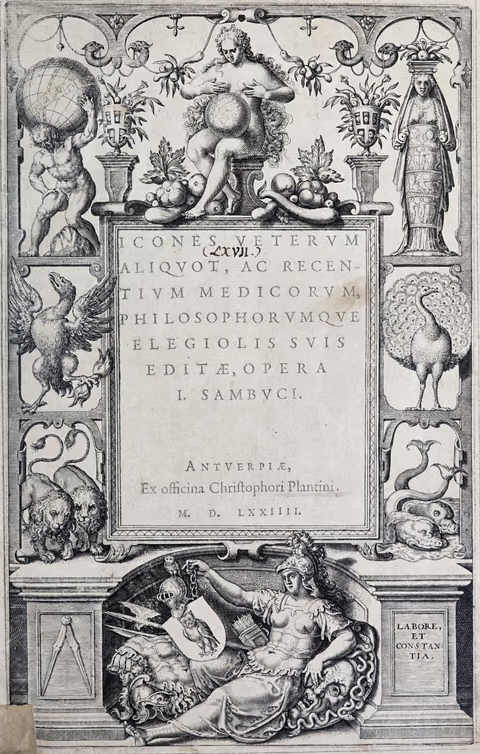 An ornate frame surrounds Latin text, featuring figures including a man holding a globe, a reclining armored woman with a shield, lions, a griffin, and a peacock.
“PORTRAITS OF SOME (LXVII.) ANCIENT, AND RECENT PHYSICIANS, AND PHILOSOPHERS PUBLISHED WITH THEIR SHORT ELEGIES, BY THE EFFORT OF I. SAMBUCUS. ANTWERP, From the workshop of Christopher Plantin. M. D. LXXIIII. BY LABOR, AND CONSTANCY.”
Icones veterum aliquot, ac recentium medicorum, philosophorumque elegiolis suis editae, 1574
-
 An ornate initial letter N contains a figure of a person holding a staff. Decorative plants in vases flank the letter, and garlands are draped within and around it.
Icones veterum aliquot, ac recentium medicorum, philosophorumque elegiolis suis editae, 1574
-
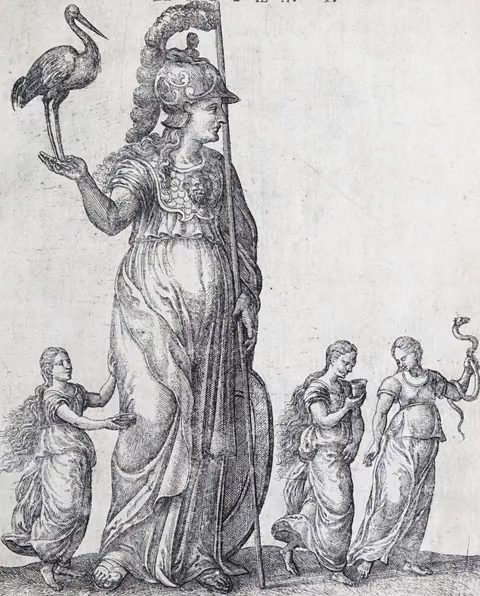 Hygiæa wears a helmet and holds a bird and a staff. Three women surround her, holding a bowl, a cup, and a staff with a snake.
“HYGIAEA. 1.”
Icones veterum aliquot, ac recentium medicorum, philosophorumque elegiolis suis editae, 1574
-
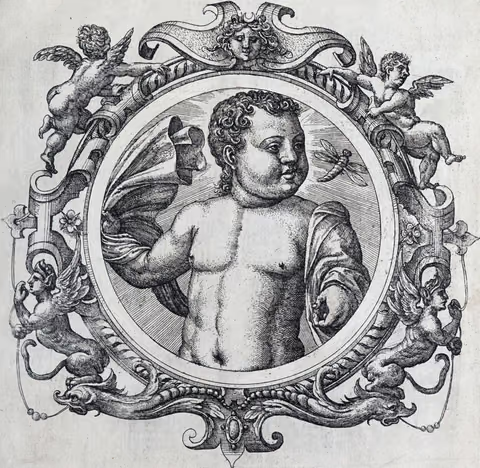 Apollo, depicted as a chubby infant, is shown within an ornate oval frame decorated with winged figures and chimeric creatures. A dragonfly flies near his face.
“APOLLO. 2.”
Icones veterum aliquot, ac recentium medicorum, philosophorumque elegiolis suis editae, 1574
-
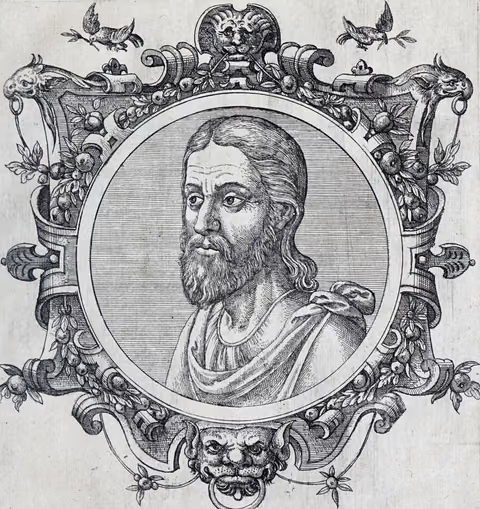 Chiron is a bearded man depicted within an oval frame. The frame is enclosed by an ornate border with foliage, fruit, and grotesque masks.
“CHIRON. 3.”
Icones veterum aliquot, ac recentium medicorum, philosophorumque elegiolis suis editae, 1574
-
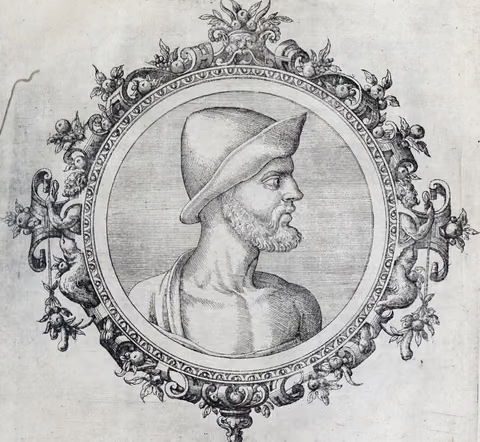 Aesculapius is shown in profile, wearing a hat and having a beard, inside an ornate oval frame.
“AESCULAPIUS. 4.”
Icones veterum aliquot, ac recentium medicorum, philosophorumque elegiolis suis editae, 1574
-
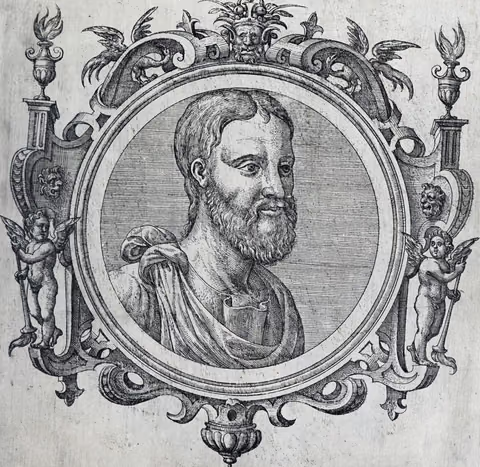 Machaon is shown in a portrait within an ornate oval frame. The frame is decorated with cherubs, a mask, and decorative scrolls.
“MACHAON. 5.”
Icones veterum aliquot, ac recentium medicorum, philosophorumque elegiolis suis editae, 1574
-
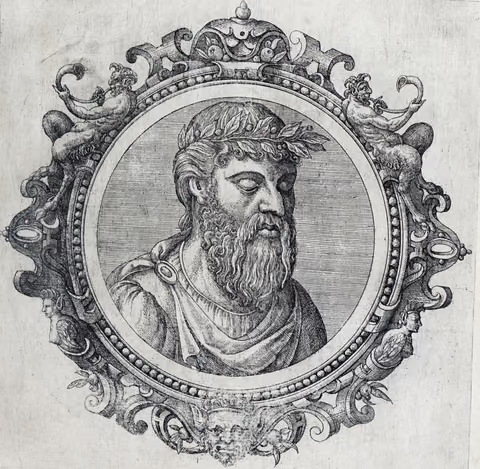 Homer is depicted within an ornate circular frame. He has a long beard, wears a laurel wreath on his head, and has closed eyes.
“HOMERUS. 6.”
Icones veterum aliquot, ac recentium medicorum, philosophorumque elegiolis suis editae, 1574
-
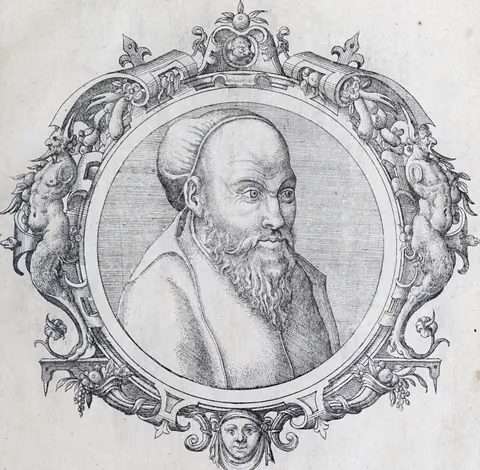 Pythagoras is depicted in a portrait, framed by an ornate oval border featuring mythical creatures and a small face at the bottom.
“PYTHAGORAS. 7.”
Icones veterum aliquot, ac recentium medicorum, philosophorumque elegiolis suis editae, 1574
-
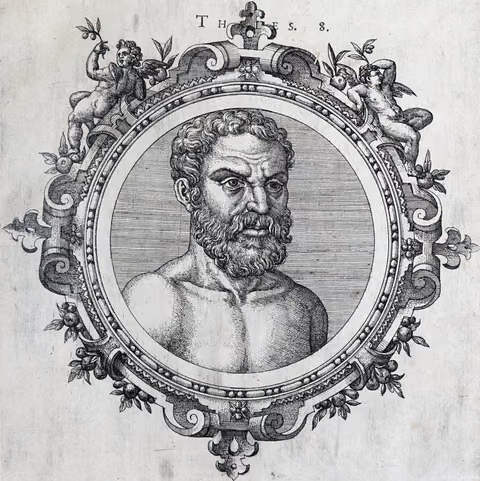 Thales is depicted as a bearded, bare-chested man within an ornate circular frame. Two cherubs sit atop the frame.
“THALES. 8.”
Icones veterum aliquot, ac recentium medicorum, philosophorumque elegiolis suis editae, 1574
-
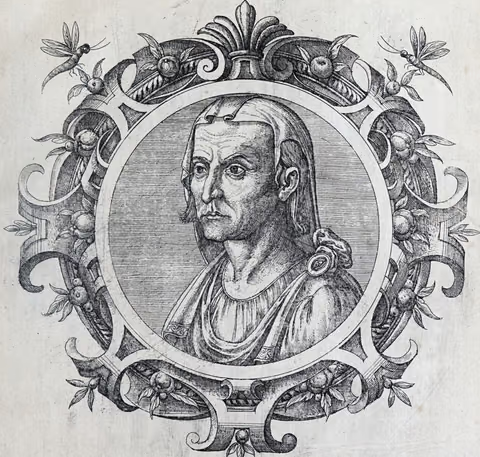 Hippocrates is shown in a circular portrait surrounded by an ornate frame with scrolls, berries, and insects.
“HIPPOCRATES. 9.”
Icones veterum aliquot, ac recentium medicorum, philosophorumque elegiolis suis editae, 1574
-
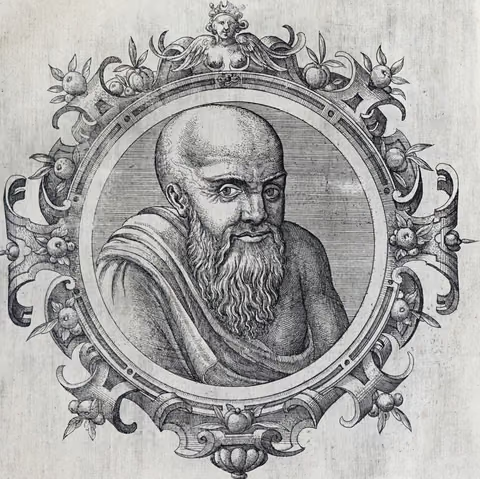 Socrates is depicted as a bald man with a beard, wearing a robe, and enclosed within an ornate circular frame.
“SOCRATES. 10.”
Icones veterum aliquot, ac recentium medicorum, philosophorumque elegiolis suis editae, 1574
-
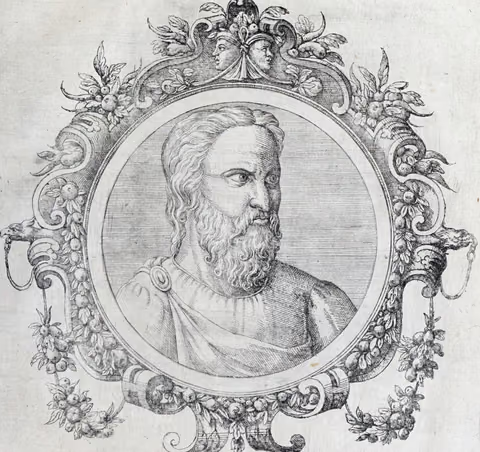 Aretævs faces right in a portrait, featuring a beard and a draped garment. He is enclosed in an ornate oval frame adorned with fruits, leaves, and small faces at the top.
“ARETAEUS. II.”
Icones veterum aliquot, ac recentium medicorum, philosophorumque elegiolis suis editae, 1574
-
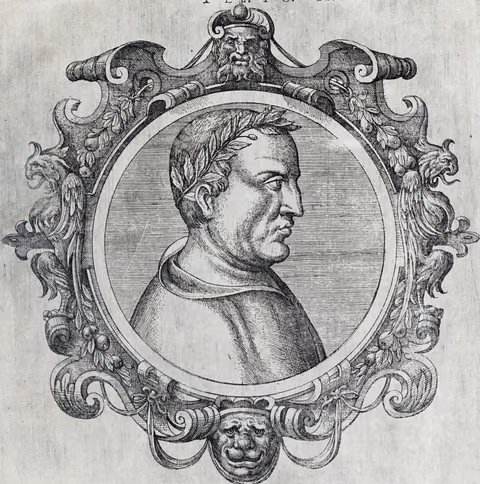 Plato is depicted in profile wearing a laurel wreath. He is enclosed within an ornate oval frame decorated with scrolls and two sculpted faces.
“PLATO. 12.”
Icones veterum aliquot, ac recentium medicorum, philosophorumque elegiolis suis editae, 1574
-
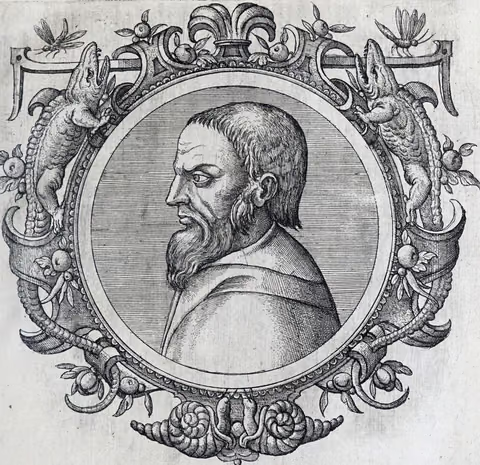 Aristoteles is depicted in a profile portrait within a circular frame. The frame is surrounded by an ornate decorative border with leaf patterns and two crocodiles.
“ARISTOTLE. 13.”
Icones veterum aliquot, ac recentium medicorum, philosophorumque elegiolis suis editae, 1574
-
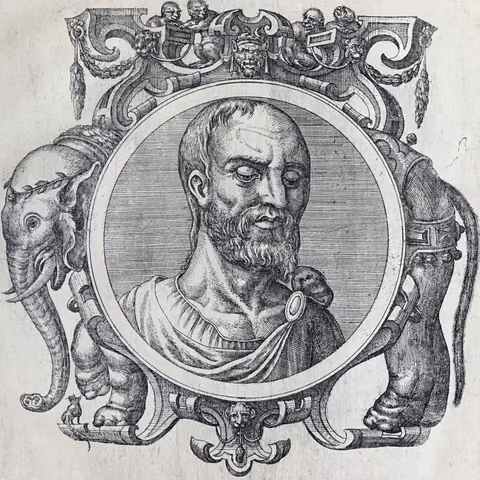 Theophrastus is shown in a portrait within an oval frame. The frame is surrounded by ornate decorations, including elephants on either side and small figures at the top.
“THEOPHRASTUS. 14.”
Icones veterum aliquot, ac recentium medicorum, philosophorumque elegiolis suis editae, 1574
-
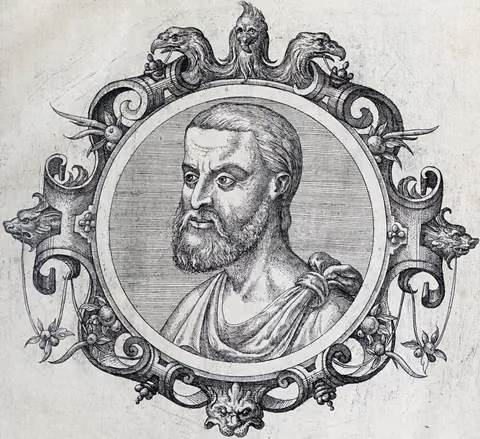 Nicander, a bearded man in a draped garment, is depicted in a portrait enclosed within an ornate circular frame decorated with scrolls and animal faces.
“NICANDER. 15.”
Icones veterum aliquot, ac recentium medicorum, philosophorumque elegiolis suis editae, 1574
-
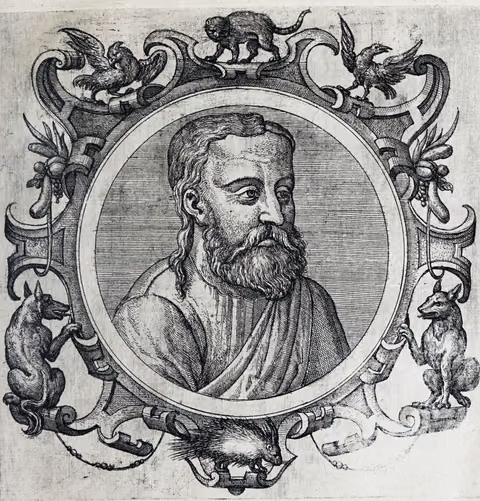 Cratevas is a bearded man in a robe, framed by an ornate oval border decorated with birds, foxes, and other animals.
“CRATEVAS. 16.”
Icones veterum aliquot, ac recentium medicorum, philosophorumque elegiolis suis editae, 1574
-
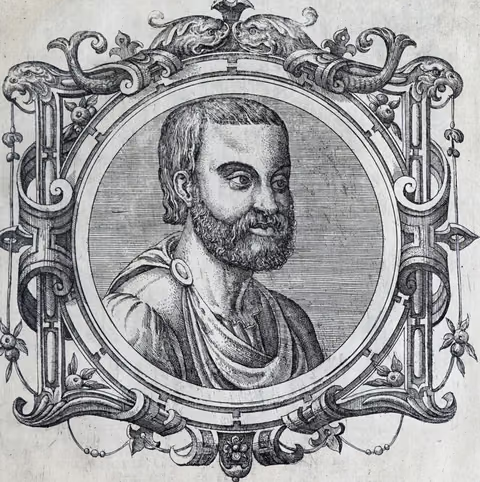 Niger is depicted as a bearded man wearing a draped cloak, enclosed within an ornate circular frame.
“NIGER. 17.”
Icones veterum aliquot, ac recentium medicorum, philosophorumque elegiolis suis editae, 1574
-
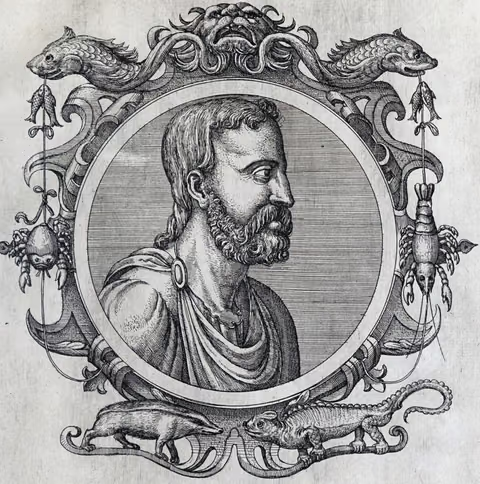 Celsus is depicted in profile within a decorative circular frame adorned with mythical fish, crustaceans, and reptiles.
“CELSUS. 18.”
Icones veterum aliquot, ac recentium medicorum, philosophorumque elegiolis suis editae, 1574
-
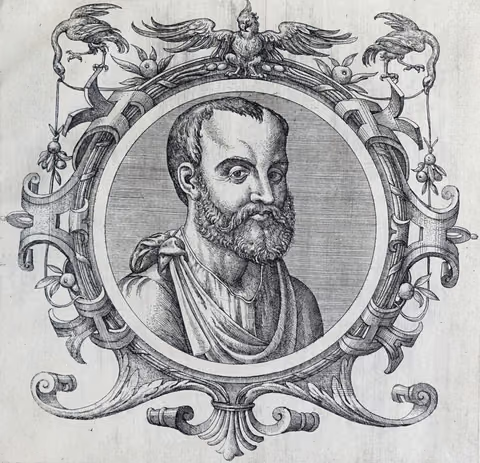 Galen is depicted as a bearded man wearing a draped garment, enclosed in an ornate oval frame decorated with birds and scrolls.
“GALEN. 19.”
Icones veterum aliquot, ac recentium medicorum, philosophorumque elegiolis suis editae, 1574
-
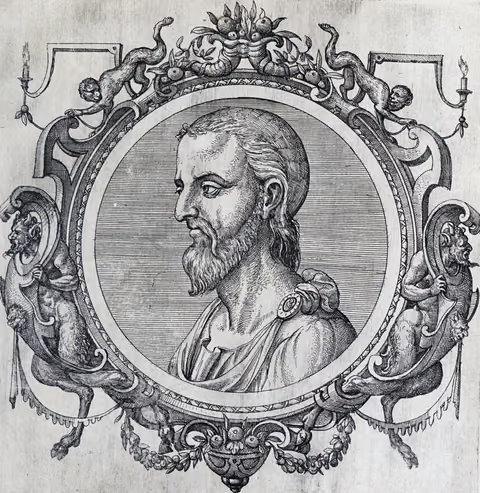 Dioscorides is depicted in a profile portrait with a beard, wearing a robe. He is enclosed in an ornate oval frame decorated with mythical creatures and garlands.
“DIOSCORIDES. 20.”
Icones veterum aliquot, ac recentium medicorum, philosophorumque elegiolis suis editae, 1574
-
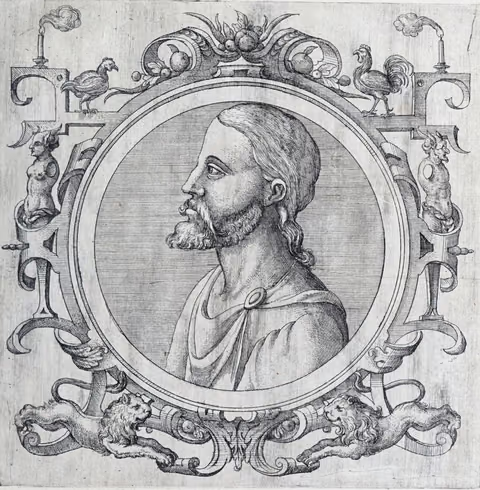 Xenocrates is shown in a profile portrait with a beard and a draped garment, enclosed in an ornate circular frame decorated with birds, lions, and figures.
“XENOCRATES. 21.”
Icones veterum aliquot, ac recentium medicorum, philosophorumque elegiolis suis editae, 1574
-
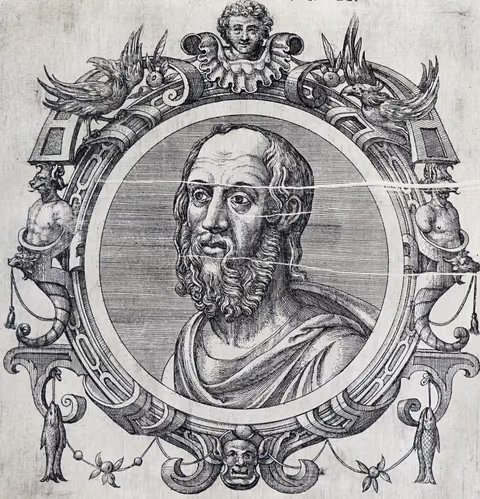 A portrait of Plinius is set within an ornate circular frame decorated with faces, birds, and fish.
“PLINY. 22.”
Icones veterum aliquot, ac recentium medicorum, philosophorumque elegiolis suis editae, 1574
-
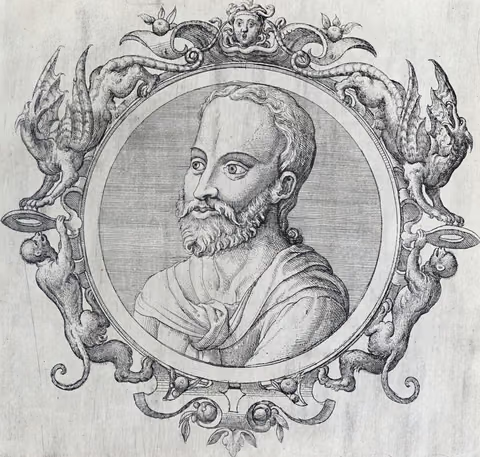 A bearded man named Ægineta is depicted within a circular frame surrounded by an ornate border featuring mythical creatures and small monkeys.
“AEGINETA. 23.”
Icones veterum aliquot, ac recentium medicorum, philosophorumque elegiolis suis editae, 1574
-
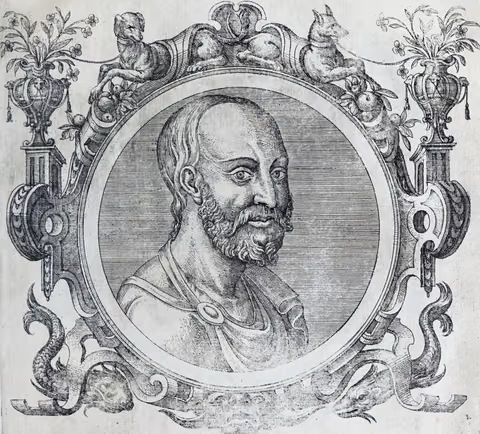 Ruffvus is depicted as a bearded man within a circular frame adorned with ornate carvings, animals, and flowers in vases.
“RVFFVS. 24.”
Icones veterum aliquot, ac recentium medicorum, philosophorumque elegiolis suis editae, 1574
-
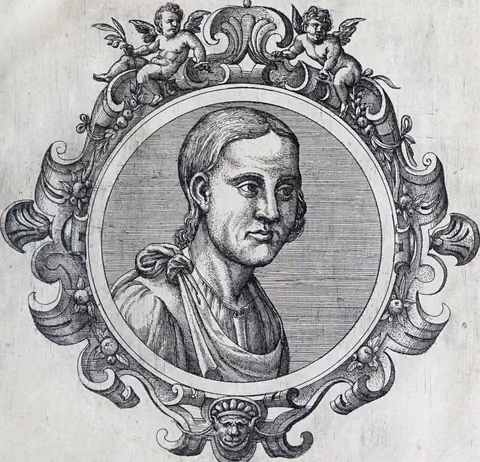 A portrait of Apollonius is shown within a circular frame surrounded by ornate scrollwork, two cherubs, and a small face at the bottom.
“APOLLONIUS. 25.”
Icones veterum aliquot, ac recentium medicorum, philosophorumque elegiolis suis editae, 1574
-
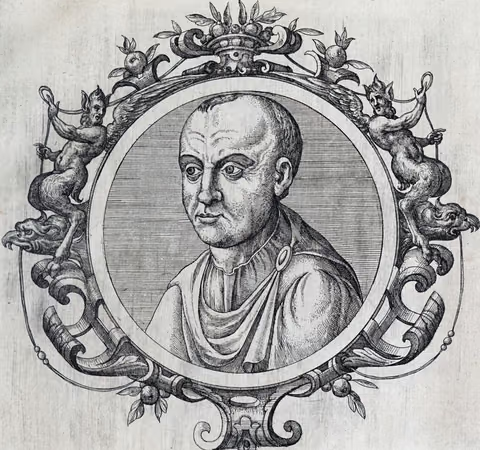 Heraclius Tarent is shown in a portrait within an ornate oval frame decorated with winged figures and foliage.
“HERACLIUS TARENT. 26.”
Icones veterum aliquot, ac recentium medicorum, philosophorumque elegiolis suis editae, 1574
-
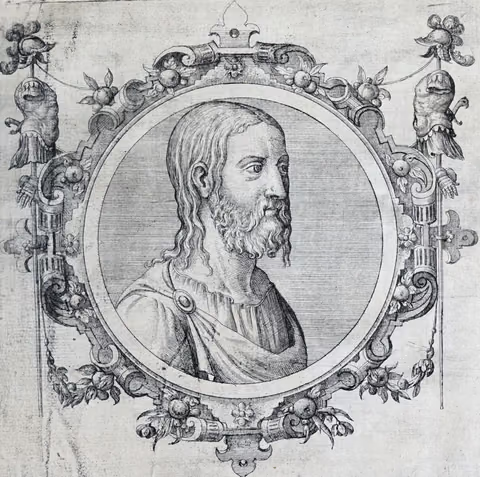 A profile portrait of a bearded man named Pamphilus is enclosed within an ornate circular frame decorated with scrolls and helmets.
“PAMPHILUS. 27.”
Icones veterum aliquot, ac recentium medicorum, philosophorumque elegiolis suis editae, 1574
-
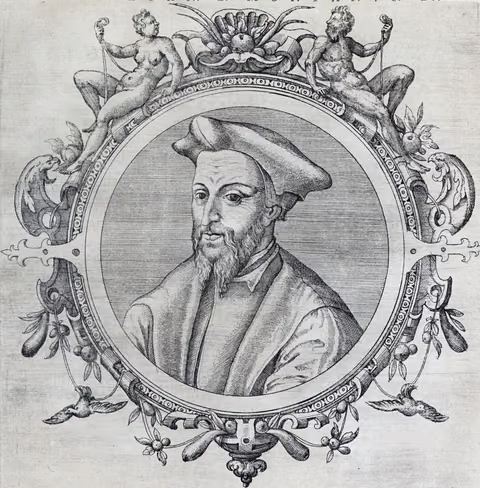 IOAN. B. MONTANVS appears in a portrait within an ornate circular frame decorated with human figures and animals.
“IOAN. B. MONTANUS. 28.”
Icones veterum aliquot, ac recentium medicorum, philosophorumque elegiolis suis editae, 1574
-
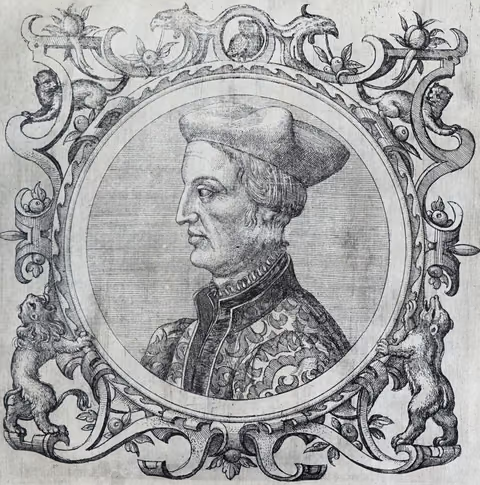 Fernelivs is shown in profile facing left, wearing a cap and an ornate high-collared garment. He is enclosed within an ornate oval frame decorated with scrollwork and lions.
“FERNELIUS. 29.”
Icones veterum aliquot, ac recentium medicorum, philosophorumque elegiolis suis editae, 1574
-
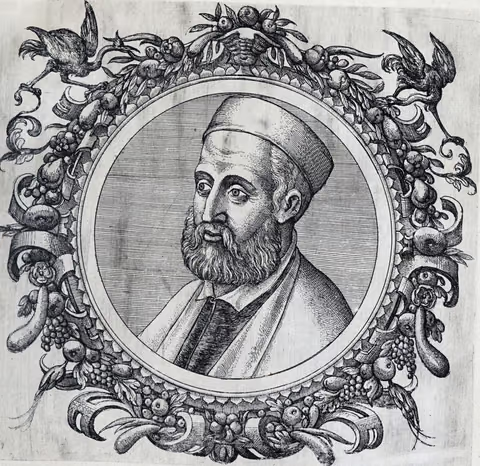 Trincavela is depicted in a circular frame, wearing a cap and sporting a beard. An ornate border containing fruits, foliage, and birds surrounds the portrait.
“TRINCAVELA. 30.”
Icones veterum aliquot, ac recentium medicorum, philosophorumque elegiolis suis editae, 1574
-
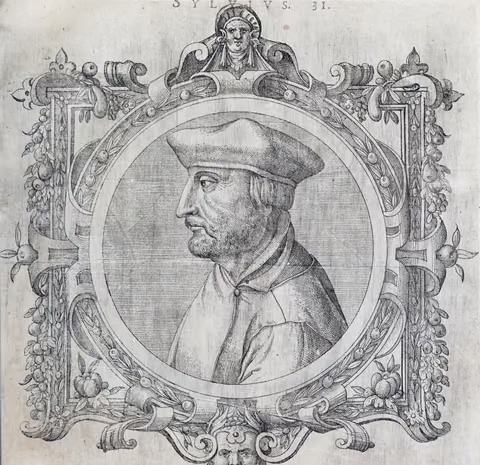 Sylvius is shown in a profile portrait wearing a cap and gown, enclosed within an ornate circular frame decorated with foliage and figures.
“SYLVIVS. 31.”
Icones veterum aliquot, ac recentium medicorum, philosophorumque elegiolis suis editae, 1574
-
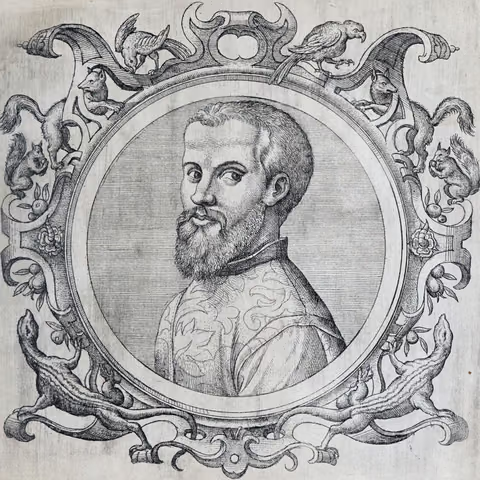 Vesalius is depicted in a circular frame surrounded by an ornate border featuring birds, squirrels, and lizards.
“VESALIUS. 32.”
Icones veterum aliquot, ac recentium medicorum, philosophorumque elegiolis suis editae, 1574
-
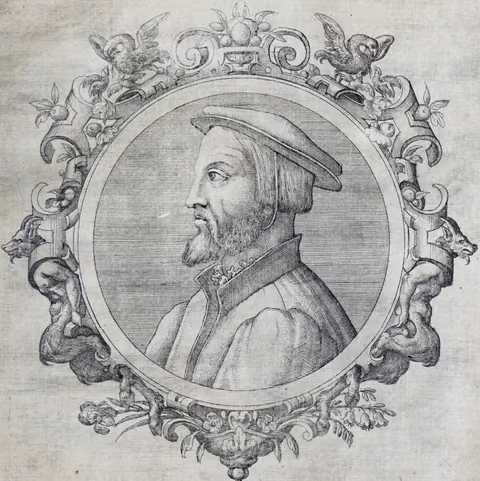 Gesnervs is shown in profile wearing a cap and a collared garment. He is enclosed in an ornate circular frame decorated with birds and creatures.
“GESNER. 33.”
Icones veterum aliquot, ac recentium medicorum, philosophorumque elegiolis suis editae, 1574
-
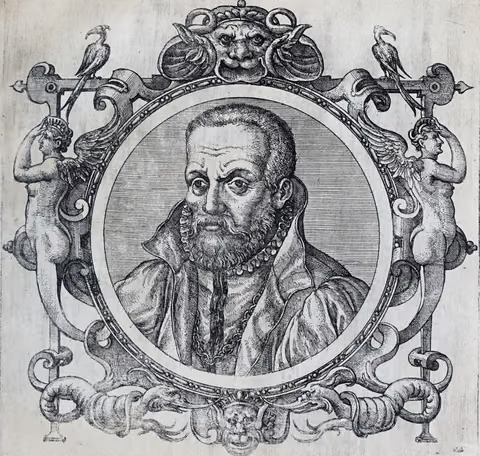 A portrait of Andernacvs is enclosed in an ornate oval frame decorated with mythical figures, birds, and grotesque faces.
“ANDERNACUS. 34.”
Icones veterum aliquot, ac recentium medicorum, philosophorumque elegiolis suis editae, 1574
-
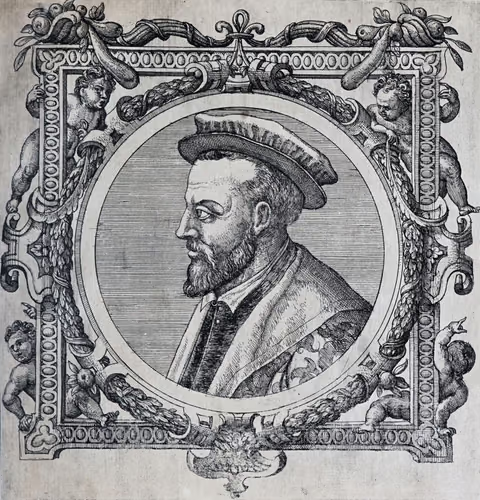 Brassavolvs is shown in profile, wearing a hat and having a beard. The portrait is set within an ornate circular frame surrounded by a rectangular border with cherubs and floral motifs.
“BRASSAVOLVS. 35.”
Icones veterum aliquot, ac recentium medicorum, philosophorumque elegiolis suis editae, 1574
-
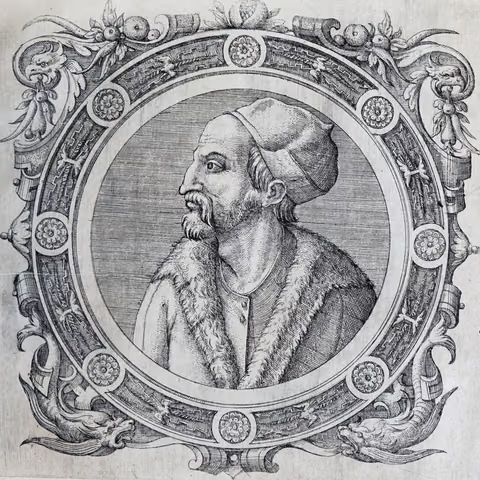 P. Iovivs is shown in profile within an ornate circular border, wearing a cap and a fur-collared garment.
“P. IOVIUS. 36.”
Icones veterum aliquot, ac recentium medicorum, philosophorumque elegiolis suis editae, 1574
-
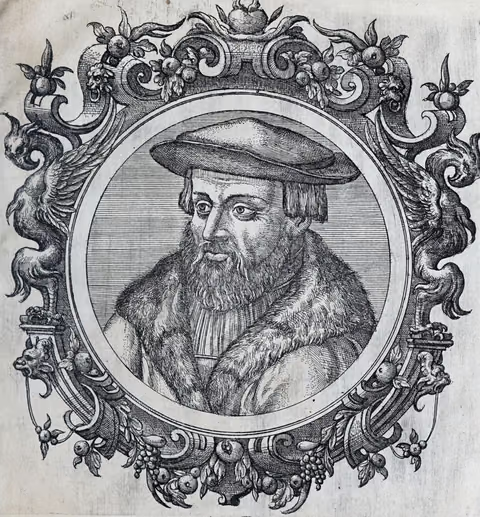 A bearded man named FVXIVS wears a flat hat and a fur-collared robe. He is enclosed in a circular frame surrounded by an ornate border with foliage and winged figures.
“FVXIVS. 37.”
Icones veterum aliquot, ac recentium medicorum, philosophorumque elegiolis suis editae, 1574
-
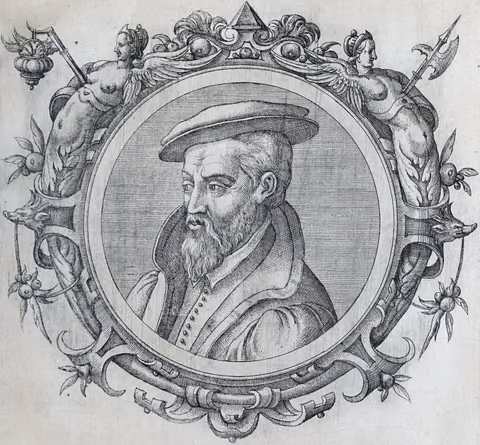 G. Agricola is depicted in profile within an oval frame, wearing a cap and a collared coat. The frame is decorated with winged female figures, floral patterns, and scrollwork.
“G. AGRICOLA. 38.”
Icones veterum aliquot, ac recentium medicorum, philosophorumque elegiolis suis editae, 1574
-
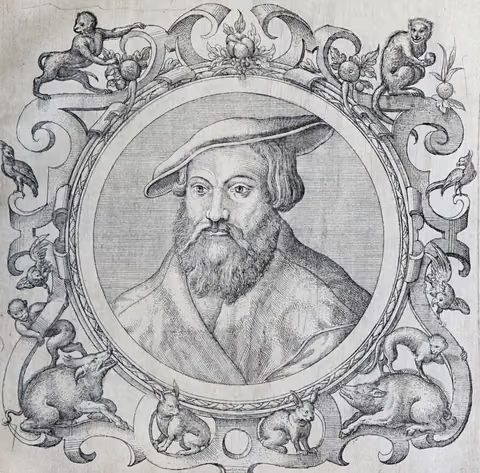 Cornarivs is a bearded man wearing a wide-brimmed hat inside an ornate oval frame. The frame is decorated with monkeys, pigs, rabbits, and birds.
“CORNARIUS. 39.”
Icones veterum aliquot, ac recentium medicorum, philosophorumque elegiolis suis editae, 1574
-
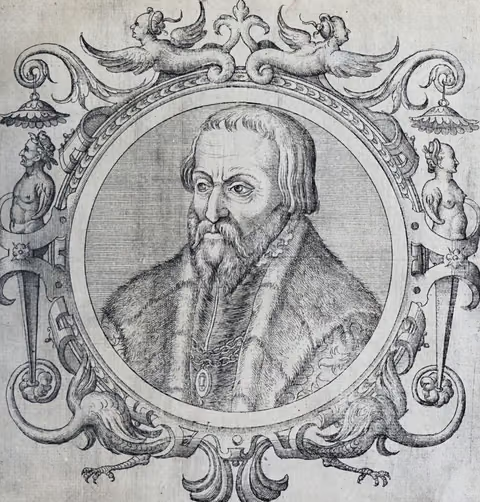 Matthiolus is shown in a circular portrait, wearing a fur-collared garment and a chain. He is surrounded by an ornate frame featuring scrolls and figures.
“MATTHIOLUS. 40.”
Icones veterum aliquot, ac recentium medicorum, philosophorumque elegiolis suis editae, 1574
-
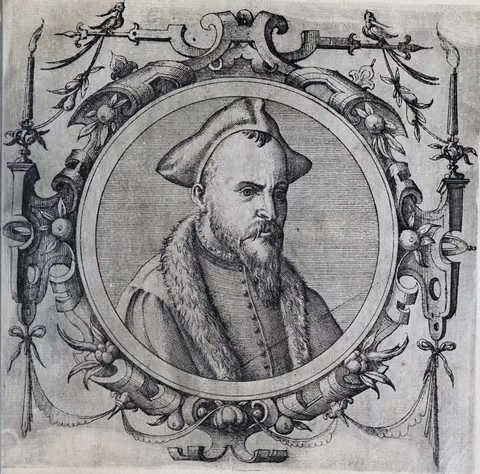 Hypol. Salvianus is shown in a circular frame, wearing a cap and a fur-lined garment. An ornate decorative border surrounds the frame.
“HYPOL. SALVIANUS. 41.”
Icones veterum aliquot, ac recentium medicorum, philosophorumque elegiolis suis editae, 1574
-
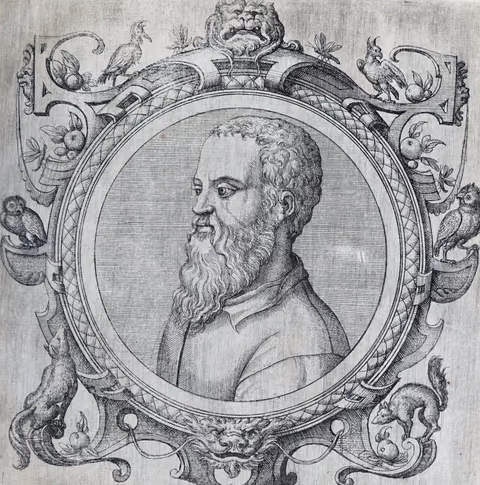 Rondeletivs is depicted in a profile portrait within an ornate circular frame decorated with animals and foliage.
“RONDELETIUS. 42.”
Icones veterum aliquot, ac recentium medicorum, philosophorumque elegiolis suis editae, 1574
-
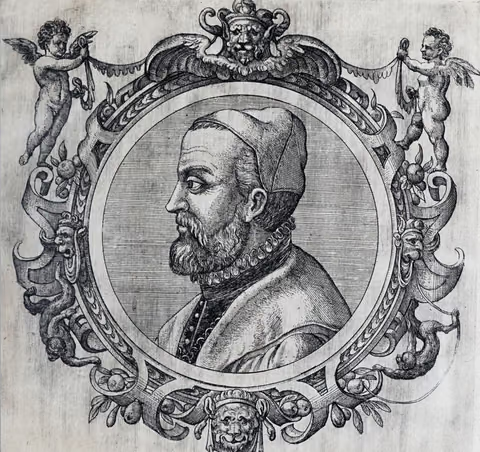 IVL. ALEXANDRINVS is depicted in profile facing left within an ornate oval frame decorated with cherubs and masks.
“IVL. ALEXANDRINVS. 43.”
Icones veterum aliquot, ac recentium medicorum, philosophorumque elegiolis suis editae, 1574
-
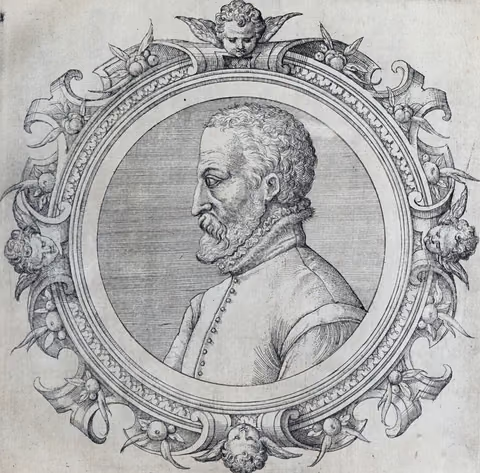 Ioan. Crato is depicted in profile within an ornate oval frame adorned with foliage and cherub heads. He has short curly hair, a beard, and wears a high-collared buttoned garment.
“IOAN. CRATO. 44.”
Icones veterum aliquot, ac recentium medicorum, philosophorumque elegiolis suis editae, 1574
-
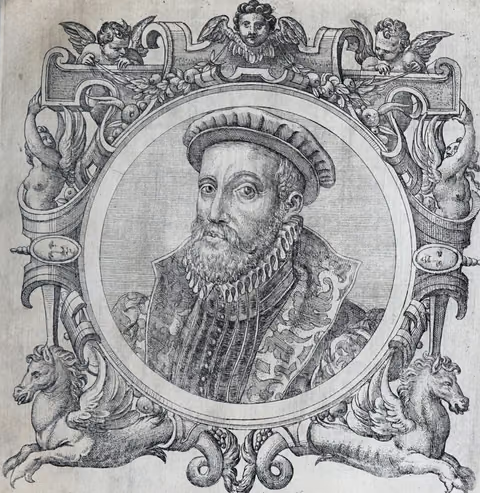 Nicol. Biesivs is depicted in a circular frame adorned with cherubs, winged horses, and scrolls. He wears a cap and an ornate collar.
“NICOL. BIESIUS. 45.”
Icones veterum aliquot, ac recentium medicorum, philosophorumque elegiolis suis editae, 1574
-
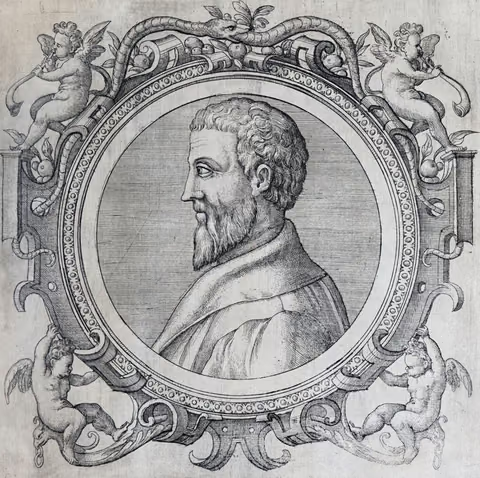 Altomarvs is shown in profile within a circular frame. The frame is decorated with ornate scrolls and four winged cherubs.
“ALTOMARUS. 46.”
Icones veterum aliquot, ac recentium medicorum, philosophorumque elegiolis suis editae, 1574
-
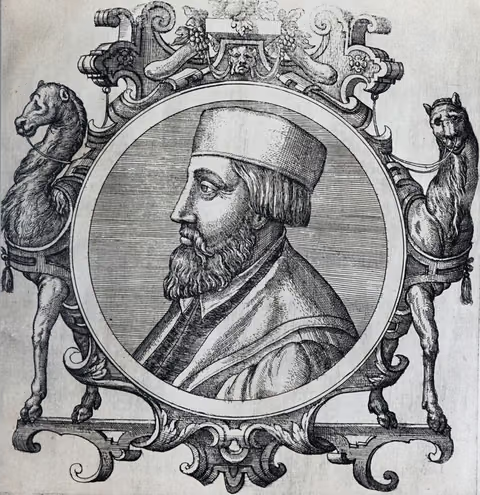 Nicol. Massa is depicted in profile within an ornate oval frame. He has a beard and wears a cap and robe, while two animal figures flank the frame.
“NICOL. MASSA. 47.”
Icones veterum aliquot, ac recentium medicorum, philosophorumque elegiolis suis editae, 1574
-
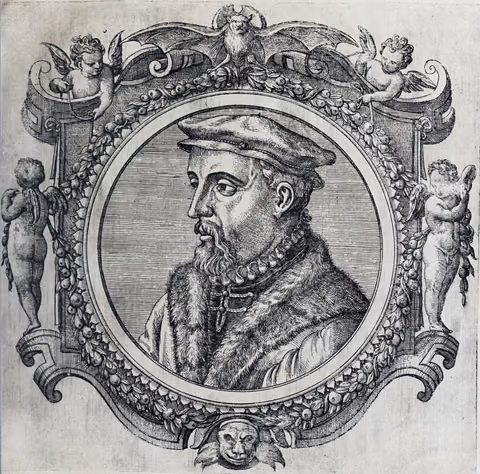 HADR. IVNIVS is shown in profile facing left, wearing a flat cap and a fur-trimmed robe, enclosed in an ornate oval frame decorated with cherubs and greenery.
“HADR. IVNIVS. 48.”
Icones veterum aliquot, ac recentium medicorum, philosophorumque elegiolis suis editae, 1574
-
 A decorative circular frame featuring winged female figures, dolphins, and foliage surrounds a blank center.
“ARGENTERIUS. 49.”
Icones veterum aliquot, ac recentium medicorum, philosophorumque elegiolis suis editae, 1574
-
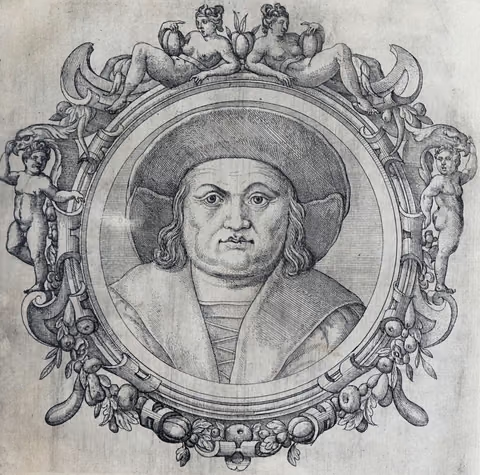 Ioan. Cuspinianvs is depicted in a circular frame decorated with reclining figures, cherubs, and fruit. He wears a wide-brimmed hat and a robe.
“IOAN. CVSPINIANVS. 50.”
Icones veterum aliquot, ac recentium medicorum, philosophorumque elegiolis suis editae, 1574
-
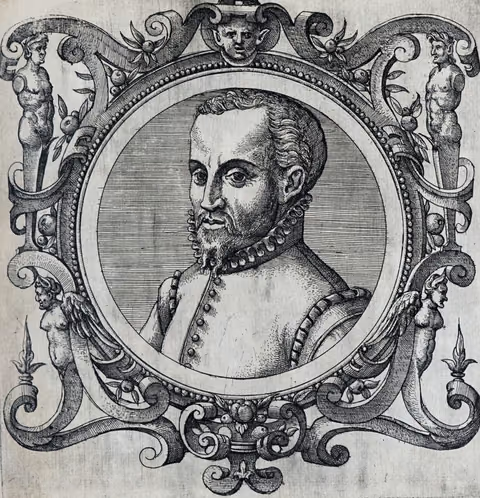 Cordvs is depicted as a bearded man wearing a ruff collar, enclosed within an ornate oval frame decorated with classical figures and scrolling ornaments.
“V. CORDVS. 51.”
Icones veterum aliquot, ac recentium medicorum, philosophorumque elegiolis suis editae, 1574
-
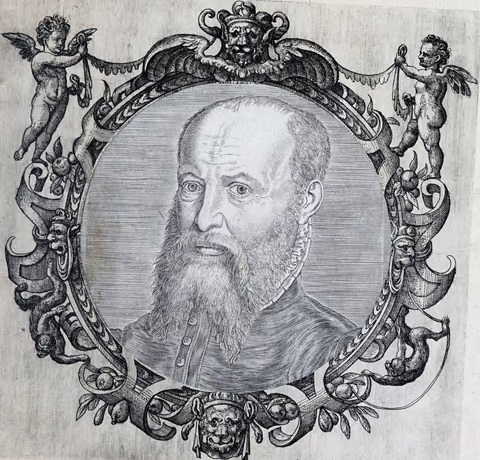 Goropius Becanus is shown as a man with a high forehead and a long, full beard. An ornate oval border featuring cherubs and grotesque masks surrounds the portrait.
“GOROPIUS BECANUS. 52.”
Icones veterum aliquot, ac recentium medicorum, philosophorumque elegiolis suis editae, 1574
-
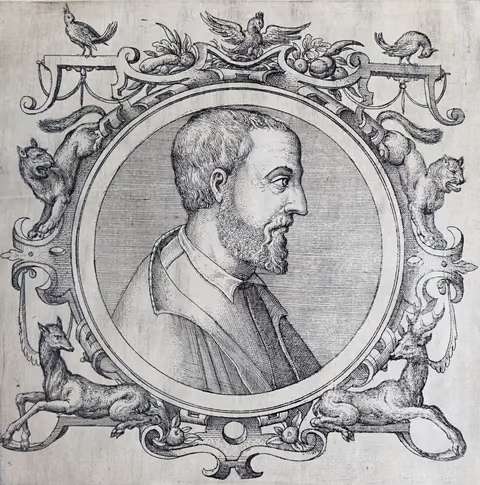 A profile portrait of Cardanus is enclosed within a circular frame decorated with birds, cats, and deer.
“CARDANUS. 53.”
Icones veterum aliquot, ac recentium medicorum, philosophorumque elegiolis suis editae, 1574
-
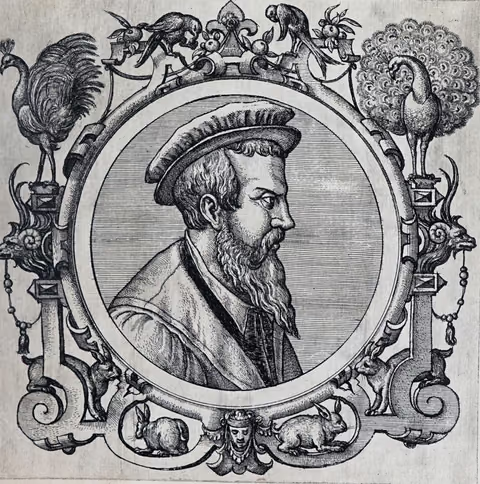 A profile portrait of C. Scaliger, wearing a cap and having a beard, is enclosed in an ornate circular frame decorated with birds, rabbits, and other creatures.
“C. SCALIGER. 54.”
Icones veterum aliquot, ac recentium medicorum, philosophorumque elegiolis suis editae, 1574
-
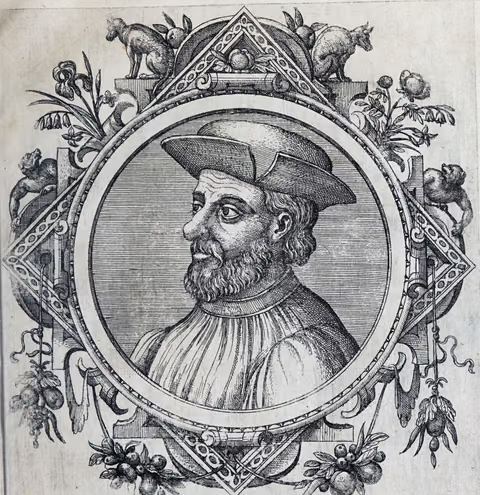 B. Victorius is depicted in profile within a circular frame. He wears a hat and a pleated garment, and the frame is surrounded by an ornate border featuring animals and floral elements.
“B. VICTORIUS. 55.”
Icones veterum aliquot, ac recentium medicorum, philosophorumque elegiolis suis editae, 1574
-
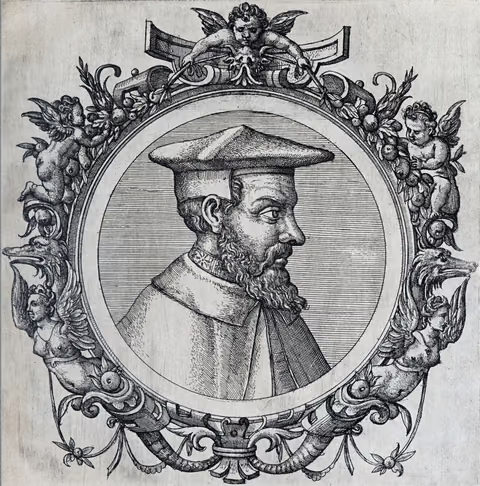 P. Crassvs is shown in profile, wearing a cap and a robe. He is enclosed within an ornate oval frame featuring cherubs and mythical creatures.
“P. CRASSUS. 56.”
Icones veterum aliquot, ac recentium medicorum, philosophorumque elegiolis suis editae, 1574
-
 An ornate circular frame is decorated with winged female figures, mythological creatures, and floral motifs around a blank center.
“MONTAGNANA. 57.”
Icones veterum aliquot, ac recentium medicorum, philosophorumque elegiolis suis editae, 1574
-
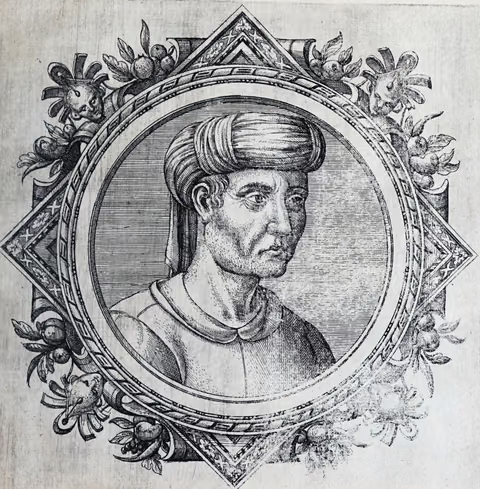 Savanorela appears in a circular frame surrounded by foliage and a diamond border. He wears a large, wrapped hat.
“SAVANORELA. 58.”
Icones veterum aliquot, ac recentium medicorum, philosophorumque elegiolis suis editae, 1574
-
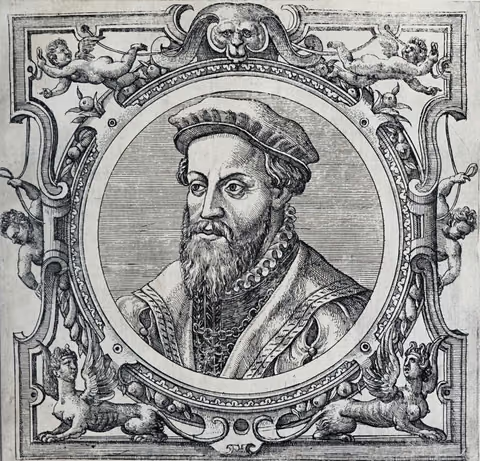 Lazius is a bearded man wearing a cap and an ornate garment, framed within an oval medallion surrounded by a decorative border featuring cherubs and winged mythical creatures.
“VV. LAZIUS. 59.”
Icones veterum aliquot, ac recentium medicorum, philosophorumque elegiolis suis editae, 1574
-
 An ornate circular frame with a blank center is set within a diamond-shaped border decorated with leaves, fruit, and masks.
“CURTIUS. 60.”
Icones veterum aliquot, ac recentium medicorum, philosophorumque elegiolis suis editae, 1574
-
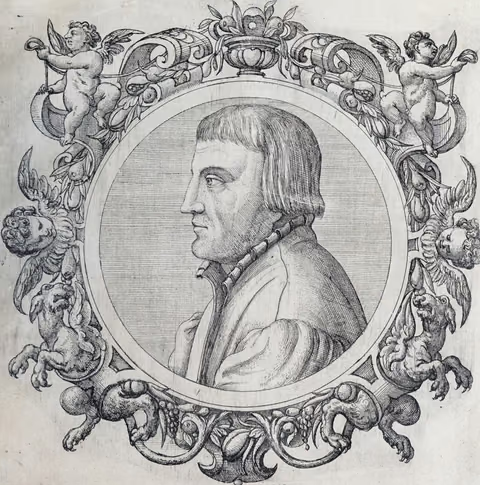 A profile portrait of Tragus is framed within a circle. The circle is surrounded by an ornate border featuring cherubs and winged creatures.
“TRAGVS. 61.”
Icones veterum aliquot, ac recentium medicorum, philosophorumque elegiolis suis editae, 1574
-
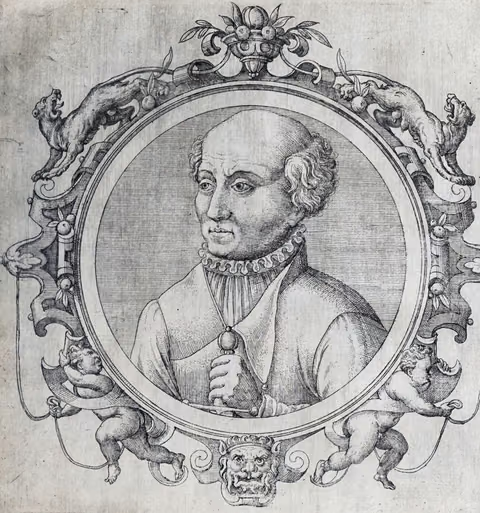 Paracelsus is depicted in a portrait within an ornate oval frame. The frame features lions, cherubs, and a grotesque face at the bottom.
“PARACELSVS. 62.”
Icones veterum aliquot, ac recentium medicorum, philosophorumque elegiolis suis editae, 1574
-
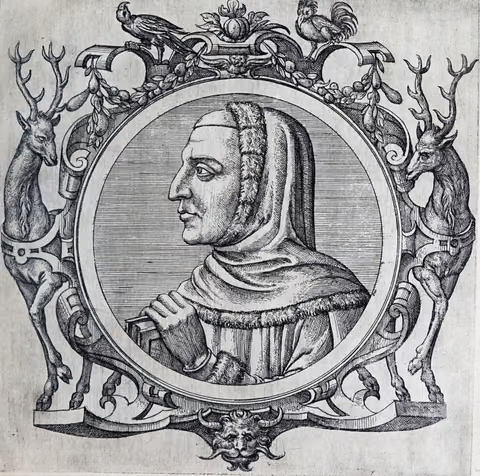 Seneca is shown in profile within an oval frame, wearing a hooded, fur-trimmed garment and holding a book. The frame is decorated with deer, birds, and a face at the bottom.
“SENECA. 63.”
Icones veterum aliquot, ac recentium medicorum, philosophorumque elegiolis suis editae, 1574
-
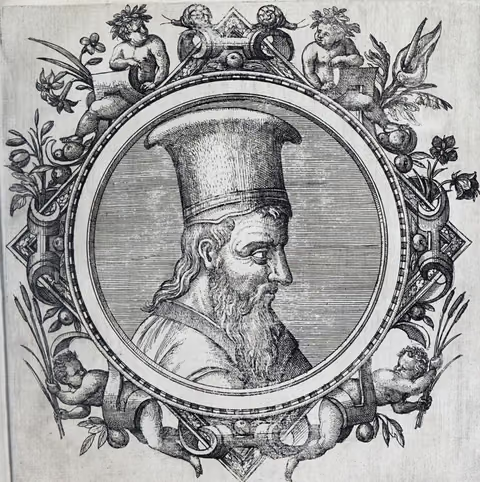 Strabo is shown in a profile portrait wearing a tall hat within a circular frame. The frame is decorated with cherubs and foliage.
“STRABO. 64.”
Icones veterum aliquot, ac recentium medicorum, philosophorumque elegiolis suis editae, 1574
-
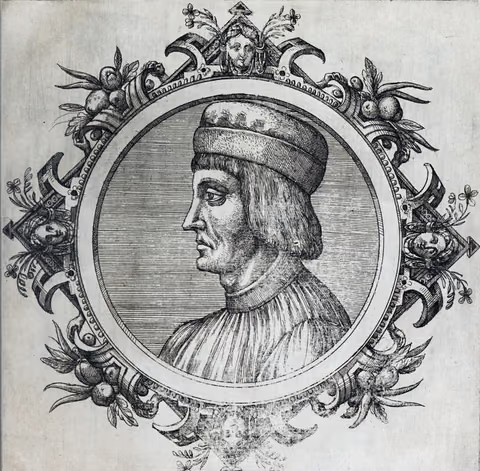 P. Crescentivs is shown in profile facing left, wearing a cap and a pleated garment. He is enclosed within a circular ornate frame decorated with foliage, fruit, and small faces.
“P. CRESCENTIVS. 65.”
Icones veterum aliquot, ac recentium medicorum, philosophorumque elegiolis suis editae, 1574
-
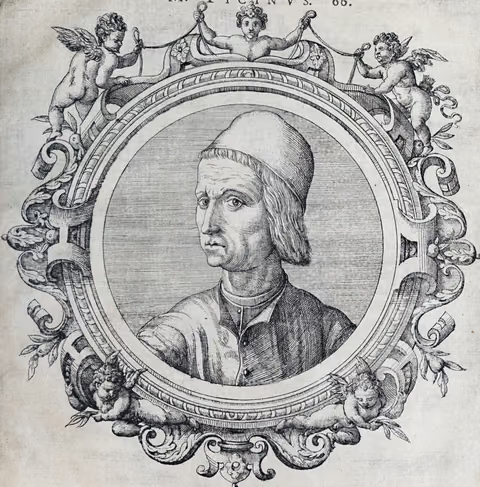 M. FICINVS is depicted in a circular frame adorned with cherubs and ornamental scrolls. He wears a cap and a buttoned garment.
“M. FICINUS. 66.”
Icones veterum aliquot, ac recentium medicorum, philosophorumque elegiolis suis editae, 1574
-
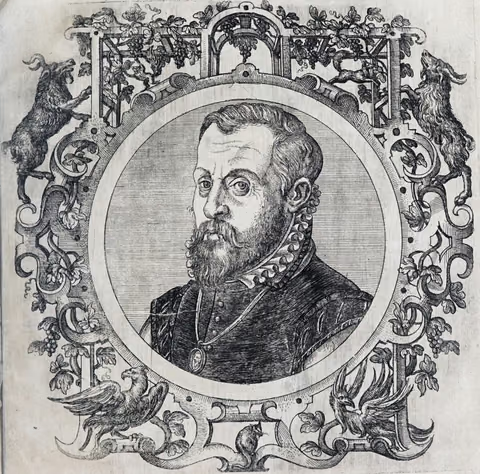 D. Ioan. Sambvco, a bearded man wearing a ruff collar and a medallion, is depicted within an oval frame surrounded by an ornate border of vines, animals, and birds.
“ON MASTER JOANNES SAMBUCUS. I. L. 67.”
Icones veterum aliquot, ac recentium medicorum, philosophorumque elegiolis suis editae, 1574
-
 A dark, ornate decorative symbol consisting of stylized floral and scroll-like patterns.
Mikrokosmographia Metrica, sive Humani Corporis Historia, 1679
-
 A decorative capital letter 'Q' is filled and surrounded by floral and foliate patterns.
Mikrokosmographia Metrica, sive Humani Corporis Historia, 1679
-
 An ornate decorative design features a centered human face surrounded by elaborate scrolling foliage and tassels. Two fantastical creature heads flank the top corners of the arrangement.
“FINIS.”
Mikrokosmographia Metrica, sive Humani Corporis Historia, 1679
-
 A small, dark, stylized floral ornament is centered on a light-colored, textured background.
Mikrokosmographia Metrica, sive Humani Corporis Historia, 1679
No illustrations match these filters.
Try a shorter search, or clear the filters.