De medicis poetis dissertatio: Thomas Bartholin on physicians who wrote poetry
By Thomas Bartholin · Published 1669 · Latin with English translation · Wellcome Collection
Historian’s note. This text records the medicine of its own time, and later evidence has replaced most of it. It is not medical advice. We read it as history, and we ask what, if anything, connects it to medicine today.
Historian’s note. This text records the medicine of its own time, and later evidence has replaced most of it. It is not medical advice. We read it as history, and we ask what, if anything, connects it to medicine today. More on how we read old medical books
De medicis poetis dissertatio
Thomas Bartholin on physicians who wrote poetry
By Thomas Bartholin, 1669. The edition has the page scans, the Latin text, and an English translation.
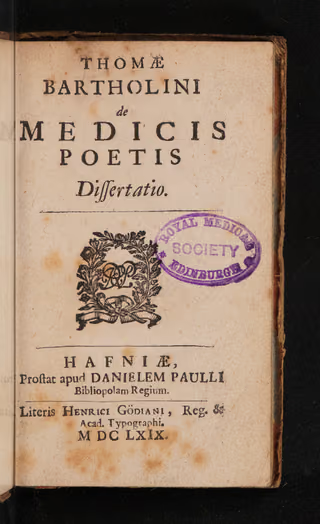
Thomas Bartholin published this Latin dissertation on physicians who wrote poetry at Copenhagen in 1669. Daniel Paulli, the royal bookseller, sold it, and Henrik Göde, printer to the king and the university, printed it. Jacob Henrik Paulli, the royal historiographer, wrote the epigram that opens the book. It says that Bartholin strengthens the bond between physicians and poets, and that Parnassus rightly has two peaks, one for each.
Bartholin begins with a defence. He says that poetry is both useful and pleasant to physicians, who imitate bees that seek flowers for their beauty and their sweetness. Both arts work by fixed weight and measure, the poet in his verse and the physician in the formulas of his remedies. He then reads the poets for medicine, starting with the potion that Hecamede gives the wounded Machaon in the Iliad. Later pages discuss medical poems such as Nicander’s poems on venomous animals and poisons, and Euricius Cordus’s Latin verse translation of them.
The last pages name physicians of the University of Copenhagen and the Danish court who wrote verse, among them Hans Frandsen, Anders Krag, Jacobus Fabricius, Ole Borch, Jacob Henrik Paulli and Bartholin’s father, Caspar Bartholin. Bartholin ends with an epigram of his own. An index of the authors he names and a list of errata follow the 149 printed pages.
Georg Litzel says in his De poetis medicis of 1743 that he first planned to supplement this dissertation. Achille Chéreau names it in the preface of Le Parnasse médical français (1874) among the earlier studies of his subject. Both books are in this library.
| Date | Place | Work | Notes |
|---|---|---|---|
| Antiquity | Greece | Iliad By Homer | Bartholin calls Homer the first of poets and starts his survey with book 11, where Hecamede mixes a drink for the wounded Machaon. He then asks what the drink did for the wound. |
| 1669 | Copenhagen | De medicis poetis dissertatio By Thomas Bartholin | Sold by Daniel Paulli and printed by Henrik Göde. The title page gives the year as M DC LXIX. A leaf of additions to be inserted in their places precedes the text, and the errata say that the errors entered the book while the author was away. |
Illustrations
2 illustrations. Each opens its page in the reader, zoomed to the picture.