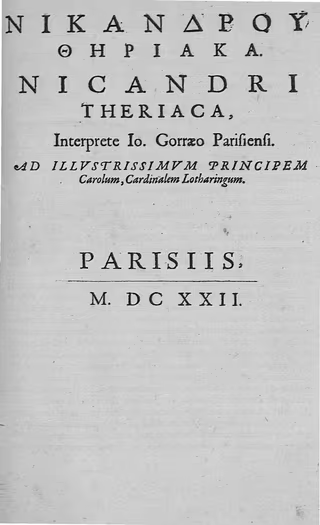
Nicandri Theriaca, interprete Ioannis Gorraeo parisiensi: Greek toxicological poems with Jean de Gorris's Latin translation and commentary
By Nicander; Jean de Gorris · Published 1622 · Ancient Greek and Latin with English translation · BIU Sante copy via Internet Archive
Historian’s note. This text records the medicine of its own time, and later evidence has replaced most of it. It is not medical advice. We read it as history, and we ask what, if anything, connects it to medicine today.
Historian’s note. This text records the medicine of its own time, and later evidence has replaced most of it. It is not medical advice. We read it as history, and we ask what, if anything, connects it to medicine today. More on how we read old medical books
We have not yet reviewed the translation of this book.
Nicandri Theriaca, interprete Ioannis Gorraeo parisiensi
Greek toxicological poems with Jean de Gorris's Latin translation and commentary
By Nicander; Jean de Gorris, 1622. The edition has the page scans, the Ancient Greek and Latin text, and an English translation.
Nicander of Colophon wrote two Greek didactic poems in hexameters on poisons, probably in the second century BCE. The Theriaca (958 lines) covers snakes, scorpions, spiders and other venomous animals and the wounds they cause. The Alexipharmaca (630 lines) covers poisons that are swallowed, such as aconite, hemlock, opium and white lead, and their antidotes. This edition, printed at Paris in 1622, sets the Greek beside the Latin verse translation and medical commentary of Jean de Gorris (1505–1577), dean of the Paris Faculty of Medicine in 1548.
The word “theriac,” later the name of a compound antidote, and the title Theriaca both come from the Greek thērion, “venomous beast.” Gorris’s notes test Nicander against Galen and Dioscorides. They also correct Pliny, who thought the salamander so cold that it puts out fire. The 1622 reprint still carries Gorris’s dedications to Cardinal Jean du Bellay and to Charles, Cardinal of Lorraine.
This edition is listed with the physician-poets in this library.
| Date | Place | Work | Notes |
|---|---|---|---|
| 2nd century BCE | Colophon | Theriaca; Alexipharmaca By Nicander of Colophon | Two Greek hexameter poems on venomous animals and on poisons and their remedies. Nicander was hereditary priest of Apollo at Claros. Most modern scholars place him at the court of Attalus III of Pergamum, about 130 BCE, but his date is disputed. Ancient tradition held that he put a lost prose treatise by Apollodorus into verse. |
| 1549 | Paris | Nicandri Alexipharmaca Edited by Jean de Gorris | Printed by Michel de Vascosan with Gorris’s Latin verse translation and commentary, and dedicated to Cardinal Jean du Bellay. Gorris was a Paris physician trained in Greek. He also edited Hippocrates, and his medical dictionary, the Definitionum medicarum libri XXIIII, was first printed in 1564. |
| 1556–1557 | Paris | Nicandri Theriaca Edited by Jean de Gorris | Gorris’s Latin verse translation of the Theriaca with his commentary, dedicated to Charles de Guise, Cardinal of Lorraine. In 1557 Guillaume Morel printed both poems together in Greek and Latin, with the ancient Greek scholia. |
| 1622 | Paris | Nicandri Theriaca, interprete Ioannis Gorraeo parisiensi | A reprint by the Societas Minima, a group of Paris booksellers, issued 45 years after Gorris’s death. It keeps the sixteenth-century layout of Greek text, Latin verse, commentary and index. Who prepared the reprint is not known. |

Illustrations
21 illustrations. Each opens its page in the reader, zoomed to the picture.
-
-
-
-
NICANDER'S THERIACA. NICANDER'S THERIACA, Translated by Jean de Gorris of Paris. -
-
-
ON THE THERIACA OF NICANDER Annotations of Jean de Gorris. -
ON THE THERIACA OF NICANDER Annotations of Jean de Gorris. -
-
-
-
-
-
-
-
-
-
-
-
JEAN DE GORRIS'S APOLOGY CONCERNING THE SEA HARE TO GUILLAUME RONDELET. -
Poems
33 poems, grouped by theme.