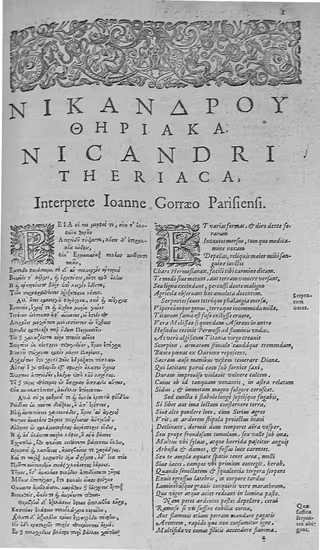
EASILY indeed to you the forms, and deadly harms of beasts
I would accurately portray, and the strong remedy of care,
Dear Hermesianax, most honored of many kinsmen,
I would firmly declare. And this in turn the hard-working plowman
And the herdsman would heed, and the traveler, when in the woods
Or even to one plowing it casts a deadly tooth,
Being thus warned of the antidotes for diseases.
But indeed the evil-doing phalangia, and with the grievous
Creepers, and vipers and the countless burdens of the earth
They say issue from the blood of the Titans, if truly then
The Ascraean on the inmost banks of Melisseus
Hesiod recounted by the waters of Permessus.
For the chilling Titanian maiden sent up
The scorpion sharpened from its sting, when she went
Against the Boeotian Orion preparing an evil fate,
When with his hands he grasped the undefiled robes of the goddess.
But the unforeseen scorpion, having lain in ambush under a small stone,
Struck down upon the ankle of his sturdy foot.
For this reason it stands as a fixed sign among the stars thus,
As of one hunting, it is established unseen.
But you indeed in flight from the stall and the fold all creeping things
Easily will drive out, either from the crag,
Or even from a self-made low bed, when the parching Sirius
Roasting ignites its blast,
Sleeping under the open sky having cast yourself on the stubble at evening,
Or even up along a wooded hill, or up the edge of a glen,
Where the most beasts of the wood feed,
The thickets and bushy places, and dark ravines.
And whether you have built beside the smooth threshing-floor, or where the grass
First springing up you sleep in the green shadows.
Then, when it has stripped off the vine-like old age of its scales
Walking with difficulty, when fleeing its den in spring
It is dim-sighted in its eyes; but it hastens to the shoot of fennel
Having fed on which, it restores its swiftness and brightness.
And you will drive out the soul-devouring breathing doom of snakes,
Smoking the many-branched horn of a deer,
And at another time burning the dry Gagates stone,
Which not even the rush of strong fire burns down.
And cast into the fire the much-cleft shoots of fern.
Or taking the thoroughly heating root bearing *cachrys*,
Having mixed it with an equal weight of cress; and mix
Making equal the new dry horn of a gazelle on the scale,
And a matching weight of *melanthion*, at other times sulfur,
And at other times bringing an equal portion of asphalt.
Or kindling the Thracian stone on the fire,
Which, moistened with water, blazes, but
A little sprinkled oil extinguishes it when it catches the scent.
The shepherds bring it from the Thracian river,
Which they call Pontus, where flesh-eating
Rustic herdsmen follow their helpful sheep.
Truly also to be apportioned onto the flame is the heavy-smelling
Galbanum, and the nettle, and the cedar similar to pines,
Scraped down with many-toothed files,
On the flame brings a smoky and fleeing odor.
By these things indeed emptying their hollow holes and woody beds,
Trusting in the ground you will be satisfied with sleep.
But if weariness lacks these things for you, and night nearby
Brings a dwelling, and you desire a bed having finished your work,
Then indeed along the many-broken eddies of the river
Procure the leafy water calamint.
For it grows abundantly by the streams, and around the lips
It is dewy, rejoicing in the rustic rivers.
Or you might spread underneath yourself, having cut the many-flowered withy,
Or the heavy-smelling poly, which smells most intensely.
Just likewise echium, and the sacred foliage of oregano,
Truly also of southernwood, whose wild shoot blooms
Under the neighboring glen, and the joint of creeping thyme,
Which, loving life, feeds upon the damp earth,
Always downward-looking with its root-throwing bushy leaves.
And notice what resembles the lowly fleabane,
And the white blossoms of the chaste-tree, and the falling-in *onogyros*.
Likewise having cut the rough branches from the pomegranate,
And also the new many-flowered shoot of the asphodel,
And nightshade, and the hateful *scyra*, which the cowherd resents in spring,
When the cows leap about with the biting drug.
Truly also the heavy-breathing sulfurweed, whose odor
Scares away the beasts and pursues them when they oppose.
And let these random things be provided on the rustic bed,
But also block up the holes of the dens with these.
If indeed into a clay vessel, or an oil-flask,
Crushing cedar-berries, anointing your well-fitted limbs,
Or the heavy-breathing [leaves] of sulfurweed, or of mountain
Fleabane you stroke the dry leaves with oil.
Likewise sage, and in it the root
Of silphium, you might grind down the scraper of poison with a tooth.
Often they shrink from the smell of mortal saliva.
But if you, grinding in a little dye a caterpillar,
Dewy from the garden, with a green back,
Or also the swelling fruit of the wild mallow,
You anoint your limbs with them, you will sleep bloodless.
And scrape, having placed in the curved hollow of a millstone
Two leafy shoots of good southernwood.
Mixed together with cress; a proper weight of an obol for it.
And into it a hand's fullness of the newly-sprouted fruit of the carrot
To smooth with a pestle; and shaping them wheel-like,
Dry them in a clod-breathing windy place.
Dry, break them in a flask, and straightaway you might anoint your limbs.
If indeed beasts mingling at the crossroads on dry land
Alive, newly mating and piercing, you cast such into [a pot],
A warding defense of destructive woe.
In it for me, of the marrow of a newly-slaughtered deer
Throw down a threefold weight of a decade of drachms.
And in it a third part of a *chous* of rose oil, to which continually
They call the first and middle much-rubbed.
And pour an equal portion of raw unmixed olive oil,
A four-part of wax. And these in a bronze vessel
Heat lovingly, until the flesh around the spines
Melting is broken in pieces; and then take the made [mixture]
Well-wrought spoon, performing all ten thousand things
Boiling the mixture together, drawing off enough scum
And having cleansed them, rub away the poisons of the snake;
With this anoint everything, whether for a journey or for bed,
Or when in the harvest summer after the threshing floor's works
Girded up, you separate the deep chaff with pitchforks.
But if you encounter them on the ground with unanointed skin
Fasting from food, when necessity drives men,
Young man, attend to my commands as well.
Look out for the hostile female herself as she approaches,
Greater in bulk and swelling in flesh.
For that reason she also launches a doom harder than death.
But indeed you must avoid the harmful bite of summer,
Watching the risings of the Pleiades, which beneath the bull's
Tail go down, and are borne along smaller.
Or when with her young wrapped around her, unfed
She sleeps thirsty in ambush beneath the hollows of a den.
Or when she eagerly goes to her pasture, or to her bed
Returns from pasture, heavy with sleep, satiated from the woods.
Do not chance upon them at crossroads, when fleeing a bite
The dark male viper escapes the murky gall of the livid female,
When mounting her she is held by his deceitful canine tooth.
Biting the beast she cuts off the head of her mate.
And the young avenging the outrage to their father immediately
Being born as little vipers, since through their mother's thin
Belly bursting forth they are born without a mother.
For she alone is heavy with young; while the others in the woods
Egg-laying snakes warm their shelled offspring.
Nor when having stripped the shrivelled old age of scales
He eagerly ranges anew, rejoicing in fresh youth;
Or when having escaped the leaps of deer by their scent,
He attacks a man, angered, with soul-destroying poison.
For exceedingly against the long beasts are angered
The fawns and gazelles; immensely through all
The rough places and walls, tracking them out of their hiding places,
Hastening a terrible breath from their nostrils.
Yes indeed also snowy rugged Othrys bears
Deadly bites, and the hollow ravine, and the rough crags,
And the wooded rock, where the thirsty Seps treads.
In skin of strange appearance, it has no single form,
Always appearing like the place where it makes its hole.
Of these, those dwelling in rocks and stone-heaps
Are fewer, rough and fiery; on account of them
To men a bite is swift, but mighty.
And another again resembles the pasture snails themselves,
And another is green with scales, an immense circle
Variously shifting; and many mixed with the sands
With a white-gleaming coil roll in the sands.
Observe the destructive and with bristling scales
Fearsome Aspis, the most sluggish biting beast of all.
For its path creeps straight ahead along the opposite
Track by the long trailing drawn out of its belly;
And it has a terrible body; but it bears the sluggish
Weight of its trail along the path; and sleepily
Always blinking it appears continuously in sleep.
But when they either hear a new noise, or some voice
They observe, it casts off sluggish sleep from its limbs,
And trailing out its coil like a wheel on the earth,
It raises terribly its bristling head in the middle.
Its length is as much as a handle the earth nourished,
A measurable fathom, but its width is filled out
As much as an expert spear-maker makes straight a javelin,
For the battle of bulls, and heavy-roaring lions.
In skin sometimes it is overrun with ashen backs,
Sometimes ash-colored, and mottled, sometimes dark.
And often sooty under the black-clodded soil
Of the Ethiopians, such as the widely-winding Nilus into the sea
Wandering pours down the slime, and like parched pitch.
And two on the top of the conjoined forehead rise up...
Like calluses, and above they shade the eyes
deeply under their coils. Grievous swellings on its rough
neck as it hisses, whenever you rouse its fierce [spirit] there
by suddenly passing by, as it is violently angry.
Indeed four hollow teeth beneath,
crooked [and] long, are rooted in its jaws,
poison-receiving, and an innermost membrane covers them from below,
whence it spews unlooked-for poison into the limbs.
May those [dangers] somehow approach the heads of our enemies!
For no bite appears on the flesh, nor does any hard-to-heal
swelling burn; but without suffering a man dies,
and a sleepy lethargy brings the end of life.
But indeed only the ichneumon [Greek: Ἰχνεύμων] avoids the attack
of the shameless asp, either when it goes into battle, or when
it scatters all the baneful seeds of the female snake
throughout the earth, and shakes them from their membranes,
devouring them, and crushes them with destructive teeth.
In shape the ichneumon [Greek: ἰχνεύμων] is similar to the obscure
marten [Greek: Ἰκτιδός], which seeks destruction for domestic
birds, snatching them from sleep off their perches,
where they make their bed on the roost, or even placing
their sightless children beneath their flanks as they nurse them.
But whenever beside the rushy meadows of Egypt
it brings terrible battle to the coiling asps,
at once it leaps into the river, and prepares a muddy
crust with clay, and immediately cakes its limbs,
covering its small body with clay, until
Sirius dries its hair, and makes it unbending to the tooth.
Then leaping upon it he bites off the head of the darting-tongued
terrible [snake], seizing it, or snatching it by the tail,
he rolls it into the mossy river.
If on the other hand you should see the widely-varied shape of the viper,
now long, now shorter, such as
Europe and Asia nourish, you would consider these fitting.
Indeed those of Europe are smaller, and above the tips of
their nostrils they are horned and white;
some under the mountains of Sciron, and steep Pammonia,
Rhypeum, the crag of Corax, and hoary Aselenus.
But Asia feeds reptiles of a fathom, and more,
such as around rugged Bucarteron, or even the fortified
crag of Aigage, and Cercaphus encloses within.
The top of the head of these is wide, and upon the end
creeps the docked tail of its coil;
they bristle continuously with harsh scales,
and with a sluggish trail it goes here and there through the copses.
The male viper is sharp-headed to look at, whose length
is greater, but its thickness is small; and it is more slender straight along
the belly, and it is stretched out tapering to a point in its trail,
and under the belly it is flattened at the long end of its trail,
and equally rubbed bare of scales. But as for its eyes,
the pupils turn red when it is angered, and sharply darting
its tongue at the tip it points its lowest trail like a stake.
Travelers call the viper Cocytus.
For the male, two canine teeth mark the skin
belching poison. But those of the female viper are always more.
For she clings with her whole mouth, and around the flesh
you could easily observe the widened jaws.
And from her strike flows ichor like fat,
sometimes bloody, sometimes colorless. And the flesh upon it
often becomes green and rises with a heavy swelling,
at other times turning red. Then it swells as if livid;
at other times it conceives a watery weight. And frequent
blisters, like porous blisters in a fire,
fill with fluid like skin burned by fire.
And putrefactions overrun him around it, some apart,
and some at the strike itself, sending forth a poisonous ruin.
And the ruin feeds entirely upon his wretched body,
burning sharply. And hiccups strike down his throat,
breathing in upon him one after another, and shake him.
Then, feeling dizzy, his body is weighed down. And at the same time upon his limbs
a heavy weakness weighs, and settles in his waist.
A dark mist settles as a weight. But the sufferer
sometimes has his dry throat parched with thirst.
Often a chilling cold shivers from his nails, and around his limbs
a wintry, heavy hail overcomes him.
Often again he vomits bilious masses from his stomach,
his body turning pale all over. And a sweat, like a stream of water,
colder than the blasts of snow, pours around him.
His skin color becomes like heather or dark lead,
at other times dark blue, then resembling the bloom of copper.
You would easily recognize the treacherous cerastes [Greek: κεράστην] when it approaches,
like a viper. For it appears with an identical body.
However, the latter is hornless, while the former relies on horns,
sometimes four, at other times the cerastes [Greek: κεράστης] has two.
In its dusty color it is rough. And in the sands
or by the wagon-ruts along the path it sleeps soundly.
Truly, the swift one, running straight ahead with its coils,
directs its course along a long path with the trailing of its belly.
But this one rolls clumsily with its middle coil,
wandering along the way with a crooked, hairy back,
like a dinghy of a merchant ship from Teumessos, which through the brine
dips its whole side when the wind blows badly,
and is forced against the wind, driven back by the east wind from the southwest.
When it bites, a hideous swelling around the wound
becomes callous, resembling a nail. And livid
blisters, resembling the drops of rain,
abound around the bite, darkening the sight.
Indeed it causes a weaker pain. For nine dawns
he will look upon the sun, mingling with it, he whom the cerastes [Greek: κεράστης]
strikes with its deadly, evil-doing fang.
In the twin groins and the backs of the knees alike
distress roars with anguish, and the skin turns livid.
And as they grow weary, little spirit remains around his pains
in his weariness. Only with difficulty do they escape Hades.
Let me now tell you the sign of the venomous haemorrhois [Greek: αἱμόῤῥου],
which always dwells securely in rocky dens,
making its small nest spread out in a rough hole,
where it keeps its retreat, whenever it is sated with food.
In length it is equal to the track of a foot, but in width
its roaring bulk is broken down from its fiery head.
Sometimes it is scaly in color, at other times conversely dark brown.
It is tightly pinched at the neck. And its short tail
is violently squashed and stretched out from its mucous body.
Beneath its forehead two snowy horns
are drawn out, and its eyes are naturally like a locust's pupils.
Its bold head bristles terrifyingly upon it.
Dragging its small body aslant, like a cerastes [Greek: κεράστης],
it always steers its short course from the middle of its back.
pressing its belly underneath against the earth. And with its scales along the path
it hisses slightly, as someone creeping through straw.
Over the undefiled bite a colorless appearance runs
dark blue. And an evil pain is formed around his heart.
His watery belly runs through. And in the dead of night
blood from his nostrils, his neck, and his ears
gushes forth, newly mixed with bilious venom.
His urine runs down red; and beneath his limbs
his wounds break open, and they harden with the dryness of the skin.
May the female haemorrhois [Greek: αἱμοῤῥοῒς] never inject venom into you.
For when she bites, the gums swell up all together,
and unceasing blood trickles from the roots of the nails;
and the teeth, dripping with gore, fall out.
If it is true, Helen herself once wandered from Troy in her ships,
when she halted the ship among the scattered peoples around the Nile,
having escaped the evil threat of the North Wind.
Then Thonius beheld the vigorous helmsman Canobus
in the sands. For the female haemorrhois [Greek: Αἱμοῤῥοῒς],
squeezing his neck, struck him, and belched heavy venom into him,
and inflicted an evil sleep upon him.
There Helen broke the middle coil. She crushed the cruel
Bonds of the back, pressing down, and the spine became exposed on the limbs.
Since then the haemorrhois [*αἱμοῤῥοῖδαι*] and the obliquely crawling cerastes [*κεράσται*]
Are weighed down as if by a crippling blemish.
Next you should well know the body of the sepedon [*σηπεδόνος*]. It is formed
Similarly to the haemorrhois [*αἱμοῤῥῷ*], but it steers its track oppositely,
And its body is entirely without horns. Its skin
Has the artistry of a hairy rug running over it.
It is heavy in the head, but the tail appears small,
Drawn into a crooked coil, which it extends alike.
The wound of the sepedon [*σηπεδόνος*] is indeed deadly and painful.
The great and destructive venom consumes
The whole body. The hair, parched around the dry skin,
Scatters like the aged fluff of a chilled acanthus.
From the head and eyebrow of the struck man
They shed, and the black down of the eyelids perishes.
Quickly white leprous spots [*λευκαὶ*] smear the taut joints,
And alphos-like freckles [*ἔφηλοι*] tread upon them.
Truly the form of the dipsas [*διψάδος*] is always likened to a smaller
Viper [*ἐχίδνῃ*]. But the doom of death flies swifter
For those into whom the grim biter digs, whose feeble tail,
Always darkening beneath, turns black at the tip.
The heart is completely set aflame by the bite. Both lips
Are parched dry with blazing thirst.
But he, like a bull over a river, eagerly receives
An unmeasured drink in his jaws, until his belly
Bursts at the navel, and sheds its over-heavy load.
An ancient myth is carried among men,
That when the eldest son of Cronus took heaven,
Apportioning glorious dominions far apart to his brothers
In his wisdom, he gave youth as a gift to mortals,
Honoring them. For indeed they reproached the thief of fire.
Fools! They indeed reaped the benefit of their senselessness.
For growing weary, they shifted the gifts to a sluggish
Beast of burden. It, panting heavily with thirst in its jointed neck,
Rushed on. Seeing a trailing, deadly beast at a spring,
It begged it, fawning, to ward off its evil affliction.
But it demanded the burden which it had received on its back,
A senseless gift. And it did not refuse because of its need.
Since then the creeping things cast off their deadly aged slough,
And evil old age is thrust upon mortals.
The beast received the painful, destructive disease of the brayer,
And strikes him with joyless blows.
Come now, you should know the form of the chersydrus [*χερσύδροιο*] and the asp [*ἀσπίδος*]
To be equal. Malignant signs accompany its blow.
For all the parched, loathsome skin below
Gives evidence of a festering puncture from the dirty flesh,
Swelling with putrefaction. Innumerable fiery pains
Subdue the man. Quickly they pour
Bitterly over his limbs, shifting and striking from one place to another.
This one indeed formerly bears unspeakable anger against the frogs
In its own gulping lake. But when Sirius
Parches the water, and it dries at the bottom of the lake,
Even then it becomes parched and colorless on dry land,
Warming its grim body in the sun. And among the pebbles
Blowing with its tongue it feeds in the thirsty woods.
After this is the amphisbaena [*ἀμφίσβαιναν*], smaller and darker
Than the divine cerastes [*ἀμφικέρωος*], always dim in its pupils.
For its blunt chin is rounded on both sides,
Away from each other. Its color is indeed like the earth,
Bearing a robust, speckled, shifting skin.
When it has grown large, cutting a branch of the deep,
Mountain-dwelling, twisting wild olive,
They flay it of its skin, when the cicadas strike up,
And it makes a great benefit for walkers, and those
Suffering badly in the cold, when they are conquered in their hands,
Idle from close labor, by the chill,
Or whenever the joints are loosened from the bond of the sinews,
You could liken the scytale [*σκυτάλην*] to the twin amphisbaena [*ἀμφισβαίνῃ*].
Like it, but thicker in girth and on its insignificant tail.
For the thickness of the *scytale* [Greek: σκυτάλης] is made equal to the handle of a hoe,
but the other is at once like an earthworm,
or an intestine of the earth, which the mighty soil nourishes.
For not leaving the gullies or the cleft rock as spring advances,
when the earth brings forth creeping things,
does it feed upon the abundant unwearied shoot of fennel,
when in the sun the snake casts off its slough.
But having fallen into desolate places and into the lowest depths,
it hibernates in deep sleep. The pasture of the earth has sufficiently supplied it,
and it does not ward off thirst with the moisture of a spring.
But take note of the *basilisk* [Greek: βασιλῆα], small indeed, but the most excellent of other
creeping things. Its body is pointed-headed,
golden-yellow, having three palms in length and extent.
The coiled beasts of the earth do not await its hissing,
when they are going to pasture, or even into the woods,
or darting unawares at midday,
but they are carried backwards in flight.
And by its strike the body of a man is inflamed, and from his limbs
the livid and dark flesh falls away.
Neither does any bird of prey stretching its steps over the corpse,
vultures and griffins, and the raven croaking of rain,
nor indeed as many tribes of wild beasts as are named in the mountains
feast upon it, such a terrible breath does it send forth.
But if destructive ravenous hunger approaches in ignorance,
for it death and swift fate are prepared.
Hear of the monstrous *dryinas* [Greek: Δρυίναο]. Others call this one
*chelydrus* [Greek: χέλυδρον]. It makes its home in oaks,
or somewhere about beeches in the mountain glens;
they call it *hydrus* [Greek: Ὕδρον], and have changed its name to *chelydrus*.
Leaving the moss and the marsh and the bordering lake,
hunting in the meadows for snakes or frogs,
it is driven frantic by the attack of the sharp-cutting gadfly.
There it shrinks away beneath the roots of a hollow beech,
leaping swiftly, and binds its bed in a deep thicket.
It is sooty-dark on its back; its head is just like an asp's,
resembling a *hydrus* [Greek: Ὕδρῳ]. An offensive odor blows from its skin,
such as when squirming grubs putrefy from the wet hides and skins
of horses under the shoemakers' rounded knives.
Whenever it strikes in the hollow of the knee or on the track of the foot,
a dispersing odor from its skin breathes forth.
And about its strike a black swelling arises.
Painful distresses fetter the mind of the one suffering from madness.
The skin of the man is withered by the disease,
and the hides fester on his flesh; such sharp venom constantly spreading devours him,
and a mist hiding his eyes subdues him
as he gasps.
And some bellow, oppressed in the throat,
and their urine is suppressed. Others conversely falling asleep
snore, weighed down by frequent hiccoughs,
or belching forth bilious vomit from the neck,
and at other times bloody. Evil, destructive ruin
suddenly pours a tremor upon the limbs of their body.
Mark now the greenish and blood-red *draco* [Greek: δράκοντα],
which once the Phoebean offspring reared in a bushy beech tree,
down in the Pelethronian glen on snowy Pelion.
It looks bright indeed; and in its mouth already
teeth in three rows on each side are set in order.
Its fat eyes are under its conjoined eyebrows. Beneath, a golden-gleaming
beard rolls under its chin. If it attacks with strikes,
one is not terribly distressed.
For a faint wound from its bite appears on the skin, like that of a mouse,
narrow where the top is bloodied.
Against it, terribly enraged, the kingly bird the eagle
goes forth from birth. Face to face it wages hostile strife
as it exults, whenever it sees it coming through the woods;
for it has laid waste to all the nests,
and likewise the offspring of birds, devouring the empty eggs.
But it also swiftly snatches the struggling hare,
Easily the tame dragon escapes the one newly snatching it with claws, darting under a bush.
The fisher [eagle] misses. And instead of a terrible
Fight. Sending forth a hiss, it swirls oppositely
In coils, and looks askance with biting eyes.
If indeed to the fiery island of Hephaestus the hail-bringer
You should go, or to wintry Samos, or whenever you come
To the one cast into the Thracian sea, far from Rescynthian Hera,
Where the Hebrus is, and the Zonaean mountains crested with snows,
And the Oeagrian oaks, where the Zerynthian cave is,
You will find the long terror of the Cenchrines, which a lion
Nimble they call it, entirely spotted with scales.
Its thickness and length are tremendous. Nor does a putrefying
Rot shed deadly putrefactions. And on the belly
The venomous sores feed. Always under the bowels a dropsy
Weighing down with pains settles in the middle of the navel.
Indeed when the hottest ray of the sun stands,
Raging it visits the rugged mountains,
Lusting for blood, or lying in wait for the tame sheep
Of Saïos or Mosychlus, when around the tall firs
The rustic shepherds dwelling in the marsh cool down their toils.
Do not boldly wish to go towards it merely
When it is maddened, lest indeed it burn you up, from a deceit
Whipping its body on all sides with its tail, and the blood
It gulps down having torn open the collarbones on both sides.
But flee always crookedly: it rolls along the straight path,
Sideways striking the course of its spine. For it is smooth
And is harmed in the bends by the much-crowned thorns.
But on the straight track it creeps swift on the run.
Such a serpent approaches in the Thracian islands.
There also are the hateful gnashings of the worthless
Stellio. Which truly fame says Achaean
Demeter harmed, when it mocked the limbs of the child
At the well Callichorus, when in the dwellings of Celeus
Ancient prudent Metanira received the goddess.
But yet harmless creatures feed in the wood
And the copses and thickets and dark ravines
Which elopes, and libyas, and much-crowned myagri
They consider, and along with them they think of the acontias, and molurus,
And somewhere the typhlopes move harmless.
Of these I will declare all the herbs and the remedies for diseases
And leaves, and will detail to men the time of root-cutting,
All things continuously and carefully, with which to assist
You will heal the unseen disease pressing hard.
These things indeed while the blood still flows in the newly-sprouting grass
Having plucked newly cut: for this is the best defense
In the place where the creatures feed flourishing throughout the wood.
First of all take the healing root of Chiron
Bearing the name of the Centaur son of Cronus, which once Chiron
Having found it on snowy Pelion noted it with his neck.
Its marjoram-like spreading foliage runs around it
And the golden flowers shine, and of the earth
The root, and not deep, holds the Pelethronian glade.
Which you both dry, and sometimes green having pounded in a mortar
Having mixed it drink a cotyle of sweet-smelling wine.
For it is sufficient for everyone, therefore they called it panacea.
Truly the completely shaded aristolochia they placed on the ground,
Bearing the ivy-like leaves of the honeysuckle.
And the flowers are reddened with crimson. And its odor
Scatters heavily. And in the middle a fruit like a wild pear
From the myrtle pear you will see, or you [will see] of a berry.
And the root of the female is rounded in a mass.
But in the male it is long and holds depth to the surface.
And its color is like Thessalian boxwood.
From it indeed the burden of the dragging and wandering viper
It would render useless having drunk it. From there a fragment
Of a drachma weight you should mix in a drink of tawny wine.
Yes indeed also seek out the stalk of the triphyllon,
Either somewhere on a rough peak or in an abrupt ravine.
To it truly [one sings] minyanthes, but another sings tripetelon.
In foliage it resembles lotus, and in smell rue.
When it has formed all its flowers and they are fully dappled,
it exudes a heavy smell like asphalt. Then into a cup
throwing in as much seed as a table bowl holds,
having ground a mixture, a helpful drink will follow.
Now come, I will tell of mixed remedies for the sickness.
Taking the Trinacrian root of the thapsia bush
having mixed it, and in it the loose seed of the white-flowered vitex,
nerion, and a shoot of rue, and also of savory
and a pungent sprig of chamaecyparis, which in the woods
like serpyllum breaking off from the spine, grows.
And near it the root of asphodel, rounded with flowers,
or at other times stretching the higher neck of the stalk,
and often the seed, which the pod grows around,
Or even helxine, which they call clybatis,
delighting in water and unparched beds.
Drink it, having ground it, drawing off a cotyla of vinegar,
or of wine; or again you could easily ward off the fates with water.
And the good bristly-haired root of alcibium echium,
whose thorny foliage always grows around,
and crowns the crops like violets, and deep
and slender straight root grows underneath.
A viper, having bitten him at the lowest part of his groin,
sleeping in a cave near the poured boundary of the threshing floor,
immediately breathed heavy distress upon him, but he
having pulled the root from the earth, crushed it with the fence of his teeth
sucking it, and quickly threw the rind on his wound.
Truly, having also pounded the shoots of green-flowering prasium,
you would defend against snakes, drinking it with unmixed wine.
Indeed, it has drawn down the udders of a hard-hearted
first-born calf, and loves it, bursting with milk,
which herdsmen call meliphyllon,
and others melittaeon; for around its leaves bees
charmed by the smell of honey rush with a buzzing sound.
Or you, having removed the thin membranes of the brain
of a domestic hen, take it; at other times wipe off
shavings of polycnemon and origanon, or from a boar
having cut the topmost lobe of the liver, which from the table
grows out, and inclines near the bile and the gates.
And give these things mixed to drink, having immediately pounded them
with vinegar or wine; but a greater cure will follow with wine.
But if you wish to draw out the drink of evergreen cypress,
into a drink, or panaces, or to take the testicle of a beaver,
or of the horse which the Nile beyond sooty Sais
feeds, and which lays its evil scythe upon the fields
which, having left the muddy surging from the river,
when the fodders are green, and it has tasted the new grass,
advancing leaves the depth so much, as indeed
it grazes the green, driving a returning path.
From this one equalize a vigorous weight of a drachma,
and with water coming over it, having pounded it all together in a vessel.
Do not you forget abrotonum; nor of the laurel's
fitting of fruits, and very much again let there be amaracus
greening the hollows of the garden-bed and its banks.
And put in the rennet of a young nimble hare,
or of a deer, or of a fawn, having first pounded out the impurities,
Or the stomach of a stag, which indeed they call echinus,
and others the enclosed reticulum. Having drawn off from these
as much as equal parts of two drachmas cast down
having mixed them in four cyathi of hoary wine.
Nor should you forget the help of polium, or of cedar,
of juniper, and the sphere of the intertwining plane tree,
seeds of bupleurum and of Idaean cypress,
or even having cut the genital penis from a stag.
For all these will heal, and will drive aversive death away.
Consider another cure among them, and also
mark another, taking polybatea and breaking it in a mortar
the seed, and pour into it a cotyla of ptisana;
And in it two cyathi of ancient-born wine,
Or mixing the fat of a wild animal [Greek: ἀγρώστιος] in equal part with olive oil, with which you may check the maddening venom from the blows.
Take a sixth of a cotyle of fragrant pitch, and tearing the pith from the middle of green giant fennel [Greek: νάρθηκος], or the many-flowered root of horse-fennel [Greek: μαράθου], having rubbed the seeds with cedar berries and marsh-nourished celery [Greek: σελίνῳ]; and let an oxybaphon [Greek: ὀξύβαφον] be filled with them all.
There also cutting the seeds of horse celery, put in the burden of two drachmas of myrrh, and pulling off and cutting the fruit of star-shaped cumin [Greek: κυμίνου], or stirring around the unweighed flesh of a viper. Drink them, having mixed three cyathi of wine as an antidote.
And take a drachma's weight of full-eared nard, and crush together in newly-warm milk an eight-footed crab snatched away from a river, and iris [Greek: Ἰρίν] which the Drilon and the bank of the Naron nourished, the Sidonian foundation of Cadmus and Harmonia, where two dragons tread the pasture in the plains.
And quickly take the flowering long-leaved heath [Greek: ἐρείκην], which the creeping crowd of bees feeds around. And take the fresh fruit of the tamarisk [Greek: μυρίκης] bush, since it is an honorable prophet for the living, in which Corypaean Apollo established prophecies and the law of men.
Mix the green plant of fleabane [Greek: κονύζης], and the rust-colored stalks of elder [Greek: ἀκτῆς], and the many leaves and flowers of marjoram [Greek: σαμψύχου], and cytisus [Greek: κύτισόν] and milky spurges [Greek: θυμαλίδας]. And break all these smooth at once, and medicating them in receiving bowls, add that wine in a tenth portion of a chous [Greek: χοὸς].
But indeed the fierce parents of tadpoles [Greek: γερύων] around the houses, frogs [Greek: βάτραχοι] boiled down in pots are excellent in a dip. And often a liver drunk straightaway in wine, or similarly the head of the evil destroyer, sometimes falling in waters, sometimes in the breakers of wine [Greek: οἴνῳ ἐνὶ ῥηγμῖσιν], helps.
Do not omit the flower of much-soothing helichrysum [Greek: ἑλιχρύσοιο], drooping pimpernel [Greek: κόρκορόν], and panacean fleabane [Greek: κονίλην], which they also call Heraclean origanon [Greek: ὀρείγανον]. Along with the donkey's [Greek: ὄνειον] origanon, crumble the dry seeds of savory [Greek: θύμβρης] with its leaves, which drive out evil disease.
Take indeed small poppies equal to the buckthorn [Greek: ῥάμνῳ], creeping, and it is always crowned with a shining flower. Men call it by the name philetairis [Greek: φιλέταιριν], those who dwell by Tmolus and the tomb of Gyges at the Parthenian rock, where the Clerus is, and idle horses graze [Greek: χηλεύουσι], and are the outflows of the Cayster.
Now come, I will tell you the roots that are helpful against snakes: here two kinds of viper's bugloss [Greek: ἐχίεια] are revealed. One of them perhaps bristles with points like thorns on its leaves; it stretches a small root a little way in the earth.
But the other blooms luxuriantly in leaves and in calyxes [Greek: κάλυκεσσι], and is purpled around with a little flower. In its shoot it is like a viper [Greek: ἔχιος], and livid is its head above. From both of these cut off equal weights to help, having split them either with a wooden block [Greek: σφίλᾳ], or in a mortar, or in a cleft rock.
Or you should grind smooth the root of eryngo [Greek: ἠρύγγοιο] and of healing bear's breech [Greek: ἀκάνθου], and bring an equal weight of both, and of the wild fig [Greek: ἐρίνου] that grows in the sounding glens [Greek: ἄγκεσιν]. And take the foliage of the mountain wild [Greek: συενέμου] eucnemos [Greek: εὐκνήμοιο], and the Nemean seed of the ever-leafy celery [Greek: σελίνου].
And along with them double the weight of the invincible [Greek: ἀνικήτοιο], raising the pan that had sunk down, weighed down by the roots. And you should mix them together, and mingling them in a vessel, you would heal at one time the deadly harm of vipers, at another the strike of a scorpion, and the bites of a phalangium [Greek: φάλαγγος], taking the threefold weight of an easily-crumbled obol inside wine.
And note the shining chameleon [Greek: χαμαίλεον] and the mountain one: they are two distinct kinds. The one is simply like the dark; it resembles the golden thistle [Greek: σκολύμῳ], and pours forth boundless hair, and has a strong and dark root. It flourishes under rugged slopes in the glades, shunning the sun.
Its bush is always proud with leaves, and a stem grows from the ground in the middle of its top; and its root is somewhat white, and naturally honey-sweet. Avoid the dark blue one; but taking a drachm of the white one, drink it mixed with river water.
Take another plant, named Alcibia [Greek: Ἀλκιβίην], twisting a handful in your hand; pounding a little in nectar. Which when a hunter on the Phalacraean crags, over the plain of Crymne and through the Gras, and where the meadows of the Horse are, commands his hounds with a shout, urging on the destructive whining of a dog that is distressed on the trail; who, seeing a goat in the thicket of the woods between them, was violently struck in the bushes and received the bite of a viper. And he, yelping, threw it from his snout; and swiftly devoured the leaves of the plant, and escaped bloody destruction.
Take the green oily bark of the castor-oil plant [Greek: κρότωνος] mixed with the leaves of the hairy bee-foraged plant [Greek: μελισσοβότοιο]; or the shoot named after the turnings of the sun, which gives a sign of the returning path of the one who journeys on high, equal to the blue-grey leaves of the olive. Just so indeed the root of pennywort [Greek: κοτυληδόνος], which distinguishes and dissolves the lamentable chilblains breaking out on the feet. Sometimes indeed bring the green leaves of a pellitory [Greek: πυρεθρέος] shoot, or having reaped the stalk of a hart's-tongue fern [Greek: σκολοπενδρήσιο]. Take also the Phlegyan all-heal [Greek: πάνακες Φλεγυήϊον], which the youth Paean plucked by the lip of the black river, bringing the shoot to Iphiclus son of Amphitryon, when with Heracles he was burning the evil hydra.
If you have taken the trouble to hunt the pups of a weasel [Greek: γαλέης] or the impudent mother, tear off its hairy coat over the dry breath of a blazing fire. Casting out all its entrails and the excrement of its belly, mix it with divine salt, and dry it away from the sun, lest the fresh blaze melt it, darting swiftly. But whenever necessity encompasses you suffering, scraping it near the bite, rub it down like weak silphium, or grating a top of dried-out milk over wine. This will be the most venerable of all for you; for you will escape all dooms alike.
Learn of the prevailing aid of the sea turtle [Greek: χέλυος], being a defense against the bite of destructive creeping things, as many as shamelessly harm mortals. Let this be a great antidote for you. When fishermen drag a man-destroying turtle from the sea onto the dry shore, turning it over, strike off its neck from its head with a bronze knife; and pour out the grim blood into a newly-made earthen vessel; and strain it out somehow, squeezing out the wet urine with a well-made cloth. Upon which indeed you should dry the blood, splitting it into fragments, mixing a weight of four drachmas; and two of wild cumin, and a quarter part of a drachm from the rennet of a hare; throw in an equal lump. Cutting from thence, drink a drachm in wine. And you should establish these remedies as defenses against snakes.
Consider the deeds of the destructive venomous spider [Greek: φάλαγγος], and the signs in its bites. Since the sooty one is called a grape [Greek: ῥὼξ], being dense, creeping with closely set feet. In the middle of its belly it strikes with destructive teeth. When it has drawn near, the bite on the skin remains bloodless; but the eyes beneath become red. Shivering falls upon the limbs; and straightaway the skin and thighs are stretched upwards to the genitals, and the shaft is swollen wet with a confused emission. And the hams breaking the joints likewise bring down the fastenings of the limbs.
Let another be shown to you, the asterion; upon its back
shine smoky, translucent stripes on its skin.
When it bites, pain and shivering swiftly run over the joints, and there is a heaviness in the head; and it breaks the bonds of the knees from beneath.
Another dark blue one darts about raised on high
Shaggy. And it brings a terrible blow upon the skin,
Whomever they perceive. And it holds his heart deep within.
Night falls on his temples; and a vomit erupts from his neck
Foul and spider-like; and destruction weighs near him.
Another is the *agrostis* [Greek: ἄγρωστις], which takes the shape of a wolf,
A driver-away of flies, which stalks bees,
Gall-flies, and gadflies, which it places under its bond.
And it brings an untiring, vain pain upon its strike.
Another is the hard-to-see *dysderkes* [Greek: δυσδερκὲς], which they call *sphecion* [Greek: σφηκεῖον],
Reddish enough, like a raw-eating leopard-wasp,
Which is molded from the fleshy tomb of horses.
For wasps have their birth in horses, and bees in bulls,
When they are born as wolf-torn grubs in the rotting corpses.
And of this one, when it wounds, a swelling runs strongly,
And diseases fall out; a throbbing leaps along the knees,
And at other times weakness. A sudden, evil-doing
Sleep overpowers him as he closes his eyes, bringing a cessation.
But come, [observe] the *myrmecion* [Greek: μυρμηκίον], which resembles an ant;
Its neck is fiery, but its shape seems like dry soot.
It is completely dotted with a starry, broad back.
And a sooty head is raised upon its little neck.
It brings pains equal to the jagged gnats.
And wherever men gather the sickle-reaped crops of the land,
And clear away legumes and other mid-greenery outside,
Here tiny creatures, in shape like blister beetles (*cantharides*) [Greek: κανθαρίδεσσι],
Wrapped in a fiery-colored skin, chase after the reaper.
From this one, equally toilsome blisters always pour out
Around the bite. And the heart wanders in madness,
The tongue babbles erratically, and the eyes are distorted.
And mark the destructive beasts which the land of Egypt breeds,
Resembling the moth (*phalaina*) [Greek: φαλαίνῃ], which at nightfall
Drives away the diners, fluttering around the lamps.
Its wings are covered and so lacking in green moisture, like dust,
Or it appears from ashes, to whoever touches it.
Like to it, one buzzes beneath the leaves of the *persea* [Greek: περσείοις] tree.
Its terrible head constantly nods, looking from under its brow,
Dried up, and its belly is heavy; but if with its sting
It wipes against the topmost neck and head of a man,
Easily and immediately it would send the fate of death.
But come, I will sing of the scorpion [Greek: Σκορπίον], helmeted with its painful
Sting, and the unseemly race of it.
Of these, the white one is harmless and not injurious.
But the one fiery in its jaws, as much as it wipes its sooty limb
On men; they gasp around with a fierce
As if feverish condition; and a mighty thirst arises.
But the dark one grants an unstable, evil blow
To a man; and they are deranged and laugh senselessly.
And another might be greenish, and whenever it strikes the limbs,
It sends forth shivers; and an evil hail seems to
Entangle them, and as if the great Dog Star parches.
Such is the fatigue of its sting; upon such a sting
Are the nine-jointed upper vertebrae of its horn.
And another is livid; and it carries a broad, grazing
Belly; for indeed it is a grass-eater, always insatiable,
An earth-eater, and it inflicts harm on the struck groins.
Such a ravenous hunger is dried upon its jaws.
And another you will find resembling the shore
Crab (*karkinos*) [Greek: καρκίνῳ], which feeds on white feathers and the dirt of the brine.
And others again, heavy in their limbs, equal to crumbly crabs (*pagouroi*) [Greek: παγούροις];
They carry dried-up claws
Like those of the crabs (*pagouroi*) upon the rocky jagged crags.
And indeed, their birth attacked, when they leave
The rocks and the fine moss of the roaring sea,
Whom the approaching fishers drag out of the sea.
And straightaway, caught, they entered a hole
Receptive to mice, where the ruinous children of these dead ones,
Scorpions [Greek: Σκορπίοι], were born, secret dooms among the creeping things.
And the honey-pale (*melichloros*) [Greek: μελίχλωρον]; for its topmost joint
Is somewhat black, and it distributes unquenchable [fire] backward with its many joints.
And this most hateful creature bears small limbs like fire
For sleepy men; which nearby touches with a burning heat.
On whose back indeed around the body wings are poured
Looking like a scattered locust, and they above the highest
Pedasus, or walking upon the shoots of ivy.
I know indeed how to declare the remedies for these darts,
Such as from the mountain silkworm, or the bee.
Or also from the sting it is harsh, when it scratches
A man, who is working with beehives, or even in the fields.
For it left behind a broken sting in the wounds.
The sting indeed brings both life and death to the bee.
I know indeed also what the millipede plots, and the deadly wasp,
And the small pemphredo, and the two-headed centipede,
Which also from both sides is always driven to row.
Like a ship liking oars under its sides,
And the blind one which scratching a terrible ruin on mortals
They pour forth of a leaping wagon.
Avoiding indeed the lizard trailing its body with short steps,
And the deceitful bite of the salamander always hateful.
Which also having a path through the unquenchable fire,
Follows untiring and without pain. Nor does the flame at all
Harm it with soot, its slender skin, and the tips of its limbs.
Yes indeed, not even as many as the sea rolls in its roaring waves.
And the terrible bite of the moray eel, when the wretched fishermen
Often having gnashed it strikes down from the boats,
Fleeing into the sea, the wretched one having emerged.
If indeed it is true, that it with the venomous vipers
Mates, having left the pasture of the sea for the lands.
The destructive stingray, and the sea-born dragon
I know how to ward off; it bears indeed a hateful bite,
When in the trailing nets it strikes the worker
Toiling with the sting, or it is fixed in the trunks
Of a tree. It becomes much weaker;
Of it, subdued under the blows as of the sun,
The roots, and together the foliage perish; and for a man the flesh
Rotting decays; the story indeed is that thus once Odysseus
Perished, struck by the baneful sea sting.
For which I will seek out each remedy fitting for diseases:
For indeed when you take the lettuce-like leaf of alkanet,
At another time cinquefoil, when the gray flowers of the bramble,
Burdock, and sorrel, and the straight-stalked lycopson,
And cicuma, and the very leafy ordile, and in the low
Pine easily, having struck the deep bark from the beech,
And together with caucalis, and having gathered from the wild
Carrot seeds, and the new very fragrant fruit of the terebinth,
Or whatever blood-red seaweed you cast down.
And the untouched maidenhair, which by the drops of rain
Falling lightly strives with moisture on its leaves.
Come now if the ever-blooming smyrnium, or of the herb
Leucas, and the spiky root of eryngo you should cut,
Together with the canchry-bearing libanotis, and do not refuse;
Nor let the polybatea, and the livid poppy,
Thylacis, or epitelis be absent from helping;
And with the fig branch you should cut off the swelling bud,
Or the cuckoos themselves of the wild fig, which around it
Appear round, making the autumn shameless.
Take also the pyracantha, and the flower of the male mullein,
And together the leaves of the aegilops and the celandine,
Daucus, and the roots of bryony, which also the freckle
Hateful to the female skin wiped away the leprosy.
And in it you should crush the leaves of the pigeon-herb,
Or also pluck the branch of the buckthorn warding off the sharp fate,
For it alone keeps a fasting mortal from death;
Yes indeed, with the newly-plucked shoots of parthenium,
Pluck the corcoros, or petalitis; often with the red
Lemnian earth, to which in all things is the charm of ruin.
And consume and cut the very bitter root of the wild
Cucumber, and of the paliurus and the one heavy with thorns
Half, and indeed the unbroken fruit of paliurus [Greek: παλιούρου],
Along with the leaves of the little thorn [Greek: ἀκανθυλίδος], and the bane of broomrape [Greek: ὀροβάγχης],
And the moist, closed buds of the pomegranate [Greek: Σίδης],
At the neck, where the white flowers grow red all around.
At other times hyssop [Greek: ὑσσωπός], or the prolific restharrow [Greek: ὄνωνις],
And leaves of orpine [Greek: τηλεφίοιο], and a new shoot with clusters,
Cloves of garlic [Greek: Αγλῖδές], and the mountain-grown fruit of coriander [Greek: κορίοιο],
Or also the many-tufted leaves of fine-haired fleabane [Greek: κονύζης].
And often having pounded fresh pepper [Greek: πεπέρι], or cress [Greek: Κάρδαμον] from the Medes, swallow it.
But you, in turn, save the sufferer with many-formed pennyroyal [Greek: γλήχωνι], and nightshade [Greek: Στρυχνόν], and mustard [Greek: σίνηπι].
Take also green leek [Greek: πράσον] of Stratia. And take the destructive seed of the nettle [Greek: κνίδης] itself, with which boys play their games.
Along with the snowy head of a squill [Greek: σκίλλης], and the dry seeds of bulbs [Greek: βολβῶν],
And the stalk of the dragon-plant [Greek: δράκοντος] so called,
And the shoots of the thick-leaved buckthorn [Greek: Ράμνου], and whatever the topmost pines [Greek: πεῦκαι] hide, nourishing them in the woods.
If you should cut the green root from the soft-sounding herb, which is equal to the venomous sting of the beast, the scorpion [Greek: Σκορπίου],
Or the pomegranates [Greek: σίδας] of Psamathe, which the land nourishes, and which the Copaeans rear by the lake water, where the stream of Schoenus [Greek: Σχοινῆός] and Cnopus flows,
And all the almond-like pistachios [Greek: Πιστάκι'] that appear on the branches by the Indian stream of the loud-roaring Choaspes,
Caucalis [Greek: Καυκαλίδας], and again you should add myrtle berries [Greek: μύρτα] that love the myrtle-tree, and dry leaves of clary [Greek: ὁρμίνειο], and of blooming fennel [Greek: μαράθου], and iasimon [Greek: Ἰάσιμόν], and seeds of wild chickpea [Greek: ἐρεβίνθου], and with the green bushes you should add heavy-scented celery [Greek: σέλινα].
And indeed sisymbrium [Greek: σίσυμβρα] is a soothing remedy for the disease, along with a new garland of melilot [Greek: μελιλώτοιο], and all the white blooms of the foliage of the wild vine [Greek: Οἰνάνθης] that shepherds rub down, and whatever the lower lychnis [Greek: λυχνὶς], and the red thryallis [Greek: θρυαλλίς], and the rose [Greek: ῥόδον], and the violet [Greek: ἴα] continually grow as a fine seed.
Or cut knotgrass [Greek: πολύγονον] from under the bushy thickets, and psilothrum [Greek: Ψίλωθρον], and the fruit of the much-lamented hyacinth [Greek: ὑακίνθου], whom Phoebus mourned with tears, when unwillingly he killed the boy, casting him face down by the swift stream of the Amyclaean river, the youthful Hyacinthus [Greek: Υάκινθον], when the discus fell on his head, springing off a rock, and smashed the lowest membrane.
And to this you should add trefoil [Greek: τρίφυλλον], and the tears of silphium juice [Greek: ὀποῖο], balancing them with three weight-obols [Greek: ὀβελοῖσιν].
Or often scraping horned thyme [Greek: ἕρπυλλον], or plucking low cypress [Greek: κυπάρισσον], and along with them scrape anise [Greek: Ἄννησον] and Libyan roots [Greek: λιβυκάς ῥίζας] into the drink.
Of which you should drink some mixed together, and some broken up separately in a cup; and mix them with vinegar [Greek: ὄξεϊ]. And often with wine [Greek: οἴνῳ], or water [Greek: ὕδατι]. And they also help when dissolved in milk [Greek: γάλακτι].
But if, as you wander on the road and in the glades, a waterless bite oppresses you, being weighed down, immediately chew roots or herbs or green seed by the paths with your jaws. And milking the juice from your lips, plaster the half-chewed remnants of the meal onto the wounds, so that you may escape the misery and doom of the destructive beast.
Yea verily, having applied a bronze cupping-glass [Greek: σικύην], for the ruin of the poison, you may empty out both the poison and the uncontainable blood.
Or pouring the milky juice of a fig-branch [Greek: κράδης], or iron [Greek: σίδηρον] heated under a solid, burning furnace.
At another time the skin of a grazing goat full of wine [Greek: οἴνης] will help, when cut, whenever a snake's bite strikes the hand, pressing the heavy middle of the forearm inside the skin, or the ankle. And you should wrap it tightly above with linen threads, until the struggle wards off the pain from your skin through the wine.
And sometimes you may sate leeches [Greek: βδέλλας], feeding them on the wounds, or having squeezed juice from onions [Greek: κρομμύοισι], and at another time having poured it in, you may mix the dregs of wine [Greek: οἴνης] or of vinegar [Greek: ὄξεος] at the bottom, and cover the harm with fresh dung.
So that having prepared it you may trust it to thoroughly ward off all harms. This will be a great benefit to you, when you mix all the harvest under one hand.
In it birthwort [Greek: ἀριστολόχεια], and irises [Greek: ἴριδες], and of butterbur [Greek: πεταύσου]
The root [Greek: Ῥίζα], and galbanum [Greek: χαλβάνη] with the flowers of pellitory [Greek: πυρέθροις]
Let there be, and daucus [Greek: δαυκαῖόν], and of the highly-nourishing bryony [Greek: βρυώνης],
And for you to scrape the root of the somewhat-pale peony [Greek: γλυκυσίδης],
And the dry pieces of black-skinned hellebore [Greek: ἑλλεβόρου], mixed with the foam
Of niter [Greek: νίτρου], and pouring in cumin [Greek: κύμινα], and the shoot of fleabane [Greek: κονύζης].
Mixed with the husk of wild stavesacre [Greek: σταφίδος]—and equal of laurel [Greek: δάφνης]
Seeds [Greek: Σπέρματα], and cytisus [Greek: κύτισον], and dried nettle [Greek: ἀκαλήφην].
Horse lichen [Greek: ἱππείην λειχῆνα], and that of cyclamen [Greek: κυκλάμινον] you should gather.
And in it the juice of fresh poppy [Greek: μήκωνος ὀπὸν], and around the seeds
Of the chaste tree [Greek: ἁγνὰ σπέρματα], and you should cast in balsam [Greek: βάλσαμον] and cinnamon [Greek: κινάμωμον].
With cow-parsnip [Greek: σφονδύλειον], and the added shell of salt [Greek: ἁλός τ' ἐμπελαδίαν κύμβην].
Mixed with rennet [Greek: τάμισον] and crab [Greek: καρκίνον]; but let the one be
Of a hare [Greek: πτωκὸς], and the other dwelling in the many-cleft rivers [Greek: ἐν ποταμοῖσι].
And having cast them into the hollow of a wide-holding mortar [Greek: ὅλμου],
Pack them down, striking with stone pestles [Greek: ὑπέροισιν].
And straightaway pour the juice of cleavers [Greek: ἀπαρίνεα χυλὸν] on the parched [Greek: ἑψαλέοισι] things,
Mix them together; and you should fashion round pills [Greek: κύκλους],
Drawing out the separated weight on a drachma-weighing scale [Greek: Δραχμαίαις πλάστιγγι]
And stirring them loosed in two kotylai [Greek: κοτύλῃσι] of wine.
And of Homeric and still-living Nicander [Greek: Νικάνδροιο] you would
Hold the memory [Greek: Μνῆστιν], whom the snowy town of Clarus [Greek: Κλάρου] nourished.
ΡΕΙΑ κέ τοι μορφάς τε, σίνη τ' ὀλο-
φώϊα θηρῶν
Ατρεκέως εἴξαιμι, λύσιν δ' ἐπαλ-
κέα κήδευς,
Φίλ' Ἑρμησιάναξ πολέων κυδίστατε
πηῶν,
Ἔμπεδα φωνήσαιμι. σὺ δ' αὖ πολυεργὸς ἀροτρεὺς
Βουκόλος τ' ἂν ἀλέγοι, καὶ ὁδοιπόρος, εὖτε καθ' ὕλην
Ἢ καὶ ἀροτρεύοντι βάλη ἐπὶ λοιγὸν ὀδόντα,
Τοῖα περισφραθέντος ἀλεξητήρια νούσων.
Ἀλλ' ἤτοι κακοεργὰ φαλάγγια, σύν τ' ἀνιγροῖς
Ἑρπηστὰς, ἔχιάς τε καὶ ἄχθεα μυρία γαίης
Τιτήνων διέπουσιν ἀφ' αἵματος, εἰ ἐτεὸν ἄρ
Ἀσκραῖος μυχάτοιο μελισσέντος ἐν ὄχθαις
Ἡσίοδος κατέλεξε παρ' ὕδασι Περμησσοῖο.
Τὸν δὴ χαλαζήεντα κόρη τιτηνὶς ἀνῆκε
Σκορπίον ἐκ κέντροιο τεθηγμένον, ἦμος ἐπῆλθε
Βοιωτῷ τεύχουσα κακὸν μόρον Ὠαρίωνι,
Ἀχράντων ὅτε χερσὶ θεῆς ἐδράξατο πέπλων.
Αὐτὰρ ὅ γε στιβαροῖο κατ' σφυρὸν ἤλασεν ἴχνους
Σκορπίος ἀπροϊδὴς, ὀλίγῳ ὑπὸ λᾶϊ λοχήσας.
Τῶ ὅ γε τέρας ἐφίστηκεν ἐν ἄστρασιν ἀπλανὲς αὕτως,
Οἷα κυνηλατέοντος, ἀείδελον ἐστήρικται.
Ἀλλὰ σύ γε σταθμοῦ τε καὶ αὐλίου ἑρπετὰ φύζην
Ῥηϊδίως ἐκ πάντα διώξεαι, ἤ ἀπ' ἐρίπνης,
Ἠὲ καὶ αὐτοπόνοιο χαμευνάδος, ἦμος ἄρ' ἀγροὺς
Φρύγων ἀζαλέος Σείριος πυρσέηται ἀϋτμὴν,
Αἴθριος ἐν καλάμῃσι ῥίψας ἀκρέσπερος εὕδης,
Ἢ καὶ ἀν' ὑλήεντα παρὲκ λόφον, ἢ ἀνὰ βήσσης
Ἐσχατιὴν, ὅθι πλεῖστα κνώδαλα βόσκεται ὕλης,
Δρυμούς καὶ λασιῶνας, ἀμορβαίους τε χαράδρας.
Καί τε παρὲξ λευρωτὸν ἅλω δέδμεν, ἠδ' ἵνα ποίη
Πρῶτα κυϊσκομένη σκιὰς χλοάοντας ἰαύης.
Τῆμος, ὅτ' ἀμπέλινον φολίδων ἀπεδύσατο γῆρας
Μῶλις ἐπιστείχων, ὅτε φωλεὸν εἴαρι φεύγων
Ὄμμασιν ἀμβλυώσσει. μαράθου δ' ἐπείγεται ὄρπηξ
Βοσκηθεὶς, ὠκύν τε καὶ ἀγλαΐην ἀνατίθησι.
Θυμοβόρον δ' ἐξελάσεις ὄφεων ἐπιπνείοντα κῆρα,
Καπνίζων ἐλάφοιο πολυκλάδηγα κεραίην,
Ἄλλοτε δ' ἀζαλέην καίων Γαγάτιδα πέτρην,
Ἣν οὐδὲ κρατεροῖο πυρὸς ὑποκαίεται ὁρμὴ.
Ἒν δὲ πολυσχιδέας βλάστας πυρὶ βάλλεο πτέριος.
Ἢ σύγε καχρύονταν ἐλὼν πευθαλπέα ῥίζαν,
Καρδάμῳ ἀμμίξας ἰσοηκέϊ· μίσγε δ' ἰοῦσαν
Ζορκὸς ἐπὶ πλάστιγγι νέον κέρας ἀζαλέης ἰσάς,
Καί τε μελανθίοιο παρίσταθμον, ἄλλοτε θεῖον,
Ἄλλοτε δ' ἀσφάλτοιο φέρων ἰσοηκέα μοῖραν.
Ἢ σύ γε Θρηΐκιον ἐπὶ φλέξας πυρὶ λᾶαν,
Ἢ ῥ' ὕδατι βρεχθεὶς σελάγεται, ἔσβεσε δ' αὐτὸν
Τυτθὸν ὅτ' ὀδμήσηται ἐπιῤῥανθέντος ἐλαίου.
Τὸν ἀπὸ Θρηϊκίης νομέες ποταμοῖο φέρονται,
Ὃν Πόντον καλέουσι, τόθι θρέπτρες ἀμορβοὶ
Κρειοφάγοι μήλοισιν ἀρηγόσιν ἕπονται.
Ναὶ μὴν καὶ βαρύοδμον ἐπὶ φλογὶ μοιρηθῆναι
Χαλβάνην, ἀκνυστίς θ', ἠδ' ἡ πεύκησιν ὁμοίη
Κέδρος πουλυόδοισι καταψυχθεῖσα χνοίῃς,
Ἐν φλογιῇ καπνηλὸν ἄγει καὶ φύξιον ὀδμήν.
Τοῖς δὴ χηραμὰ κοῖλα καὶ ὑληωρέας εὐνὰς
Κενώσας, δαπέδῳ ᾧ πισύνος ὕπνοιο κορέσσῃ.
Εἰ δέ τά γε κάματός σε ἐπιδεύεται, ἄγχι δέ τοι νὺξ
Αὖλιν ἄγει, κοῖτόν θ' ἱλαίεαι ἔργον ἀνύσσας,
Τῆμος δὴ ποταμοῖο πολυῤῥώγοις κατὰ δίνας
Ὑδρηλὴν καλάμινθον ὀπάζεο χαιτήεσσαν.
Πολλὴ γὰρ λιβάσι περιτέτροφεν, ἀμφί τε χείλη
Ἔρσεται, ἀγραύλοισιν ἀγαλλομένη ποταμοῖσιν.
Ἢ σύ γ' ὑποστορέσαιο, λύγον πολυανθέα κόψας,
Ἢ πόλιον βαρύοδμον, ὃ δὴ ῥίγιστον ὀδώδει.
Ὡς δ' αὔτως ἔχιον, ὀρίγανόν θ' ἱερὴν χαίτην,
Ναὶ μὴν ἀβροτόνοιο, τό τ' ἄγριον ἔρνος θάλλει
Ἀγχονόμου ὕπο βῆσσαν, ἠδ' ἑρπύλλοιο γομείην,
Ὅστε φιλόζωος νοτερὴν ἐπιβόσκεται αἶαν,
Ῥιζοβόλοις λασίῃσιν ἀεὶ φύλλοισι κατηφής.
Φράζεο δ' ἢ ἐπίοικε χαμαιζήλοιο κονύζης,
Ἄγνου τ' βρύα λευκὰ, καὶ ἐμπεσόντ' ὀνόγυρον.
Αὔτως τετρηχόντα ταμὼν ἀπὸ κλήματα σίδης,
Ἠδὲ καὶ ἀσφοδέλοιο νέον πολυανθέα μόσχον,
Στρύχνον τ', σκύρατ' ἐχθρὰ, τά τ' εἴαρι ἄγατο βοῦτις,
Ἦμος ὅταν σπιράωσι βόες χαυληΐδι φαρμάσου.
Ναὶ μὴν πευκέδανον βαρύπνοον, ἧς τε καὶ ὀδμὴ
Θῆρσ' ἀποσσεύει τέ καὶ ἀντιόωντα διώκει.
Καὶ τὰ μὲν εἰκαῖα παρέσθω ἐπ' ἀγραυλέϊ κοίτῃ,
Ἀλλὰ καὶ φωλειοῖσι τάδ' ἐμφράξαιο χηλειάς.
Εἴγε μὲν ἐς τεῦχος κεραμήϊον, ἠὲ καὶ ὄλπην,
Κεδρίδας ἐνθρύπτων λιπόων εὐήρεα γυῖα,
Ἢ καὶ πευκεδάνου βαρύπνοον, ἠέ τ' ὀρείης
Αὖα καταψήχοιο λίπει ἐπὶ φύλλα κονύζης.
Αὔτως δ' ἐλελίσφακον, ἐν δέ τε ῥίζαν
Σιλφίου, ἰοῦ κνῆστιν κατατρίψειας ὀδόντι.
Πολλάκι καὶ βροτέων σιάλων ὑποτρέσσουσιν ὀδμήν.
Εἰ δέ σύ γε τείρας ὀλίγῳ ἐν βάμματι κάμπην
Κηπαίην δροσόεσσαν, ἐπὶ χλωρηΐδι νώτῳ,
Ἢ καὶ ἀγριάδος μαλάχης εὐκύμονα καρπὸν
Γυῖά σφιν λιπάσειας, ἀπαίμακτός κεν ἰαύοις.
Ψήχεο δ', ἐν στείρῳ περιηγέϊ μυλόεντι θείνας
Ἐσθλοῦ ἀβροτόνοιο δύω κομόωντας ὀρπήκους.
Καρδάμῳ ἀμμίγδην· ὀβολοῦ δέ οἱ αἴσιον ὁλκήν.
Ἐν δὲ χερὸς πλῆθος καρπὸν νεοθηλέα δαύκου
Λεαίνειν τριπτῆρι· τὰ δὲ τροχοειδέα πλάσσων,
Τέρσου ὑποπνείοντι βόλῳ ἀνεμώδεϊ χώρῳ.
Αὖα δ' ἐν ὄλπῃ θρύπτε, καὶ αὐτίκα γυῖα λιπαίνοις.
Εἴ γε μὲν ἐν τριόδοισι μιγαινύμενα κνώδαλα χέρσῳ
Ζωὰ νέον θορνύοντα καὶ ἔντορα τοιάδε βάλοις,
Δύης οὐλομένης ἀλεξητήριον ἄλκαρ.
Ἐν γέ μοι μυελοῖο νεοσφαγέος ἐλάφοιο
Δραχμάων τρίφατον δεκάδος καταβάλλεο βρῖθος.
Ἐν δέ τρίτου μοῖραν ῥοδέη χοὸς, ᾧ τε συνεχεῖ
Πρώτιον μεσατίου τ' πολύτριπτον καλέουσι.
Ἰσόμορον δ' ὠμοῖο χέειν ἀκρήτου ἐλαίου,
Τετράμορον κηροῖο. τὰ δ' ἐν τεύχεϊ χαλκῷ
Θάλπε καταστέργων, ἔστ' ἂν περὶ σάρκες ἀκάνθας
Μηδόμεναι θρύπτωνται· ἔπειτα δ' λάζεο τυκτὴν
Εὔεργῆ λιάστιν, τὰ ἣ μυρία πάντα περαίνων
Συμφερτὸν ἕψησιν, ἅλις δ' ἀπὸ ρῦπα ἐρύσσας
Καὶ τὰ μὲν ἐκκαθάρας ὄφιος ἐκτρίβεο ἰούς·
Τῷ ὅ γε πάντα λίπαζε ἢ εἰς ὁδὸν, ἢ ἐπὶ κοίτην,
Η ὅτε ἀμητῆρι θέρει μετ' ἀλωΐα ἔργα
Ζωσάμενος, θρίναξι βαθὺν διακρίναι ἄντλον.
Εἰ δέ τευ ἐν δαπέδοισι ἀφαρμάκτῳ χροῒ κύρσῃς
Ἀκμήνοις σίτοισι, ὅτε δὴ χρεὼν ἄνδρας ἰάπτει,
Αἰζηὲ καὶ ἡμετέρας ἐπιφράσσεο ἐφετμὰς.
Τὴν αὐτὴν θήλειαν παλίγκοτον ἀντιόωσαν,
Δέρκευ πλειοτέρῃ, καὶ ὀγκηρῇ ἐπὶ σαρκὶ.
Τούνεκα καὶ θανάτοιο δυώτερον ἵεται αἶσα.
Ἀλλ' ἤτοι θέρεος βλαβερὸν δάκος ἐξαλέασθαι,
Πληϊάδων φάσεις δεδοκημένος, αἵθ' ὑπὸ ταύρου
Οὐραίῳ ὑπονείαται, ὀλίζονες φορέονται.
Η ὅτε σὺν τέκεσιν περιειλομένοισι ἄβοσκος
Φωλειοῦ λοχάδην ὑπὸ γυάλοις δίψας ἰαύῃ.
Η ὅτε δὴ λίπτησι ἐπὶ ὃν νομὸν, ἢ ἐπὶ κοίτην
Εκ νομοῦ ὑπνώσουσα κίῃ κεκορημένη ὕλης.
Μὴ σύ γ' ἐπὶ τριόδοισι τύχοις, ὅτε δῆγμα πεφυζὼς
Περκνὸς ἔχις φεύγῃσι χόλον θολόεντα πελίδνης,
Ηνίκα θορνυμένη ἔχεται δολερῷ κυνόδοντι.
Θηρὸς ὀδὰξ ἐμφῦσα κάρην ἀπέκοψεν ὁμεύνου.
Οἵ γε πατρὸς λώβην μετεκίαθον αὐτίκα τυτθοὶ
Γεινόμενοι ἐχιδνεῖς, ἐπεὶ διὰ μητρὸς ἀραιὴν
Γαστέρ' ἀναρρήξαντες ἀμήτορες ἐξεγένοντο.
Οἴη γὰρ βαρύθει ὑπὸ κύματι· τοὶ δ' ἤτοι καθ' ὕλην
Ὠοτόκοι ὄφιες λεπυρὴν θάλπουσι γενέθλην.
Μηδ' ὅτε ῥικνὴν φολίδων ἀπὸ γῆρας ἀμέρσας
Αἶψ' ἀναφοιτήσῃ νεαρῇ γε κεχαρηὼς ἥβῃ·
Η ὁπότε σκαρθμοὺς ἐλάφων ὀδμῇσιν ἀλύξας,
Ἀνδρὸς ἐπισκήψῃ χολόων θυμοφθόρον ἰόν.
Ἔξοχα γὰρ δολιχοῖσι κνωπέεσσι κοτέουσι
Νεβροτόκοι καὶ ζόρκες· ἀπειρέσιοι διὰ πάντα
Τρηχαλέην, αἱμασιάς τ', ἐξ εἰλυοὺς ἐρέοντες,
Σμερδαλέην μυκτῆρσι ἐπισπέρχοντες ἀϋτμήν.
Ναὶ μὴν καὶ νιφόεσσα φέρει δυσπαίπαλος Ὄθρυς
Φοινὰ δάκη, κοίλη τε φάραγξ, καὶ τρηχέες ἀγμοὶ,
Καὶ λέπας ὑλῆεν, τόθι δίψιος ἐμβατέει σὴψ.
Χροιὴν δ' ἀλλοφατὸν, τῇ δ' οὔ μίαν εἴδεϊ ἴσχει,
Αἰεὶ εἰδόμενος χώρῳ ἵνα χείραμα τεύχῃ.
Τῶν οἱ μὲν λίθακάς τε καὶ ἑρμασιὰς ἐνναίοντες
Παυρότεροι τραχεῖς τε καὶ ἔμπυροι· ἕνεκ' ἐκείνων
Ἀνδράσι δῆγμα πέλει μεταμώνιον, ἀλλὰ κραταιόν.
Ἄλλος δ' αὖ κόχλοισι νομίῳ ἰνδάλλεται αὐτοῖς,
Ἄλλος δ' ἐγχλοάουσι λεπὶς περιμήκεα κύκλον
Ποικίλον αἰόλλει· πολέες δ' ἀμάθοισι μιγέντες
Σπείρῃ λευκανόωνται ἀλινδόμενοι ψαμάθοισι.
Φράζεο δ' οὐλομένην μὲν ἐπὶ φρικτὴν φολίδεσσιν
Ἀσπίδα φοινήεσσαν, ἀμυδρότατον δάκος ἄλλων.
Τῇ μὲν γάρ τε κέλευθος ὁμῶς κατ' ἐναντίον ἕρπει
Ἄτραπον ὀλκαίῳ δολιχῷ μηρύματι γαστρὸς·
Η καὶ σμερδαλέον μὲν ἔχει δέμας· ὃν δὲ κέλευθον
Νωχελὲς ἐξ ὀλκοῖο φέρει βάρος· ὑπναλέως δὲ
Αἰὲν ὀπιλλίζουσα φαίνεται ἐνδυκὲς ὕπνοις.
Αλλ' ὅταν ἢ δοῦπον νέον ἄασιν, ἠέ τιν' αὐδὴν
Αθρήσῃ, νωθρὸν μὲν ἀπὸ ῥέθος βάλεν ὕπνον,
Ολκῷ δ' ἣ προχόωσα δίκην εἰλίξατο γαίῃ,
Σμερδαλέον δ' ἀνὰ μέσσα κάρη πεφρικὸς ἀείρει.
Τῆς ἤτοι μῆκος μὲν, ὅσον κώπητον ἔτρεφεν αἶα,
Οργυιὴν μετρητὴν, ἀτὰρ πεπλήθεται εὖρος
Οσσοντ' αἰγανέην ἐλατηβόλος ἴθυνε τέκτων,
Εἰς ἐνοπὴν ταύρωντε, βαρυφθόγγων τε λεόντων.
Χροιῇ δ' ἄλλοτε μὲν ψαφαροῖς ἐπιδέδρομε νώτοις,
Αλλοτε μειλινόεσσα, καὶ αἰόλος, ἄλλοτε περκνὴ.
Πολλάκι δ' αἰθαλόεσσα μελανομβέϊ ὕπο βώλῳ
Αἰθιόπων, οἷόν τε πολύστροφος εἰς ἅλα Νεῖλος
Πλαζόμενος κατέχευεν ἄσιν, φρυκτῇ τε δὴ πίττῃ.
Δοιαὶ δ' ἐν συνοχῇσιν ὑπεραίρουσι μετώπων
Οἷα τύλοι, τὰ δ' ὕπερθεν ὑποσκιάονται ὄμμα
Πολλὸν ὑπὸ σπείρῃς. ψαφαροῖς δ' ἐξοιδήματα λυγρὰ
Αὐχέσι ποιφύσσοντος, ὅτ' αὐτόθι θοῦρον ὀρίνῃ
Αἶψα παρερχόμενοι, ἐπιζαφελὲς κοτέοντος.
Τῆς ἤτοι πίσυρες κοῖλοι ὑπένερθεν ὀδόντες
Αἱμύλοι ἐν γναθμοῖς δολιχέες ἐῤῥίζωνται,
Ἰοδόκοι, μύχατος δέ χιτὼν ὑπένερθε καλύπτει,
Ἔνθεν ἀνέλπιστον γυίοις ἐπερεύγεται ἰόν.
Ἐχθρῶν που τόγε κεῖνα καρήασιν ἐμπελάσειε.
Σαρκὶ γὰρ οὔτέ τι δῆγμα φαείνεται, οὔτε δυσαλθὲς
Οἶδος ἐπιφλέγεται· καμάτου δ' ἄτερ ὄλλυται ἀνὴρ,
Ὑπναλέον δ' ἐπὶ νῶκαρ ἄγει βιότοιο τελευτήν.
Ἰχνεύμων δ' ἄρα μοῦνος ἀναιδέος ἀσπίδος ὁρμὴν
Ἢ μὲν ὅτ' ἐς μόθον εἶσιν, ἀλεύεται, ἠδ' ὅτε λυγρὰ
Θηλυτέρης ὄφιος σπερμεῖα διὰ γαίῃ
Πάντα διασκίδνησι, καὶ ἐξ ὑμένων ἐτίναξε
Δαρδάπτων, ὀλοοῖς δ' συνέθλασεν ὀδοῦσι.
Μορφῇ δ' ἰχνεύμων εἰδώπεται, οἷον ἀμυδρῆς
Ἰκτιδός, ἥτ' ὄρνισι κατοικιδίῃσιν ὄλεθρον
Μαίεται, ἐξ ὕπνοιο καθαρπάζουσα πετεύρων,
Ἔνθα λέχος τεύχονται ἐπ' ἴκριον, ἠὲ καὶ ἀφεγγῆ
Τέκνα τιθαιβώσσῃσιν ὑπὸ πλευρῇσι θέμεναι.
Ἀλλ' ὅταν Αἰγύπτοιο παρὰ θρυόεντας ἰάμνους
Ἀσπίσι μῶλον ἄγῃσιν ἀθέσφατον εἱλίσσῃσι,
Αὐτίχ' ὁ μὲν ποταμόνδε καθάλατο, τεῦχε δὲ πηλοῖς
Τάρτασιν ἰλυόεσσαν, ἄφαρ δ' ἐφορύξατο γυῖα
Πηλῷ δηθυνθεὶς ὀλίγον δέμας, εἰσόκε λάχνην
Σείριος ἀζήνῃ, τεύξῃ δ' ἄγναμπτον ὀδόντι.
Τῆμος δ' ἠὲ κάρη λιχμήρεος ἐμπηδήσας
Σμερδαλέης ἔβρυξεν ἐπιλαβόμενος, ἠὲ καὶ οὐρῆς
Ἁρπάξας, βρυόεντος ἔσω ποταμοῖο κύλισεν.
Εἰ δ' αὖ ἐχιδνήεσσαν ἴδοις πολυδερκέα μορφὴν,
Ἄλλοτε μὲν δολιχὴν, ὅτε παυροτέρην τοῖον ἀέξει
Εὐρώπη τ' Ἀσίη τ', τάδ' ἂν ἐπεοικότα θείης.
Ἤτοι αἳ Εὐρώπην μὲν ὀλίζονες, αἱ δ' ὑπὲρ ἄκρων
Ῥώθωνας, κεραοί τε καὶ ἀργινόεσσαι τελέθουσιν·
Οἳ μὲν ὑπὸ Σκείρωνος ὄρη, Παμμώνιά τ' αἰπὰ,
Ῥύπαιόν, Κόρακός τε πάγον, πολιόν τ' Ἀσέληνον.
Ἀσὶς δ' ὀργυόεντα, καὶ ἐς πλέον ἑρπετὰ βόσκει,
Οἷα περὶ τρηχὺν Βυκάρτερον, ἠὲ καὶ ἐρυμνὸς
Αἰγαγέης πρυὼν, καὶ Κέρκαφος ἐντὸς ἐέργει.
Τῶν ἤτοι βρεχμὸς μὲν ἐπιπλατὺς, ἠδ' ὑπὲρ ἄκρην
Οὐραῖον σπείρης κολοβὸν ἐπελίσσεται ἑρπύ·
Ἀργαλέαις φολίδεσσιν ἐπηετανὸν πεφρικυῖαι,
Νωθεῖ δ' ἔνθα καὶ ἔνθα διὰ δρυμὰ νίσσεται ὁλκῷ.
Ἄρσην δέ τοι ὀξυκάρηνος ἰδεῖν ἔχις, ἧστε μῆκος
Μάσσον, ἀτὰρ πάχετος παῦρος. ἀδινώτερος δ' κατ' ἰθὺς
Νηδύος, ἠδὲ μύουρος ἐς ὁλκὴν τετάνυσται,
Γαστρί θ' ὑποπεδανὴ δολιχῶ ὑπὸ πείρατι ὁλκοῦ,
Ἴσως δ' ἐκ φολίδων τετριμμένη. αὐτὰρ ἐπωπὰς
Γλῆναι φοινίσσουσι χολουμένῳ, ὀξὺ δ' ἀκρῇ
Γλώσσῃ λιχμάζων νέατον σκολοπώπεται ἑρπύ.
Κωκυτὸν δ' ἐχιδναῖον ἐπικλείουσιν ὁδῖται.
Τοῦ μὲν ὑπὸ κυνόδοντε δύο χροῒ τεκμαίρονται
Ἰὸν ἐρευγομένω. πλέονες δέ τοι αἰὲν ἐχίδνης.
Οὔλῳ γὰρ στομίῳ ἐμφύεται, ἀμφὶ δὲ σαρκὶ
Ῥεῖά κεν εὐρυνθέντας ἐπιφράσσαιο χαλινούς.
Τῆς καὶ ἀπὸ πληγῆς φέρεται λίπει ἶσος ἰχώρ,
Ἄλλοτε δ' αἱματόεις, ποτὲ δ' ἄχροος. ἡ δ' ἐπὶ οἱ σὰρξ
Πολλάκι μὲν χλοάουσα βαρεῖ ἀναδέδρομε ὄγκῳ,
Ἄλλοτε φοινίσσουσα. τότ' οἰδέται αἴτε πελιδνὴ·
Ἄλλοτε δ' ὑδατόεν κυέει βάρος. αἱ δὲ θαμειαὶ
Πομφόλυγες τὼς ἔν τε πυρὶ φλύκταιναι ἀραιαὶ
Οἷα πυρικμήτοιο χροὸς πλαδέουσιν ὕδεσσιν.
Σηπεδόνες δέ οἱ ἀμφὶς ἐπίδρομοι, αἱ μὲν ἄτερθεν,
Αἱ δ' αὐτῇ πληγῇ ἰοειδέα λοιγὸν ἱεῖσαι.
Πᾶν δ' ἐπὶ οἱ δειλαῖον δέμας καταβόσκεται ἄτη·
Ὀξέα πυρπολέουσα. κατ' ἀσφάραγον δέ ἑ λυγμοὶ
Κόπτουσ' ἐμπνείοντες ἐπασσύτεροι κλονέουσιν.
Αὖθι δ' ἰλιγγιόων δέμας ἄχθεται. ἅμα δὲ γυίοις
Ἀδρανίη βαρύθουσα, καὶ ἰξύϊ μέμβλεται ἵζῃ.
Ἐν δ' ἄχλυς σκοτίη βάρος ἵσταται. αὐτὰρ ὁ κάμνων
Ἄλλοτε μὲν δίψῃ φάρυγα ξηραίνεται αὔῃ.
Πολλάκι δ' ἐξ ὀνύχων ῥιγέει κρύος, ἀμφὶ δὲ γυίοις
Χειμερίη δαμάζει περὶ βρίθουσα χάλαζα.
Πολλάκι δ' αὖ χολόεντας ἀπήρυγε νηδύος ὄγκους
Ὠχραίων δέμας ἀμφίς. ὃ δ' ὕδατος ἠΰτε ῥεῖθρον
Ψυχρότερος νιφετοῖο βολαῖς περιχεύεται ἱδρώς.
Χροιὴν δ' ἐρείκης ἠὲ μολίβῳ ζοφοειδέϊ ἴσην,
Ἄλλοτε δ' ἠερόεντα, τότ' ἄνθεσιν εἴσατο χαλκοῦ.
Εὖ δ' ἂν καὶ δολόεντα μάθοις ἐπιόντα κεράστην,
Ηὔτ' ἔχιν. τῷ γάρ τε δέμας ἰνδάλλεται ἴσῳ.
Ἤτοι ὁ μὲν κόλος ἐστὶ, ὃ δ' αὖ κεράεσσι πεποιθὼς,
Ἄλλοτε μὲν πίσυρσιν, τότ' ἐν δοιοῖσι κεράστης.
Χροιῇ δ' ἐν ψαφαρῇ λεπρύνεται. ἐν δ' ἀμάθοισιν
Ἢ καὶ ἁμαξοτροχιῇ παρὰ στίβον ἐνδυκὲς εὕδει.
Τὸν δ' ἤτοι σπείρῃσιν ὁ μὲν θοὸς ἀντία θείων
Ἀτραπὸν ἰθύσει δολιχὴν μηρύγματι γαστρός.
Αὐτὰρ ὁ γε σκαιὸς μεσάτῳ ἐπαλίνδεται ὁλκῷ,
Οἶμον ὁδοιπλανέων σκολιῷ τετριχότι νώτῳ,
Τεύμισος ὁλκαίης ἀκάτῳ ἴσος, ἥτε δι' ἅλμης
Πλευρὴν ὅλον βάπτουσα κακοσταθέοντος ἀήτεω,
Εἰς ἄνεμον βεβίηται ἀπόκρουτος λιβὸς εὔρῳ.
Τοῦ μὲν, ὅταν βρύξῃσιν, ἀεικέλιον περὶ νοῦσμα
Ἥλῳ ἐειδόμενον τυλόεν πέλει. αἱ δὲ πελιδναὶ
Φλύκταιναι, πέμφιξιν ἐειδόμεναι ὑετοῖο,
Δήγμα πέριξ πλήθουσιν ἀμαυρώσαντ' ἐς ὀπωπὴν.
Ἤτοι ἀφαυρότερον τελέει πόνον. ἐννέα δ' αὐγὰς
Ἠελίῳ μιγὼν ἐπιόσσεται, οἷσί κεράστης
Οὐλόμενον κακόεργον ἐνιχρίμψειε κυνόδοντα.
Διπλοῖς δ' ἐν βουβῶσι καὶ ἰγνύσιν ἀσχαλίᾳ αὔτως
Μόχθος ἐνιβρέμεται, πελιὸς δέ τοι ἐμφέρεται χρὼς.
Τῷ δέ τ' ἐπικαμόντων ὀλίγος περὶ ἄλγεα θυμὸς
Λείπεται ἐν καμάτοισι. μόγις γε μὲν ἔκφυγον αἴδην.
Σῆμα δέ τοι δάκεος αἱμόῤῥου αὐτίκ' ἐνίσπω,
Ὅς τε κατ' εἰλυθμοὺς πετρώδεας ἐνδυκὲς αἰεὶ,
Τρηχεῖ ὑπεστρωθεὶς θαλάμῃ ὀλιγήρεα τεύχων,
Ἐνθ' εἰλυθμὸν ἔχεσκεν, ἐπεί τ' ἐκορέσσατο φορβῆς.
Μήκει μὲν ποδὸς ἴχνος ἰσάζεται, αὐτὰρ ἐπ' εὖρος
Τέθρυπται μύκεσις ἀπὸ φλογέοιο καρήνου.
Ἄλλοτε μὲν χροιῇ φολιδὼς, ὁτὲ δ' ἔμπαλιν αἰθὸς.
Δειρὴν δ' ἐσφήκωται ἁλὶς. πεδανὴ δέ οἱ οὐρὴ
Ζαχρεὼς θλιφθεῖσα καταμύξοιο τετάνυσται.
Τοῦ μὲν ὑπὸ νιφόεντα κεράατα δοιὰ μετώπῳ
Ἕλκεται, πάρνοψι φάη λογάδεσσι πεφυκώς.
Σμερδαλέον δ' ἐπὶ οἷ λάμυρον πέφρικε κάρηνον.
Δοχμὰ δ' ἐπισπάζων ὀλίγον δέμας, οἷα κεράστης,
Μέσου ὅγ' ἐκ νώτου βαιὸν πλόον αἰὲν ὀκέλλει.
Γαίῃ ὑποθλίβων νηδύν. φολίσιν δὲ καὶ οἴμῳ
Παῦρον ἐπιῤῥοιζέων, καλάμης ὥςτις διὰ σέρπει.
Νύγματι δ' ἀχράνθῳ μὲν ἐπιτρέχει ἄχρουν εἶδος
Κυάνεον. κραδίην δὲ κακὸν περιτεύχεται ἄλγος.
Γαστὴρ δ' ὑδατόεσσα διέσσυτο. νυκτὶ δ' ἀωρῇ
Αἷμα δι' ἐκ ῥινῶν τε καὶ αὐχένος ἠδὲ καὶ ὤτων
Πιδύεται, χολόεντι νέον πεφυρμένον ἰῷ.
Οὖρα δὲ φοινίσσοντα κατέδραμεν· αἱ δ' ὑπὸ γυίοις
Ὠτειλαὶ ῥήγνυνται, ἐπισκληρῶσι χροὸς ἄζῃ.
Μὴ ποτέ τοι θήλει' αἱμοῤῥοῒς ἰὸν ἐνείη.
Τῆς γὰρ ἐδαψαμένης, τὰ μὲν ἀθρόα πίμπραται οὖλα,
Ῥιζόθεν ἐξ ὀνύχων δὲ κατελείβεται ἀστεγὲς αἷμα·
Οἱ δὲ φόνῳ μυδόωντες ἀναστείουσιν ὀδόντες.
Εἰ γ' ἔτυμον, Τρωϊάδεν ποτ' ἐξαλήλατο νηυσὶν
Αὐτ' Ἑλένη, ὅτε νῆα πολυσπερέων περὶ Νεῖλον
Ἔστησε, βορέαο κακὴν πεφευγόντες ὀμοκλὴν.
Ἦμος αἰζηῆρα κυβερνητῆρα Κανώβου
Θώνιος ἐν ψαμάθοισιν ἀθρήσατο. τύψε γὰρ αὐτὸν
Αὐχέν' ἀποθλίψασα, καὶ ἐν βαρὺν ἤρυγε ἰὸν
Αἱμοῤῥοῒς δήλεια, κακὸν δέ οἱ ἤχραε κοῖτον.
Τῆ δ' Ἑλένη μέσον ὁλκὸν ἀνέκλασε. θραῦσε δ' ἀνιγρῶν
Δεσμὰ πιὲξ νωταῖα, ῥάχις δ' ἐξεδέρκετο γύοις.
Ἐξόθεν αἱμοῤῥοῖοι σκολιοπλαγίες τε κεράσται
Οἷα χαλειούσῃ καταπηλίδι βαρύθοντες.
Εὖ δ' αὖ σηπεδόνος γνώῃς δέμας. ἀλλ' ὃ μὲν αὕτως
Αἱμοῤῥῷ σύμμορφος, ἀτὰρ στίβον ἀντί' ὀκέλλει,
Καὶ κεράων δέμας ἔμπαν ἄμμορον. ἡ δέ τε χροιὴ
Οἵη πὲρ δάπιδος λασίης ἐφιδέδρομε τέχνη.
Κράατι δ' ἐμβριθὴς. ἐλάχεια δὲ φαίνεται ὀρρὴ
Ἐσταλμένην σκολιὴν, ἣν ὁμῶς ἐπιτείνεται ἄγλιν.
Τῆς δ' ἤτοι ὀλοὸν καὶ ἐπώδυνον ἔπλετο ἕλκος
Σηπεδόνος. νέμεται μέγας ἠδ' ὀλοφώιος ἰὸς
Πᾶν δέμας. αὐαλέη δὲ περὶ χροῒ καρφωθεῖσα θρὶξ
Σκίδναται ὡς γήρεια καταψυχθέντος ἀκάνθης.
Ἐκ ῥά τοι κεφαλῆς τε καὶ ὀφρύος ἀνδρὶ τυπέντι
Ῥαίνονται, βλεφάρων δὲ μέλαιν' ἐξέφθιτο λάχνη.
Αἶψα δὲ περιταγέα ἐπιχρίσουσι μὲν ἄρθρα
Λευκαὶ τ' ἀλφόεσσαι ἐπιστείβονται ἔφηλοι.
Ναὶ μὴν διψάδος εἶδος ὁμώσαται αἰὲν ἐχίδνῃ
Παυροτέρῃ. θανάτοιο δὲ θοώτερος ἵεται αἶσα
Οἷσιν ἐπισκάψῃ βλοσυρὸν δάκος, ἥ τοι ἀφαυρὴ
Αἰὲν ὑποζοφόωσα μελαίνεται ἄκροθεν ὀρρὴ.
Δάγματι δ' ἐμφλέγεται κραδίη περίπαν. ἀμφὶ δὲ χείλη
Χείλεά τ' αὐαλέοις ἀζαίνεται αἴθοπι δίψῃ.
Αὐτὰρ ὅγ' ἠΰτε ταῦρος ὑπὲρ ποταμοῖο γένυσσι
Χανδὸν, ἀμέτρητον δέγεται ποτὸν, εἰσόκε νηδὺς
Ὀμφαλὸν ἐκρήξειε, χέῃ δ' ὑπεραχθέα φόρτον.
Ὠγύγιος δ' ἄρα μῦθος ἐν αἰζηοῖσι φορεῖται,
Ὡς ὁπότ' οὐρανὸν εἷλε Κρόνου πρεσβύτατος υἱὸς,
Νειμάμενος κασιγνήτοισιν ἑκὰς ἐρικυδέας ἀρχὰς
Ἰδμοσύνῃ, νεότητος γέρας πόρεν ἠμερίοισι
Κυδαίνων. δὴ γὰρ ῥα πυρὸς ληΐστορ' ἔνιπτον.
Ἄφρονες. οἵ μὲν δή τι κακοφραδίης ἀπόναντο.
Νωθεῖ γὰρ κάμνοντες ἀμορβεύοντα λεπάδνῳ
Δῶρα. πολυσάρθμιος δὲ κεκαφηὼς αὐχένα δίψῃ
Ῥώετο. χωλαδίῃσι δ' ἰδὼν ὀλκήρεα θῆρα
Οὐλοὸν, ἐλλιτάνευε κακῇ ἐπαλκήσεμεν ἄτῃ
Σαίνων. αὐτὰρ ὃ βεῖδος ὃ δὴ ῥ' ἀνεδέξατο νώτοις
Ητήτησ' ἄφρενα δῶρον. ὁ δ' οὐκ ἀπεσείσατο χρείῃ.
Ἐξότε γηραλέον μὲν ἀπὸ φλόον ἑρπετὰ βάλλει
Οὐλοὸν, θνητοῖς δὲ κακὸν περὶ γῆρας ὀπάζει.
Νοῦσον δ' ἀργαλέην βρωμήτορος οὐλομένης θὴρ
Δέξατο, καί ἑ τυπῇσιν ἀμειδήτοισιν ἰάπτει.
Νῦν δ' ἄγε χερσύδροιο καὶ ἀσπίδος εἴδεο μορφὴν
Ἰσαίας. πληγῇ δὲ κακήθεα σήμαθ' ὁμαρτεῖ.
Πᾶσα γὰρ αὐαλέη ῥινὸς ἀπὸ σάρκα μυσαχθὴς
Νειόθι πιναλέην, μυδόεν τεκμήρατο νῦγμα,
Σηπεδόσι φλίδουσα. τὰ δ' ἄλγεα φῶτα δαμάζει
Μυρία πυρπολέοντα. θοῶς δ' ἐπὶ γυῖα χέονται
Πευκεδανῶς, ἄλλοθεν ἄλλαι ἐπημοιβαὶ κλονέουσαι.
Ὅς δ' ἤτοι τὸ πρὶν μὲν ἐπὶ βροχθώδεϊ λίμνῃ
Ἄσπετον βατράχοισι φέρει κότον. ἀλλ' ὅταν ὕδωρ
Σείριος ἀζήνῃσι, τρύγῃ δ' ἐνὶ πυθμένι λίμνης,
Καὶ τόθ' ὅγ' ἐν χέρσῳ τελέθει ψαφαρός τε καὶ ἄχρους,
Θάλπων ἠελίῳ βλοσυρὸν δέμας. ἐν δὲ χηράδοις
Γλώσσῃ ποιφύζων νέμεται διψήρεας ὕλας.
Τὴν δ' μέτ' ἀμφίσβαιναν ὀλίζονα καὶ μαυροῦσαν
Δίης ἀμφικέρωος, ἀεὶ γλήναισιν ἀμυδρὴν.
Ἀμβλὺ γὰρ ἀμφοτέρωθ' ἀμφισφερές τε γένειον
Νόσφιν ἀπ' ἀλλήλων. χροιὴ γε μὲν ἠΰτε γαίης,
Ῥωμαλέην φορέουσα περιστιγὲς αἰόλον ἕρφος.
Τὴν μὲν ὅθ' ἁδρήναντα, ὀρειαύλοιο βαθείης
Κόψαντες ῥάδικα πολυστρέφεος κοτίνοιο,
Δέρματος ἐσκύλευσαν, ὅτε σκήπτουσι τέττιγες,
Πεζοῖς ὄνειαρ τετύχηκε δέρματι χραίσμῃ. ἠδ' ὀλίγῃσι
Ῥίγει δυσπαθέοντες, ὅτ' ἐν παλάμῃσιν ἀεργοὶ
Μόχθῳ ἐπισχεδίῃσιν ὑπὸ κρυεροῖο δαμῶνται,
Ἠὲ ὁπόταν ἄρθρα τε νευρῶν κεχαλασμένα δεσμῷ,
Δοιαῖς κεν σκυτάλην ἐναλίγκιον ἀμφισβαίνῃ
Εἰκὸς, ἀτὰρ πάχετός γε καὶ οὐτιδανῷ ἐπὶ σαυλῷ
Πάσσων. ἐπεὶ σκυτάλης μὲν ἴση σμίνθοιο τέτυκται
Σπειλειῆς πάχετος. ἡ δ᾽ ἕλμινθος πέλει εἶθαρ,
Ἠὲ καὶ ἔντερον γῆς, ὅτε τρέφει ὄμβριμος αἶα.
Οὐ γὰρ ὅγ᾽ αὖ χαράδρῃσιν ἀλίπῃ ἢ ῥωχμάδι πέτρῃσιν
Ἦρος ἀεξομένου, ὁπότ᾽ ἑρπετὰ γαῖα φαείνει,
Ἀκμήνοις μαράθοιο χυτὸν φυλλίζεται ἔρνος,
Εὖτ᾽ ἂν ἅμ᾽ ἠελίῳ ὀφὶ γῆρας ἄλυφα βάλλῃ.
Ἀλλ᾽ ὅγ᾽ ἐρημαίαις τέ καὶ ἐν νειήεσσι πεσοῦσαι
Φωλεύει βαθύυπνος. ἅλις δ᾽ ἐπήρκεσε βοσκὴν
Γαίης, οὐδ᾽ ἀπὸ δίψος ἀλέξεται ἰκμάδι πηγῆς.
Τεκμαίρευ δ᾽ ὀλίγον μὲν, ἀτὰρ προφερέστατον ἄλλων
Ἑρπετῶν βασιλῆα. τὸ μὲν δέμας ὀξυκάρηνον
Ξανθὸς, ὑπὸ τρία δῶρα φέρων μῆκός τὲ καὶ ἰθύν.
Οὐκ ἄρα δὴ κείνου σπειρηδὸν κνώδαλα γαίης
Ἰυγμῷ μιμνοῦσιν, ὅτ᾽ ἐς νομὸν, ἠὲ καὶ ὕλην,
Ἠὲ καὶ ἀψαδίῃσι μεσημβρινὸν ἀίξαντος
Μέλλονται, φυγῇ δὲ παλιντροπίης φορέονται.
Τύμματι δ᾽ ἐπρήθη φωτὸς δέμας. αἱ δ᾽ ἀπὸ γυίων
Σάρκες ἀποῤῥέουσιν πελιδναί τὲ ζοφεραί τε.
Οὐδέ τις οὐδ᾽ οἰωνὸς ὑπὲρ νέκυν ἴχνια τείνας,
Αἰγυπιοὶ, γῦπές τὲ, κόραξ τ᾽ ὀμβρήρεα κρώζων,
Οὐδὲ μὲν ὅσσα τε φῦλ᾽ ὀνομάζεται οὔρεσι θηρῶν
Δαίνυνται, τοῖόν περ ἀϋτμῆνα δεινὸν ἐφείη.
Εἰ δ᾽ ὀλοὴ βούβρωστις ἀϊδρείῃσι πελάσσει,
Αὐτῷ οἱ θάνατός τὲ καὶ ὠκέα μοῖρα τέτυκται.
Κλῦθι Δρυίναο πελώριον. τόνδε χέλυδρον
Ἐξέτεροι καλέουσιν. ὁδ᾽ ἐν δρυσὶν οἰκία τεύξας,
Ἢ ὅγε που φηγοῖσιν ὀρεσκώοις ἀμφὶ βήσσαις·
Ὕδρον μιν καλέουσι, μετέφρασαν δὲ χέλυδρον,
Ὅστις βρύα προλιπὼν καὶ ἕλος καὶ ὁμότερμον λίμνην,
Ἀγρώσσων λειμῶσι μολουρίδας ἢ βατραχίδας,
Σπήρχεται ἐκ μύωπος ἀλυσσὰς ὀξυτόμου ὁρμῆς.
Ἔνθα κατὰ πρέμνων κοίλης ἀπεδύσατο φηγοῦ
Ὀξὺς ἀλείς· κοῖτον δὲ βαθεῖ ἐνεδήσατο θάμνῳ.
Αἰθαλόεις μὲν νῶτα· κάρη γέ μὲν ἀσπίδι αὕτως
Ὕδρῳ ἐϊσκόμενον. τὸ δ᾽ ἀπὸ χροὸς ἐχθρὸν ἀῇ,
Οἷον ὅτε πλαδόωντα ἀπὸ σκύλα καὶ δέρμα ἵππων
Γναμπτόμενοι μυδόωσιν ὑπ᾽ ἀρβήλοισι λάδαρροι·
Ἤτοι ὅτ᾽ ἐν κώληπι ἢ ἐν ποδὸς ἴχνεϊ τύψῃ,
Χρωτὸς ἀποπνείουσα κεδαιομένη φέρετ᾽ ὀδμή.
Τοῦδ᾽ ἤτοι περὶ τύμμα, μέλαν κορθύεται οἶδος.
Ἐν δὲ νόον πεδόωσιν ἀλυσσαίνοντος ἀνῖαι
Ἐχθόμενοι. χροιὴ δὲ νόσῳ αὐαίνεται ἀνδρός,
Ῥινοὶ δὲ πλαδόωσιν ἐπὶ χροί. τοῖά μιν ἰὸς
Ὀξὺς ἀεὶ νεμόων ἐπιδάπτεται· ἀμφὶ δὲ ἀχλύς
Ὄσσε κατακρύπτουσα κατασπαίροντα δαμάζει.
Οἱ δέ τὲ μυκάονται, πεπιεσμένοι φάρυγγι,
Οὖρα δ᾽ ἀπίσχονται. τοὶ δ᾽ ἔμπαλιν αὖ ὑπνώοντες
Ῥέγκουσιν, λυγμοῖσι βαρυνόμενοι θαμέεσσιν.
Ἢ ἀπερευγόμενοι ἔμετον χολοειδέα δειρῆς·
Ἄλλοτε δ᾽ αἱματόεντα. κακὴ δ᾽ ἐπιδήλεος ἄτη
Ἐξαπίνης μελέεσσι τρόμον κατεχεύατο γυίοις.
Φράζεο δὴ χλοάοντα δαφοινόν τε δράκοντα,
Ὅν ποτε Φοιβείη λασίῃ ἐνιθρέψατο φηγῷ,
Πηλίου ἐν νιφόεντι πελεθρονίην κατὰ βῆσσαν·
Ἤτοι ὅγ᾽ ἀγλαός τ᾽ ἐπιδέρκεται· ἐν δέ οἱ ἤδη
Τρίστοιχοι ἑκάτερθεν ἐπιστιχόωσιν ὀδόντες.
Πίονα δ᾽ οἱ συνοφρύσιν ὑπόθυατα. νέρθε δὲ πώγων
Εἰλεῖθ᾽ ὑπ᾽ ἀνθερεῶνα χρυσαυγής. ὃ μέν τ᾽ ἄρ᾽ αὕτως
Ἐγχειρήσας πληγῇς, καὶ οὐκ ἔκπαγλα χαλεφθῇ.
Βληχρὸν γὰρ μυὸς οἷα παρυδίζει ἐν χροί τύμμα
Εἴδεται. αἱμαχθέντος ἐπικρατῆρος ἀραιόν.
Τῷ μέν τ᾽ ἐκπαγλον κοτέων βασιλήϊος ὄρνις
Αἰετὸς ἐκ παλαγῆς ἐπινίσεται. ἀντία δ᾽ ἐχθρὴν
Δῆριν ἄγει γαίοντος, ὅταν βλώσκοντα καθ᾽ ὕλην
Δέρκηται· πάσας γὰρ ὅγ᾽ ἐρήμωσε καλιάς,
Αὕτως ὀρνίθων τέ τόκον, κενά τ᾽ ὠὰ βρύκων.
Αὐτὰρ ὅγε καὶ ῥίμφα καὶ ἐριδμαίνοντα λαγωόν
Ρεῖα δράκων ἥμερος νέον μάρψαντος ὄνυξι,
Θάμνῳ ὑπαΐξας. ὁ δ᾽ ἁλιεὺς). ἀντὶ δὲ δεινῆς
Μαρναμένης. ἰλυγμὸν ὅδ᾽ ἱεὶς ἀντία δινῇ
Σπειρηδὸν, λοξὸν δ᾽ ὑπὸ δὰξ ὄμμασι λεύσσει.
Εἴ γε μὲν Ηφαίστοιο χαλαζήεντος ἐς πυρὶ νῆσον
Βήσεαι, ἠὲ Σάμον δυσχείμερον, εὖτ᾽ ἂν ἵκηαι
Θρηϊκίῳ βεβληυῖαν, ἑκὰς ῥησκυνθίδος Ἥρης,
Εβρος ἵνα ζωναῖά τ᾽ ὄρη χιόνεσσι φάληρα,
Καὶ δρύες οἰαγρίδες, τόθι ζηρύνθιον ἄντρον,
Δήεις κεγχρίνεω δολιχὸν τέρας, ὅντε λέοντα
Αἰόλον αὐδάζουσι περίστικτον φολίδεσσι.
Τοῦ πάχετος μῆκός τε πολύσφερον. οὔτέ τι σαπρὴ
Πυθεδόνας κατέχευε δυσολθέας. αἱ δ᾽ ἐπὶ γαστρὶ
Ιοβόροι βόσκονται. αἰεὶ δ᾽ ὑπὸ νηδύσιν ὕδρωψ
Αλγεσιν ἐμβαρύθουσα κατὰ μέσον ὀμφαλὸν ἵζει.
Ητοι ὅτ᾽ ἠελίοιο θερειτάτη ἵσταται ἀκτίς,
Οὔρεα μαιμώσσων ἐπινίσσεται ὀκριόεντα,
Αἵματος ἰσχανόων, ἢ ἐπὶ κτίλα μῆλα δοκεύων
Ἡ Σάϊα ἠὲ μόσυχλα, ὅτ᾽ ἀμφ᾽ ἐλάταισι μακεδναῖς
Αγραυλοι ψύχωσιν, ἑλειόπιτες ἔργα νομῆες.
Μή σύγε θαρσαλέος τῷ ἰὼν θέλε βήμεναι αὔτως
Μαινομένῳ, μὴ δή σε καταφλέξῃ, ἐξ ἀπάτῃ
Πάντοθι μαστίζων οὐρῇ δέμας, ἐν δέ τε αἷμα
Λαιφάξῃ κληῖδας ἀναρρήξας ἑκάτερθεν.
Φεῦγε δ᾽ ἀεὶ σκολιῶς· τὴν ἰθεῖαν ἀτραπὸν ἴλλει,
Δοχμὸς ἀνακρούων ῥαχίης δρόμον. ἦ γὰρ ὁ λισπῇς
Βλάπτεται ἐν καμπῇσι πολυστέπτοισιν ἀκάνθαις.
Ιθεῖαν δ᾽ ὤκιστος ἐπιδρομάδην στίβον ἕρπει.
Τοῖος θρηϊκίῃσιν ὄφις νήσοισι πελάζει.
Ενθα καὶ οὐτιδανοῦ ἄρ᾽ ἀπεχθέα βρύγματ᾽ ἔασιν
Ασκαλάβης. ἣν μήν τ᾽ ἐρέει φάτις οὕνεκ᾽ Ἀχαιὼ
Δημήτηρ ἔβλαψεν, ὅθ᾽ ἅψεα σίνατο παιδὸς
Καλλίχορον ἐπὶ φρέαρ, ὅτ᾽ ἐν Κελεοῖο θεράπναις
Αρχαίη Μετάνειρα θεὴν δείδεκτο περίφρων.
Αλλα γεμὴν ἄβλαπτα κνώπετα βόσκεται ὕλην
Δρυμούς τε λασιώνας ἀμορβαίους τε χαράδρας
Οὓς ἔλοπας, λίβυάς τε, πολυστεφέας τε μυάγρους
Φράζονται, σύν τ᾽ ὀΐουσ᾽ ἀκοντίαν, ἠδὲ μόλουρον,
Καὶ ἔπι που τυφλῶπες ἀπήμαντοι φορέονται.
Τῶν μὲν ἐγὼ θρόνα πάντα καὶ ἀλθεστήρια νούσων
Φύλλα τε, ῥιζότομόν τε διείσομαι ἀνδράσιν ὥρην,
Πάντα διαμπερέως καὶ ἀπηλεγὲς, οἷσιν ἀρήγειν
Αλθήσῃ νούσοιο κατασπέρχοντ᾽ ἀΐδηλον.
Ταὶ μὲν ἔτι βλύζοντι φόνῳ νεοθηλέϊ ποίῃ
Δρεψάμενος νεόκοπτα· τὸ γὰρ φερέστατον ἄλκαρ
Χώρῳ ἵνα κνῶπες θαλεροὺς βόσκονται ἀν᾽ ὕλην.
Πρωτίστην μὲν Χείρωνος ἐπαλθέα ῥίζαν ἑλέσθαι
Κενταύρου κρονίδαο φερώνυμον, ἥν ποτε Χείρων
Πηλίῳ ἐν νιφόεντι κιχὼν ἐφράσσατο δειρῇ.
Τῆς μὲν ἀμαρακόεσσα χυτὴ περιδέδρομε χαίτη
Ανθεα δὲ χρύσεια φαείνεται, ἠδ᾽ ἄρ᾽ αἴης
Ρίζα, καὶ οὐ βυθόεσσα πελεθρόνιον νάπος ἴσχει.
Ην σὺ καὶ αὐαλέην, ὁτὲ δ᾽ ἔγχλοον ὅλμῳ ἀράξας
Φυρσάμενος κοτύλην πίειν εὐηδέος οἴνης.
Παντὶ γὰρ ἄρκιος ἐστι, τό μιν πανάκειον ἔνισπον.
Ητοι ἀριστολόχεια παλίσκιος οὐδατέοντο,
Φύλλα τε κισσήεντα περικλυμένοιο φέρουσα.
Ανθεα δ᾽ ὑσγίνῳ ἐρερεύθεται. ἡ δ᾽ οἱ ὀδμὴ
Σκίδναται ἐμβαρύθουσα. μέσον δ᾽ ὡς ἀχράδα καρπὸν
Μυρτίδος ἐξ ὄγχνης ὀπώψεαι, ἢ σύ γε βάκχης.
Ρίζα δὲ θηλυτέρης μὲν ἐπιστρογγύλλεται ὄγκῳ.
Αρσενι δ᾽ αὖ δολιχή τε καὶ ἄμπυκος βάθος ἴσχει.
Πύξῳ δ᾽ ἡ χροιὴ θεσσαλίδι εἴκελος.
Τῆς ἤτοι ὀλκός τε καὶ ἀποπλάγχης ἐχίδνης
Αχρειώσειε ἄχθος πεπίοι. ἔνθεν ἀπορρὼξ
Δραχμαῖα μίσγοιο ποτῷ ἐνὶ κιρράδος οἴνης.
Ναὶ μὴν καὶ τρίφυλλον ὀπάζεο καυλὸν ἐρευνῶν,
Ηέ που ἐν τρηχέϊ πάγῳ ἢ ἀπορρῶγι βήσσῃ.
Τῷ ἤτοι μινυανθὲς, ὃ δὲ τριπέτηλον ἀείδει.
Χαίτην μὲν λωτῷ, ῥυτῇ γέ μὲν εἴκελον ὀδμήν.
Ἤτοι ὅτ' ἄνθεα πάντα καὶ ἐς τέλος αἰόλα τεύξῃ,
Οἷόν τ' ἄσφαλτος ἀποζείει ἔνθα κυπέλλης
Σπέρμαθ' ὅσον κύμβησι τραπεζῆτις ἰάλλει,
Κυκεῶν' ἐντρίψας, πόσιν ἕψεται ἀρωγήν.
Νῦν δ' ἄγε δὴ σύμμεκτα νόσου ἀλκτήρια λέξω.
Θαψίης μὲν ῥίζαν ἑλὼν τρινακρίδα θάμνου
Μίξας, ἐν δὲ σπέρμα χυτὸν λευκανθέος ἄγνου,
Νήριον, πηγάνου τ' ἀκρέμον', ἠδέ τε θύμβρης
Δριμύς θ' ὃς βλαστὸς χαμαικυπρίδος, ἥ τ' καθ' ὕλην,
Οἷά τ' ἑρπύλλοιο ἀποῤῥαχίσας ἀέξει.
Ἄγχι δ' ἀσφοδέλοιο δινωτὴν ἄνθεσι ῥίζαν,
Ἄλλοτε καὶ καυλοῖο ὑπέρτερον αὐχένα τείνον,
Πολλάκι δ' οἷς καὶ σπέρμα, τό τε λοβὸς ἀμφὶς ἀέξει,
Ἠὲ καὶ ἑλξίνην, τήντε κλύβατιν καλέουσιν,
Ὕδατι τερπομένην καὶ ἀνιδάλλοισι λάχαις.
Πῖνε δέ γ' ἐντρίψας κοτυλήῤῥυτον ὄξος ἀφύσσων,
Ἢ οἴνου· ῥέα δ' αὖτε καὶ ὕδατι κῆρας ἐρύξαις.
Ἐσθλὴν δ' ἀλκιβίου ἔχεος φρισσότριχα ῥίζαν,
Τῆς καὶ ἀκανθοβόλος μὲν ἀεὶ περιπέτροφε χαίτη,
Λήϊα δ' ὥς ἴα τοῖα περιστέφει, ἡ δὲ βαθεῖα
Καὶ ῥαδινὴ ὑπένερθεν ἀέξεται ἰθείη ῥίζα.
Τὸν μὲν ἔχις βουβῶνος ὑπαὶ νείατον χαράξας,
Ἄντρῳ ἐννώοντα χυτὰς περὶ τέλσον ἀλωῆς,
Εἶθαρ ἀπέπνευσεν κάματον βαρὺν, αὐτὰρ ὁ γαίης
Ῥίζαν ἐρυσσάμενος, τὸ μὲν ἕρκεϊ θρύψεν ὀδόντων
Θηλάζων, τὸ δὲ πέσκος ἑῷ τάχα κάββαλεν ἕλκει.
Ἢ μὴν καὶ πρασίοιο χλοανθέος ἔρνεα κόψας,
Χραισμήσειας ὀφίεσσι, πιὼν ἀκρῆτι σὺν οἴνῳ.
Ἤτοι καὶ ἀστόργοιο κατείρυσεν οὔθατα μόσχου
Πρωτογόνου, στέργει δὲ περισφαραγεῦσα γάλακτι,
Τὴν ἤτοι μελίφυλλον ἐπικλείουσι βοτῆρες,
Οἱ δὲ μελιτταῖον· ᾗ γὰρ περὶ φύλλα μέλισσαι
Ὀδμῇ θελγόμεναι μέλιτος ῥοιζηδὸν ἵενται.
Ἠὲ σύ γ' ἐγκεφάλοιο ἀφεὶς μήνιγγας ἀραιὰς
Ὄρνιθος λάζοιο κατοικίδος· ἄλλοτ' ὀμόρξαις
Ψήγματα πολυκνήμου ἠδ' ὀριγάνου, ἢ ἀπὸ κάπρου
Ἤπατος ἀκρότατον κέρσας λοβὸν, ὅστε τραπέζης
Ἐκφύεται, νεύει δὲ χολῆς σχεδὸν ἠδὲ πυλάων.
Καὶ τὰ μὲν αὖ σύμμικτα πιεῖν δίδοθι, αὐτίκα κόψας
Ὄξεος ἢ οἴνῳ· πλέον δ' ἄκος ἕψεται οἴνῳ.
Εἰ δ' ἐθέλοις ἐρύσασθαι ἀειθαλέος κυπαρίσσου
Ἐς ποτὸν, ἢ πάνακες, ἢ κάστορος ἑλεῖν ὄρχιν,
Ἢ ἵππου ὃν Νεῖλος ὑπὲρ Σάϊν αἰθαλόεσσαν
Βόσκει, ἀρούρῃσιν δὲ κακὴν ἐπιβάλλεται ἅρπην
Ὅς τε καὶ ἐκ ποταμοῖο λιπὼν ζάλον εἱλυόεντα,
Χιλοὶ ὅτε χλοάουσι, νέον δ' ἀπεγεύσατο ποίην,
Τόσον ἐπιστείχων λείπει βυθὸν, ὁππόσον ἄρ
Ἐκνέμεται χλοόεντα παλίσσυτον οἶμον ἐλαύνων.
Τοῦ μὲν ἄπο σφριγανὸν δραχμῆς βάρος ἰσοφαρίζειν,
Ὕδατι δ' αὖ γ' ἐπιόντι κύτει ἐν ἀολλέα κόψας.
Μηδὲ σύ γ' ἀβροτόνου ἐπιλήθεο· μηδέ τε δάφνης
Καρπῶν ἁρμονίης, μάλα δ' αὖ καὶ ἀμάρακος εἴη
Χηραμοῖς πρασιῆς τέ καὶ ᾐόσιν ᾖσι χλοάζων.
Ἐν δὲ τίθει ταμίσου σκίτακος νεαροῖο λαγωοῦ,
Ἢ σερκός, ἢ νεβροῖο πάροιθ' ἀπολύματα κόψας,
Ἢ ἐλάφου νηδὺν, ὃ δὴ καλέουσιν ἐχῖνον,
Ἄλλοι δ' ἐγκατέοντα κεκρύφαλον. ὧν ἀφύσας
Δραχμάων ὅσον ἴσον δύο καταβάλεο μοίρας
Τέτρασιν ἐν κυάθοις μέθυος πολιοῦ ἀναμίξας.
Μηδὲ σύ γε χραίσμην πολίου λήθοι, ἠὲ κεδρείου,
Ἀρκεύθου, σφαῖράν τε περιπλέγεος πλατάνοιο,
Σπέρματα βουπλεύρου τέ καὶ Ἰδαίης κυπαρίσσου,
Ἠὲ καὶ ἐξ ἐλάφοιο ταμὼν πεῖναν θοραίην.
Πάντα γὰρ ἀλθήσει, καὶ ἀπότροπον ἐκ μόρον ὤσει.
Τῶν δ' μετεξέτερον σκέψαι τ' ἄκος ἠδὲ καὶ ἄλλην
Φράζεο, πολυβάτειαν ἑλὼν καὶ ῥῆξον ἐν ὅλμῳ
Σπέρμ', ἐν δὲ τέ οἱ κοτύλην πτισάνης χέασθαι·
Ἐν δὲ δύω κυάθους παλαιγενέως οἴνοιο,
Εν δ' ἤ ἀγρώστιος λίπεος ἰσόμοιρον ἐλαίῃ,
Φύρσας, ᾧ πληγῇσι χαλιφρονέοντ' ἰὸν ἐρύξαις.
Ἄγρει δ' ἑξάμοιρον κοτύλης εὐώδεα πίσσαν,
Καὶ χλοεροῦ νάρθηκος ἀπὸ μέσου ἤτρον ἐλάψας,
Ἠὲ καὶ ἱππείης μαράθου πολυανθέα ῥίζαν,
Κεδρίσιν ἐντρίψας ἑλειοθρέπτῳ τε σελίνῳ
Σπέρματα, μεστωθὲν δ' ὀξύβαφον ἔστω ἅπασιν.
Ενθα καὶ ἱππείοιο ταμὼν σπερμεῖα σελίνου,
Δραχμάων δ' δύο σμύρνης ἐγκάτθεο ἄχθος,
Εν δ' ἀστερεγχοῖο καρπὸν κέρσαιο κυμίνου
Σπάσας, ἤ ἐχίδναιο τό κ' ἄσταθμον ἀμφικυκήσας.
Πῖνε δ' ἐπιμιξάμενος κυάθῳ τρεῖς ἀφύξιμον οἶνον,
Νάρδου τ' εὐσαθέος δραχμαῖον ἄχθος ἑλέσθαι,
Σύν τε καὶ ὀκταπόδην ποταμῷ ἀποσυληθέντα
Καρκίνον ἐνθρύψαιο νεοθάλποιο γάλακτος,
Ἰρίν θ' ἣν ἔθρεψε Δρίλων καὶ Νάρωνος ὄχθη,
Σιδονίη Κάδμοιο θεμείλιον Ἁρμονίης τε
Ενθα δύω δαπέδῃσι νομὸν στείβουσι δράκοντε.
Λάζεο δ' ἀνθεμόεσσαν ἄφαρ τανύφυλλον ἐρείκην,
Ηντε μελισσαῖος περιβόσκεται οὐλαμὸς ἕρπων.
Καὶ μυρίκης λάζοιο νέον περικάρπιον θάμνου
Μάντιν ἐπεὶ ζώοισι γεράσμιον, ᾗ ἐν Ἀπόλλων
Μαντοσύνας Κορυπαῖος ἐθήκατο, καὶ θέμιν ἀνδρῶν.
Μίξ' ὅ γε κονύζης φυτὸν ἔγχλοον, ἠδὲ καὶ ἀκτῆς
Καυλοὺς ἰωθέντας, ἰδὲ πτερὰ πολλὰ καὶ ἄνθη
Σαμψύχου, κύτισόν τε καὶ εὐγλαγέας θυμαλίδας.
Πάντα δὲ λεῖ' ἄφαρ θρύπτε, καὶ ἐν σκαφίδεσσι δοχαίαις
Φαρμάσσων μέθυ κεῖνο χοὸς δεκάτῃ ἐνὶ μοίρῃ.
Ἀλλ' ἤτοι γερύων χαροποὶ περὶ δώματα τοκῆες
Βάτραχοι ἐν χύτρῃσι καθεψηθέντες ἄριστοι
Βάμματι. πολλάκι δ' ἧπαρ ἐνὶ σχεδίῃ ποθὲν οἴνῳ
Η αὔτως σίνταο κάρη κακοῦ, ἄλλοτε νύμφαις
Ἐμπεσὸν, τοτὲ δ' οἴνῳ ἐνὶ ῥηγμῖσιν ἀρήξῃ.
Μὴ σύγ' ἑλιχρύσοιο λιπεῖν πολυθελκέος ἄνθος,
Κόρκορόν ἠμύοντα, πανακτείην τε κονίλην,
Ην τε καὶ ἠράκλειον ὀρείγανον ἀμφιέπουσι.
Σύν γ' ὄνειον πετάλοισιν ὀρείγανον αὔατε θύμβρης
Σπερμεῖα ψήχοιο κακῆς ἐκφόρβια νούσου.
Ἄγρει μὴν ὀλίγας μηκωνίδας ῥάμνῳ ἐίσας
Ερπυλίδας, ἀργῆτι δ' ἀεὶ περιστέφεται ἄνθει.
Τὴν ἤτοι φιλέταιριν ἐπίκλησιν καλέουσιν
Ἀνέρες, οἱ Τμώλοιο παραὶ Γύγαό τε σῆμα
Παρθένιον ναίουσι λέπας, τόθι Κλῆρος ἀεργοὶ
Ἵπποι χηλεύουσι, καὶ ἀπορροαί εἰσι Καΐστρου.
Νῦν δ' ἄγε τοι ῥίζας ἐρέω ὀφίεσσιν ἀρωγούς·
Ενθα δύω ἐχίεια πεφάσται. τό γε μέν που
Αἰχμῇσιν πεφρίκεν ἀκανθαῖον πετάλοισιν·
Παῦρον ἐπὶ τυτθὸν ὅ γε χθονὶ πυθμένα τείνει.
Η δ' ἑτέρη πετάλοισι καὶ ἐν κάλυκεσσι θάλεια
Τηλεθάει, ὀλίγῳ δέ περὶ πορφύρεται ἄνθει.
Βλάστῃ δ' ὡς ἔχιος, πελιδνὸν δ' ἐφύπερθε κάρηνον.
Τῶν μὲν ἀπ' ἀμφοτέρων περίταμν' ἰσόρροπα χραισμεῖ
Η σφίλα, ἢ ὅλμῳ κεάσας, ἢ ῥωγάδι πέτρῃ.
Ἠὲ σύ γ' ἠρύγγοιο καὶ ἄλθεστος ἀκάνθου
Ῥίζαν λειώσαιο, φέροις δ' ἰσόρροπον ἄχθος
Ἀμφοῖν καὶ κλυθόεντος ἐν ἄγκεσιν εἶσιν ἐρίνου.
Λάζεο δ' εὐκνήμοιο κόμην συενέμου ὀρείης,
Καὶ σπέρμα τε νεμεαῖον ἀειφύλλοιο σελίνου,
Σύν θ' ἅμ' ἀνικήτοιο τὸ διπλόον ἄχθος, ἀείρας
Ῥίζαις ἑλκήσασαν ὑπὸ πλάστιγγα πεσοῦσαν.
Καὶ τὰ μὲν ὁμάσαιο, καὶ ἐνὶ τεύχεϊ μίξας,
Ἄλλοτε μὲν τ' ἔχεων ὀλοὸν σίνος, ἄλλοτε τύμμα
Σκορπίου, τά τε δήγματ' ἐπαλθήσαιο φάλαγγος,
Τριπλόον εὐθρύπτου ὀβελοῦ βάρος ἔνδοθεν οἴνης.
Φράζεο δ' αἰγλήεντα χαμαίλεον ἠδὲ ὀρεινόν·
Δοιοὶ δ' ἀμφίς ἔασιν· ὁ μὲν ζοφοείκελος αὔτως·
Ηἴκται σκολύμῳ, προχέει δ' ἀπερείσιον χαίτην,
Ῥίζῃ δέ οἱ βριαρῇ τε καὶ αἴθαλος. ὃ δ' ὑπαὶ κνημοῖς
Σκληροῖς ἐντελέθει φυξήλιος ἐν νεμέεσσιν.
Τῆς δ' ἤτοι θάμνος αἰεὶ πετάλοισιν ἀγαυρὴ,
Μέσσα δ' ἐκ κορυφῆς φύεται πεδόθεν μελεδρὴ·
Ῥίζα δ' ὑπαργαλέη, μελιζωρίς τε πεφυῖα.
Τὸν δὴ κυανέον μὲν ἀλύετε. τὸ δ' ἀπὸ φάρεος
Δραχμαίην ποταμοῖο πιών, ὕδατοισι ταράξας.
Ἄλλην δ' Ἀλκιβίην φερώνυμον αἴρεο ποίην,
Δράγμα χερὸς πλέξας· παῦρον δ' ἐν νέκταρι πτίσας.
Τὴν μὲν ὅτε σκοπέλοισι Φαλακραίοισιν ἐπακτὴρ
Κρύμνης ἀμπεδίον καὶ ἀνὰ χράσον, ἠδ' ἵνα θ' ἵππου
Λειμῶνες, σκυλάκεσσιν ὁμοκλήσῃσι κελεύων,
Κνιζηθμὸν κυνὸς οὖλον ἐπ' ἴχνεσι δυσκολέοντος·
Ὅστε μεταίχμιον αἰγὸς ἰδὼν ἐν τάρφει ὕλης,
Καρθὰ ἐν ῥωπήϊσι τυπεὶς ἀνεδέξατ' ἐχίδνης.
Καὶ ῥ' ὃ μὲν κλάγξας ἀπὸ ῥινὸς βάλε· ῥίμφα δὲ ποίης
Φύλλα κατέβρυξεν, καὶ ἀλεύατο φοινὸν ὄλεθρον.
Λάζεο δ' ἔγχλοα φλοιὸν ἐλαιήεντα κρότωνος
Συμμίγδην πετάλοισι μελισσοβότοιο δασείης·
Ἠὲ καὶ ἠελίοιο τροπὰς ἐπώνυμον ἔρνος,
Ηθ' ἱστοριόθοιο παλισσύτοιο κελεύθου
Τεκμαίρει γλαυκοῖσιν ἴσον πετάλοισιν ἐλαίης.
Αὔτως δὴ ῥίζαν κοτυληδόνος, ἥτ' ἀποκριδὸν
Ῥηγνυμένων ὀλοφυῖδα διέλυσε ποσσὶ χίμετλα.
Δή ποτε δ' ἢ βλαστοῖο πυρεθρέος ἔγχλοα φύλλα,
Ἢ σκολοπενδρήσιο φέρειν ἀπὸ καυλὸν ἀμήσας.
Ἄγρει καὶ πάνακες Φλεγυήϊον, ὅῤῥά τε κοῦρος
Παιήων μέλανος ποταμοῦ παρὰ χεῖλος ἄμερσεν.
Ἀμφιτρυωνιάδαο φέρων Ἰφικλέος ἔρνος,
Εὖτε σὺν Ἡρακλῆϊ κακὴν ἐπυράκτεεν ὕδρην.
Εἰ δ' ἤ σύ γε σκύλακας γαλέης ἢ μητέρα λαιδρὴν
Ἀγρώσσειν πεπόνησαι, ἀποσπάλασον δ' ἐλάχνην,
Καρφαλέῃ καθύπερθε πυρὸς σελάοντος ἀϋτμῇ.
Τῆς δ' ἐξ ἔγκατα πάντα βαλὼν καὶ ἀφόρδια γαστρὸς,
Φύρσον ἁλὸς θείοιο, καὶ ἠελίῳ δίχα τέρσον,
Μήτι ἐπιτήκῃ νεαρὸν σέλας ὠκὺς ἀΐξας.
Ἀλλ' ὁπόταν χρειώ σε κατεμπαζῇ μογέοντα,
Σώχε διακνίσας σχεδὸν δάκος, οἷά τ' ἀφαυρὸν
Σίλφιον, ἢ στροφάλιγγα περιξηροῖο γάλακτος
Οἴνῳ ἐπικνήθων. τὸ δέ τοι πρεσβηρέστατον ἄλλων
Ἔσσεται· πάσας γὰρ ὁμῶς ἀπὸ κῆρας ἀλύξεις.
Πεῦθεο δ' εἰναλίης χέλυος κρατέουσαν ἀρωγὴν
Δήγματος εἶλαρ ἐοῦσαν ὀλοῶν ὅσα φῶτας ἀναιδῶς
Ἑρπετὰ σίνονται. τὸ δέ τοι μέγ' ἀλέξιμον εἴη.
Ἤτοι ὅταν βροτολοιγὸν ὑπὲρ πόντοιο χελώνην
Αἰγιαλὸν ἐρύσωσιν ἐπὶ ξηρὸν ἀσπαλιῆες,
Τὴν ῥ' ἀνακυπώσας, κεφαλῆς ἀπὸ δειρὴν ἀράξαι
Μαιμάδι χαλκείῃ· βλοσυρὸν δ' ἐξ αἷμα χέασθαι
Ἐν κεράμῳ νεοτευχέϊ· καί ποθεν ἐκ διύλισον
Οὖρον ἀποθλίψας πλαδόωντ' εὐεργέϊ μίτρῃ.
Ἧς ἔπι δὴ τέρσαιο διαθρυφὲν αἷμα κεάσσας,
Δραχμάων πισύρων μίσγων βάρος· ἐκ δὲ κυμίνου
Δοιὰς ἀγροτέροιο, καὶ ἐκ ταμίσοιο λαγωοῦ
Τετράμορον δραχμῆς· ἴσην καταβάλλεο βῶλον.
Ἔνθεν ἀποτμήξας, πίειν δραχμαίην ἐν οἴνῳ.
Καί τάδε ἰώματ' ὀφίων ἀλεξητήρια θείης.
Ἔργα δέ τοι σίνταο πεφραζέο φάλαγγος,
Σήματά τ' ἐν βρυχμοῖσιν. ἐπεὶ ῥ' ὅ γε αἰθαλόεις ῥὼξ
Κέκληται, πυκινός τ', ἐπασσύτερος ποσὶν ἕρπων.
Γαστέρι δ' ἐν μεσάτῃ ὀλοοῖς ἐπέληκεν ὀδοῦσι.
Τῷ δ' ὅ γ' ἐγχρίμψαντος, ἀναίμωτον ἴσχει χροὸς
Μίμνει ὅμως· τὰ δ' ἔνερθε φάε' ὑποφοινίσσοντα.
Φρίκη δ' ἐν ῥεθέεσσι σκίμπεται· αὐτίκα δὲ χρὼς
Μηρία τ' αἰδοίῳ ὕψοσε τιταίνεται, ἠδὲ καὶ καυλὸς
Φύρματι μυδαλέος πεπίανται. ἰγνύα δ' αὔτως
Μῆλα ἐπικλάσασα κατήριπεν ἅμματα γυίων.
Ἀστέριον δέ φιν ἄλλο πεφάσθω· τὸ δ' ἐπὶ νώτῳ
Λιγνωταὶ στίλβουσι, διαυγεῖς ἐν χροῒ ῥάβδοι.
Βρύξαντος δ' αἶψ' ἄλγος ἐπέδραμεν ἄρθρα φρίκη,
Ἐν δὲ κάρος κεφαλῇ· γονάων δέ γ' ὑπέκλασε δεσμά.
Κυάνεον δέ τοι ἄλλο πεδάρσιον ἀμφὶς ἀΐσσει
Λαχνήεις. δεινὸς δὲ φέρει καὶ ἐπὶ χροῒ τύμμα,
Οἵ τινα γνώσωσι. κραδίη δέ οἱ ἐν βάθει ἴσχει.
Νὺξ δ' ἐπὶ κροτάφοις· ἔμετος δ' ἐξήρυγε δειρῆς
Δυσχρὴ ἀραχνήεντα· ῥέπει δέ οἱ ἐγγύθι ὄλεθρος.
Ἄγρωστίς γε μὲν ἄλλος, ὃ δὴ λύκου εἴσατο μορφῇ
Μυῖαν ἐλητῆρῃσι, ὀπιπεύει ἣ μελίσσας,
Ψῆνας, μύωπάς τ', ᾗς ὅγ' ὑπὸ δεσμὸν ἵησι.
Ἄκμητον δ' ἐπὶ τύμμα φέρει μεταμώνιον ἄλγος.
Ἄλλο γεμὴν δυσδερκὲς, τὸ ῥ' σφηκεῖον ἔπουσι,
Πυρσὸν ἅλις σφηκὶ παρδαλίῳ ὠμηστῇ,
Ὅς δὴ σαρκαλέῳ ἠρίῳ ἐκμάσσεται ἵππων.
Ἵππῳ γὰρ σφηκῶν γένεσις, ταῦροι δὲ μελισσῶν,
Σκώληκες πυθομένοισι λυκοσπάδες ἐξεγένοντο.
Τοῦ δὲ καὶ οὐτάσαντος ἐπικρατέως θέει οἶδος,
Νοῦσοί τ' ἐξέπεσαν, μετὰ γούνασιν ἅλλεται παλμὸς,
Ἄλλοτε δ' ἀδρανίη. μύσαντα δὲ τόνδε δαμάζει
Ἐξάπινον κακόεργον, ἄγον παυστήριον ὕπνον.
Εἰ δ' ἄγε μυρμηκίον, ὃ δὴ μύρμηξιν ἔϊκται,
Δειρὴ μὲν πυρσὴ, ἄζη γε μὲν εἴσατο μορφὴν.
Πάντοθεν ἀστερόεντι περιστιγὲς εὐρέϊ νώτῳ.
Αἰθαλόεν δ' ἐπὶ τυτθὸν ἀείρεται αὐχένα κόρση,
Ἄλγεα δὲ ῥωγαλέοισιν ἴσα κνώδωσι πελάζει.
Χερσαῖόν τι δ' ἵνα φῶτες ἅτε δρεπανήϊον λέγῃσι,
Ὄσπρια χέδεσπά τ' ἄλλα μεσοχλόα ἐκτὸς ἀφέρπῃ,
Ἐνθάδ' ἐπαυστῆρα φλογερῇ εἰλυμένον χροιῇ
Ἴχθια κανθαρίδεσσι φυὴν ἅμα τυτθὰ δίενται.
Τῷ μὲν ὁμῶς ἔμμοχθον ἀεὶ περὶ δήγμα χέονται
Φλύκταιναι. κραδίη δὲ παρεπλάγχθησι μεμηνὼς,
Γλῶσσα δ' ἄτακτα λέλακε, παρέστραπται δὲ καὶ ὄσσε.
Φράζεο δ' Αἰγύπτοιο τὰ ῥ' τρέφει οὐλοὸς αἶα
Κνώδαλα, φαλαίνῃ εἰδοΐκια, ἣ περὶ λύχνους
Ἀκρόνυχες δειπνητὰς ἀπήλασε παιφάσσουσα.
Στέγνα δέ οἱ πτερὰ καὶ ἐξ ἄχλοα τοῖα κονίλῃς,
Ἢ καὶ ἀπὸ σποδιῆς φαίνεται, ὅστις ἐπιψαύῃ.
Τῷ ἴκελος περσείοις ὑποβρέμεται πετάλοισι.
Τοῦ καὶ σμερδαλέον νεύει κάρη αἰὲν ὑπεδρὰξ
Ἐσκληκὸς, νηδὺς δὲ βαρύθει· αὐτὰρ ὁ κέντρῳ
Αὐχένι τ' ἀκροτάτῳ, κεφαλῇ τ' ἀνεμάξατο φωτὸς,
Ῥεῖα δέ κεν θανάτοιο καὶ αὐτίκα μοῖραν ἐφείη.
Εἰ δ' ἄγε καὶ κέντρῳ κεκορυθμένον ἀλγινόεντι
Σκορπίον ἀείσω, καὶ ἀεικέα τοῖο γένεθλον.
Τῶν ἤτοι λευκὸς μὲν ἀκήριος, οὐδ' ἐπιλωβής.
Πυρσὸς δ' ἐν γένυσιν, ὅσον περιεμάξατο κῶλον
Ἀνδράσιν αἰθαλόεντα· περιπταίρουσι δὲ λάβρῳ
Οἷα πυρειξίοντες· κρατέον δ' ἐπὶ δίψος ὄρωρεν.
Αὐτὰρ ὅ γε ζοφόεις ἄσταθον κακὸν ὤπασε τύμμα
Ἀνδρί· παραπλῆγες δὲ καὶ ἄφρασοι γελόωσι.
Ἄλλος δὲ χλοόων ᾖ, καὶ ὁππότε γυῖα ἀράξῃ,
Φρῖκας ἐπιπροΐησι· κακὴ δ' ἐπὶ τοῖσι χάλαζα
Εἴδεται ἐμπαλάζουσα, καὶ εἰ μέγα σείριος ἄζῃ.
Τοῖος οἱ κέντροιο κόπος, τοιῷδ' ἐπὶ κέντρῳ
Σφόνδυλοι ἐννεάδεσμοι ὑπερτέριοι κεραίης.
Ἄλλος δ' ἐμπέλιος· φορέει δέ τε βοσκάδα νηδὺν
Εὐρεῖαν· δὴ γάρ τε ποηφάγος αἰὲν ἄατος
Γηοφάγος βουβῶσι τυπεῖσιν δήλησιν ἰάπτει.
Τοίη οἱ βούβρωστις ἐπέσκληκεν γένυσσι.
Τὸν δ' ἕτερον δήεις ἐναλίγκιον αἰγιαλῆϊ
Καρκίνῳ, ὃς πτίλα λευκὰ ῥύπον τ' ἐπιβόσκεται ἅλμης.
Ἄλλοι δ' αὖ ψαφαροῖσιν ἰσήρεες ἅτε παγούροις
Γυῖα βαρύνονθ'· φορέουσι δ' ἐσκληκόσι χηλαῖς
Οἷά τε πετραίοισιν ἐπ' ὀκρίοισι παγούροις.
Τῶν δὴ καὶ γένεθλον ἐπέχρασεν, εὖτε λίπωσι
Πέτρας καὶ βρύα λεπτὰ πολυῤῥοίζοιο θαλάσσης,
Τοὺς ἁλὸς ἐξερύουσι πελαστίδες ἰχθυβολῆες.
Αὐτίκα δ' ἀγρευθέντες, ἐνὶ χηραμὸν ἔδυσαν
Μυοδόχοις, ἵνα τέκνα κακόφθορα τῶνδε θανόντων
Σκορπίοι ἐξεγένοντο καθ' ἕρπεα λαθοκῆρες.
Τὸν δὲ μελίχλωρον· τῷ γὰρ παραμέλαίνεται ἄκρος
Σφόνδυλος, ἄσβεστον δὲ νέμει πολυκνήμον' ὀπίσω.
Εχθίστης δ' ὅγε βαιὰ φέρει φλογὶ ἶσα γυῖα
Ἀνδράσιν ὑπναλέοις· ὃ παρασχεδὸν ἥψατο αἴθῃ.
Οἷς δὴ καὶ τὤπισθε δέμας πυκινὰ χέονται
Μάστιγες σποράδην ἐσφημέναι, ταὶ δ' ὑπὲρ ἄκραν
Ἰγνύην ἁλτῆρα, λιπερνῆές τ' ἐφάλλονται,
Πήδημά τε νωτοῖο κατ' αὐχένας ἐμβάλλονται.
Οἶδα γεμὴν φράσασθαι ἀλέξια τοῖσι βελέμνων
Οἷά τε ἐκ βόμβυκος ὀρέστερο, ἠὲ μελίσσης.
Ἢ τέ καὶ ἐκ κέντροιο χαλεπὸν πέλει, εὖτε χαράξῃ
Ἄνδρα, ὅτις σίμβλοισι πενοίμενον, ἠὲ καὶ ἀγροῖς.
Κέντρον γὰρ πληγῇσι περίκλαστον ἐγκατέλειπε.
Κέντρον δὴ ζωόν τε φέρει θάνατόν τε μελίσσῃ.
Οἶδά γε μὴν καὶ ἴουλος ἃ μήδεται, ἠδ' ὀλοὸς σφὴξ,
Πεμφρηδὼν ὀλίγη τε, καὶ ἀμφικάρης σκολόπενδρα,
Ἣ τε καὶ ἀμφοτέρωθεν ἐπάζεται αἰὲν ἐρέσσειν.
Νηϊάδ' ὡς στέρξασαν ἑοῖς ὕπο πλευρὰ κούπῃς,
Τυφλόν θ' ὃς σμερδνόν τε βροτοῖς ἐπὶ λοιγὸν ἀμύξας
Μυγαλέην προχέουσιν ἐπιθρώσκοντος ἁμάξης.
Σαῦραν μὴν πεδανῇσι δέμας σπείρουσαν ἀλύξαις,
Καὶ σαλαμάνδρειον δόλιον δάκος αἰὲν ἀπεχθές.
Ἢ τε καὶ ἀσβέστοιο δι' ἐκ πυρὸς οἶμον ἔχουσα,
Ἕσπεται ἀκμῆνος καὶ ἀνώδυνος. οὐδέ τί οἱ φλὸξ
Σίνεται ἀσβόλῃ, ῥαδινὸν δέρας, ἄκρα τε γυίων.
Ναὶ μὴν οὐδ' ὅσα πόντος ἁλὸς ῥοθίοισιν ἑλίσσει.
Μυραίνης δ' ἔκπαγλον, ἐπεὶ μογεροὺς ἁλιῆας
Πολλάκις ἐμβρύξασα κατεπλήϊξεν ἐπάκτρων,
Εἰς ἅλα φυζηθέντας, σχετλίη ἐξαναδῦσα.
Εἰ δ' ἔτυμον, κείνην γε σὺν ἰοβόλοις ἐχίεσσι
Θόρνυσθαι, προλιποῦσαν ἁλὸς νομὸν ἠπείροισι.
Τρυγόνα μὴν ὀλοεργὸν, ἁλίβλαστόν τε δράκοντα
Οἶδ' ἀπαλέξασθ'· φορέει γε μὲν δῆγμα στυγνὸν,
Ἦμος ἐν ὁλκαίοισι λίνοις μεμογηκότα κέντρῳ
Εργοπόνον πλήξῃσ', ἢ ἐν πρέμνοισι παγείη
Δενδρέου. τὸ γε πολλὸν ἀφαυρότερον τελέθησι·
Τοῦ μὲν, ὕπο πληγῇσιν ἅ τ' ἠελίοιο δαμέντος,
Ῥίζαι, σὺν δέ τε φυλλάς ἀποφθίνει· ἀνδρὶ δὲ σάρκες
Πυθόμεναι μύδουσιν· λόγος γε μὲν ὥς ποτ' Ὀδυσσεὺς
Ἔφθιτο, λευγαλέοιο τυπεὶς ἁλιὸς ὕπο κέντρῳ.
Οἷσιν ἐγὼ τὰ ἕκαστα διείσομαι ἄρμενα νούσων·
Δὴ γὰρ ὅτ' ἀγχούσης θριδακινίδα λάζεο χαίτην,
Ἄλλοτε πεντάφυλλον, ὅτ' ἄνθεα φαιὰ βάτοιο,
Ἄρκτιον, ὀξαλίδας τε, καὶ ὀρθόκαυλον λύκοψον,
Κίκυμά τ', ὀρδίλην τε περίδρυες, ἣν δὲ χαμηλὴν
Ῥεῖα πίτυν, φηγοῦ τε βαθὺν ἀπὸ φλοιὸν ἀράξας,
Σὺν δ' ἄρα καυκαλίδας τε, καὶ ἐκ σταφυλίνου ἀμήσας
Σπέρματα, καὶ τερμίνθοιο νέον πολυωδέα καρπὸν,
Ἠέ τί περ φοίνιον δὴ καταβάλλεο φῦκος.
Ἀχραές τ' ἀδίαντον, ὅ ῥα ὄμβροιο ῥαθάμιγξι
Λεπταλέῃ πίπτουσι νοτὶς πετάλοισιν ἐρίζει.
Εἰ δ' ἄγε καὶ σμυρνεῖον ἀειθαλὲς, ἠὲ σὺ ποίης
Λευκάδος, ἠρύγγου τε τάμοις ἀθερηλέα ῥίζαν,
Ἄμμιγα καχρυφόρον λιβανωτίδα, μηδ' ἀπανήνῃ·
Μηδέτι πουλυβάτεια, πελιδνωθεῖσά τε μήκων,
Θυλακὶς, ἢ ἐπιτηλὶς ἐπιχραίσμουσιν ἀπείη·
Σὺν δὲ κράδης κυέουσαν ἀπημήξαιο κορύμβην,
Ἢ αὐτοὺς κόκκυγας ἐρινάδος, οἵ τε περὶ αὐτῆς
Γόγγυλοι ἐκφαίνουσιν ἀναιδεύοντες ὀπώρην.
Λάζεο καὶ πυράκανθαν, ἰδὲ φλόμου ἄρρενος ἄνθος,
Ἄμμιγα δ' αἰγίλιπός τε χελιδονίης τε πέτηλα,
Δαύκειον, ῥίζας τε βρυωνίδος, ἣ καὶ ἔφηλιν
Θηλυτέρης ἐχθρὴν χροΐης ἀπεμόρξατο λεύκην.
Ἐν δὲ περιστερεῶνα κατασμύξαιο πέτηλα,
Ἢ καὶ ὀξηαρκὲς πότμου ἀπαμέργεο ῥάμνου
Μαύλιν, ὃ γὰρ νήστειρα βροτὸν ἀπὸ κῆρας ἐρύκει·
Ναὶ μὴν παρθενίοιο νεοδρέπτοις ὀροδάμνοις,
Κόρκορον, ἢ πεταλίτιν, ἀμέργεο· πολλάκι μίλτῳ
Λημνίδι, ᾗ πάσῃσι πέλει θελκτήριον ἄτης.
Δάπτεο καὶ σικύοιο τάμοις ἐπιπικρέα ῥίζαν
Ἀγροτέρου, παλιούρου δὲ καὶ ἐμβρίζουσαν ἀκάνθῃς
Ἤμισυὲ καρπὸς ναὶ μὴν ἄῤῥηχος παλιούρου
Σύν γ' ἀκανθυλίδος χαῖται, πημαί τ' ὀροβάγχης
Σίδης δ' ὑγρόεντας ἐπιμύοντας ὀλύπης
Αὐχενίου, ἵνα λευκὰ πέριξ ἐρεύθεται ἄνθη.
Ἄλλοτε δ' ὑσσωπός τ', ἠ' ἣ πολύγονος ὄνωνις,
Φύλλα τ' τηλεφίοιο, νέον τ' ἐν βότρυσι κλῆμα,
Αγλῖδές, καὶ καρπὸς ὀρεσγῷος κορίοιο,
Η καὶ λεπτοθρίοιο πολύθροα φύλλα κονύζης.
Πολλάκι δ' ἢ πεπέρι κόψας νέον, ἢ ἀπὸ μήδων
Κάρδαμον ἀμπέσσον. σὺ δ' αὖ πολυειδέϊ γήραϊ,
Στρυχνόν τ', ἠδὲ σίνηπι κακηπελέοντα σάωσον.
Ἄγρει καὶ Στρατίης χλοερὸν πράσον. ἄγρει δ' αὐτῆς
Σπέρμ' ὀλοὸν κνίδης, ᾗ τ' ἑψία παίζετο κούροις.
Σὺν καὶ που νιφόεν σκίλλης κάρα, αὖα τε βολβῶν
Σπέρματα, καὶ καυλεῖον ὁμοκλήτοιο δράκοντος,
Ράμνου τ' ἀσπαράγους δασυπήτιδος, ἧς δ' ὅσα πεῦκαι
Ἀκρότεραι κρύπτουσιν ὑποθρέψαντο παρ' ὕλας.
Εἰ γ' σύ γ' ἐκ ποίης ἁπαληχέος ἔγχλοα ῥίζαν
Θηρὸς ἰσοζυγέουσαν ταμήξεαι ἰοειδεῖ κέντρῳ
Σκορπίου, ἠὲ σίδας Ψαμαθηΐδας, ἅς τρέφει αἶα,
Κωπαῖαί τε λιμναῖον ὑπεθρέψαντο παρ' ὕδωρ,
Ἧιπὲρ Σχοινῆός τε ῥόος Κνώποιό τε βάλλει,
Οσσα τ' ὑπ' Ἰνδὸν χεῦμα πολῠφλοίσβοιο Χοάσπου
Πιστάκι' ἀκρεμόνεσσιν ἀμυγδαλόεντα πέφανται,
Καυκαλίδας, σὺν δ' αὖτε βάλοις φιλόμυρσα μύρτα,
Καρφαλά τ' ὁρμίνειο, καὶ ἐν μαράθου βρύοντος,
Ἰάσιμόν τ' καὶ ἀγροτέρου σπέρματ' ἐρεβίνθου,
Σὺν χλοεροῖς θάμνοισι βάλοις βαρύοδμα σέλινα.
Καὶ μὴν καὶ σίσυμβρα πέλει μειλίγματα νούσου,
Σύν γε μελιλώτοιο νέον στέφος, ἠδ' ὅσα χαίτης
Οἰνάνθης βρύα λευκὰ καταψήχουσι νομῆες,
Οσσα τε λυχνὶς ἔνερθεν, ἐρευθής τ' θρυαλλίς,
Καὶ ῥόδον, ἠδ' ἴα λεπτὸν ἀεὶ σπερμεῖον ἀέξει.
Η καὶ πολύγονον λασίων ὑπάμησον ἰάμνων,
Ψίλωθρον, καρπόν τε πολῠθρήνους ὑακίνθου,
Ον Φοῖβος δακρύοισιν, ἐπεί ῥ' ἀκούσιος ἔκτα
Παῖδα, βαλὼν πρηνῆ περὶ θοὴν ἀμυκλαίῳ ποταμοῖο,
Πρωθήβην Υάκινθον, ἐπεὶ σόλος ἔμπεσε κόρσῃ
Πέτρῃ ἀφορμηθεὶς, νέατον δ' ἤραξε κάλυμμα.
Τῷ δέ τε καὶ τρίφυλλον, ὀποῖό τε δάκρυα βάλοις
Τρισσοῖς ὁλκέεσιν ἰσοζυγέων ὀβελοῖσιν.
Ηὲ σύ γ' ἕρπυλλον κεροειδέα πολλάκι κνήθων,
Η χθαμαλὴν κυπάρισσον ἀμέργων, σὺν δ' ἄρ' αὐτοῖς
Ἄννησον λιβυκάς τε ποτῷ ἐπικνήθεο ῥίζας.
Ὧν σὺ τό, τ' ἀμμίγδην, τό, δ' ἄνδιχα πῖνε θρύψας
Ἐν κύμβῃ· κεράσαι δὲ σὺν ὄξεϊ. πολλάκι δ' οἴνῳ,
Η ὕδατι. χραισμεῖ δὲ καὶ ἐκθρυφθέντα γάλακτι.
Ην δέ σ' ὁδοιπλανέοντα καὶ ἐν νεμέεσσιν ἄνυδρος
Νῆγμα κατασπέρχῃ βεβαρημένον, αὐτίκα ῥίζας
Η ποίας ἢ σπέρμα παρ' ἀτραπιτοῖσι χλοάζον
Μαστάζειν γναθμοῖσιν. ἀμελγόμενος δ' ἀπὸ χηλῶν
Τύμμασιν ἡμιέφεστ' ἐμπλάσσοις ἀπολύματα δαιτός,
Οφρα δύην ὀλοοῦ καὶ πότμον θηρὸς ἀλύξῃς.
Ναὶ μὴν καὶ σικύην χαλκήρεα λοιγὸν ἰοῦ περ
Προσμάξας, ἰόν τε καὶ ἄσχετον αἷμα κενώσαις.
Ηὲ κράδης γλαγόεντα χέας ὀπὸν, ἠὲ σίδηρον
Καυτηρῆς θαλφθεῖσαν ὑπὸ στερεοῖσι καμίνῳ.
Ἄλλοτε φορβάδος αἰγὸς ἐπίπλεον δέρος οἴνης
Χραισμήσει τμηθέντος, ἐπὴν ὀφίη τε χέρα κόψῃ
Ασκῷ ἔσω βαρύθοντα μέσον διὰ πῆχυν ἐρείσας,
Ἢ σφυρόν. ἀπριγδὼς δ' ἄρ' ὕπερθε λίνῃσιν ἑλίξαις,
Εἰσόκε τοι μόθος οἴνῳ ἀπὸ χροὸς ἄλγος ἐρύξῃ.
Δὴ ποτὲ καὶ βδέλλας κορέσαις ἐπὶ τύμμασι βόσκων,
Η ἀπὸ κρομμύοισι πιέσσας ὀπὸν, ἄλλοτε δ' οἴνης
Μίγδην ἐν πυθμένεσσι χέας τρύγα φυρήσαιο,
Η ὄξεος, νεόμῃ δὲ πάτῳ ἐπὶ πῆμα καλύξαις.
Οφρα ὅ καὶ πάσῃσι διέξ ἀλέξαιο ἄταις
Τευξάμενος πεπίθοις. τό τοι μέγα κρήγυον ἔσται,
Ημος ὅτε τρῦγα πάντα μιᾷ ὑπὸ χειρὶ ταράξαις.
Ἐν τῷ ἀριστολόχεια, καὶ ἴριδες, ἔν δὲ πεταύρου
Ῥίζα, χελιδονίης τε σὺν ἀνθέμασι πυρέθροις
Εἴη, δαυκαῖόν τε, πολυθρέπτοιο δὲ βρυώνης,
Σοὶ δέ τε ῥίζαν χραῖναι παρωχέος γλυκυσίδης,
Κάρφεά τ' ἑλλεβόρου μελανόχροος, ἄμμιγα δ' ἀφρῷ
Νίτρου, σὺν δὲ κύμινα χέας, βλαστήντε κονύζης.
Ἄμμιγα δ' ἀγρεστέρης σταφίδος λέπος· ἴσα δὲ δάφνης
Σπέρματα, κύτισόν τε, κατεσκληθυῖάν τε ἀκαλήφην.
Ἱππείην λειχῆνα, καὶ ὃν κυκλάμινον ἀγείραις.
Ἐν καὶ μήκωνος νεαρῆς ὀπὸν, ἀμφὶ καὶ ἁγνὰ
Σπέρματα, βάλσαμόν τε καὶ ἐν κινάμωμον βάλοισθα.
Σύν καὶ σφονδύλειον, ἁλός τ' ἐμπελαδίαν κύμβην.
Ἄμμιγα καὶ τάμισον καὶ καρκίνον· ἀλλ' ὁ μὲν εἴη
Πτωκὸς, ὁ δ' ἐν ποταμοῖσι πολυσχιδέεσσι νομάζων
Καὶ τὰ μὲν ἐν τύπει περιβαλὼν πολυχάνδεος ὅλμου
Νάξαι λαϊνέοισιν ἐπιπλήσσων ὑπέροισιν.
Αἶψα δ' ἔθ' ἑψαλέοισι χέας ἀπαρίνεα χυλὸν,
Ἄμμιγα συμφύρσαιο· καταρτίζοιο δὲ κύκλους
Δραχμαίαις πλάστιγγι διακρινὸν ἄχθος ἐρύσας
Οἴνου δ' ἐν δοιῇσι χαλῶν κοτύλῃσι ταράξας.
Καί κεν ὁμηρείοιο καὶ εἰσέτι Νικάνδροιο
Μνῆστιν ἔχοις, τὸν ἔθρεψε Κλάρου νιφόεσσα πολίχνη.