De poetis medicis S. Scripturae interpretibus commentariolus: Georg Litzel on physician-poets who rendered Scripture in verse
By Georg Litzel · Published 1743 · Latin with English translation · Internet Archive / Google Books
Historian’s note. This text records the medicine of its own time, and later evidence has replaced most of it. It is not medical advice. We read it as history, and we ask what, if anything, connects it to medicine today.
Historian’s note. This text records the medicine of its own time, and later evidence has replaced most of it. It is not medical advice. We read it as history, and we ask what, if anything, connects it to medicine today. More on how we read old medical books
De poetis medicis S. Scripturae interpretibus commentariolus
Georg Litzel on physician-poets who rendered Scripture in verse
By Georg Litzel, 1743. The edition has the page scans, the Latin text, and an English translation.
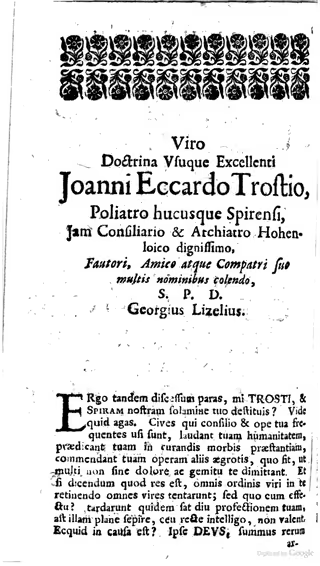
Georg Litzel addresses this commentary to Johann Eckhard Trost as Trost leaves his post as town physician of Speyer to become a councillor and court physician of Hohenlohe. Litzel had intended to supplement Thomas Bartholin’s De medicis poetis. He instead chose a narrower subject, physicians who rendered Scripture in verse. His dedicatory letter describes a list of fifty men and says that he gives the titles, places and dates of their books rather than their lives. The entries cover Latin and Greek verse and biblical paraphrases in English and other vernacular languages.
This copy also contains De poetis consiliariis S. Codicis interpretibus, printed at Speyer in 1744 and dedicated to Christian Gottlieb von Passern, a Hessian councillor. Litzel describes its sixty-six poets as jurists and statesmen. A German appendix, also printed in 1744, gives a letter that Philip, Landgrave of Hesse, sent to Johann Sturm at Strasbourg on 12 July 1561. Philip asks about lodging and board for his sons, first with Sturm and then with Master Prothasius Sopherus. Litzel dedicates the printed letter to Johann Jacob Gottlieb von Passern on 30 May 1744. The letter’s title page names Litzel as conrector of the Gymnasium at Speyer.
| Date | Place | Work | Notes |
|---|---|---|---|
| Before 1743 | De medicis poetis By Thomas Bartholin | In his letter to Trost, Litzel describes Bartholin as a physician of Copenhagen who surveyed ancient and modern writers of medical verse. Litzel says that he first planned to supplement this dissertation, then chose physician-poets who interpreted Scripture. | |
| 1743 | Speyer | De poetis medicis S. Scripturae interpretibus commentariolus By Georg Litzel | The commentary and its letter to Johann Eckhard Trost. This scanned copy also binds the 1744 commentary on councillor-poets and the German edition of Philip of Hesse’s 1561 letter to Johann Sturm, printed by Christoph Heinrich Goethel at Speyer. |
Illustrations
7 illustrations. Each opens its page in the reader, zoomed to the picture.
-
-
-

ON PHYSICIAN POETS INTERPRETERS OF SACRED SCRIPTURE A BRIEF COMMENTARY. -
-

-
-