Hygieine, sive ars sanitatem conservandi: Étienne-Louis Geoffroy's Latin poem on the art of keeping health
By Étienne-Louis Geoffroy · Published 1771 · Latin with English translation · Wellcome Collection
Historian’s note. This text records the medicine of its own time, and later evidence has replaced most of it. It is not medical advice. We read it as history, and we ask what, if anything, connects it to medicine today.
Historian’s note. This text records the medicine of its own time, and later evidence has replaced most of it. It is not medical advice. We read it as history, and we ask what, if anything, connects it to medicine today. More on how we read old medical books
Hygieine, sive ars sanitatem conservandi
Étienne-Louis Geoffroy's Latin poem on the art of keeping health
By Étienne-Louis Geoffroy, 1771. The edition has the page scans, the Latin text, and an English translation.
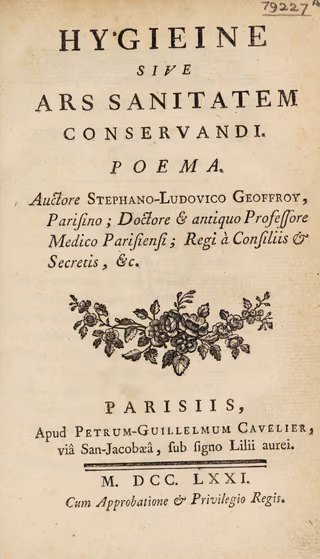
Étienne-Louis Geoffroy put the rules of health into Latin verse. His title page calls him a doctor and former professor of medicine at Paris and a counsellor and secretary to the king. In his notice to the reader he says that physicians count six things, outside the body’s own nature, that keep or harm health: air, food and drink, motion and rest, sleep and waking, excretions and retentions, and the passions of the mind. The poem has seven books. They treat air, food, drink, motion and rest, sleep and waking, things excreted and retained, and the passions of the mind.
Geoffroy writes that he composed the verses while the duties of his practice carried him slowly through the streets of Paris, and that few poets had gone before him on so rough a path. A verse dedication addresses Anne-Charles Lorry, doctor of medicine of Paris and his friend from their earliest years. It praises Lorry’s writings on melancholy, on foods and on Hippocrates. The royal censor Vernage approved the poem on 23 August 1771. Pierre-Guillaume Cavelier published it in Paris, and L. F. Delatour printed it.
Étienne-Louis Geoffroy is listed with the physician-poets in this library.
| Date | Place | Work | Notes |
|---|---|---|---|
| 1757 | Paris | Essai sur les alimens, pour servir de commentaire aux livres diététiques d'Hippocrate By Anne-Charles Lorry | Lorry’s commentary on the dietetic books of Hippocrates, printed by Vincent. Geoffroy’s dedication praises Lorry for teaching how foods, once digested, restore strength. |
| 1765 | Paris | De melancholia et morbis melancholicis By Anne-Charles Lorry | Lorry’s book on melancholy and melancholic diseases, published by P. G. Cavelier, who also published the Hygieine. Geoffroy’s dedication says that patients weighed down by melancholic grief gain strength from Lorry’s precepts. |
| 1771 | Paris | Hygieine, sive ars sanitatem conservandi. Poema By Étienne-Louis Geoffroy | An octavo of xi and 191 pages, published by Pierre-Guillaume Cavelier in the rue Saint-Jacques and printed by L. F. Delatour, with the approbation of 23 August 1771 and the royal privilege of 22 August 1771. |
Illustrations
20 illustrations. Each opens its page in the reader, zoomed to the picture.
-
-
-

-
-

-
-
HYGIENE OR THE ART OF PRESERVING HEALTH. -
-

-

-

-
-
-
-
-
End of the Fifth Book. -

-
-
-
Poems
43 poems, sorted by title.
- Aeris humidior sibi si conjunxerit æstum
- Aeris levitas & ipsius effectus. SI contrà vitro inclusus se trudat ad ima
- Affectus animi, vario quàm corda tumultu
- Digeſtionis mechaniſmus. PRINCIPIO bipatens alimenti janua maſſam
- DILECTISSIMO COLLEGÆ ANNÆ-CAROLO LORRY, DOCTORI MEDICO PARISIENSI.
- Diviſio totius operis. QUALIS conveniat variis mortalibus aer
- DUM cumulos auri fossâ tellure requirit,
- DUM properans sequor incœptum , tritoque viarum
- DUM stabili terras primùm libravit in axe
- DUM tener ingreditur vitam sine viribus infans ,
- Effectus amoris. CONGENITUS nobis, latitans sub pectore nostro
- Effectus gravitatis & elaterii. AT quæ sanguineas hominum mens vertit ad
- Gaudium. LÆTA tibi festivam agitant si gaudia mentem,
- HÆC timidus vates dum carmine pando salubri,
- HIC stimulo leviter fibras impellit amico,
- Hoc fuge , nî justo fibrarum robore pollens
- LIBER QUARTUS DE MOTU ET QUIETE.
- LIBER QUINTUS. DE SOMNO ET VIGILIA.
- LIBER SECUNDUS. DE CIBO.
- LIBER SEPTIMUS DE ANIMI PATHEMATIS.
- LIBER SEXTUS. DE EXCRETIS ET RETENTIS.
- LIBER TERTIUS. DE POTU.
- MUSA mihi memora tenui quid in aere lædat,
- Nata levare sitim, Cerasus lymphâ inficit ora
- Nempe gravi pollens muco, non fragrat odore
- Non nisi temporibus coeunt animantia certis;
- Non satis est epulas dente attrivisse voraci ,
- NON tamen ancipiti torquens formidine mentem,
- Nonne vides granis quot constet acervus arenæ
- NUNC me defessum ingluvies hominumque libido
- Nunc radiis tenebras pellit, nimbisque remotis
- Olera & herbæ. DUM nova progenies terris immissa parentum,
- PRÆTEREA, firmum si vis servare vigorem,
- PRINCIPIÒ exercenda gravi non membra labore ,
- Quantitas Cibi. MULTAS ille dapes largam detrudit in alvum
- REGULA nunc superest circa somnum ultima,
- Somnus nimius. ERGO age, si segnes nimius sopor occupat artus,
- TANTA quidem soli tentant adscribere Baccho
- Tantaque vesanas hominum dementia mentes
- Urina pauca. SCILICET urinæ nunquam vesica laborat
- Urinæ dotes. NEC minus urinæ dotes diversaque signa
- Veneris mo- deratæ com- moda. AT tu blanda parens, hominum jucunda voluptas
- Vina varia. AT veluti vultu & diverso discrepat ore