Hover or tap a word to see its match.
Part 1
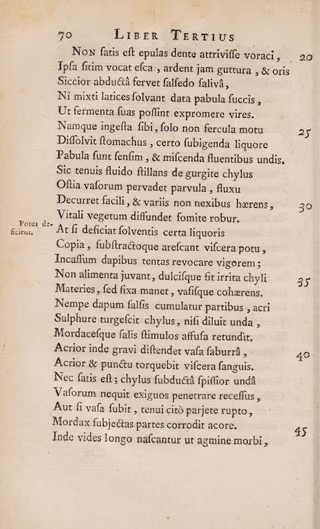
It is not enough to have ground down the feast with a voracious tooth;
Food itself invites thirst, the throat already burns, and the drier
Saltiness of the mouth seethes when saliva is withdrawn,
Unless mingled liquids dissolve the given nourishment with their juices,
So that the ferments may be able to exert their powers.
For the stomach does not dissolve the dishes ingested into it
By motion alone; the nourishment must be gradually worked down
By a definite liquid, and mixed with flowing waters.
Thus the thin chyle, trickling from the fluid stream,
Will pass through the tiny mouths of the vessels, will run down
With an easy flow, and, not clinging in various entanglements,
Will diffuse a lively strength with its vital fuel.
But if a definite supply of dissolving liquid should fail,
And the viscera grow dry when drink is withheld,
In vain do you try to restore vigor with feasts;
Foods do not help, and the sweet matter of the chyle
Becomes useless, but remains fixed and adhering to the vessels.
For indeed it is heaped up with the salty particles of the feasts, and the chyle
Swells with acrid sulphur, unless water dilutes it,
And, poured upon it, blunts the biting stings of the salt.
More acrid therefrom, it will distend the vessels with heavy saburra,
And the blood, more acrid, will torture the viscera with its pricking.
Nor is this all; the chyle, thicker when water is withdrawn,
Cannot penetrate the tiny recesses of the vessels,
Or if it enters the vessels, the thin wall is quickly ruptured,
And, biting, it corrodes the underlying parts with its acidity.
Thence you see how diseases are born in a long train,
Non ſatis eſt epulas dente attriviſſe voraci ,
Ipſa ſitim vocat eſca , ardent jam guttura , & oris
Siccior abductâ fervet ſalſedo ſalivâ ,
Nî mixti latices ſolvant data pabula ſuccis ,
Ut fermenta ſuas poſſint expromere vires.
Namque ingeſta ſibi , ſolo non fercula motu
Diſſolvit ſtomachus , certo ſubigenda liquore
Pabula ſunt ſenſim , & miſcenda fluentibus undis.
Sic tenuis fluido ſtillans de gurgite chylus
Oſtia vaſorum pervadet parvula , fluxu
Decurret facili , & variis non nexibus hærens ,
Vitali vegetum diffundet fomite robur.
At ſi deficiat ſolventis certa liquoris
Copia , ſubſtractoque areſcant viſcera potu ,
Incaſſum dapibus tentas revocare vigorem ;
Non alimenta juvant , dulciſque fit irrita chyli
Materies , ſed fixa manet , vaſiſque cohærens.
Nempe dapum ſalſis cumulatur partibus , acri
Sulphure turgeſcit chylus , niſi diluit unda ,
Mordaceſque ſalis ſtimulos affuſa retundit.
Acrior inde gravi diſtendet vaſa ſaburrâ ,
Acrior & punctu torquebit viſcera ſanguis.
Nec ſatis eſt ; chylus ſubductâ ſpiſſior undâ
Vaſorum nequit exiguos penetrare receſſus ,
Aut ſi vaſa ſubit , tenui citò parjete rupto ,
Mordax ſubjectas partes corrodit acore.
Inde vides longo naſcantur ut agmine morbi ,
Part 2
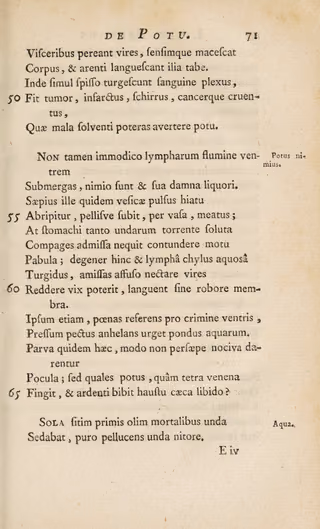
strength perishes from the viscera, and gradually the body
wastes away, and the flanks languish with a parching consumption.
Thence at once the plexuses swell with thick blood,
A tumor is formed, infarction, scirrhus, and bloody
cancer,
Evils which you could have averted with a dissolving drink.
Yet you should not submerge the belly in an immoderate river
of waters,
for excessive liquid also has its own harms.
Quite often indeed it is driven out and carried away through the opening
of the bladder, or enters, through the vessels, the passages of the skin;
But the structure of the stomach, loosened by so great a torrent of waters,
cannot by its motion mash the admitted
food; hence the chyle, degenerate and swollen with watery lymph,
will scarcely be able to restore lost strength with its poured-in nectar,
and the limbs languish without vigor.
Even the panting chest itself, paying the penalty for the crime of the belly,
is oppressed and burdened by the weight of the waters.
Small things indeed are these, provided that harmful cups were not very often
given; but what drinks, what foul poisons
does blind lust fashion and drink with an ardent draught? Excessive drink.
Water alone once quenched the thirst of the first mortals,
water shining transparently with pure brightness. Water.
Viſceribus pereant vires, ſenſimque maceſcat
Corpus, & arenti langueſcant ilia tabe.
Inde ſimul ſpiſſo turgeſcunt ſanguine plexus,
Fit tumor, infarctus, ſchirrus, cancerque cruen-
Quæ mala ſolventi poteras avertere potu.
Non tamen immodico lympharum flumine ven-
Submergas, nimio ſunt & ſua damna liquori.
Sæpius ille quidem veſicæ pulſus hiatu
Abripitur, pelliſve ſubit, per vaſa, meatus;
At ſtomachi tanto undarum torrente ſoluta
Compages admiſſa nequit contundere motu
Pabula; degener hinc & lymphâ chylus aquosâ
Turgidus, amiſſas affuſo nectare vires
Reddere vix poterit, languent ſine robore mem-
Ipſum etiam, pœnas referens pro crimine ventris,
Preſſum pectus anhelans urget pondus aquarum.
Parva quidem hæc, modo non perſæpe nociva da-
rentur
Pocula; ſed quales potus, quâm tetra venena
Fingit, & ardenti bibit hauſtu cæca libido? Potus nimius.
Sola ſitim primis olim mortalibus unda
Sedabat, puro pellucens unda nitore. Aqua.
Part 3
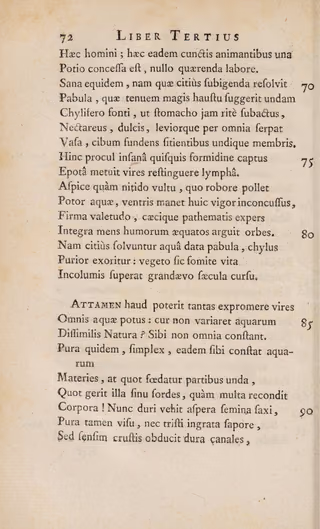
This to man, this same single drink to all living beings
Has been granted, to be sought with no labor.
Wholesome indeed, for what more quickly dissolves the food
To be digested, what supplies by its draught a thinner wave
To the chyle-bearing fount, so that, now duly digested by the stomach,
Nectareous, sweet, and lighter, it may creep through all
The vessels, pouring nourishment everywhere to the thirsty limbs?
Far hence be whoever, seized by an insane dread,
Fears to quench his strength by drinking lymph.
Behold with how bright a countenance, with what strength
The drinker of water thrives; the vigor of his belly remains unshaken,
His health firm, and, free from blind passions,
His sound mind proves the balanced courses of his humors.
For food given with water is more quickly dissolved, a purer chyle
Arises: with such vigorous fuel, life,
Unharmed, outlasts the ages in a long-lived course.
YET not every draught of water will be able to put forth
Such great powers: why should not the dissimilar Nature
Of waters vary? Not all things are consistent with themselves.
Pure indeed, simple, and self-consistent is the
Matter
Of waters, yet by how many particles is the wave defiled,
How much filth does it carry in its bosom, how many bodies
Does it conceal! Now it bears the rough seeds of hard stone,
Though pure to the sight, nor unpleasant with a harsh taste,
Yet being hard, it gradually coats the channels with crusts,
Hæc homini; hæc eadem cunctis animantibus una
Potio conceſſa eſt, nullo quærenda labore.
Sana equidem, nam quæ citiùs ſubigenda reſolvit
Pabula, quæ tenuem magis hauſtu ſuggerit undam
Chylifero fonti, ut ſtomacho jam ritè ſubactus,
Nectareus, dulcis, leviorque per omnia ſerpat
Vaſa, cibum fundens ſitientibus undique membris.
Hinc procul inſanâ quiſquis formidine captus
Epotâ metuit vires reſtinguere lymphâ.
Aſpice quàm nitido vultu, quo robore pollet
Potor aquæ, ventris manet huic vigor inconcuſſus,
Firma valetudo, cæcique pathematis expers
Integra mens humorum æquatos arguit orbes.
Nam citiùs ſolvuntur aquâ data pabula, chylus
Purior exoritur : vegeto ſic fomite vita
Incolumis ſuperat grandævo ſæcula curſu.
ATTAMEN haud poterit tantas expromere vires
Omnis aquæ potus : cur non variaret aquarum
Diſſimilis Natura? Sibi non omnia conſtant.
Pura quidem, ſimplex, eadem ſibi conſtat aqua-
rum
Materies, at quot fœdatur partibus unda,
Quot gerit illa ſinu ſordes, quàm multa recondit
Corpora ! Nunc duri vehit aſpera ſemina ſaxi,
Pura tamen viſu, nec triſti ingrata ſapore,
Sed ſenſim cruſtis obducit dura canales,
Part 4
Silently deposits fine sand at the bottom,
Does not dissolve salt, and, slowly heated, scarcely
Cooks pulse; let anyone shun this who desires
To keep the vigor of his stomach
Safe, and fears to feel the savage gripes
Of the belly from a hardened stone.
Now water, heavy with greasy mud and fetid
With a foul taste, upsets the viscera with its filthy dregs,
And taints the pure chyle with foul putridity.
Why should I mention noxious metals mixed with lymph?
Why rotting masses of wood, and grasses dissolved
In corruption, by which the brightness of the waters is spoiled? His urn
The indignant God of the spring casts away, and the anxious crowd
Of Nymphs deserts the banks, their ancient homes.
Often indeed Medicine, with her healing right hand, pours out
For earth-born men water teeming with salts and various metals,
And, cleansing the viscera with the drunk lymph,
Unites the fountain Nymphs to herself in an auspicious bond:
Latium boasted of the cold baths of Baiae, the warm springs,
And fountains famous for their varied remedies;
Nor has Nature grudged such gifts to the Gauls.
Yet what sober man would dare with a calm countenance
To drink a liquid swelling with arsenic or copper?
Moreover, waters celebrated for their Apolline inspirations,
Imbued with sulphurous iron, and potent with salts,
When accumulated too often in a healthy body, put forth
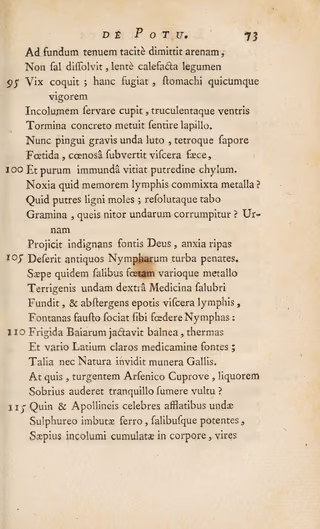
Ad fundum tenuem tacitè dimittit arenam,
Non ſal diſſolvit, lentè calefacta legumen
Vix coquit; hanc fugiat, ſtomachi quicumque
vigorem
Incolumem ſervare cupit, truculentaque ventris
Tormina concreto metuit ſentire lapillo.
Nunc pingui gravis unda luto, tetroque ſapore
Fœtida, cœnosâ ſubvertit viſcera fæce,
Et purum immundâ vitiat putredine chylum.
Noxia quid memorem lymphis commixta metalla?
Quid putres ligni moles; reſolutaque tabo
Gramina, queis nitor undarum corrumpitur? Ur-
nam
Projicit indignans fontis Deus, anxia ripas
Deſerit antiquos Nympharum turba penates.
Sæpe quidem ſalibus fœtam varioque metallo
Terrigenis undam dextrâ Medicina ſalubri
Fundit, & abſtergens epotis viſcera lymphis,
Fontanas fauſto ſociat ſibi fœdere Nymphas:
Frigida Baiarum jactavit balnea, thermas
Et vario Latium claros medicamine fontes;
Talia nec Natura invidit munera Gallis.
At quis, turgentem Arſenico Cuprove, liquorem
Sobrius auderet tranquillo ſumere vultu?
Quin & Apollineis celebres afflatibus undæ
Sulphureo imbutæ ferro, ſalibuſque potentes,
Sæpius incolumi cumulatæ in corpore, vires
Part 5
put forth harmful ones, and become a poison instead of a remedy.
Do sound entrails truly need a medicated drink?
Can they endure the goads of a saline spring?
Pure things befit a healthy body; let him who is healthy and wishes to lead a long life take the purest
cups.
Therefore let water please you with a genuine brightness,
which neither torments the nostrils with odors, nor the mouth with taste,
but tickles the throat with a sweet sensation.
Let this water boil quickly from fires placed beneath it,
and once warmed, let it quickly return to its former rest:
let it not coat vessels with mud, nor dissolve soap
with difficulty, and let it cook legumes with a swift heat.
Such will be the water snatched from the winding eddy of a river,
or leaping from the pure abyss of a spring, which the sun
looks upon with its rays, thinned by a perennial course:
such water the Seine pours forth in its happy course;
with its health-bringing liquor it refreshes Parisian
breasts, and with its subtle nectar draws forth the keenness of the mind,
pure like the wave of Phoebus's Aganippe.
Hence Lutetia flourishes so greatly in study and in various
arts, and thence the kindly Mother cherishes so many Poets in her bosom. The best water.
Depromunt nocuas, fit pro medicamine virus.
Integra numquid egent medicato viſcera potu ?
Num fontis ſtimulos poſſunt perferre ſalini ?
Pura decent ſanum corpus, puriſſima captet
Pocula, qui ſanus longam vult ducere vitam.
Inde tibi ſincero arrideat unda nitore,
Quæ, non halitibus nares, non ora ſapore,
Torqueat, at dulci titillet guttura ſenſu.
Hæc citò ſuppoſitis ferveſcat ab ignibus unda,
Reddaturque citò antiquæ tepefacta quieti:
Hæc non vaſa luto obducat, non ſmegma reſolvat
Difficilè, celerique legumina concoquat æſtu.
Talis erit fluvii ſinuoſo vortice rapta,
Aut fontis ſaliens puro de gurgite, quam ſol
Proſpiciat radiis, curſu tenuata perenni:
Talem felici diffundit Sequana curſu;
Illa ſalutifero recreat Pariſina liquore
Pectora, ſubtili depromit acumina mentis
Nectare, pura velut Phœbææ Aganippidos unda.
Hinc tantùm ſtudio, variiſque Lutetia floret
Artibus, inde ſinu tantos fovet alma Poetas. Aqua optima.