Hover or tap a word to see its match.
Part 1
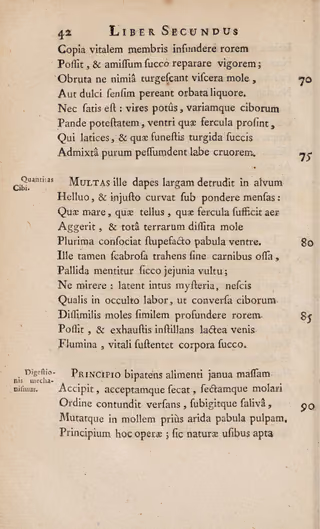
Mechanism of digestion. First, the double-opening doorway receives the mass of nourishment,
and having received it, cuts it, and turning what is cut, crushes it
with the row of molars, and kneads it with saliva,
and changes the previously dry food into a soft pulp.
This is the beginning of the work; thus fitted for nature's uses,
Accipit, acceptamque ſecat, ſectamque molari
Ordine contundit verſans, ſubigitque ſalivâ,
Mutatque in mollem priùs arida pabula pulpam.
Principium hoc operæ; ſic naturæ uſibus apta
Part 2
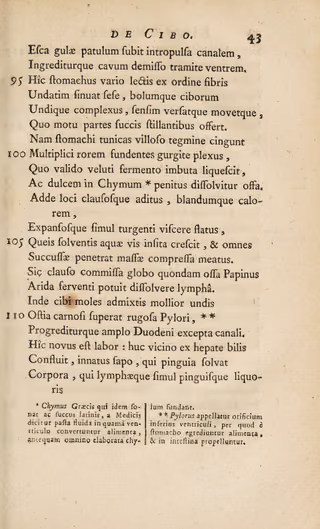
the food, pushed inward, enters the wide canal of the gullet,
And by a descending path enters the hollow belly.
Here the stomach, with fibers gathered in a varied order,
Bends itself in waves, and embracing the bolus of food
On all sides, gradually turns and moves it,
By which motion it presents the parts to the dripping juices.
For plexuses, pouring forth dew from a manifold eddy,
Surround the coats of the stomach with a villous covering,
Imbued with which, as if by a strong ferment, the morsel melts,
And is thoroughly dissolved into sweet chyme. *
Add both the closed passages of the place, and the gentle
heat,
And at the same time the expanded airs in the swelling viscus,
By which the innate force of the dissolving water grows, and compressed,
Penetrates all the passages of the shaken mass.
Thus Papin was once able to dissolve dry bones,
Committed to a closed globe, with boiling lymph.
Thence the mass of food, softer from the mingled waves,
Surmounts the wrinkled openings of the fleshy pylorus, * *
And advances, received by the ample canal of the duodenum.
Here is a new labor: hither from the neighboring liver bile
Flows together, an innate soap, which may dissolve fatty
Bodies, and which of both lymph and fatty liquor
Eſca gulæ patulum ſubit intropulſa canalem ,
Ingrediturque cavum demiſſo tramite ventrem.
Hîc ſtomachus vario lectis ex ordine fibris
Undatim ſinuat ſeſe , bolumque ciborum
Undique complexus , ſenſim verſatque movetque ,
Quo motu partes ſuccis ſtillantibus offert.
Nam ſtomachi tunicas villoſo tegmine cingunt
Multiplici rorem fundentes gurgite plexus ,
Quo valido veluti fermento imbuta liqueſcit ,
Ac dulcem in Chymum * penitus diſſolvitur offa.
Adde loci clauſoſque aditus , blandumque calo-
rem ,
Expanſoſque ſimul turgenti viſcere flatus ,
Queis ſolventis aquæ vis inſita creſcit , & omnes
Succuſſæ penetrat maſſæ compreſſa meatus.
Sic clauſo commiſſa globo quondam oſſa Papinus
Arida ferventi potuit diſſolvere lymphâ.
Inde cibi moles admixtis mollior undis
Oſtia carnoſi ſuperat rugoſa Pylori , * *
Progrediturque amplo Duodeni excepta canali.
Hîc novus eſt labor : huc vicino ex hepate bilis
Confluit , innatus ſapo , qui pinguia ſolvat
Corpora , qui lymphæque ſimul pinguiſque liquo-
ris
Part 3
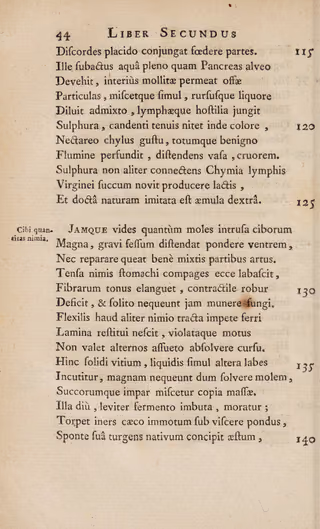
And unites in a peaceful bond the discordant parts.
That bile, tempered by the water which the pancreas in a full channel
Carries down, permeates inwardly the particles of the softened
Morsel, mixes them together, and again with the admixed
Liquid dilutes them, and joins the hostile sulphurs to the lymph;
Thence the thin chyle shines with a dazzling white color,
And a nectar-like taste, and with a kindly stream
Bespreads the whole blood, distending the vessels.
Not otherwise does Chemistry, connecting sulphurs with lymph,
Know how to produce the juice of virgin's milk,
And as a rival has imitated nature with a skilled right hand.
Excessive quantity of food.
AND now you see how much a great mass of food thrust in
Distends the weary belly with its heavy weight,
Nor is able to repair the limbs with well-mixed parts.
Stretched too far, behold, the structure of the stomach gives way,
The tone of the fibers languishes, their contractile strength
Fails, and they can no longer perform their accustomed duty.
Not otherwise does a flexible blade of iron, drawn with too much force,
Know not how to be restored, and once violated, is unable
To complete its alternating motions in its accustomed course.
Hence comes a defect of the solid part, while at the same time another blemish
Is inflicted on the liquids, while they are unable to dissolve the great mass,
And an unequal supply of juices is mixed with the lump.
That mass delays for a long time, only lightly imbued with ferment;
The sluggish, unmoved weight lies torpid within the dark viscus;
Swelling of its own accord, it conceives a native heat,
Diſcordes placido conjungat fœdere partes.
Ille ſubactus aquâ pleno quam Pancreas alveo
Devehit, interiùs mollitæ permeat offæ
Particulas, miſcetque ſimul, rurſuſque liquore
Diluit admixto, lymphæque hoſtilia jungit
Sulphura, candenti tenuis nitet inde colore,
Nectareo chylus guſtu, totumque benigno
Flumine perfundit, diſtendens vaſa, cruorem.
Sulphura non aliter connectens Chymia lymphis
Virginei ſuccum novit producere lactis,
Et doctâ naturam imitata eſt æmula dextrâ.
JAMQUE vides quantùm moles intruſa ciborum
Magna, gravi feſſum diſtendat pondere ventrem,
Nec reparare queat benè mixtis partibus artus.
Tenſa nimis ſtomachi compages ecce labaſcit,
Fibrarum tonus elanguet, contractile robur
Deficit, & ſolito nequeunt jam munere fungi.
Flexilis haud aliter nimio tracta impete ferri
Lamina reſtitui neſcit, violataque motus
Non valet alternos aſſueto abſolvere curſu.
Hinc ſolidi vitium, liquidis ſimul altera labes
Incutitur, magnam nequeunt dum ſolvere molem,
Succorumque impar miſcetur copia maſſæ.
Illa diù, leviter fermento imbuta, moratur;
Torpet iners cæco immotum ſub viſcere pondus,
Sponte ſuâ turgens nativum concipit æſtum,
Part 4
putrefies, and taints the chyle with a foul putridity.
Often too, incautiously entrusted to the wide-open palate,
whole morsels of food are rolled down the headlong
throat, not broken down by chewing and the pure fountain
of saliva; the fluids cannot penetrate the resistant mass,
nor can the powers of the stomach dissolve so great a bulk.
Thence comes the distress of the belly; hence, thicker than muddy water,
arises the chyle, which the mouths of the veins refuse to admit
into their narrow channel; clinging to the walls,
it blocks its own way, and gradually wastes away
the body, swelling in vain with a worn-out weight:
or if, compressed at last, some tiny portion of chyle
enters the lactiferous passages, it infects the blood
with its viscosity, and, mixed in, thickens the pure fluids.
With their course suspended, they cling in the bends
of the vessels, and, driven by repeated beats into the narrow
windings, they block the vessels with a hard mash.
Why should I recount the numerous diseases from such an origin,
and nourishment turned into a source of fierce pain?
First the guilty part suffers, and pays for its offense with a fierce
punishment; now the anxious stomach shudders with a constricting
weight, soon, tottering in an uncertain whirl,
it is wrenched, and darkens the senses with a black mist.
Thus nature strives either to repel the heavy mass by vomiting,
or to thrust it toward the lowest part of the belly.
That first way indeed is safer, the other far
inferior; available if neither succeeds, the enemy
Putret, & informi vitiat putredine chylum.
Sæpe etiam incautè patulo commiſſa palato,
Integra præcipiti volvuntur fruſta ciborum
Gutture, non morſu, puroque ſubacta ſalivæ
Fonte ; reluctantem nequeunt penetrare liquores,
Nec tantam ſtomachi vires diſſolvere maſſam.
Inde labor ventris ; cænosâ hinc craſſior undâ
Exoritur chylus, tenui quem admittere ductu
Oſcula venarum renuant , parjetibus hærens
Ipſe viam ſibi præcludit, ſenſimque maceſcit
Necquicquam effœto turgeſcens pondere corpus :
Aut ſi lactiferos tandem compreſſa meatus
Quantula pars chyli ingreditur , lentore cruorem
Inficit, & ſpiſſat puros admixta liquores.
Illi ſuſpenſo vaſorum in flexibus hærent
Tramite, & in tenues repetitis ictibus acti
Anfractus, durâ obturant farragine vaſa.
Quid tali referam numeroſum ab origine morbum,
Pabulaque in ſævi fontem converſa doloris.
Pars primùm patitur rea , delictumque feroci
Supplicio ſolvit ; modò ſtringenti anxius horret
Pondere ventriculus , dubio mox vortice nutans
Vellitur, obſcuratque atrâ caligine ſenſus.
Sic natura gravem vomituve repellere maſſam
Nititur, aut imum verſus protrudere ventrem.
Tutior illa quidem via prima eſt , altera longè
Inferior ; quod ſi neutrum ſucceſſerit, hoſtis
Part 5
creeps with hidden forces, and beneath the sluggish belly
wages lethal battles against all the limbs.
For soon the vessels, swelling with crude blood,
supply to the stomach, from a vapid source, an exhausted
liquor; hence arises new tinder, and at the same time another
cause of disease, and plague succeeds plague in an unbroken circle.
Thus an immense throng of diseases attacks the various parts
and diverse viscera with slow blows.
Behold how many chronic languors cling within with fixed
roots, how much, hiding in the deepest seat,
they creep unknown, and at last torture with a sudden onset,
and give sure signs of themselves, when no hope of safety
remains, the reproach of Physicians and the scourge of the
art.
The unhappy sick man tosses his limbs on the couch, and lays them down again,
and, his viscera agitated by internal flames,
at night he seeks the day with groaning, and blames the long
span of the day, hoping for rest beneath the night.
None is given to the wretch; the disease feeds upon the innermost recesses
of life, and, bursting through the barriers with increased fury,
inflicts upon the unfortunate just punishments for their crime.
Gluttony breeds these diseases, cruel pleasure pours forth
these gifts, while the sober man by an easy art
leads a safe life with constant strength.
Viribus occultis ſerpit, pigrâque ſub alvo
Prælia molitur totos lethalia in artus.
Namque brevì crudo turgentia vaſa cruore
Effætum ſtomacho, vapido de fonte, liquorem
Suppeditant; novus hinc fomes, ſimul altera morbi
Cauſa, lueſque luem haud intermiſſo excipit orbe.
Sic varias partes diverſaque viſcera lentis
Ictibus aggreditur morborum immenſa caterva.
Aſpice quot fixis intus radicibus hærent
Languores chronici, quantùm imâ ſede latentes
Ignoti ſerpunt, ſubito tandem impete torquent,
Signaque certa ſui præbent, cum nulla ſalutis
Spes manet, opprobrium Medicorum artiſque fla-
gellum.
Membra thoro quatit infelix, iterumque reponit
Æger, & internis agitatus viſcera flammis,
Nocte diem gemitu quærit, longumque diei
Incuſat ſpatium, ſperans ſub nocte quietem.
Nulla datur miſero; vitæ penetralia morbus
Paſcitur, atque aucto perrumpens clauſtra furore,
Infauſtis infert juſtas pro crimine pœnas.
Hos parit ingluvies morbos, hæc ſæva voluptas
Munera profundit, facili dum ſobrius arte
Incolumem ducit conſtanti robore vitam.