Hover or tap a word to see its match.
Part 1
NOW whither do the gluttony and lust of men
snatch me, exhausted as I am? With a parched throat
the drunken tippler gulps down liquors boiling with ethereal fire,
trying in vain to stimulate his blunted palate.
To him sweet wine has no savor, nor do the gifts of Bacchus
please him; he craves drinks that scatter flames through his limbs,
and in his madness drinks poison with a joyful face.
To be sure, that liquor thickens all the blood throughout
the vessels, and wrinkles the viscera with scorched fibers.
For, touched by the dreadful liquor, the dry fiber stiffens,
and stands motionless, benumbed; then, turned into a hard
lump,
the blood itself sticks in vain at the furthest channels:
the lymph, its body congealed, is turned into gypsum.
Hence the stomach languishes, full of sluggish phlegm;
thence the limbs tremble, the mind grows torpid, the tongue falters,
and before long the humor, unable to be mixed, overflows.
Then, dragging his emaciated bones under rough skin,
the drunkard knows, alas, all too well the waters which he dreaded.
Let him alone taste ethereal drinks and these cups
who feels the fierce cold beneath the star of Arcturus:
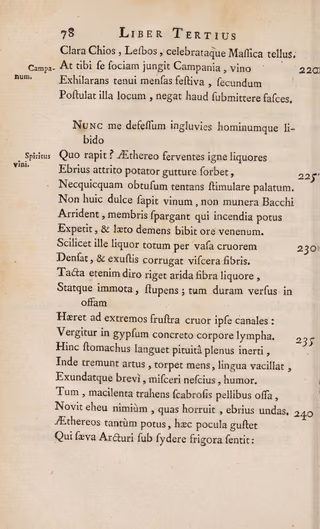
NUNC me defeſſum ingluvies hominumque li-
bido
Quo rapit? Æthereo ferventes igne liquores
Ebrius attrito potator gutture ſorbet,
Necquicquam obtuſum tentans ſtimulare palatum.
Non huic dulce ſapit vinum, non munera Bacchi
Arrident, membris ſpargant qui incendia potus
Expetit, & læto demens bibit ore venenum.
Scilicet ille liquor totum per vaſa cruorem
Denſat, & exuſtis corrugat viſcera fibris.
Tacta etenim diro riget arida fibra liquore,
Statque immota, ſtupens; tum duram verſus in
offam
Hæret ad extremos fruſtra cruor ipſe canales:
Vergitur in gypſum concreto corpore lympha.
Hinc ſtomachus languet pituitâ plenus inerti,
Inde tremunt artus, torpet mens, lingua vacillat,
Exundatque brevì, miſceri neſcius, humor.
Tum, macilenta trahens ſcabroſis pellibus oſſa,
Novit eheu nimiùm, quas horruit, ebrius undas.
Æthereos tantùm potus, hæc pocula guſtet
Qui ſæva Arcturi ſub ſydere frigora ſentit:
Part 2
ON DRINK.
But you, whom Phoebus greets from a nearer sky,
Restrain rather with an acidic liquid the boiling
Motions of the sanguine fluid; the expanded mass
Of blood swells with heat, which this liquid binds
With its sour juice, and checks the swollen heats of bile.
By no other art did the Roman soldier drive diseases
From the camps; secure by drinking vinegar,
He felt neither the heat nor, more to be feared than a hostile band,
The troops of diseases, beneath a hot sky.
Thence the powers of acid avail, but medicines must be given
With a sparing hand; and acid by excessive virtue would do harm.
Why should I relate the perverse ruin of the stomach hence,
With the viscus constricted, and the bloody sputum from a torn lung?
While this liquid plucks at the fibers through repeated use.
Nor is this peculiar to acids; sugars too in an excessive dose
Disturb the stomach, and weary it with a sweet viscosity. Acidic liquids.
AND NOW you see how much with varied drink
Mortals stimulate their throats; nothing does Luxury not dare
To turn over with a sagacious hand; grains, fruits,
Seeds, roots, leaves, and woods she turns about;
Each land boasts its own drinks, its own cups:
France celebrates the Burgundian liquor, Normandy the thick
Juice of apples, by which the stomach is often
Weighed down, but by which in phthisical fibers the weak Cider.
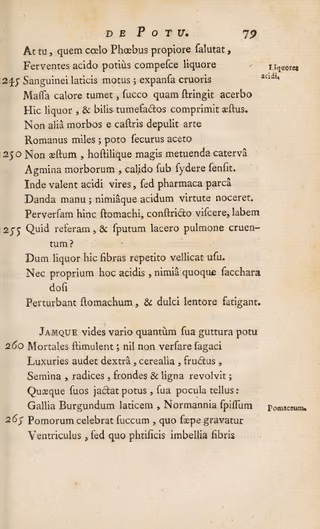
At tu, quem cœlo Phœbus propiore ſalutat,
Ferventes acido potiùs compeſce liquore
Sanguinei laticis motus; expanſa cruoris
Maſſa calore tumet, ſucco quam ſtringit acerbo
Hic liquor, & bilis tumefactos comprimit æſtus.
Non aliâ morbos e caſtris depulit arte
Romanus miles; poto ſecurus aceto
Non æſtum, hoſtilique magis metuenda catervâ
Agmina morborum, calido ſub ſydere ſenſit.
Inde valent acidi vires, ſed pharmaca parcâ
Danda manu; nimiâque acidum virtute noceret.
Perverſam hinc ſtomachi, conſtricto viſcere, labem
Quid referam, & ſputum lacero pulmone cruen-
tum?
Dum liquor hic fibras repetito vellicat uſu.
Nec proprium hoc acidis, nimiâ quoque ſacchara
doſi
Perturbant ſtomachum, & dulci lentore fatigant. Liquores acidi.
JAMQUE vides vario quantùm ſua guttura potu
Mortales ſtimulent; nil non verſare ſagaci
Luxuries audet dextrâ, cerealia, fructus,
Semina, radices, frondes & ligna revolvit;
Quæque ſuos jactat potus, ſua pocula tellus:
Gallia Burgundum laticem, Normannia ſpiſſum
Pomorum celebrat ſuccum, quo ſæpe gravatur
Ventriculus, ſed quo phtiſicis imbellia fibris Pomaceum.
Part 3
chests of consumptives are strengthened; to the throats of the Dutch alone
beer is pleasing, and they spurn the Lenaean gifts.
That thin liquor, prepared with a light juice and a sure
fire, tempers the burning heat with its soothing
stream, and softens the praecordia with an harmless drink;
but shun the liquor fermenting with hops, or thick with gross
matter, for with its sluggish gluten such
beer blunts the stomach, and, Lethaean, offends the head
with a gloomy stupor. Let him take pure
cups, who wishes to lead his life with a vigorous body. Beer.
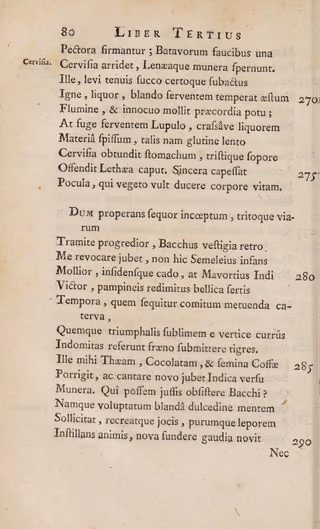
Pectora firmantur ; Batavorum faucibus una
Cerviſia arridet, Lenæaque munera ſpernunt.
Ille, levi tenuis ſucco certoque ſubactus
Igne, liquor , blando ferventem temperat æſtum
Flumine , & innocuo mollit præcordia potu ;
At fuge ferventem Lupulo , craſsâve liquorem
Materiâ ſpiſſum , talis nam glutine lento
Cerviſia obtundit ſtomachum , triſtique ſopore
Offendit Lethæa caput. Sincera capeſſat
Pocula , qui vegeto vult ducere corpore vitam. Cerviſia.