Hover or tap a word to see its match.
Part 1
Indeed, abounding in heavy mucus, the viscid matter
does not emit a fragrant odor, or if it scatters corpuscles,
With their blunt structure they scarcely strike the papillae of the nose,
While on the contrary, a light breeze scattering thin vapors,
Deeply imprints subtle atoms; the pores of the skin
Yield, and the fibrils are moved by the implanted particle.
Thus coffee, previously odorless, is attenuated by fire
And refreshes mortal hearts with a pleasant flavor.
Nor is this enough: the coffee bean, roasted by fiery vapor,
Is ground by iron, and boiled in hot lymph,
When warmed, it steeps the liquid mixed with the powder.
Now let the juice of laserpitium yield, and let the honeyed
Wines of our fathers yield, and the drinks celebrated in many a song;
Indeed, to the throng of heaven-dwellers the Junonian maiden
And the Trojan boy pour coffee from a hot vessel;
Bacchus himself is steeped in this changed nectar.
For Phoebus has enriched the new cups with a manifold gift,
And wished to infuse strength into the weak.
How could they not suffice? A bitterness commends the drink,
Not a morose one that ruins the throats of drinkers with a harsh
Taste, but one that stimulates the languishing viscera with a sweet
Spur, and, being lighter, entices the glad throat
Of the drinkers with a mingled sweetness.
Thus the belly dissolves the given food with strengthened
Vigor, phlegm does not beget sluggish saburra,
Nor do acid winds creep from the swollen viscus.
For coffee absorbs the serum, and with its saline parts
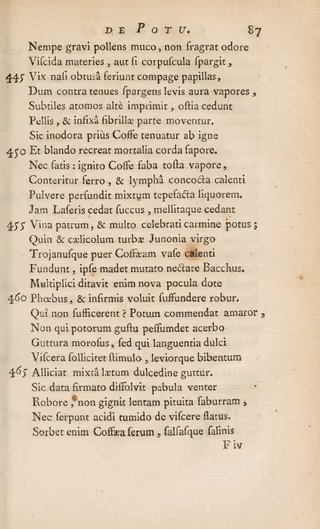
Nempe gravi pollens muco, non fragrat odore
Viſcida materies, aut ſi corpuſcula ſpargit,
Vix naſi obtusâ feriunt compage papillas,
Dum contra tenues ſpargens levis aura vapores,
Subtiles atomos altè imprimit, oſtia cedunt
Pellis, & infixâ fibrillæ parte moventur.
Sic inodora priùs Coffe tenuatur ab igne
Et blando recreat mortalia corda ſapore.
Nec ſatis: ignito Coffe faba toſta vapore,
Conteritur ferro, & lymphâ concocta calenti
Pulvere perfundit mixtum tepefacta liquorem.
Jam Laſeris cedat ſuccus, mellitaque cedant
Vina patrum, & multo celebrati carmine potus;
Quin & cælicolum turbæ Junonia virgo
Trojanuſque puer Coffæam vaſe calenti
Fundunt, ipſe madet mutato nectare Bacchus.
Multiplici ditavit enim nova pocula dote
Phœbus, & infirmis voluit ſuffundere robur.
Quî non ſufficerent? Potum commendat amaror,
Non qui potorum guſtu peſſumdet acerbo
Guttura moroſus, ſed qui languentia dulci
Viſcera ſollicitet ſtimulo, leviorque bibentum
Alliciat mixtâ lætum dulcedine guttur.
Sic data firmato diſſolvit pabula venter
Robore, non gignit lentam pituita ſaburram,
Nec ſerpunt acidi tumido de viſcere flatus.
Sorbet enim Coffæa ſerum, ſalſaſque ſalinis
Part 2
parts with its saline parts, while with its sulphur it dissolves the gluten,
and with its roasted particles drinks in the moisture deeply.
When in ancient times coffee once lay neglected,
if anyone suffering from a sluggish stomach
could not dissolve his food except with difficult effort,
it was a harsh rule to offer the sick bitter centaury,
and wormwood, unpleasant to the austere fibers;
the stomach refused dire medicines for a milder disease,
and threw up the foul remedies by vomiting:
but what remedy is gentler than coffee, what
nourishment aids the belly more? Truly this is Nepenthes,
straightway driving out bitter
pains once the mind is soothed.
Driven through the internal recesses of the vessels,
it rouses the parts with a stimulus, and thins down the fluid
of the blood; hence the blood, dispersed through the whole body,
now runs more quickly through the small vessels in a swift course,
and waters the winding channels of the brain with a copious shower:
add that the veins, swollen with expanded blood,
stretch the neighboring nerves with the weight imposed upon them,
and force them to repeat their accustomed vibration more quickly.
Hence the vigor of the body grows, hence too the keenness
of the mind
is exalted, and joys bedew the glowing countenance.
Many a poet is celebrated for distinguished song
to whom coffee is the Pegasean font, to whom it alone is Apollo:
nor does [Bacchus] kindle hearts more with his divine vapor
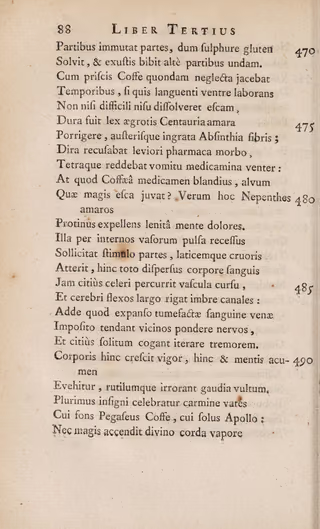
Partibus immutat partes, dum ſulphure gluten
Solvit, & exuſtis bibit altè partibus undam.
Cum priſcis Coffe quondam neglecta jacebat
Temporibus, ſi quis languenti ventre laborans
Non niſi difficili niſu diſſolveret eſcam,
Dura fuit lex ægrotis Centauria amara
Porrigere, auſteriſque ingrata Abſinthia fibris;
Dira recuſabat leviori pharmaca morbo,
Tetraque reddebat vomitu medicamina venter:
At quod Coffæâ medicamen blandius, alvum
Quæ magis eſca juvat? Verum hoc Nepenthes
amaros
Protinus expellens lenitâ mente dolores.
Illa per internos vaſorum pulſa receſſus
Sollicitat ſtimulo partes, laticemque cruoris
Atterit, hinc toto diſperſus corpore ſanguis
Jam citiùs celeri percurrit vaſcula curſu,
Et cerebri flexos largo rigat imbre canales:
Adde quod expanſo tumefactæ ſanguine venæ
Impoſito tendant vicinos pondere nervos,
Et citiùs ſolitum cogant iterare tremorem.
Corporis hinc creſcit vigor, hinc & mentis acu-
men
Evehitur, rutilumque irrorant gaudia vultum.
Plurimus inſigni celebratur carmine vates
Cui fons Pegaſeus Coffe, cui ſolus Apollo:
Nec magis accendit divino corda vapore
Part 3
Bacchus, and instills gentle loves into the mind.
Therefore, if sluggish phlegm weighs you down, do not refuse
the wholesome drink of coffee; indeed, the obese grossness of the belly
will collapse therefrom, sleep will not relax the languid
breasts after feasts, and, warmed by its soothing relief,
the belly with an urgent stimulus will demand new nourishment.
Yet just as she who pours forth an ambrosial fragrance far and wide,
who gleams with her neck dyed in Idalian blood,
and unfolds the splendid folds of her glowing flower,
the glory of spring, the Rose, queen of the meadows, conceals
thorns within, and pricks with a bitter wound:
and as the gift of the Gods, fitted for so many uses of life,
the iron structure supplies the useful plowshare
that can cleave the earth, and at the same time furnishes weapons
which scatter savage slaughter with repeated wounds;
so too the cups of coffee, most sweet to the taste, often
do harm, when they are given with no distinction to all
bodies, or drench the belly with an excessive flood.
They indeed gradually dry the overly moist viscera
with their hot particles; but if bodies already dry
grow stiff, or the nerves are stretched with excessive vigor,
and if the sensitive fiber vibrates with a rapid tremor,
how great a brood of evils! Thus fire is added to fire,
and from the kindling placed beneath, a flame is quickly gathered.
In vain, her hair wreathed with sleep-bringing poppy,
Night veils the weary earth in silent darkness;
restless limbs toss upon the couch, by sleep
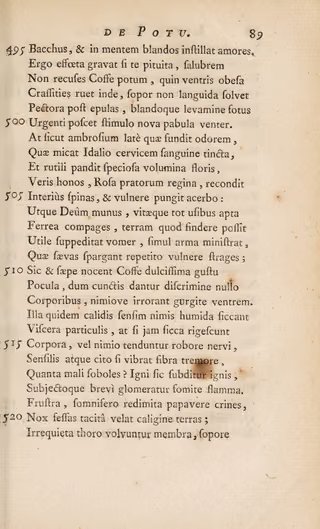
Bacchus, & in mentem blandos inſtillat amores.
Ergo effœta gravat ſi te pituita, ſalubrem
Non recuſes Coffe potum, quin ventris obeſa
Craſſities ruet inde, ſopor non languida ſolvet
Pectora poſt epulas, blandoque levamine fotus
Urgenti poſcet ſtimulo nova pabula venter.
At ſicut ambroſium latè quæ fundit odorem,
Quæ micat Idalio cervicem ſanguine tincta,
Et rutili pandit ſpecioſa volumina floris,
Veris honos, Roſa pratorum regina, recondit
Interiùs ſpinas, & vulnere pungit acerbo:
Utque Deûm munus, vitæque tot uſibus apta
Ferrea compages, terram quod findere poſſit
Utile ſuppeditat vomer, ſimul arma miniſtrat,
Quæ ſævas ſpargant repetito vulnere ſtrages;
Sic & ſæpe nocent Coffe dulciſſima guſtu
Pocula, dum cunctis dantur diſcrimine nullo
Corporibus, nimiove irrorant gurgite ventrem.
Illa quidem calidis ſenſim nimis humida ſiccant
Viſcera particulis, at ſi jam ſicca rigeſcunt
Corpora, vel nimio tenduntur robore nervi,
Senſilis atque cito ſi vibrat fibra tremore,
Quanta mali ſoboles? Igni ſic ſubditur ignis,
Subjectoque brevì glomeratur fomite flamma.
Fruſtra, ſomnifero redimita papavere crines,
Nox feſſas tacitâ velat caligine terras;
Irrequieta thoro volvuntur membra, ſopore
Part 4
Scarcely are the agitated eyes relaxed in light slumber, sleep
Flies away, and a heavy languor remains in the sickened body.
And how could Morpheus relax the threads of the nerves,
Which, stretched tight, the blood driven with a mighty force shakes?
Shaken by this throbbing, they grow stiff; scarcely can the weary
Limbs be moved, and a wandering tremor seizes the feeble
Joints.
Nor should you hope to restore strength with heaped-up feasts,
Which a false hunger demands, which the parched stomach in its cavity
Absorbs; thinned by dry heat,
The foods drench the small vessels with a pungent chyle,
Nor is the thirsty body refreshed by a soothing nectar.
Thus a parching wasting gradually consumes the viscera,
And the unsightly limbs grow lean as the fires are let in.
Indeed, those discomforts do not trouble one when coffee is taken,
If the hardy body is strengthened by a vigorous robustness,
And the threads of the nerves are shaken only by a heavy motion.
Yet do not on that account trust too much in your vigor,
Nor drench your viscera with a copious draught of coffee.
For although the strength stands intact in a vigorous body,
That accustomed vigor would soon collapse, a dry emaciation
Would wear away the parched body, and, constricted by the hot liquor,
The belly would refuse to dissolve the food.
Hence let him beware of indulging too much in the liquor of coffee
Who desires to prolong his life into an aged old age.
For whatever encloses great force in a small bulk,
Like a two-edged sword, never stands idle, great
Vix agitata levi ſolvuntur lumina, ſomnus
Avolat, atque gravis manet ægro corpore languor.
Et quî nervorum laxaret ſtamina Morpheus
Quæ diſtenta quatit valido cruor impete pulſus?
Hæc fremitu concuſſa rigent, vix laſſa moveri
Membra queunt, vagus imbelles tremor occupat
artus.
Nec dapibus ſperes cumulatis reddere robur
Quas mentita fames poſcit, quas aridus alveo
Abſorbet ſtomachus; ſicco tenuata calore,
Pabula pungenti perfundunt vaſcula chylo,
Nec blando ſitiens recreatur nectare corpus.
Torrida ſic ſenſim conſumit viſcera tabes,
Informeſque macent admiſſis ignibus artus.
Illa quidem ſumptâ haud vexant incommoda Coffe,
Si valido durum firmatur robore corpus,
Nervorumque gravi quaſſantur ſtamina motu.
Non tamen inde tuo nimiùm confide vigori,
Nec largo Coffe perfundas viſcera potu.
Nam licet intactæ vegeto ſtent corpore vires,
Ille brevì rueret ſolitus vigor, arida ſiccum
Detereret corpus macies, calidoque liquore
Conſtrictus, nollet diſſolvere pabula venter.
Hinc caveat Coffe nimis indulgere liquori
Qui ſenio cupit annoſo producere vitam.
Quidquid enim parvâ magnam vim mole recludit,
Anceps ut gladius, nunquam ſtat inutile, magnos
Part 5
effects it exerts; whether it restores diseased
bodies with a wholesome gift, or, spreading a foul taint
through the body, ruins bodies with its sharp poison.
Come then, do not pour forth the juice of coffee without distinction
to all, nor try to thin with this drying liquor
the disciples whom Phoebus has chosen for himself.
For whoever, wakeful day and night, indulges in the sacred
arts of Phoebus, and assiduously fatigues his mind
with studies, often pays for his learning
with manifold disease; rarely without detriment
to the body does the divine acuity of the intellect grow.
That vapor of the nerves, the thin breeze by which the limbs are moved,
by which the mind is connected to the gross frame,
the support and fuel of the soul, flows together from the whole body
to the brain; the stamens of the nerves languish, deprived of their liquor,
and no longer fulfill their duties.
Thus innate strength perishes, thus the limbs grow faint,
and the viscera, and the organs once roused by strong nerves.
But the stomach, rich with an ample cluster of nerves,
first languishes inert, and from its relaxed wall pours forth
a copious lymph on all sides in a flowing stream.
Coffee indeed absorbs this, and, provoking the viscera
with its stimuli, lulls the disease with a deceptive solace;
meanwhile the cause of the evil remains, the gripes rise up
renewed, nay, more and more parched by the dry drink,
Exerit effectus; ſeu morbida dote ſalubri
Corpora reſtauret, tetram ſeu corpore labem
Diffundens acri peſſumdet corpora viru.
Ergo age, non Coffe nullo diſcrimine ſuccum
Profundas cunctis, nec quos ſibi legit alumnos
Phœbus, ſiccanti tentes tenuare liquore.
Quiſquis enim ſacris Phœbi noctùque diùque
Artibus indulget vigilans, ſtudiiſque fatigat
Aſſiduus mentem, doctrinam ſæpe rependit
Multiplici morbo; rarò ſine detrimento
Corporis, ingenii divinum creſcit acumen.
Nervorum ille vapor, tenuis quâ membra moventur,
Quâ craſſæ compagi animus connectitur, aura,
Subſidium, fomeſque animæ, de corpore toto
Confluit ad cerebrum, languent orbata liquore
Stamina nervorum, nec jam ſua munia complent.
Sic perit innatum robur, ſic membra fatiſcunt,
Viſceraque, & validis quondam organa concita nervis.
At ſtomachus, nervorum amplo glomeramine dives,
Primùm languet iners, laxato e parjete largam
Undique diffundit mananti flumine lympham.
Hanc Coffæa quidem ſorbet, ſtimuliſque laceſſens
Viſcera, fallaci ſopit ſolamine morbum;
Cauſa mali manet interea, rediviva reſurgunt
Tormina, quin ſicco magis ac magis arida potu