Hover or tap a word to see its match.
Part 1
SUCH great gifts indeed do they try to ascribe to Bacchus alone,
who rejoice to pour libations to sweet Lyaeus;
That is not the praise of Bacchus; another abundance of praises remains for Bacchus,
nor would he become greater by a feigned honor.
He plucked various clusters from the teeming vine Wine.
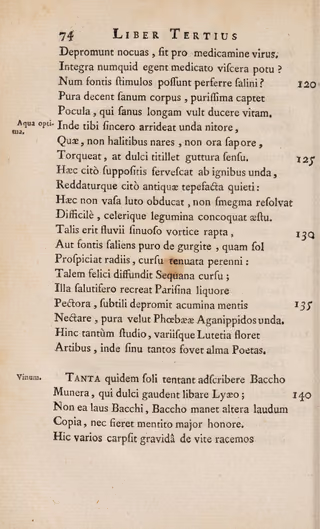
TANTA quidem ſoli tentant adſcribere Baccho
Munera, qui dulci gaudent libare Lyæo;
Non ea laus Bacchi, Baccho manet altera laudum
Copia, nec fieret mentito major honore.
Hic varios carpſit gravidâ de vite racemos Vinum.
Part 2
First, and pouring forth rivers from the pressed fruit,
He refreshed the breasts of the earth-born with an ambrosial drink.
That fervent liquor swells with subtle sulphur,
And strengthens the languishing viscera with a burning breeze:
At the same time it diffuses tartareous salts, and foods dissolved in water
Through the vessels; thus partly
Does wine nourish the body, and partly fortify it with a foreign strength.
You whose belly languishes in its native strength,
Or whose limbs are often broken by heavy labor,
Do not spare the offered pure wine, and the opportune gifts of Bacchus
Do not spurn, but with water quench the
Sulphureous fires of Lyaeus; let wine serve as a medicine.
Penetrating with its lightness into the internal recesses,
It will subdue the sanguineous mass with commingled sulphur,
And will firm the tone in the fibers, and by a quickened motion
Will elicit the nervous dew from the agitated blood.
Thence vigor is firmed throughout the whole body, strength
Is added, and the inflated vessels swell with expanded blood,
Nor does the mind itself indulge in its accustomed quiet.
These are the endowments, these the genuine gifts of sparing Lyaeus,
While on the contrary Bacchus rages with a foul train,
Whom not just reason rules, but pleasure alone.
Yet how could he follow counsel, and the innate commands of kindly
Reason, who in an immoderate river of wine
Infamously rejoices to submerge his heavenly mind?
Let this man pay the deserved penalties of his crime; the horrid
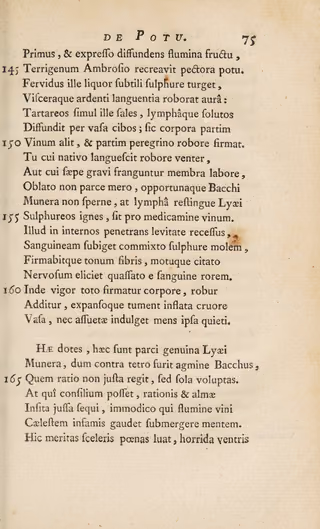
Primus, & expreſſo diffundens flumina fructu ,
Terrigenum Ambroſio recreavit pectora potu.
Fervidus ille liquor ſubtili ſulphure turget ,
Viſceraque ardenti languentia roborat aurâ:
Tartareos ſimul ille ſales , lymphâque ſolutos
Diffundit per vaſa cibos ; ſic corpora partim
Vinum alit , & partim peregrino robore firmat.
Tu cui nativo langueſcit robore venter ,
Aut cui ſæpe gravi franguntur membra labore ,
Oblato non parce mero , opportunaque Bacchi
Munera non ſperne , at lymphâ reſtingue Lyæi
Sulphureos ignes , ſit pro medicamine vinum.
Illud in internos penetrans levitate receſſus ,
Sanguineam ſubiget commixto ſulphure molem ,
Firmabitque tonum fibris , motuque citato
Nervoſum eliciet quaſſato e ſanguine rorem.
Inde vigor toto firmatur corpore , robur
Additur , expanſoque tument inflata cruore
Vaſa , nec aſſuetæ indulget mens ipſa quieti.
Hæ dotes , hæc ſunt parci genuina Lyæi
Munera , dum contra tetro furit agmine Bacchus ,
Quem ratio non juſta regit , ſed ſola voluptas.
At quî conſilium poſſet , rationis & almæ
Inſita juſſa ſequi , immodico qui flumine vini
Cæleſtem infamis gaudet ſubmergere mentem.
Hic meritas ſceleris pœnas luat , horrida ventris
Part 3
gripes, while the mass of food is hardened by the wine;
let this man, with the vessels of his brain distended with blood,
endure unaccustomed heats, and be weighed down by the heaviness
of his head; already tottering, let him draw stammering words from his mouth.
Nor is this enough; the time will come when sluggish gout
will torment his stiffened limbs with savage tortures,
and his wretched groin will be torn by a sharp stone:
such companions does heedless pleasure bring with itself.
But the wise man, never straying from the fixed boundary
of what is right, rejoices at times to drive away the sadness of his mind
with proffered unmixed wine; then, joyful with his friendly
guests, amid laughter and the sincere joys of the table,
he pours out goblets of aged wine.
He dedicates the first cup to thirst, the second goblets
to his friends, and sometimes joins a third to merriment,
but prudently leaves the fourth to be drained by madmen.
Yet the law is not always the same, nor the rule constant:
there are those in whose weak viscera the boiling blood
strives with unceasing effort to burst the vessels;
there are those who, groaning with bent knee, quite often mourn
their blood dried up with thick viscosity.
Let these men, unless they are weary of life, flee deceitful drinks
worse than a dog or a snake, and, captivated by foul gluttony,
let them not supply grim fuel to their diseases.
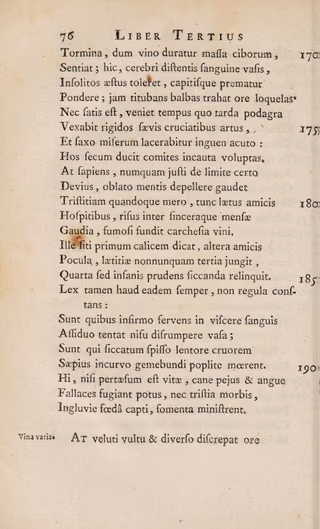
Tormina, dum vino duratur maſſa ciborum,
Sentiat ; hic, cerebri diſtentis ſanguine vaſis,
Inſolitos æſtus toleret, capitiſque prematur
Pondere ; jam titubans balbas trahat ore loquelas.
Nec ſatis eſt, veniet tempus quo tarda podagra
Vexabit rigidos ſævis cruciatibus artus,
Et ſaxo miſerum lacerabitur inguen acuto :
Hos ſecum ducit comites incauta voluptas.
At ſapiens, numquam juſti de limite certo
Devius, oblato mentis depellere gaudet
Triſtitiam quandoque mero, tunc lætus amicis
Hoſpitibus, riſus inter ſinceraque menſæ
Gaudia, fumoſi fundit carcheſia vini.
Ille ſiti primum calicem dicat, altera amicis
Pocula, lætitiæ nonnunquam tertia jungit,
Quarta ſed inſanis prudens ſiccanda relinquit.
Lex tamen haud eadem ſemper, non regula conſ-
tans :
Sunt quibus infirmo fervens in viſcere ſanguis
Aſſiduo tentat niſu diſrumpere vaſa ;
Sunt qui ſiccatum ſpiſſo lentore cruorem
Sæpius incurvo gemebundi poplite mœrent.
Hi, niſi pertæſum eſt vitæ, cane pejus & angue
Fallaces fugiant potus, nec triſtia morbis,
Ingluvie fœdâ capti, fomenta miniſtrent.