Hover or tap a word to see its match.
Part 1
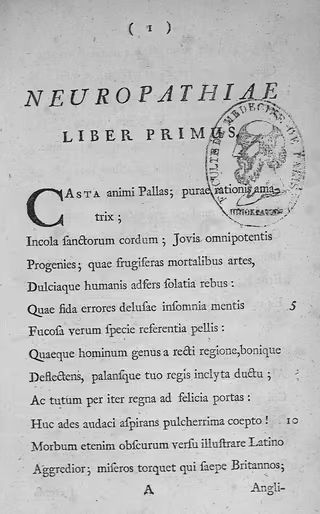
Chaste Pallas of the mind; lover of pure reason;
Dweller in holy hearts; of omnipotent Jove
The offspring; who bringest fruitful arts to mortals,
And sweet consolations to human affairs:
Who faithfully drivest away errors, the dreams of a deluded mind,
Which counterfeit the truth with a specious appearance:
And who gloriously rulest under thy guidance the race of men
Swerving and wandering from the region of the right and the good;
And bearest them along a safe path to happy realms:
Come hither, most fair one, breathing favor on a bold undertaking!
For to illustrate an obscure disease in Latin verse
I undertake; one which often torments wretched Britons;
CASTA animi Pallas; purae rationis amatrix;
Incola ſanctorum cordum; Jovis omnipotentis
Progenies; quae frugiferas mortalibus artes,
Dulciaque humanis adfers ſolatia rebus :
Quae fida errores deluſae inſomnia mentis
Fucoſa verum ſpecie referentia pellis :
Quaeque hominum genus a recti regione, bonique
Deflectens, palanſque tuo regis inclyta ductu ;
Ac tutum per iter regna ad felicia portas :
Huc ades audaci aſpirans pulcherrima coepto !
Morbum etenim obſcurum verſu illuſtrare Latino
Aggredior; miſeros torquet qui ſaepe Britannos;
Part 2
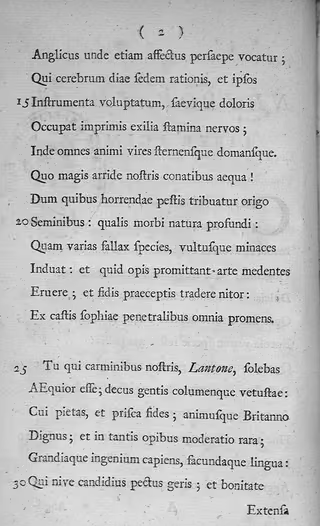
Whence it is also very often called the English disease;
Which occupies above all the brain, the seat of divine reason, and those very
Instruments of pleasures and of savage pain,
The slender threads, the nerves;
Thence laying low and subduing all the powers of the mind.
Wherefore smile all the more favorably upon our endeavors!
While I strive to bring to light to what seeds the origin of the dreadful plague
Is to be attributed: what is the nature of the deep-seated disease:
How many varied appearances and threatening countenances the deceitful malady
Puts on: and what help those who heal by art promise;
And to hand them down in faithful precepts:
Drawing forth all things from the chaste sanctuaries of wisdom.
You who used to be so favorable to our songs, Lanton,
Ornament and pillar of an ancient family:
Who possess piety, and ancient faith; and a spirit worthy of a Briton;
And rare moderation amid such great wealth;
And an intellect grasping grand things, and an eloquent tongue:
Who bear a heart whiter than snow; and with a goodness
Anglicus unde etiam affectus perſaepe vocatur ;
Qui cerebrum diae ſedem rationis, et ipſos
Inſtrumenta voluptatum, ſaevique doloris
Occupat imprimis exilia ſtamina nervos ;
Inde omnes animi vires ſternenſque domanſque.
Quo magis arride noſtris conatibus aequa !
Dum quibus horrendae peſtis tribuatur origo
Seminibus : qualis morbi natura profundi :
Quam varias fallax ſpecies, vultuſque minaces
Induat : et quid opis promittant arte medentes
Eruere ; et fidis praeceptis tradere nitor :
Ex caſtis ſophiae penetralibus omnia promens.
Tu qui carminibus noſtris, Lantone, ſolebas
AEquior eſſe ; decus gentis columenque vetuſtae :
Cui pietas, et priſca fides ; animuſque Britanno
Dignus ; et in tantis opibus moderatio rara ;
Grandiaque ingenium capiens, facundaque lingua :
Qui nive candidius pectus geris ; et bonitate
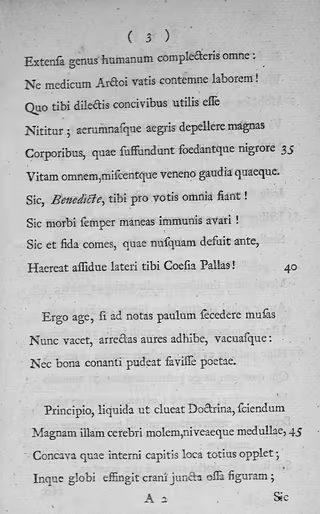
Part 3
extended, embrace the whole human race:
do not disdain the medical labor of a Northern bard!
By which he strives to be useful to the fellow citizens dear to you;
and to drive away great afflictions from sick
bodies, which suffuse and befoul with blackness
all of life, and mingle every joy with poison.
So, Benedict, may all things turn out according to your wishes!
So may you always remain immune to the greedy disease!
So too may a faithful companion, who has never failed you before,
gray-eyed Pallas, cling constantly to your side!
Come then, if you now have leisure to withdraw for a little while
to the familiar Muses, lend attentive and unhurried ears:
and do not be ashamed to have favored a poet attempting good things.
In the first place, that the teaching may be clear, one must know
that that great mass of the brain and snow-white marrow,
which fills the hollow spaces of the whole inner head,
and shapes the joined bones of the cranium into the form of a globe,
Extenſa genus humanum complecteris omne :
Ne medicum Arctoi vatis contemne laborem !
Quo tibi dilectis concivibus utilis eſſe
Nititur ; aerumnaſque aegris depellere magnas
Corporibus, quae ſuffundunt foedantque nigrore
Vitam omnem, miſcentque veneno gaudia quaeque.
Sic, Benedicte, tibi pro votis omnia fiant !
Sic morbi ſemper maneas immunis avari !
Sic et fida comes, quae nuſquam defuit ante,
Haereat aſſidue lateri tibi Coeſia Pallas !
Ergo age, ſi ad notas paulum ſecedere muſas
Nunc vacet, arrectas aures adhibe, vacuaſque:
Nec bona conanti pudeat faviſſe poetae.
Principio, liquida ut clueat Doctrina, ſciendum
Magnam illam cerebri molem, niveaeque medullae,
Concava quae interni capitis loca totius opplet ;
Inque globi effingit cranî juncta oſſa figuram ;
Part 4
is so fabricated and constructed with a wonderful design, that
the part of the vital stream which is by far the finest,
and flows more mobile, and purer than the rest of the fluid,
projected by the force of the heart, and pressed against the soft brain,
through a thousand windings, and invisible passages,
is at last strained and carried into the hollows of the nerves.
Thence flowing and reflowing within the minute tubules,
and very often striking its own origins with impacts,
it rouses all sense and motion in man; it presents all
the images of things
to the mind, varying in wonderful ways;
and the same fluid excites all the affections of the soul.
Hence men easily remember things done before;
hence by beautiful reason they turn out equal to the great gods.
Since this performs all the fairest offices of the animal
by far; and those which separate and remove far the whole race of living
beings
from the green stock of plants;
it is hence rightly called the animal spirit by the learned.
Sic fabricatam eſſe et ſtructam mira ratione, ut
Vitalis quae pars rivi tenuiſſima longe,
Mobiliorque fluit, reliquo et mage pura liquore,
Vi cordis projecta, et molli appreſſa cerebro,
Mille per anfractus, inviſibileſque meatus
In cava nervorum tandem colata feratur.
Inde fluens intra tubulos refluenſque minutos,
Ictibus atque ortus proprios perſaepe laceſſens
Senſum omnem motumque homini ciet; omnia
rerum
Menti offert ſimulacra modis variantia miris ;
Atque animi affectus idem liquor excitat omnes.
Hinc meminere homines rerum facile anteactarum
Hinc pulchra evadunt magnis ratione pares dîs.
Qui quoniam longe pulcherrima cuncta animalis
Munera obit ; quaeque a plantarum ſtirpe virenti
Secernunt, removentque procul genus omne ani-
mantum ;
Spiritus hinc doctis animalis rite vocatur.
Part 5
Against this doctrine lately some have begun
To rise up; and relying on false arguments, they contend
That the nerves themselves are not rightly called hollow bodies;
And that no liquor passes through them from the brain.
Doubtless because they cannot perceive with their eyes those things
Which, even if they certainly existed, ought nevertheless to escape
Sight itself, and far elude human vision,
However much it be fortified by invented lenses.
These men maintain that the nerves, like chords, struck on all sides
By bodies, are stirred with a swift and tremulous motion;
And that the brain, struck by them, trembles in like manner.
Hence they will have it that man feels; nay, is even strong
In reason; and moves his various limbs hither and thither,
As the fibres are drawn or vibrated by I know not what impulse:
Or by the impulse and flow of thick blood through diverse regions
Of the brain, and its manifold meanders:
Without the aid of the praised fluid, or subtle liquor.
But wrongly: for by what impulse can it be made to vibrate when struck,
Moist-
Hoc placitum nuper nonnulli inſurgere contra
Coepêre; et falſis freti rationibus ipſos
Haud bene contendunt dici cava corpora nervos;
A cerebroque per hos nullum tranſire liquorem.
Nimirum quia non oculis ea cernere poſſunt,
Quae, ſi certo eſſent, viſum tamen effugere ipſum
Deberent, aciemque humanam fallere longe,
Inventis utcunque ſit haec munita dioptris.
Hi Chordarum inſtar nervos celeri undique motu
Corporibus pulſos ſtatuunt, tremuloque cieri ;
Percuſſumque ipſis pariter trepidare cerebrum.
Hinc ſentire volunt hominem ; quin et ratione
Pollere ; atque artus varios hinc inde movere,
Neſcio quo tractis vibratiſve impete fibris :
Sanguinis aut craſſi loca per diverſa cerebri
Impulſu fluxuque, et multiplices maeandros :
Abſque ope laudati fluidi, tenuiſve liquoris.
At male : nam quo vibrari queat impete pulſus
Humi-
Part 6
a nerve that is moist, and slack with a soft structure?
Moreover, it is necessary that the vital stream be stripped of its thin part,
forced through the blind and slender passages of the brain,
woven from twisted vessels.
Yet that the nerves draw this into themselves and transmit it
is established as altogether likely and probable.
For indeed the outer part of the brain, bearing the color
of brownish ash, and called by name the cortex,
terminates everywhere in the hard and snow-white medulla,
which is built of drier and more compacted fibers:
But the nerves arise from this, and are made of this medulla;
And thus composed, they are distributed throughout the whole body.
The other matters of this kind, in full discourse every year,
shining equally in eloquence and in Apollo's art,
Boerhaave unfolds and establishes with his sweet voice:
The sweet glory of the medical choir, and of the Dutch nation:
Things which can scarcely be aptly related in verse,
on account of the uncouthness of the words and the novelty of the subjects.
Let it suffice to have touched upon and grazed them summarily.
Humidus, et molli laxus compagine nervus?
Praeterea tenui ſpolietur parte neceſſe eſt
Per caecos cerebri truſa, exileſque meatus
Tortilibus textos vaſis, vitale fluentum.
Hanc autem trahere in ſe, et tranſmittere nervos
Omnino vero ſimile, atque probabile conſtat.
Pars etenim cerebri exterior, cineriſque colorem
Subfuſci referens, et cortex nomine dictus,
In dura, et nivea finitur ubique medulla;
Exſuccis mage quae ſtruitur, fibriſque coactis:
At nervi exoriuntur ab hac, fiuntque medulla;
Et ſic compoſiti corpus diduntur in omne.
Caetera de genere hoc pleno ſermone quotannis
Eloquio pariter fulgens, et Apollinis arte,
Explicat, et ſuavi ſtabilit Boerhavius ore:
Dulce decus medicique Chori, gentiſque Batavae:
Carmine quae poſſunt vix ennarrier apte;
Barbariem propter vocum et rerum novitatem.
Summatim tetigiſſe, et perſtrinxiſſe ſatis ſit.
Part 7
If this spirit is duly produced in a firm brain;
And, received by healthy and strong nerves, flows freely;
Then it is necessary that a man feel altogether rightly:
Then it is granted to use a sound and serene reason:
Then to rejoice in a cheerful mind, and to flourish with a firm one:
And well and constantly to discharge all the fairest
Duties of life: and ever happily to enjoy the soul:
As the frame of each, and the native force of his mind allow:
Even though the remaining parts in the whole body be
feeble:
Even though all external things be ever so unprosperous.
But if these skilful instruments of the soul suffer,
And, being impaired, perform their duties in a sluggish manner;
All things happen to the contrary: the mind is clouded:
The spirit is weighed down by grief, and base fear:
And it wearies one to run through the course of an unwelcome life:
Even though the remaining parts in the whole body be steadfast:
Even though all external things be ever so fortunate.
Spiritus hic firmo ſi fiat rite cerebro ;
Nerviſque exceptus ſanis fluitet, validiſque ;
Tunc hominem omnino recte ſentire neceſſe eſt :
Tunc ratione uti ſana datur, atque ſerena :
Tunc alacri gaudere animo, firmoque vigere :
Et bene, conſtanterque omnis pulcherrima vitae
Munera obire : fruique anima feliciter uſque :
Ut cujuſque ſinit fabrica, et nativa animi vis :
Sint reliquae imbelles licet omni in corpore
partes :
Sint externa etiam quamvis male proſpera cuncta.
Daedala vero animae ſi haec inſtrumenta laborent,
Officiis et laeſa modo fungantur inerti ;
Omnia contingunt contraria : nubila mens eſt :
Deprimitur moerore animus, turpique timore :
Toedet et ingratae ſpatium decurrere vitae :
Sint reliquae ſtabiles licet omni in corpore partes :
Sint externa etiam quamvis felicia cuncta.
Part 8
Behold some men in riches, and in proud titles
Flourishing, in good fame, and in green youth,
Keen in intellect, and firm with hardy strength,
Do you not see them languish sluggishly, and perform all duties
Benumbed, and enfeebled throughout their whole body;
And painfully drag out and waste a cruel life;
Even though they themselves be untouched by manifest diseases?
No masonry delights these sad ones, nor a structure leveled with the sky;
No groves delight them, nor pleasant lawns;
Garments graced with gold and purple are spurned;
And banquets, and festival days, and crowded dances.
For indeed in them the powers of the brain and the nerves grow faint;
And the whole substance of the spirits is corrupted:
Hence perishes the vivid sense of life, and its keen relish:
And the vigor innate to a healthy man, and the force of the mind:
Even though the remaining parts throughout the whole body be stable.
Nay, they even very often destroy themselves, and cast away
Their own lives, essaying the thresholds of death;
So utterly weary are they of beholding the vault of heaven.
Aſpice divitiis quoſdam, tituliſque ſuperbis
Florentes, famaque bona, viridique juventa,
Ingeniiſque acres, et duro robore firmos,
Nonne vides languere pigros, et munera quaeque
Torpentes, totoque enerves corpore, obire ;
Crudelemque aegre trahere, et diſperdere vitam ;
Sint ipſi morbis licet intacti manifeſtis ?
Non caementa juvant triſtes, aequataque coelo
Fabrica ; non arbuſta juvant, et amoena vireta ;
Auro ſpernuntur veſtes, oſtroque decorae ;
Atque epulae, feſtique dies, celebreſque choreae.
Scilicet his cerebri vires, nervique fatiſcunt ;
Materies et ſpirituum corrumpitur omnis :
Vividus hinc vitae ſenſus perit, et ſapor acer :
Innatuſque homini ſano vigor, atque animi vis :
Sint reliquae ſtabiles licet omni in corpore partes.
Quin et conficiunt ſeſe perſaepe, ſuaſque
Projiciunt animas tentantes limina lethi ;
Uſque adeo toedet coeli convexa tueri.
Part 9
The common crowd, ignorant of diseases and of the animal fabric,
Marvels and seeks the causes of the bitter event;
And with a loud voice pronounces them to have been mad.
Yet on the other hand you will see men weighed down by a slender fortune;
Obscure in talents and fame; slowed by icy
Old age; heavy with diseases; and near to
death;
Who nevertheless have a steadfast mind, and one prepared
for every
Duty; eager to run out the remainder of life;
Brave to endure evils, and desirous of obtaining good things.
For indeed the vigor of their nerves and brain is intact;
While the remaining parts are feeble and without strength.
Now by what causes above all, and in what manner,
The tone and powers of the nerves and brain begin to totter;
And how the very spirit of the brain is vitiated along with them;
While the remaining viscera are firm and sound,
Or injured in the least degree; attend skilfully, I shall teach.
Miratur, cauſaſque eventus quaerit acerbi
Morborum ignarum vulgus, fabricaeque animalis;
Deliroſque fuiſſe alto pronunciat ore.
At contra tenui depreſſos forte videbis;
Ingeniis, fama obſcuros; gelidaque ſenecta
Tardatos; morbiſque graves; mortique propin-
quos;
Queis tamen eſt animus praeſens, et ad omne pa-
ratus
Officium; reliquamque alacer decurrere vitam;
Et fortis mala ferre, bonis cupiduſque potiri.
Nempe eſt nervorum et cerebri vigor integer ollis;
Dum reliquae imbelles ſunt, et ſine robore partes.
Nunc quibus imprimis cauſis, et qua ratione
Nervorum cerebrique tonus, vireſque labaſcant;
Spiritus atque una vitietur et ipſe cerebri;
Viſceribus reliquis conſtantibus, integriſque,
Vel minimum laeſis; ſolers adverte, docebo.
Part 10
In the first place, so that the various humours in the living body,
Which are secreted from the thick and ruddy stream,
By the winding vessels of the glands, and their minute cells,
Such as fat, and acrid bile, and tenacious phlegm,
And the genital fluid, and the very spirit of the brain,
May each be generated fit for their proper offices,
It is above all necessary that the organs be in a right state,
Which by their native virtue each secrete their own liquor,
And separate it from the thick blood;
Nay, and at the same time somewhat alter it themselves by their own power.
Moreover, a manifold concoction must duly
Be performed by sound and strong viscera,
From the mastication and deglutition of food,
Right up to the wondrous generation of purple blood:
Whereby each matter flowing in the teeming blood,
Assimilated to the animal juices, and subdued,
May be dissolved, or changed in such a manner,
That it may be strained by its proper glands, suitable for constituting each
Principio varii humores in corpore vivo,
Qui craſſo ſecernuntur, rutiloque fluento,
Tortilibus glandum vaſis, celliſque minutis,
Qualis adeps, biliſque acris, pituita tenaxque,
Et liquidum genitale, et ſpiritus ipſe cerebri ;
Ut propriis quique officiis apti generentur,
Organa recte ſeſe habeant ante omnia oportet,
Nativa quae quaeque ſuum virtute liquorem
Secernunt, et ſejungunt a ſanguine craſſo ;
Quin et nonnihil immutant ſimul ipſa ſua vi.
Multiplex et praeterea concoctio rite
Viſceribus debet ſanis peragi, validiſque,
A manducatu, deglutituque alimenti,
Uſque ad purpurei mirandum ſanguinis ortum :
Materies qua quaeque fluens in ſanguine foeto
Succis aſſimilata animalibus, atque ſubacta,
Solvatur, vel mutetur tali ratione,
Glandibus ut propriis coletur idonea cuique
Part 11
a pure and perfect liquid:
Hence health remains intact, and blessed in every part.
Yet since our humours are infinite in kind and number,
nothing stands in the way, nor prevents
the concoction of this one or that from often being disturbed,
while the rest are not badly formed, and flow healthily;
or perhaps suffer lightly from a slight defect.
Furthermore, a defect of the first concoction is often so slight,
and so minute, that it cannot
betray itself, while the instruments are warm in the midst of their labour;
and that fault of the juices, which arises thence,
not rarely lies covered, and rests buried,
while all the liquids flow mingled in the great vessels.
But when the intricate structure of the glands
has drawn the manifold humours selected out of the whole mass of blood,
leading them through winding vessels, and storing them in cells;
then at length, if any one of these fails in its proper duties,
it is surely necessary that some
Sincero liquido, et perfecto conſtituendo :
Hinc intacta ſalus, omnique ex parte beata.
Aſt infiniti cum ſint ſpecie, numeroque,
Humores noſtri, nihil obſtat, nec prohibet quin
Illius aut hujus turbetur coctio ſaepe,
Dum reliqui male non fiunt, fluitantque ſalubres;
Aut vitio forte exiguo, leviterque laborant.
Porro ſaepe adeo levis eſt, adeoque minutus
Cocturae primae defectus, ut is nequeat ſe
Prodere, dum fervent medio inſtrumenta labore;
Succorumque illud vitium, quod naſcitur inde,
Non raro tectum lateat, jaceatque ſepultum,
Dum permiſta fluunt vaſis liquida omnia magnis.
Verum ubi multigenos humores daedala glandum
Fabrica delectos e ſanguine traxerit omni,
Tortilibus ducens vaſis, celliſque reponens;
Tum demum, officiis propriis ſi quilibet horum
Defuerit, quaedam laedatur nempe neceſſe eſt.
Part 12
function; and by this means that very defect of the
humor, which before lay concealed, must become clear:
As cruel gout teaches by a manifest example.
Finally, if crude matter of that or this juice
be generated for a long time, and it be continually faulty
in the first concoction; then the fabric of the gland,
which the vitiated stream penetrates and continually washes,
must at length necessarily be injured and weakened:
And gradually be rendered less fit for rightly
and constantly performing its proper offices;
Even if good matter be supplied afterward:
Hence the defect must necessarily be confirmed and grow.
But if the glands themselves suffer of their own accord,
Formed with a structure either too lax or too tight;
Or bearing the cavities of their own cells obstructed,
Or be held overcome by any other disease;
Then they will certainly not be able to pour forth a healthy
humor;
Functio; et hoc ipſum pacto clareſcere debet
Humoris vitium, quod celatum ante latebat:
Ut docet exemplo manifeſto ſaeva podagra.
Denique cruda diu ſi materies generetur
Illius aut hujus ſucci, et culpabilis uſque
Coctura fiat prima; tum fabrica glandis,
Quam rivus penetrat vitioſus, et alluit uſque,
Tandem laedatur, labefacteturque neceſſe eſt:
Paulatimque minus reddatur idonea recte
Muneribus propriis, et conſtanter peragendis;
Materies etiam ſi poſt bona ſuppeditetur:
Hinc confirmetur vitium creſcatque neceſſe eſt.
At vero glandes ipſae ſi ſponte laborent,
Aut nimium laxa aut ſtricta compagine cretae;
Aut cava cellarum propriarum obſtructa gerentes,
Aut alio quovis morbo victae teneantur;
Tunc ſanum haud poterunt humorem fundere
certe;
Part 13
Even though healthy and suitable matter reaches them:
As the fact is clearly evident to anyone who considers it.
These foundations having been established, is it not to be seen
That the very subtle and swift fluid of the encephalon,
If its first coction is badly performed,
Or the brain is lax with a weak structure,
Or especially, as happens more often, both of these occur together,
Can for a long time become degenerate and crude, and flow about,
Even though the remaining juices are well prepared;
Or suffer only slightly from a small defect?
Moreover, since this same fluid is the thinnest of all,
Although it be morbid, yet all the vessels,
Which admit and contain any other
fluid,
It will pass through easily, and will be delayed by no obstacle;
And thus it will make no disturbances, and no tumults
In the thick liquids, and foreign vessels.
But indeed, when into the brain and the nerves themselves has come
Materies licet has attingat ſana habiliſque :
Ut cuivis perpendenti liquido pateat res.
His fundamentis ſtabilitis, nonne videre eſt
Subtilem valde encephali, celeremque liquorem,
Ipſius male ſi peragatur coctio prima,
Aut cerebrum imbelli fuerit compagine laxum,
Aut eadem imprimis, quod ſaepius, utraque fiant,
Degenerem, crudumque diu fieri, et fluitare
Poſſe, licet reliqui ſucci bene conficiantur ;
Vel vitio tantum exiguo leviterque laborent ?
Quin et, cunctorum cum ſit tenuiſſimus idem,
Quamvis morboſus fuerit, tamen omnia vaſa,
Quae quemvis alium admittunt, capiuntque li-
quorem,
Tranſibit facile, et tardabitur obice nullo ;
Atque adeo nullas turbas, nulloſque tumultus
In liquidis faciet craſſis, vaſiſque alienis.
At vero in cerebrum, et nervos cum venerit ipſos
Part 14
the faulty liquor, and has overcome all the
Windings, and twists of the long way, and blind passages;
Then at length it will flow around, unequal to its proper duties:
And gradually it will corrupt the very nerves and the soft brain
With a crude fluid, and a vapid stream's
Perpetual flood, penetrating through all the cells;
Weakening and melting the tender structure.
Hence a culpable spirit will always inject itself
Into the cavities of the stomach, and will be mixed with all the chyle;
Distilling there from the open mouths of the nerves.
And since of that viscus the ruler and stimulus
Is the spirit, slowly will be exercised, and faultily,
The function of the stomach altering the ingested food, and concocting it:
And a crude matter of the nervous liquid will continually
Be compounded, an exhausted ferment being supplied;
And crude it will be returned to the nerves, and the soft brain.
Hence the disease must needs be confirmed, and grow.
Mendoſus liquor, et longae ſuperaverit omnes
Anfractus, tortuſque viae, caecoſque meatus ;
Tum demum officiis propriis circumfluet impar :
Paulatimque ipſos nervos et molle cerebrum
Corrumpet crudi laticis, vapidique fluenti
Perpetua alluvie, cellas penetrante per omnes ;
Compagem teneram labefactante atque liquante.
Spiritus hinc ſemper culpabilis injiciet ſe
In cava ventriculi, et chylo miſcebitur omni ;
Nervorum patulis deſtillans oribus illic.
Viſceris et quoniam illius rector ſtimuluſque
Spiritus eſt, tarde exercebitur, et vitioſe
Functio ventriculi mutans ingeſta, coquenſque :
Crudaque materies liquidi conflabitur uſque
Nervorum, effoeto fermento ſuppeditato ;
Crudaque reddetur nervis, mollique cerebro.
Hinc morbus confirmetur, creſcatque neceſſe eſt.
Part 15
Moreover, if the disorder should last for a long time,
the intricate structure of the nerves and of the tender brain
will be weakened further, and, languishing, will give way:
namely because they must draw all their nourishment
and sustenance from a crude and vapid fluid.
For at every moment in a living animal body
the slender vessels are stretched and elongated,
pulled apart by the continual force of the propelled fluids:
and thus they are thinned as their parts are drawn away from one another:
and their torn ends are broken and abraded;
falling off upon the skin in the form and appearance of scales,
dried up and condensed by the contact of the air:
while internally they are mixed with the fluids and swept away.
Yet the interstices and defects left behind from this
no other fluid could supply or repair,
than that which, penetrating the same, passes through and washes over them
continually.
Therefore, the slender nerves and the soft brain, to be sure,
Praeterea longo ſi duret tempore labes,
Debilitabitur ulterius, languenſque fatiſcet
Daedala nervorum, et teneri ſtructura cerebri:
Nimirum quoniam a crudo, vapidoque liquore
Nutritum debent omnem trahere, atque alimenta.
Omni etenim momento animali in corpore vivo
Extenduntur, et elongantur tenuia vaſa,
Vi propulſorum jugi diſtracta liquorum :
Diductis hinc a ſe partibus attenuantur:
Fineſque avulſi franguntur, et abraduntur ;
In cute ſquamarum forma ſpecieque cadentes,
Aeris attactu deſiccati, atque coacti:
Interne vero liquidis mixti abripiuntur.
Aſt interſtitia, et defectus inde relictos
Non alius ſupplere liquor, ſarcireve poſſit,
Quam qui eadem penetrans pertranſit et alluit
uſque.
Nervi igitur tenues nimirum, et molle cerebrum
Part 16
seek and take their nourishment from their own proper fluids;
For none more subtle than these are given.
Yet if these same fluids be ill-concocted and inert,
It is necessary that the elements of which the nerves and brain are built and consist
Be weakly and loosely compacted:
And on that account their strength and vigor must flag.
And these are the principles and causes of this manifold and greatly to be shunned
Disease. Physicians have assigned inept names,
And in males have called it hypochondriac;
While in females they have named it hysteric:
Namely, making two diseases out of one;
Ignorant of the nature of the malady, and of its deep origin.
For its primary seat is certainly not established
In any viscus of the chyle-making belly:
And undeservedly do physicians blame women's wombs.
But it has placed its throne in the brain, the nerves, and the fluid
of the nerves,
Nutritum a propriis liquidis quaerunt, capi-
untque ;
His etenim mage nequaquam ſubtilia dantur.
Aſt eadem vero male cocta, et inertia ſi ſint,
Debiliter compingantur, laxeque neceſſe eſt,
Queis nervi conſtant ſtructi, cerebrumque ele-
menta :
Proptereaque ipſis robur virtuſque fatiſcat.
Atque haec multiplicis morbi, et valde fugiendi
Principia et Cauſae. Tribuerunt nomina inepta,
In maribuſque hypocondriacum dixere medentes;
Hyſtericum vero in foemellis nominitarunt:
Scilicet ex uno morbo binos facientes ;
Ignari labis naturae, et originis altae.
Ejus enim ſedes primaria viſcere in ullo
Chylifici ventris non eſt ſtabilita profecto :
Immeritoque uteros medici culpant muliebres.
Aſt ſolium in cerebro, et nervis liquidoque locavit
Nervo-
Part 17
of the nerves, a cruel tyrant brandishing an unbridled
sceptre; and reigns dreadful throughout the whole body.
Namely, that liquor, which in the healthy contains in itself
attenuated elements, well mixed together,
to wit, salt, and mild oil, and minute particles
of earth, floating in the subtle dew of lymph;
vigorously shaken together and subdued by the force of life;
rendered degenerate by this disease, both vapid and watery;
and poor, embracing few animal elements;
swift with excessive mobility, and too loose,
it flows away, and flies off all too suddenly from the very nerves.
And the stamina of the brain and nerves, which in the strong and very healthy
stand stretched to a certain degree, and
elastic, according to the sex and varying age of the animal;
and flourish firm with elements compacted among themselves;
weakened by the evil blemish, and with their structure broken,
grow soft with an untimely flaccidity:
Nervorum, ſceptrum quatiens effraene tyrannus
Crudelis; totoque tremendus corpore regnat.
Scilicet ille liquor, qui ſanis continet in ſe
Attenuata, probeque ſimul permiſta elementa,
Nempe ſalem, blandumque oleum, terraeque
minuta
Corpora, ſubtili lymphae fluitantia rore;
Vi vitae valide conquaſſata atque ſubacta;
Degener hoc morbo factus, vapiduſque aqueuſque;
Paucaque complectens elementa animalia pauper;
Mobilitate celer nimia, nimiumque ſolutus
Diffluit, et nervis ſubito nimis evolat ipſis.
Et cerebri, nervûmque, valentibus et bene ſanis
Quae contenta gradu quodam, atque elaſtica
conſtant
Stamina, pro ſexu variaque aetate animalis;
Compactiſque vigent inter ſe firma elementis;
Debilitata mala labe, et compagine fracta,
Intempeſtiva molleſcunt flacciditate:
Part 18
While a crude and excessively thin humor washes over all
the windings, and wandering twists, and cells of the brain,
and the tubes of the nerves, and soaks them with a dank stream.
Moreover, since its own elements are weakly combined,
as I have taught above, it poorly nourishes and sustains the tender
fibers of the nerves and brain, and the intricate vessels;
overturning vigor and strength in the whole body.
What errors in diet, indeed, and what remote causes
bring this dreadful plague upon sickly mortals;
(and a fiercer one never raised itself from the Stygian waves)
I shall hand down in full, describing it in truthful verse.
For the lot of mankind is not so pitiable
and grievous,
that, if they obey the just laws of nature, this pestilence
should rush in, and of its own accord add itself to the heap of ills.
A fault is needed, for the bitter mass of the disease to be founded.
Wherefore all the more, these things, which I add while reciting in faithful verses,
Dum crudus, tenuiſque humor nimis alluit omnes
Anfractus, tortuſque vagos, cellaſque cerebri,
Nervorumque tubos, et flumine macerat udo.
Quin et debiliter conjectis ipſe elementis,
Ut docui ſupra, teneras male nutrit, alitque
Nervorum et cerebri fibras, et daedala vaſa ;
Virtutem roburque evertens corpore toto.
Qui vero in victu errores, cauſaeque remotae
Horrendam inducant peſtim mortalibus aegris ;
(Saevior et nunquam ſtygiis ſeſe extulit undis)
Omnia veridico deſcribens carmine tradam.
Nam neque ſors hominum eſt adeo miſeranda
graviſque,
Haec ut, ſi parent naturae legibus aequis,
Irruat, et cumulo ſeſe addat ſponte malorum.
Culpa opus, ut morbi moles condatur acerba.
Quo magis haec, fidis recitans quae verſibus addo,
Part 19
must be written in our innermost breasts, and firmly imprinted;
So that we may be able to avoid the bitter hardships of the disease.
But in these matters one ought to know this:
That those whose brain has always been by nature weak, and sluggish,
And soft from too loose a structure;
And in whom the threads of the nerves scarcely solidify with growing age,
And remain too moist with flexible fibres,
Such as the nerves and fibres of newborn infants;
Upon all these the disease easily makes an onset; inasmuch as
It can be brought about and established by slight causes:
And thus the female sex in general than males
Is more often and more severely assailed; since it stands
Furnished with weaker nerves and brain.
And these you will be able to distinguish by sure signs:
Most are of keen and lofty minds:
And a precocious wisdom brightens their earliest years.
Quickly they turn over and revolve many things in their deep
mind:
Pectoribus ſcribenda imis, ſignandaque firme ;
Ut morbi aerumnas vitare queamus amaras.
Illud in his vero rebus cognoſcere oportet,
Quod quibus uſque fuit natura debile, inerſque,
Et laxa nimium compagine molle cerebrum ;
Nervorumque parum creſcente aevo ſolideſcunt
Stamina, flexilibuſque manent nimis humida fibris,
Infantum quales nervi fibraeque recentum ;
Omnibus his morbus facile ingruat ; utpote cauſis
Qui levibus concinnari queat, et ſtabiliri :
Foemineuſque adeo ſexus maribus generatim
Saepius, et gravius pertentetur ; quoniam ſtat
Debilioribus inſtructus nervis, cerebroque.
Hos vero certis poteris dignoſcere ſignis
Plerique ingeniis ſunt acribus excelſiſque :
Primoreſque annos clarat ſapientia praecox.
Multa animo celeres verſant volvuntque pro-
fundo :
Part 20
And keep almost everything in a retentive mind.
Moreover, they are all anxious and full of fears;
And are ever too bashful in conducting affairs;
And their presence of mind, lightly shaken, wavers.
Prone to laughter or weeping, they are endowed
With a too exquisite sense of pain and pleasure.
They shudder at all cruelty, and leave it far behind.
Never with impunity are their veins swollen with wine:
Never may they frequently sacrifice to Venus with impunity:
They will not be able to endure any hard labours
Constantly; nor indeed to bear long fasts:
Finally, studying by night is ever remarkably harmful.
These, I say, the disease easily attacks and sub-
dues,
Brought on by slight causes and petty faults.
Furthermore, being furnished with weak nerves and brain,
Since they are of a pliable disposition, the errors to be recited below
They easily commit, and provoke the disease.
But many, in whom once these instruments of the soul
Atque fere memori conſervant omnia mente.
Solliciti porro, plenique timoribus omnes;
Suntque verecundi nimis uſque in rebus agendis;
Atque animi leviter praeſentia mota labaſcit.
Ad riſum aut fletum faciles, ſenſuque doloris,
Atque voluptatis pollent nimis exquiſito.
Saevitiam horreſcunt omnem, longeque relinquunt.
Non impune unquam venas inflantur Iaccho :
Non veneri crebro licet unquam impune litare :
Non duros poterunt ullos tolerare labores
Conſtanter ; nec longa quidem jejunia ferre :
Lucubratio denique obeſt inſigniter uſque.
Hos inquam morbus facile aggrediturque do-
matque,
Inductus levibus cauſis, culpiſque minutis.
Debilibus porro inſtructi nervis, cerebroque,
Indole flexibili cum ſint, infra recitandos
Admittunt facile errores, morbumque laceſſunt.
At multos, quibus haec ſemel inſtrumenta animâi
Part 21
were hard enough, and flourished firm with solid strength,
the taint invades no less, and wears them down when conquered:
For enormous faults and a dissolute way of life
drive it on, though reluctant, with strong force, and urge it powerfully.
And first, those who, captivated by the allurements of ignoble ease,
grow sluggish and exercise and agitate their bodies too little,
unless their nerves have been very firm from the beginning,
lay the most solid foundations for this disease.
For from this the concoctive power languishes in them:
and the spirit of the brain is generated crude and inert,
its elements being feebly shaken together and concocted:
and, feebly pressed to one another, the fibres' particles
are driven together, thus constituting weak nerves.
Moreover, since while awake it is forced ever to be contriving something,
and the nature of the soul flees from rest,
the less anyone exercises his body, the more he strains his keen
mind in thought, and fatigues his brain;
Dura ſatis, ſolidoque vigebant robore firma,
Non minus invadit labes, victoſque fatigat :
Quippe ipſam culpae enormes, victuſque ſolutus
Vi valida impellunt renuentem, urgentque potenter.
Et primum, illecebris qui capti ignobilis otî
Corpora torpentes minus exercent agitantque,
Ni firmi valde fuerint ab origine nervi,
Huic jaciunt morbo ſolidiſſima fundamenta.
Languet quippe ollis concoctrix inde facultas :
Spiritus et cerebri generatur crudus inerſque,
Debiliter conquaſſatis, coctiſque elementis :
Debiliterque ad ſe preſſae fibrarum adiguntur
Particulae, imbelles nervos ita conſtituentes.
Quin et cum vigilans aliquid molirier uſque
Cogatur, fugiatque animae natura quietem,
Quo minus exercet quis corpus, eo magis acrem
Cogitat intendens animum, cerebrumque fatigat ;
Part 22
Unless he suffers from a dull and sluggish intellect.
Whence indeed the fullest fuel is supplied
To the disease; for the subtle fluid of the brain, continually retained
In the head, and occupied in swift duties there,
Will be wanting to the remaining functions throughout the whole body;
Especially to the stomach, whereby foods may be duly concocted:
Hence a crude spirit will be continually generated in the man.
Nor will anything harm the brain and the nerves, and the fluid
Of the nerves, so much as—believe me with confidence—the slothful
Torpor of the body, if at the same time the mind itself is agitated.
Hence the vehement study of philosophy harms; and long-lasting
Affections of the mind: hence working by night harms;
Which also disturbs and hinders the pepsis of the spirits of the brain,
Better accomplished by timely sleep;
And thus inflicts manifold damage upon mortals.
Moreover, whatever pleasure is too often renewed
Breaks the nerves: the gifts of joyful Bacchus;
And
Ingenio ſi non hebeti, tardove laboret.
Unde quidem morbo pleniſſima ſuppeditantur
Pabula, nam tenuis cerebri liquor uſque retentus
In capite, officiiſque vacans velocibus illic
Muneribus dêrit reliquis in corpore toto ;
Ventriculo imprimis, quo rite alimenta coquantur:
Spiritus hinc homini crudus conflabitur uſque.
Nec quidquam cerebro et nervis, nervûmque li-
quori
Tantum oberit, quantum, fidentes credite, torpor
Corporis ignavus, ſi mens ſimul ipſa agitetur.
Hinc laedit ſophiae ſtudium vehemens ; animique
Affectus diuturni : hinc lucubratio laedit ;
Quae ſomno quoque maturo melius peragendam
Spirituum cerebri Pepſim turbat prohibetque ;
Multiplexque adeo damnum mortalibus infert.
Quin etiam nervos frangit quaecunque voluptas
Saepe nimis renovatur, Iacchi munera laeti ;
Et
Part 23
And the gifts of charming Venus from a comely girl;
And the soft songs of the Italians, and sonorous rhythms;
And banquets, and festival days, and crowded dances.
For English bodies cannot bear perpetual
Delights; which nature has fitted for hard labor;
Which are strong enough to cleave the earth with the pressed-down plow;
Or to fell an aged oak with a sturdy two-edged axe:
Or to outstrip in running the fox hostile to the flock.
Languor swiftly follows; and severely punishes
Those whom sweetly smiling pleasure had previously enticed.
But a sunburnt people, upon whom the eastern sun presses,
And whose dry nerves the burning heat of the sky hardens,
And concocts the fluid of the brain rich and generous,
Endures sloth and every luxury more happily,
Providing that acute diseases do not immediately arise.
In them the nerves do not grow torpid from prolonged rest:
Frequently repeated pleasure of Venus does not harm them:
And, being strong, they can both do and suffer cruel things.
To us, born under a cold and thick sky,
Et blandae veneris ſpecioſae dona puellae ;
Et molles Italûm cantus, rythmique ſonori ;
Atque epulae, feſtique dies, celebreſque Choreae.
Perpetuas nam delicias non Anglica ferre
Corpora ; quae duro aptavit natura labori ;
Quae valeant terram depreſſo findere aratro ;
Aut valida annoſum quercum exturbare bipenni :
Aut pecori infeſtum curſu praevertere vulpem.
Ocyus inſequitur languor ; plectitque ſevere
Quos blandum arridens pellexerat ante voluptas.
Torridus at populus, cui ſol incumbit eous,
Siccoſque indurat nervos calor aetheris ardens,
Et cerebri liquidum dives coquit ac generoſum,
Deſidiam, et luxum tolerat felicius omnem,
Quo non continuo morbi naſcantur acuti.
Non illis nervi torpent requie diuturna :
Non veneris laedit crebro repetita voluptas :
Et facere, atque pati fortes crudelia poſſunt.
Nobis frigenti, craſſoque ſub aethere natis
Part 24
A weaker system of the encephalon has fallen to our lot; whence
We are forced to use pleasures sparingly, and constantly
To exercise the body, if we desire long to enjoy sound health.
Often a great evacuation of the vessels has paved the way for ruin,
Producing exhausted juices in the body:
And sometimes lingering diseases, and malignant fevers:
And the pain of childbirth, excruciating and tearing wretched women:
And the fierce force of mercury, shaking the fragile nerves.
Finally, whatever ingested things diminish the vigor of the stomach,
And disturb and hinder the digestion of food in man;
Or send crude and vapid nourishment into the vessels:
At length they injure the nerves, and the fluid of the brain:
Especially if they are continued by long use.
Hence the all too common hot draughts
Encephali ceſſit ſyſtema infirmius; unde
Parce deliciis uti, corpuſque movere
Cogimur uſque, diu cupimus ſi rite valere.
Stravit ſaepe viam labi evacuatio magna
Vaſorum, effoetos pariens in corpore ſuccos:
Nonnunquam et morbi lenti; febreſque malignae:
Et partus dolor excrucians laceranſque miſellas:
Et fragiles quatiens nervos fera mercurii vis.
Denique ventriculi minuunt quae ingeſta vigorem,
Cocturamque ciborum homini turbant, prohibentque;
Aut crudum immittunt vaſis, vapidumque alimentum:
Officiunt tandem nervis, fluidoque cerebri:
Imprimis uſu longo ſi continuentur.
Hinc calidae nimium vulgatae ſorbitiones
Part 25
of coffee and tea are harmful; which offer nothing but water
pleasant to the taste, and warm to drink.
I would believe these to be wholesome for the regions of Asia,
where the high-soaring sun boils away moisture with its heat,
and parches the solid parts in the animal body.
But such things must be cautiously shunned by the chill Britons.
For indeed they blunt the edge of the stomach, and relax the
fibres:
and render the fluid of the brain both vapid and
watery.
Of its own accord indeed, on account of the damp cold of the thick
sky,
and from viscous foods, and the gluten of sluggish drink;
unless by vigorous motion they subdue and concoct the congealed matters;
it grows all too torpid in the English-born; nor do our bodies
tolerate the contrary customs of the scorched East.
Unripe fruits as well, and very many unsuitable
foods, by which tender girls are often captivated,
expose the wretched creatures to disease in their blooming youth.
Coffeae, theaeque nocent; quae nil niſi gratam
Guſtatu praebent lympham, potuque calentem.
Has Aſiae credam regionibus eſſe ſalubres,
Altivolans ubi ſol humorem decoquit aeſtu;
Et torret ſolidas animali in corpore partes.
Talia ſed gelidis caute fugienda Britannis.
Quippe aciem obtundunt ſtomachi, fibraſque re-
laxant:
Et cerebri liquidum reddunt vapidumque, aque-
umque.
Sponte quidem hoc craſſi madido prae frigore
coeli,
Viſcoſiſque cibis, et lenti glutine potus;
Ni motu valido ſubigant concreta, coquantque;
Torpeſcit nimis Angligenis; nec corpora noſtra
Adverſos tolerant mores orientis aduſti.
Immaturi etiam fructus, alimentaque inepta
Plurima, queis tenerae capiuntur ſaepe puellae,
Traducunt morbo miſeras florente juventa.
Part 26
For they breed degenerate juices in the body;
And consequently a faulty and sluggish fluid of the brain.
Who indeed would not condemn foul gluttony, and ardent liquors?
Whoever too often fills himself with excessive wine,
And takes a hostile fire into his veins,
He shall pay penalties of every kind, coming to his senses too late.
Degeneres etenim pariunt in corpore ſuccos;
Atque adeo cerebri liquidum culpabile inerſque.
Quis foedam vero ingluviem, ardenteſque liquores
Non damnet? nimio quicunque impletur Iaccho
Saepius, et venis inimicum ſuſcipit ignem,
Omnimodas dabit is poenas, ſero reſipiſcens.