Hover or tap a word to see its match.
Part 1
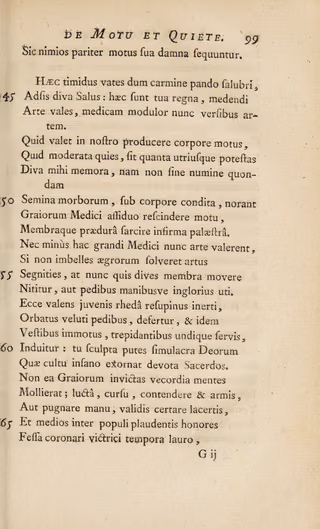
While I, a timid bard, unfold these things in a wholesome song,
Be present, divine Salus: these are your realms, by the healing
Art you prevail, the medical art I now set to verse.
What motion is able to produce in our body,
What moderate rest, how great is the power of each,
Remind me, Goddess, for not without divine will of old
Did the Physicians of the Greeks know how to cut away
The seeds of diseases, hidden within the body, by constant motion,
And to repair weak limbs in the hardy palaestra.
Nor would Physicians now prevail any less by this grand art,
If sloth did not loosen the unwarlike joints of the sick,
Yet now what rich man strives to move his limbs,
Or ingloriously to use his feet or hands.
Behold, a strong youth, lying back in a sluggish carriage,
As if deprived of his feet, is carried along, and the same man,
Unmoving, with servants bustling on all sides, in his clothes
Is dressed: you would think them carved images of the Gods
Which a devoted Priestess adorns with extravagant worship.
Such folly had not softened the unconquered minds
Of the Greeks; to contend in wrestling, running, and arms,
Or to fight by hand, to strive with strong muscles,
And amid the honors of an applauding people
To have one's weary temples crowned with victorious laurel,
HÆC timidus vates dum carmine pando ſalubri,
Adſis diva Salus : hæc ſunt tua regna, medendi
Arte vales, medicam modulor nunc verſibus ar-
tem.
Quid valet in noſtro producere corpore motus,
Quid moderata quies, ſit quanta utriuſque poteſtas
Diva mihi memora, nam non ſine numine quon-
dam
Semina morborum, ſub corpore condita, norant
Graiorum Medici aſſiduo reſcindere motu,
Membraque prædurâ ſarcire infirma palæſtrâ.
Nec minùs hac grandi Medici nunc arte valerent,
Si non imbelles ægrorum ſolveret artus
Segnities, at nunc quis dives membra movere
Nititur, aut pedibus manibusve inglorius uti.
Ecce valens juvenis rhedâ reſupinus inerti,
Orbatus veluti pedibus, defertur, & idem
Veſtibus immotus, trepidantibus undique ſervis,
Induitur : tu ſculpta putes ſimulacra Deorum
Quæ cultu inſano exornat devota Sacerdos.
Non ea Graiorum invictas vecordia mentes
Mollierat; luctâ, curſu, contendere & armis,
Aut pugnare manu, validis certare lacertis,
Et medios inter populi plaudentis honores
Feſſa coronari victrici tempora lauro,
Part 2
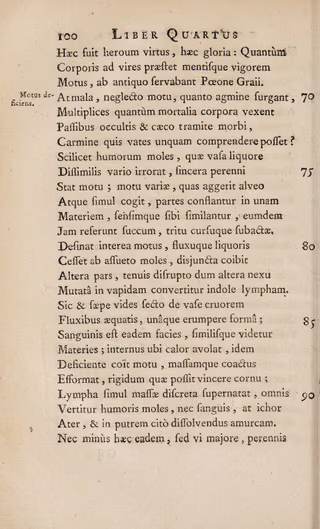
this was the virtue of heroes, this their glory: How much
motion contributes to the strength of the body and the vigor of the mind,
the Greeks preserved from ancient Paeon.
But when motion is neglected, in how great a troop evils arise,
how greatly manifold diseases vex mortal bodies
with hidden steps and by a blind path,
what bard could ever encompass in song?
Indeed, the mass of humors, which, though dissimilar, bedews the vessels
with various liquid, remains pure by perennial
motion; by motion the various parts, which it heaps up in the channel
and forces together, are fused into one
substance, and gradually are made like one another, and now
exhibit the same juice, subdued by friction and coursing.
Meanwhile, let motion cease, and let the mass of liquid
stop its accustomed flow: one part, disjoined, will clot
together, while the other thin part, its bond disrupted
and its nature changed, is converted into vapid lymph.
Thus also you often see gore from a cut vessel
burst forth in even flows and in a single form;
the appearance of the blood is the same, and its substance seems
similar; when the internal heat flies away, that same blood,
as motion fails, clots together, and, coerced, forms
a mass which could surpass rigid horn;
at the same time the separated lymph floats upon the mass, the whole
mass of humor is altered, and it is no longer blood, but black
ichor, soon to be dissolved into putrid dregs.
Nor less does perennial Motion exert these same effects, but with greater force,
Hæc fuit heroum virtus , hæc gloria : Quantùm
Corporis ad vires præſtet mentiſque vigorem
Motus , ab antiquo ſervabant Pœone Graii.
At mala , neglecto motu , quanto agmine ſurgant ,
Multiplices quantùm mortalia corpora vexent
Paſſibus occultis & cæco tramite morbi ,
Carmine quis vates unquam comprendere poſſet ?
Scilicet humorum moles , quæ vaſa liquore
Diſſimilis vario irrorat , ſincera perenni
Stat motu ; motu variæ , quas aggerit alveo
Atque ſimul cogit , partes conflantur in unam
Materiem , ſenſimque ſibi ſimilantur , eumdem
Jam referunt ſuccum , tritu curſuque ſubactæ.
Deſinat interea motus , fluxuque liquoris
Ceſſet ab aſſueto moles , disjuncta coibit
Altera pars , tenuis diſrupto dum altera nexu
Mutatâ in vapidam convertitur indole lympham.
Sic & ſæpe vides ſecto de vaſe cruorem
Fluxibus æquatis , unâque erumpere formâ ;
Sanguinis eſt eadem facies , ſimiliſque videtur
Materies ; internus ubi calor avolat , idem
Deficiente coït motu , maſſamque coactus
Efformat , rigidum quæ poſſit vincere cornu ;
Lympha ſimul maſſæ diſcreta ſupernatat , omnis
Vertitur humoris moles , nec ſanguis , at ichor
Ater , & in putrem citò diſſolvendus amurcam.
Nec minùs hæc eadem , ſed vi majore , perennis
Part 3
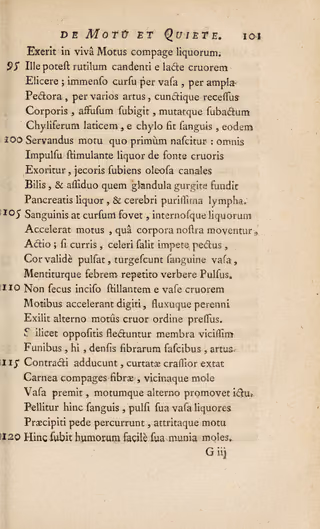
does Motion bring forth in the living frame of the fluids.
It is able to draw forth red blood from gleaming white milk;
by its immense course through the vessels, through the ample
breast, through the various limbs, and all the recesses
of the body, it works upon the poured-in chyliferous fluid,
and changes it when worked upon; from chyle is made blood, by the same
motion to be preserved by which it is first born: every
fluid arises by a stimulating impulse from the fountain of blood—
the oily bile entering the canals of the liver,
and the fluid which the gland of the pancreas pours forth
in an unceasing stream, and the purest lymph of the brain.
Moreover, the action by which our bodies are moved
cherishes the course of the blood and accelerates the internal motions
of the fluids; if you run, the chest leaps with a swift impulse,
the heart beats strongly, the vessels swell with blood,
and the Pulse, with repeated beating, mimics a fever.
Not otherwise do the fingers by their movements accelerate
the blood dripping from a cut vessel, and in a perpetual flow
the blood leaps forth, pressed by an alternating order of motion.
Indeed, the limbs are bent in turn by opposing
cords; these, with dense bundles of fibers, when contracted,
draw the limbs; the fleshy structure of the shortened
fiber stands out thicker, and by its mass presses
the neighboring vessels, and promotes motion by an alternating stroke.
Hence the blood is driven, and the driven fluids run through
their vessels with headlong foot, and worn down by motion,
hence the mass of humors easily undergoes its duties.
Exerit in vivâ Motus compage liquorum.
Ille poteſt rutilum candenti e lacte cruorem
Elicere; immenſo curſu per vaſa, per ampla
Pectora, per varios artus, cunctique receſſus
Corporis, affuſum ſubigit, mutatque ſubactum
Chyliferum laticem, e chylo fit ſanguis, eodem
Servandus motu quo primùm naſcitur: omnis
Impulſu ſtimulante liquor de fonte cruoris
Exoritur, jecoris ſubiens oleoſa canales
Bilis, & aſſiduo quem glandula gurgite fundit
Pancreatis liquor, & cerebri puriſſima lympha.
Sanguinis at curſum fovet, internoſque liquorum
Accelerat motus, quâ corpora noſtra moventur,
Actio; ſi curris, celeri ſalit impete pectus,
Cor validè pulſat, turgeſcunt ſanguine vaſa,
Mentiturque febrem repetito verbere Pulſus.
Non ſecus inciſo ſtillantem e vaſe cruorem
Motibus accelerant digiti, fluxuque perenni
Exilit alterno motûs cruor ordine preſſus.
S ilicet oppoſitis flectuntur membra viciſſim
Funibus, hi, denſis fibrarum faſcibus, artus
Contracti adducunt, curtatæ craſſior extat
Carnea compages fibræ, vicinaque mole
Vaſa premit, motumque alterno promovet ictu.
Pellitur hinc ſanguis, pulſi ſua vaſa liquores
Præcipiti pede percurrunt, attritaque motu
Hinc ſubit humorum facilè ſua munia moles.
Part 4
How beneficial it is to exercise the limbs with constant toil,
You see from this, so that the blood may fill the vessels
With pure fluid, so that it may visit the vessels with an even course,
And, sending forth immense streams from its rich bosom,
May purge of harmful dregs the viscera swelling with filth:
But if the limbs grow torpid in sluggish rest,
The sluggish blood stagnates, propelled by no beat,
And, heaped up, shortly thickens; the vessels rise
With manifold swelling; scarcely in the whole body does a gland,
Still passable, grant the ancient path to the lymph;
Instead it swells with infarction, and resists when handled by the hands.
Add to this that the filths to be driven from the whole body,
Both those which urine propels through the tubules of the kidneys,
And those which furnish the matter of sweat, snatched away
Through the manifold openings of the skin, and the thicker
Magma of the bowels, beat in vain upon the viscera allotted
to them;
The sluggish motion languishes, they stick fast; the impure dregs
Of the blood creep in the motionless vessels: the water of a marsh
Thus stagnates, tainted with mud, and exhaling a foul mephitis,
Defiles all the places far and wide with putrefaction.
Thence how dire an offspring of evil threatens the fluids!
Therefore let the sluggish man now accuse rather the idleness
Of his own slothful life, not fortune, while a gland, rising up
With a hard tuber, obstructs his flanks with juices in infarction,
Or a mass of fluids, heaped up in various
Quam juvet aſſiduo membra exercere labore
Inde vides , puro quò ſanguis vaſa liquore
Impleat , æquali quò curſu vaſa ſalutet ,
Immenſoſque ſinu mittens ex ubere rivos ,
Fæcibus expurget nocuis turgentia ſorde
Viſcera : ſed torpent ſegni ſi membra quiete ,
Stagnat iners nullo propulſus verbere ſanguis ,
Aggeſtuſque brevì concreſcit , vaſa tumore
Multiplici ſurgunt , vix corpore glandula toto
Antiquum tribuit lymphæ jam pervia callem ;
At tumet infarctu , & manibus tractata reſiſtit.
Adde quod e toto pellendæ corpore ſordes ,
Tum quas per renum tubulos urina propellit ,
Tum quæ materiem præſtant ſudoris , hiatu
Multiplici pellis raptæ , tum craſſius alvi
Magma , ſibi incaſſum conceſſa ad viſcera pul-
ſent ;
Motus languet iners , hærent ; impura cruoris
Immotis repit fæx vaſibus : unda paludis
Sic ſtagnat vitiata luto , tetramque Mephitim
Exhalans , latè loca cuncta putredine fœdat.
Inde mali ſoboles quàm dira liquoribus inſtat !
Ergo ſuæ potiùs nunc deſidis otia vitæ ,
Non fortunam incuſet iners , dum glandula duro
Tubere conſurgens , infarctis ilia ſuccis
Obſtruit , aut vario moles aggeſta liquorum
Part 5
settling in an internal organ, becomes inflamed and stirs up
a hidden abscess, weighed down with melancholic grief,
and scarcely hiding his dry bones beneath his saffron-yellow skin,
he at last implores the aid of the healing art; yet too often, alas!
the art cannot, by any remedy, pluck out the deeply fixed
roots of the disease; now nothing, nothing do medicines avail,
nor potions, nor antimony subdued with hard iron.
Motion alone could have prevented this ruin,
and motion alone could conquer it now; but all tone
fails in the solid parts, nor can the sluggish vessels
dissolve the congealed fluids; for by excessive rest
the feeble fibers are relaxed, and no longer
perform their functions as before by contracting their filaments:
the languid vessels scarcely drive on the thickened blood;
how could they remove the obstructions by repeated effort?
No safety remains, but with the nerves unstrung, the limbs
too often languish, oppressed by a sluggish stupor.
Life alone remains, yet oh, what a life, and how dreadful!
A sad life, and more anxious than a cruel death!
Thus suffers the wretched sluggard, who once
was scarcely willing to tire his soft limbs with gentle motion,
and now, with disease as his avenger, pays for his ancient faults.
Come then, do not fear to drive with vigorous motion
Viſcere decumbens , vomicam inflammata laten-
tem
Excitat , ille melancholico mærore gravatus ,
Siccaque vix croceis condens ſub pellibus oſſa ,
Artis tandem implorat opem , ſed ſæpius eheu !
Ars nequit infixas altè medicamine morbi
Vellere radices , nil jam nil pharmaca proſunt ,
Poculaque & duro Stibium cum Marte ſubactum.
Hanc ſolus potuit motus prævertere labem ,
Solus & hanc poſſet nunc vincere , ſed tonus om-
Deficit in ſolidis , nec inertia vaſa liquores
Concretos poſſunt diſſolvere ; quippe quiete
Laxantur nimiâ imbelles , nec jam ſua fibræ ,
Ut priùs , exercent contractis munia villis :
Languida vix pellunt ſpiſſatum vaſa cruorem ,
Quî poſſent obices repetito tollere niſu ?
Nulla ſalus ſupereſt , at nervis membra ſolutis
Sæpius ignavo languent oppreſſa ſtupore.
Sola manet , ſed proh qualis , quàmque horrida
Triſtis & immiti magis anxia funere vita !
Sic patitur miſerandus iners , qui mollia motu
Vix laſſare levi quondam ſua membra volebat ,
Antiquaſque luit , morbo nunc vindice , noxas.
ERGO age , non duro timeas compellere motu
Part 6
your limbs, nor to strengthen your joints with constant labors.
Yet let there be a fixed law of motion, a fixed law of rest,
And do not exhaust a weary body without any moderation.
The Sun, fertilizing the flowery fields with gentle warmth,
Scorches the dried-up lands with excessive fires:
And the rain, refreshing the crops with scattered dews,
Can often ruin the harvest with massed storm-clouds:
Thus excessive motion brings fearful dangers with it,
And ruins bodies with various kinds of decay.
Indeed, by unceasing motion the viscera are gradually
Dissolved; agitated by excessive labor, the mass of fibers
Is worn away, and the liquids tear away the rubbed vessels
In their rapid course, and gradually dissolve them.
Food could repair these lost particles with its gentle liquid,
But nourishment can neither mend
So great a ruin, nor does the weary belly digest the dishes;
Or if any part has been digested with long labor,
This runs too swiftly through the small vessels in its course, attached
To no parts, and the whole of it enters the pores of the skin.
Thus motion gradually consumes the solid parts, thus even
The hard bones of the body: no otherwise does the wave
Often hollow out the hard rock with its winding eddy,
And iron, harder than rocks, is consumed by use.
Meanwhile, another decay is at the same time impressed upon the fluids
By excessive motion; the mass of liquids becomes more acrid
As its salts expand, while, once the thin part is driven off,
An earthy magma remains with its gluten exhausted. 195 Excessive motion.
Membra , nec aſſiduis firmare laboribus artus.
Certa tamen motûs lex eſto , certa quietis ,
Nec feſſum laſſes , nullo moderamine , corpus.
Florida fœcundans blando Sol arva calore ,
Exurit nimiis ſiccatos ignibus agros :
Et ſegetes recreans diſperſis roribus imber ,
Sæpe poteſt meſſem aggeſtis ſubvertere nimbis :
Sic nimius ſecum metuenda pericula motus
Advehit , & variâ peſſumdat corpora labe.
Quippe perennanti paulatim viſcera motu
Solvuntur , nimio fibrarum agitata labore
Deteritur moles , attritaque vaſa liquores
Abripiunt rapido curſu , ſenſimque reſolvunt.
Has cibus amiſſas blando reparare liquore
Particulas poſſet , tantam ſed pabula cladem
Nec ſarcire queunt , nec feſſus fercula venter
Concoquit ; aut ſi quæ longo pars cocta labore eſt ,
Hæc citiùs curſu percurrit vaſcula , nullis
Partibus infixa , & pellis ſubit omnis hiatus.
Sic ſolidas motus partes , ſic corporis oſſa
Dura quidem ſenſim conſumit : non ſecus unda
Durum ſæpe cavat ſinuoſo gurgite ſaxum ,
Durius & ſaxis ferrum conſumitur uſu.
Interea fluidis labes ſimul altera motu
Imprimitur nimio , ſalibus fit maſſa liquorum
Acrior expanſis , tenui dum parte propulsâ
Terrenum ſupereſt effœto glutine magma. 195 Motus nimius.
Part 7
Should you imprudently fatigue your languid limbs with protracted
motions, sweat flows from your exhausted body;
not only do troublesome dregs and useless humor
fly off, but as the vessels are swollen by motion, all
the little tubes of the skin gape open; the unspoiled part of the blood,
the purer flower of the humors, and the refined lymph,
which fruitfully supplies a gentle dew to the limbs,
are forced out; hence, with their juices withdrawn, the viscera wither,
the viscid blood scarcely moves in its narrow channel,
it comes to a halt, and the dry body languishes without strength.
The more acrid saltiness of the fluids fosters this hostile
emaciation, the attenuated sulphurs of the blood
corrode the worn-down parts, and finally a premature old age
quickly disfigures bodies made callous by labor.
Behold those whom relentless poverty has compelled
to sustain life by harsh labor, and to turn the earth
with their hands; what a countenance they display on their bent bodies,
how their youthful temples are rough with white hairs!
What dry emaciation! In the very prime flower of youth,
these walking skeletons can scarcely bend their stiffened joints.
So many evils do you prevent by the due moderation of motion.
Languida protractis imprudens membra fatiges
Motibus, exhauſto manat de corpore ſudor;
Non tantùm fæx importuna, & inutilis humor
Avolat, at motu tumefactis vaſibus, omnes
Pellis hiant tubuli, pars illibata cruoris,
Purior humorum flos, defæcataque lympha,
Quæ blandum membris rorem fœcunda miniſtrat,
Truditur; hinc marcent ſubductis viſcera ſuccis,
Viſcidus anguſto ſanguis vix calle movetur,
Siſtitur, & ſiccum languet ſine robore corpus.
Hanc maciem fovet infenſam ſalſedo liquorum
Acrior, attritas partes tenuata cruoris
Sulphura corrodunt, demum calloſa labore
Corpora deturpat citò præmatura ſenectus.
Aſpice quos vitam acri ſuſtentare labore,
Quos manibus terram verſare coegit egeſtas
Improba; quem referunt incurvo corpore vultum,
Crinibus ut ſquallent juvenilia tempora canis!
Arida quæ macies! Primævo in flore juventæ
Flectere vix rigidos artus ſilicernia poſſunt.
Tot mala prævertis juſto moderamine motûs.