Hover or tap a word to see its match.
Part 1
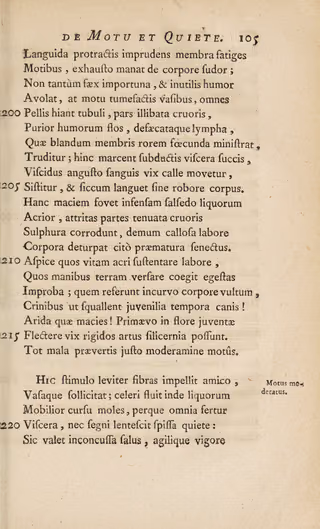
THIS gently impels the fibers with a friendly stimulus,
and stirs the vessels; thence the more mobile mass of fluids
flows in a swift course, and is carried through all
the viscera, nor does it grow sluggish and thick in slothful rest:
thus health remains unshaken, and with agile vigor Moderate motion.
HIC ſtimulo leviter fibras impellit amico,
Vaſaque ſollicitat; celeri fluit inde liquorum
Mobilior curſu moles, perque omnia fertur
Viſcera, nec ſegni lenteſcit ſpiſſa quiete:
Sic valet inconcuſſa ſalus, agilique vigore Motus moderatus.
Part 2
the limbs gleam, and the lively mind shines in a healthy
body.
Moreover, the limbs are strengthened by constant labor,
Whether you move the whole body, or whether certain
limbs alone bear the toil, these prevail with greater
strength.
Just as a band of artisans is strong with sinewy muscles
While it exercises its arms, and pressing on with repeated blows
Shakes the bronze; the iron rebounds from the ringing anvil,
Neither delay nor rest, the softer mass crackles
Beneath the weight, and when struck rises into a new shape.
No less does the child who languishes with exhausted strength,
Whom a fond nurse, or whom a pale mother
Has cherished in an anxious bosom, and kept lying
Under a soft canopy, who has felt neither the colds of winter,
Nor the rays of the sun, and has never exposed his head
To the breeze of the air—how in his whole face he conceives
Vigor and breathes strength from his hardened chest,
As soon as, a youth, he dares to exercise his limbs
With due labor, and burning with wonted desire,
Delights to turn the horse's course with the foaming bit,
Or to chase the swift wild beasts, or to wield arms,
And fears neither the airy heats, nor the colds of winter.
Meanwhile the swelling blood tinges his pale
Cheeks, and with hairy sinews stiffen his robust
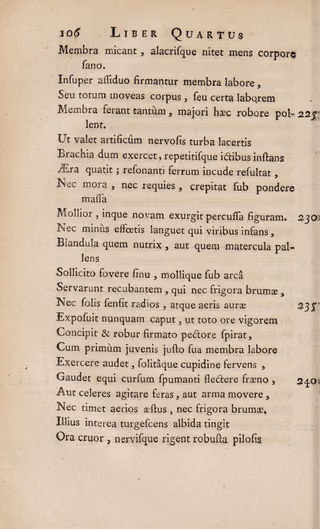
Membra micant, alacriſque nitet mens corpore
ſano.
Inſuper aſſiduo firmantur membra labore,
Seu totum moveas corpus, ſeu certa laborem
Membra ferant tantùm, majori hæc robore pol-
lent.
Ut valet artificûm nervoſis turba lacertis
Brachia dum exercet, repetitiſque ictibus inſtans
Æra quatit; reſonanti ferrum incude reſultat,
Nec mora, nec requies, crepitat ſub pondere
maſſa
Mollior, inque novam exurgit percuſſa figuram.
Nec minùs effœtis languet qui viribus infans,
Blandula quem nutrix, aut quem matercula pal-
lens
Sollicito fovere ſinu, mollique ſub arcâ
Servarunt recubantem, qui nec frigora brumæ,
Nec ſolis ſenſit radios, atque aeris auræ
Expoſuit nunquam caput, ut toto ore vigorem
Concipit & robur firmato pectore ſpirat,
Cum primùm juvenis juſto ſua membra labore
Exercere audet, ſolitâque cupidine fervens,
Gaudet equi curſum ſpumanti flectere fræno,
Aut celeres agitare feras, aut arma movere,
Nec timet aerios æſtus, nec frigora brumæ.
Illius interea turgeſcens albida tingit
Ora cruor, nerviſque rigent robuſta piloſis
Part 3
arms; he stands now a hero rivaling mighty Hercules,
who with his soft brow used to resemble an unwarlike girl:
to such a degree do the bodies of youths, strengthened by motion, thrive,
and their limbs are hardened by accustomed labor!
Hence Gaul is able with so many intrepid soldiers to overcome
numerous nations, and has brought forth so many thunderbolts of war,
wherewith, victorious, she might lay low indomitable enemies,
and subject the whole world far and wide to her empire.
Nor does Louis himself, beloved by his peoples, refuse to indulge
in constant labor, he who often before others presses the back
of a snorting steed: the trumpets give the signal,
with swift course he outstrips the rapid arrow;
now the timid fallow deer flee, now the nets ensnare
the stags; they wet their faces with large tears,
yet the relentless force of the hounds presses on continually; in vain
they struggle with opposing horns; there is no way
to delay fate; to succumb at the command of so great a King
is no disgrace to the wretched creatures; behold, the head is fixed
as a trophy upon the sacred doorposts—that glory awaits them.
Meanwhile the Fauns and the thickest crowd of Satyrs
stood amazed at the man, whom, graced with majesty,
they recognize as Lord of the woods, and revere as King;
and the Dryads felt the seeds of a sweet flame.
The woods resound with assent, and echo with applause.
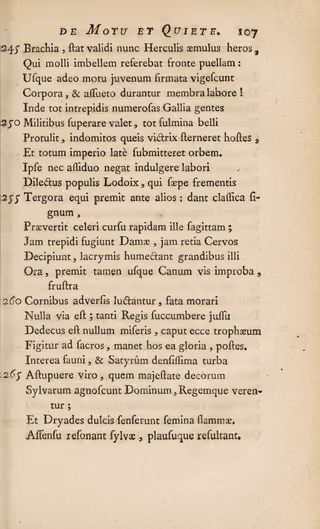
Brachia, ſtat validi nunc Herculis æmulus heros,
Qui molli imbellem referebat fronte puellam:
Uſque adeo motu juvenum firmata vigeſcunt
Corpora, & aſſueto durantur membra labore!
Inde tot intrepidis numeroſas Gallia gentes
Militibus ſuperare valet, tot fulmina belli
Protulit, indomitos queis victrix ſterneret hoſtes,
Et totum imperio latè ſubmitteret orbem.
Ipſe nec aſſiduo negat indulgere labori
Dilectus populis Lodoix, qui ſæpe frementis
Tergora equi premit ante alios: dant claſſica ſi-
gnum,
Prævertit celeri curſu rapidam ille ſagittam;
Jam trepidi fugiunt Damæ, jam retia Cervos
Decipiunt, lacrymis humectant grandibus illi
Ora, premit tamen uſque Canum vis improba,
fruſtra
Cornibus adverſis luctantur, fata morari
Nulla via eſt; tanti Regis ſuccumbere juſſu
Dedecus eſt nullum miſeris, caput ecce trophæum
Figitur ad ſacros, manet hos ea gloria, poſtes.
Interea fauni, & Satyrûm denſiſſima turba
Aſtupuere viro, quem majeſtate decorum
Sylvarum agnoſcunt Dominum, Regemque veren-
tur;
Et Dryades dulcis ſenſerunt ſemina flammæ.
Aſſenſu reſonant ſylvæ, plauſuque reſultant.
Part 4
For it is right for a leader, who has such great affairs in his care,
to refresh his mind and exercise his body with motion,
who protects the French, bound to him by an eternal bond of love,
who governs the world with just laws,
and with his temples wreathed in sacred laurel,
brings peace to nations, and as a victor holds out the olive of peace
to Europe, braver in spurning victorious palms:
meanwhile, playing in the likeness of mock war,
a most handsome band of companions follows behind their leader,
and they hang upon the King's eyes, and eagerly carry out his commands;
mothers marvel at the din, and praise the playful
battles, and point out the weapons of the men, and their strong arms.
Yet weakness does not allow everyone to outstrip fleet stags
in the chase,
to brandish weapons by hand, or to endure similar labors;
thus let each look to his own strength,
lest he weary his limbs with excessive movements.
Hence there is a diverse kind of exercise, nor has nature
denied easy movements even to the infirm.
One who is weak, or broken by the long crisis of a disease,
scarcely walks safely on his feet, and is able to bear
no labor; what prevents him from being gently propelled
in a skiff on a placid river, what forbids him to mount a soft litter?
This gentle motion will jostle the languid viscera Diverse kinds of exercise.
Nam recreare animos æquum eſt , & corpora
motu
Exercere ducem, cui tanta negotia curæ,
Qui ſibi devinctos æterno fœdere amoris
Tutatur Gallos, qui juſtis legibus orbem
Temperat , & ſacrâ redimitus tempora lauro
Componit populos , ac pacis victor olivam
Europæ oſtentat , victrices ſpernere palmas
Fortior : at ludens fallacis imagine belli
Ponè ducem ſequitur comitum pulcherrima turba,
Eque oculis Regis pendent, & juſſa capeſſunt ;
Mirantur ſtrepitum matres , & ludicra laudant
Prælia , & arma virûm oſtentant , forteſque lacer-
tos.
At non quemque leves curſu prævertere Cer-
vos ,
Tela vibrare manu , aut ſimiles perferre labores
Debilitas patitur, proprium ſic quiſque vigorem
Proſpiciat , nimiis ne laſſet motibus artus.
Hinc exercitii ſpecies diverſa, nec ipſis
Infirmis faciles motus natura negavit.
Debilis , aut longo fractus diſcrimine morbi,
Vix pedibus tutò incedit , nullumque laborem
Ferre valet; placido prohibet quid flumine cymbâ
Leniter impelli , lecticam aſcendere mollem
Quid vetat ? Hic blandus languentia viſcera motus Diverſæ ſpecies exercitii.
Part 5
will shake up, and by motion vigor itself will gradually return.
Then he will be able first to be carried in a slow chariot
through soft fields, until, borne in a creaking wagon,
he can speed across ridges rough with many stones.
What great benefits this external motion affords the sick
is scarcely to be believed, while the limbs with no labor,
agitated by a gently applied jolting, are moved.
Indeed, the various diseases fixed deep in the seed
which you try in vain to pluck out, this medicine alone
can bring a cure; motion relieves dying
bodies, upon which father Phoebus would in vain heap herbs.
By this divine art once shone forth the noble
Hippocrates the first, who, following the commands of Wisdom,
repaid an eternal gift to the human race in exchange for praise,
and daring to succor afflicted affairs,
preserved citizens for his country, and parents for their children.
He, prudent, had advised few and select remedies in their proper place,
but skilled at matching motion and foods,
so that expenditure and intake might always succeed one another
in turn, what he diminished from the latter he at once added to the former.
Hence it was granted to him to drive burning plagues far away,
and to preserve safe health for the peoples.
Thence the glory of the aged Physician is celebrated throughout the whole
world, and as long as fever shall burn mortals with its fires,
as long as the sure art of Physicians shall prevail to drive out diseases,
the name and praise of Hippocrates will remain unshaken.
Succutiet, motu ſenſim vigor ipſe redibit.
Tum curru poterit primùm per mollia tardo
Arva vehi, donec juga multis aſpera ſaxis
Stridenti vectus poſſit percurrere plauſtro.
Exterus hic motus quanta ægris commoda præſtet
Credere vix fas eſt, nullo dum membra labore
Molliter admoto ſuccuſſu agitata moventur.
Quin varios alto defixos ſemine morbos
Vellere necquicquam tentas, hæc ſola medelam
Ferre poteſt medicina; levat morientia motus
Corpora, queis fruſtra Phœbus pater ingerat her-
bas.
Hac quondam emicuit divinâ nobilis arte
Hippocrates primus, Sophiæ qui juſſa ſecutus
Æternum humano generi pro laude rependit
Munus, & afflictis auſus ſuccurrere rebus,
Servavit patriæ cives, natiſque parentes.
Hic pauca & ſelecta loco medicamina prudens
Suaſerat, at motum doctus conferre ciboſque,
Ut ſeſe alternis expenſa impenſaque ſemper
Exciperent, quodque his minuit ſimul addidit illi.
Hinc ipſi ardentes longè depellere peſtes
Fas erat, & tutam populis ſervare ſalutem.
Inde ſenis Medici toto celebratur in orbe
Gloria, dumque febris mortales ignibus uret,
Pellere dum morbos Medicorum ars certa valebit,
Hippocratis nomen lauſque inconcuſſa manebunt.
Part 6
Nor less, surveying the footsteps of Hippocrates,
has that most learned band of physicians—
of whose merits populous Paris boasts—
undertaken by motion to dispel the dire wasting that gradually consumes parched chests,
or humors accumulated in various viscera.
But as for those in whose vigorous bodies robust strength abides,
let them love to tread with their feet the blooming grasses
of the verdant countryside, or to climb the hills at a run,
and to hunt wild beasts, to guide with foaming bit
the untamed steed, to lead festive dances,
or with a stick to intercept the fall of the whizzing ball.
Nature has compelled every youth to pursue these
headlong motions; under the pleasing guise of play
she is able to strengthen the limbs of young men with healthful motion.
Nor does such play unbecome a brow venerable
with gravity; why would a Senator refuse to indulge in it,
who is not ashamed to handle cards painted in various colors,
and amid the hazards of insipid chance
to demand with pale face a king or a queen?
Not thus did the austere gravity of indomitable Cato
judge; rather, concealing an august charm beneath a stern brow,
he quite often undertook to outstrip young men in a swift race,
to frequent the vigorous palaestra,
and to refresh his wearied body with new labor.
Thus likewise by exercise did the Greeks strengthen
their bodies; by motion they knew how to forestall the seeds of disease,
and to recall the tranquil peace of the mind.
Nec minùs Hippocratis luſtrans veſtigia, diram
Arida quæ ſenſim conſumit pectora tabem,
Aut vario accretos humores viſcere, motu
Diſcutere aggreſſa eſt doctiſſima turba medentûm,
Quorum ſe meritis populoſa Lutetia jactat.
At queis robuſtæ vegeto ſtant corpore vires,
Hi viridantis ament pedibus florentia ruris
Gramina calcare, aut curſu conſcendere colles,
Atque agitare feras, ſpumanti flectere fræno
Quadrupedem indomitum, feſtivos ducere ſaltus,
Stridentiſve pilæ baculo prævertere lapſum.
Hos natura ſequi juvenem quemcumque coegit
Præcipites motus, gratâ ſub imagine ludi
Membra valet juvenum motu firmare ſalubri.
Nec talis frontem luſus gravitate verendam
Dedecet; huic nollet cur indulgere Senator,
Quem pictas vario chartas tractare colore
Non pudet, inſulſæque inter diſcrimina ſortis
Pallenti regem dominamve expoſcere vultu.
Non ſic indomiti gravitas auſtera Catonis
Senſit, at auguſtum rigidâ ſub fronte leporem
Occultans, juvenes celeri prævertere curſu
Sæpius aggreſſus, validam celebrare palæſtram,
Defeſſumque novo corpus recreare labore.
Sic exercitio pariter ſua corpora Græci
Firmabant, motu prævertere ſemina morbi,
Tranquillamque animi norant revocare quietem.
Part 7
Now it is not enough to have sung the deserved praises of motion in spun-out song;
it pleases me to ponder the hidden things of nature,
and to unfold in verse mysteries not previously unlocked:
why motion benefits, and why the very same harms
mortals, through you, Phoebus, may I be permitted to declare.
For at times you see bodies disturbed by slight motion,
and growing faint with wearied limbs; hence men
too often malign motion, hence many refuse
to exercise their sluggish limbs with labors.
Yet if by chance the viscera, swollen with food, grow faint,
do you afterwards refuse nourishment to an empty belly?
Do you decline to moisten a dry throat with water,
because a copious draught once weighed down
a weak stomach?
Assuredly life is sustained by constant drink and food,
but so that your limbs may thrive with healthy vigor,
it helps to exercise them, and to impel them with varied motion;
and just as food is the sure cause of life, so motion is of health,
nor does feeble torpor restore bodies.
Yet just as in diseases medicines quite often bring
certain harm, if they are drunk according to no rule,
so exercise has its own hazards, if a sure
method and the prudence of a physician do not govern the motion. Precautions.
NUNC meritas motûs deducto carmine laudes
Non ceciniſſe ſatis , juvat abdita volvere rerum ,
Nec reſerata priùs myſteria pandere verſu :
Cur proſit motus , cur & mortalibus idem
Officiat, per te liceat mihi, Phœbe, profari.
Nam quandoque levi turbari corpora motu ,
Defeſſiſque vides membris langueſcere ; motum
Sæpius inde homines infamant , inde recuſant
Ignavos multi exercere laboribus artus.
At ſi fortè cibis turgentia viſcera languent ,
Poſtea num vacuo detrectas pabula ventri ?
Num renuis ſiccum lymphis aſpergere guttur ,
Larga quòd infirmum ſtomachum quondam unda
gravarit ?
Scilicet aſſiduo potuque ciboque fovetur
Vita , ſed ut ſano valeant tua membra vigore
Exercere juvat , varioque impellere motu ;
Utque cibus vitæ , ſic motus certa ſalutis
Cauſa, nec imbellis reſtaurat corpora torpor.
At velut in morbis certam medicamina noxam
Sæpius important , nullâ ſi lege bibantur ,
Sic exercitii ſua ſunt diſcrimina, ſi non
Certa regit ratio , & medici prudentia motum. Cautelæ.