Hover or tap a word to see its match.
Part 1
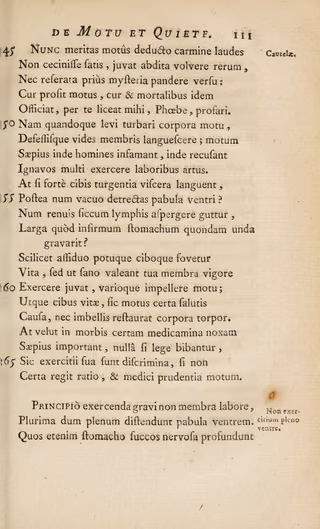
First of all, the limbs must not be exercised with heavy labor,
while abundant food distends a full belly.
For the juices which the nervous No exercise on a full stomach.
PRINCIPIÒ exercenda gravi non membra labore ,
Plurima dum plenum diſtendunt pabula ventrem.
Quos etenim ſtomacho ſuccos nervoſa profundunt Non exercitium pleno ventre.
Part 2
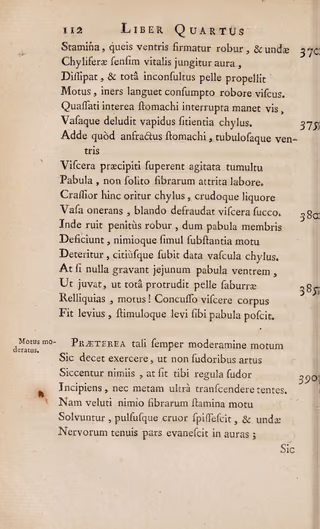
threads, by which the strength of the belly is firmed, and a vital breath
is gradually joined to the chyliferous stream,
rash motion dissipates and drives out through the whole skin,
and with its strength consumed, the sluggish viscus languishes.
Meanwhile the power of the shaken stomach remains interrupted,
and a vapid chyle mocks the thirsty vessels.
Add to this that the food, agitated by a headlong tumult,
passes through the windings of the stomach and the tubular
viscera of the belly, not ground down by the usual labor of the fibers.
Hence a thicker chyle arises, and burdening the vessels
with a crude fluid, it cheats the viscera of their soothing juice.
Thence strength utterly collapses, while nourishment fails
the limbs, and at the same time the substance is worn away by excessive
motion, and the chyle enters the appointed little vessels too quickly.
But if no food weighs down the fasting belly,
how motion helps, how it thrusts out through the whole skin the remnants
of saburra! When the viscus is shaken, the body
becomes lighter, and with a gentle stimulus demands food for itself.
Moderate motion. Furthermore, it is fitting always to practice motion with such moderation,
that the limbs are not dried out
by excessive sweats, but let incipient sweat be the rule
for you, nor should you try to cross beyond that limit.
For just as by excessive motion the threads of the fibers
are loosened, and the driven blood thickens, and the subtle part
of the fluid of the nerves vanishes into the air;
Stamina, queis ventris firmatur robur, & undæ
Chyliferæ ſenſim vitalis jungitur aura,
Diſſipat, & totâ inconſultus pelle propellit
Motus, iners languet conſumpto robore viſcus.
Quaſſati interea ſtomachi interrupta manet vis,
Vaſaque deludit vapidus ſitientia chylus.
Adde quòd anfractus ſtomachi, tubuloſaque ven-
tris
Viſcera præcipiti ſuperent agitata tumultu
Pabula, non ſolito fibrarum attrita labore.
Craſſior hinc oritur chylus, crudoque liquore
Vaſa onerans, blando defraudat viſcera ſucco.
Inde ruit penitùs robur, dum pabula membris
Deficiunt, nimioque ſimul ſubſtantia motu
Deteritur, citiùſque ſubit data vaſcula chylus.
At ſi nulla gravant jejunum pabula ventrem,
Ut juvat, ut totâ protrudit pelle ſaburræ
Relliquias, motus! Concuſſo viſcere corpus
Fit levius, ſtimuloque levi ſibi pabula poſcit.
Motus moderatus. PRÆTEREA tali ſemper moderamine motum
Sic decet exercere, ut non ſudoribus artus
Siccentur nimiis, at ſit tibi regula ſudor
Incipiens, nec metam ultrà tranſcendere tentes.
Nam veluti nimio fibrarum ſtamina motu
Solvuntur, pulſuſque cruor ſpiſſeſcit, & undæ
Nervorum tenuis pars evaneſcit in auras;
Part 3
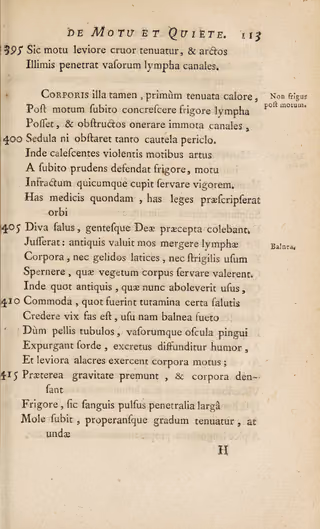
So by gentler motion the blood is thinned, and clear
Lymph penetrates the narrow channels of the vessels.
YET that lymph of the body, once thinned by heat,
Could congeal from sudden cold after motion,
And, motionless, burden the obstructed channels,
Unless diligent caution opposed so great a danger.
Hence let the prudent man defend limbs growing warm by violent motions
From sudden cold, whoever desires to preserve
His vigor unbroken by motion.
These laws to physicians once, these laws to the world
The Goddess Health had prescribed, and nations revered the Goddess's precepts.
She had commanded: among the ancients the custom prevailed to plunge bodies
In water, and not to spurn either cold streams or the use of the strigil,
Which had the power to keep the body vigorous.
Hence how many advantages the ancients had, which custom has now abolished,
How many sure safeguards of health there were,
It is scarcely possible to believe; for while baths by their accustomed use
Cleanse the tubules of the skin and the mouths of the vessels of greasy
Filth, the excreted humor is diffused,
And lighter bodies perform brisk motions;
Moreover they press by their weight, and condense the body
With cold; thus the driven blood enters the inner parts in a large
Mass, and quickening its pace is thinned, while of the water No cold after motion. Baths.
Sic motu leviore cruor tenuatur, & arctos
Illimis penetrat vaſorum lympha canales.
CORPORIS illa tamen, primùm tenuata calore,
Poſt motum ſubito concreſcere frigore lympha
Poſſet, & obſtructos onerare immota canales,
Sedula ni obſtaret tanto cautela periclo.
Inde caleſcentes violentis motibus artus
A ſubito prudens defendat frigore, motu
Infractum quicumque cupit ſervare vigorem.
Has medicis quondam, has leges præſcripſerat
orbi
Diva ſalus, genteſque Deæ præcepta colebant.
Juſſerat: antiquis valuit mos mergere lymphæ
Corpora, nec gelidos latices, nec ſtrigilis uſum
Spernere, quæ vegetum corpus ſervare valerent.
Inde quot antiquis, quæ nunc aboleverit uſus,
Commoda, quot fuerint tutamina certa ſalutis
Credere vix fas eſt, uſu nam balnea ſueto
Dùm pellis tubulos, vaſorumque oſcula pingui
Expurgant ſorde, excretus diffunditur humor,
Et leviora alacres exercent corpora motus;
Præterea gravitate premunt, & corpora den-
Frigore, ſic ſanguis pulſus penetralia largâ
Mole ſubit, properanſque gradum tenuatur, at
undæ Non frigus poſt motum. Balnea.
Part 4
cold strengthens the fibers of the vessels by its contact;
Hence, when the liquid is absorbed through the pores of the skin,
They dissolve the lymph congealed in various viscera.
Thus, with a gentle remedy, baths subdue the untamed
Fury of diseases, and procure vigor for the healthy,
Whereby they may safely resist diseases.
Medicated
baths. MOTHER Nature shows the way, who often beneath the deepest
Mountains, and in sacred caverns, places teeming with sulphur,
Prepares huge furnaces, and mixes veins of metal
With sulphurous exhalations, and waters with those of salts.
When these, mixed together beneath the blind earth, swell up,
Heat is produced; the light water bursts forth with a murmur into the thin air
And leaps up; its color is unmuddied, and such
As pleases the sight itself, yet the nose shuns the odor,
Foul as it is, which recalls the putrefied shells of eggs.
To those who touch it, it gives the feel of oil: the herbs
Which it has once touched, it robs of their verdant grace,
And imparts paleness to them, paleness to the flowers,
And commonly imprints a black stain deeply upon silver;
Yet its gifts are varied, and within it lies a precious faculty,
Whereby it can penetrate the whole body, and pour
Wholesome juices into the viscera and the deepest nerves.
Health herself, taking pity on mankind, breathed upon this water
With her sacred deity, and willed the Epidaurian temples to be forsaken.
Behold the crowd of the languishing hastening to the baths,
Roborat allapſu vaſorum ſtamina frigus;
Hinc cutis abſorpto per ſpiramenta liquore,
Diſſolvunt vario concretam viſcere lympham.
Morborum ſic indomitam medicamine blando
Balnea debellant rabiem, ſaniſque vigorem
Conciliant, quo morbis tuti obſiſtere poſſint.
dicata. MONSTRAT iter natura parens, quæ fæpe ſub
imis
Montibus, & ſacris, loca ſulphure fœta, cavernis,
Fornaces parat ingentes, venaſque metalli
Sulphureis miſcet, ſaliumque afflatibus undas.
Hæc ubi ſub cæcâ tellure remixta tumeſcunt,
Fit calor, erumpit tenues cum murmure in auras
Et ſalit unda levis, color eſt illimis, & ipſi
Qui placeat viſu, fugiat ſed naſus odorem,
Qui ovorum referat putrefacta putamina teter.
Illa olei formam reddit tangentibus: herbas
Quas ſemel attigerit viridanti fraudat honore,
Et pallorem ipſis, pallorem floribus indit,
Ac nigram argento maculam vulgò imprimit altè;
At variæ dotes, & ineſt pretioſa facultas,
Quâ totum poſſit corpus penetrare, ſalubres
Viſceribus nerviſque imis infundere ſuccos.
Ipſa homines miſerata Salus, hanc numine ſacro
Afflavit, voluitque Epidauria templa relinqui.
Aſpice languentûm properantem ad balnea turbam,
Part 5
How pale are their faces, how wasting disfigures their bodies!
That man with a lame foot scarcely drags his tottering limbs,
This one is weighed down by the hard burden of a swollen belly,
With motionless limbs, half a corpse, is carried
Another, and yet another declares his wounds with bitter wailing.
Here, whatever gripes creep up with slow step,
And with silent shafts deeply assail the mortal
Entrails, are gathered in troops, and from all sides disease
Flows together, and saddens the mind with a foul image.
Without delay, the aspect changes, a fairer image
Arises; and their countenances are adorned with rosy beauty,
And their shining bodies display a lively strength.
And now he who before was tottering begins to advance with firm
Step; the burden of his inflated belly removed,
Another tosses his limbs with unaccustomed vigor:
No ancient pain, no dire wounds remain;
Each one is well, each one in song expresses his confirmed
Health, and extols the spring with sincere praises.
These are the waters, this is the spring of youth which they sang of,
Which alone with easy art can put trembling old age to flight,
And prolong youthful grace to lengthy years.
Indeed, squalid gray hair disfigures the aging
Countenance, and wrinkles mark it, and tremor shatters the sluggish
Limbs, when the hardened threads of the fibers grow
Stiff, nor can the immobile body easily
Ut pallent ora , ut deturpat corpora tabes !
Ille vacillantes pede claudo vix trahit artus ,
Hic duro opprimitur tumefacti pondere ventris ,
Artubus immotis defertur ſemicadaver
Alter , & alter acri declarat vulnera planctu.
Hîc quæcumque gradu ſubrepunt tormina lento ,
Et tacitis altè oppugnant mortalia telis
Viſcera , turmatim glomerantur , & undique mor-
bus
Confluit , ac fœdâ contriſtat imagine mentem.
Haud mora ; mutatur facies , exurgit imago
Pulchrior ; & roſeo vultus decorantur honore ,
Ac vegetum referunt ſplendentia corpora robur.
Jamque priùs titubans firmo procedere greſſu
Incipit , inflati ſublato pondere ventris
Alter inexperto jactat ſua membra vigore :
Non dolor antiquus , non vulnera dira ſuperſunt ,
Quiſque valet , cantu firmatam quiſque ſalutem
Exprimit , & fontem ſinceris laudibus effert.
Hi latices , hic quem fontem cecinere juventæ ,
Qui ſolus tremulam facili fuget arte ſenectam ,
Et juvenile decus longos producat ad annos.
Quippe ſeneſcentem deturpat ſquallida vultum
Canities , rugæque notant , & inertia frangit
Membra tremor , quum fibrarum indurata rigeſ-
cunt
Stamina , nec facilè ſolitos immobile corpus
Part 6
able to perform its accustomed movements, by which life is sustained.
As soon as the tiny infant receives the vital breezes,
with how tender, how soft a body he enters
life! His nearly waxen bones do not yet thrive with a solid
texture; fluid stands everywhere, and numerous little vessels,
to be obliterated in the course of years,
bedew the parts.
But as the child grows, the fluid solidifies and forms a single
mass with the vessels; the viscera are condensed everywhere,
until old age has covered the rigid limbs with calluses
and bound the bones together, as death hastens on.
Accustomed baths delay this old age as it presses on with slow foot,
while the viscera are softened by the infused lymph,
and the blood is thinned by the admixed particles of water.
For if you weigh the body with the balanced tongue of the scale
while it swells, washed with lymph, then the limbs
weigh down with a heavier weight, even though they seem lighter.
Yet shortly this fluid will be breathed out through the open little mouths
of the skin; hence it was the custom among the ancients
to pour oil over the whole body; oil closes the openings of the skin,
and the body, softened by olive oil, remains more flexible.
Yet let no one dare to commit himself immersed to the lymph
in whose infirm chest a weak viscus languishes,
whom headache torments, and whom dark sanies,
defiling the sputum, and gripes of the belly vex:
Exercere valet motus , queis vita perennat.
Parvulus ut primùm vitales accipit auras
Infans , quàm tenero , quàm molli corpore vitam
Ingreditur ! nondum ſolido fere cerea textu
Oſſa vigent , ſtat ubique liquor , numeroſaque par-
tes
Irrorant delenda annorum vaſcula curſu.
At puero creſcente liquor ſolideſcit , & unam
Cum vaſis molem efformat , denſantur ubique
Viſcera , quoad rigidos callis obduxerit artus ,
Oſſaque nexuerit , letho properante , ſenectus.
Hanc pede tardo incumbentem conſueta morantur
Balnea , dum infusâ molleſcunt viſcera lymphâ ,
Et cruor admixtis tenuatur partibus undæ.
Corpus enim æquato libres examine lancis
Dum tumet ablutum lymphâ , tunc pondere mem-
bra
Librantur graviore , etſi leviora videntur.
At per aperta brevì difflabitur oſcula pellis
Hic liquor , hinc oleo totum perfundere corpus
Mos erat antiquis ; oleum cutis oſtia claudit
Flexiliuſque manet mollitum corpus olivo.
Non tamen immerſum ſeſe committere lymphis
Audeat , infirmo languet cui debile viſcus
Pectore , quem capitis torquet dolor , atraque ſpu-
tum
Conſpurcans ſanies , & ventris tormina vexant :
Part 7
For the blood, pressed by the incumbent weight of the waves,
Enters the weaker viscera with a hastening course,
Burdens the chest with its mass; the vessels swelling with gore,
Their wall ruptured, pour out the accumulated mass
Of fluid, or remain motionless from excessive infarction.
Nor less do baths ruin bodies with immediate destruction,
If the belly swells with feasts, and your weary limbs
Are broken too much by sharp labor:
Whoever dares, after Venus or Bacchus,
To enter
The rivers, pays for his crimes with headlong death.
Sanguis enim undarum incumbenti pondere preſſus
Debiliora ſubit properanti viſcera curſu,
Pectora mole gravat, turgentia vaſa cruore
Aggeſtam laticis diſrupto parjete maſſam
Effundunt, nimiove infarctu immota morantur.
Nec minùs inſtanti peſſumdant corpora labe
Balnea, ſi dapibus venter turgeſcit, & acri
Laſſa tibi nimiùm franguntur membra labore :
Poſt Venerem, quicumque audent, Bacchumve,
ſubire
Flumina, præcipiti ſolvunt ſua crimina letho.