Hover or tap a word to see its match.
Part 1
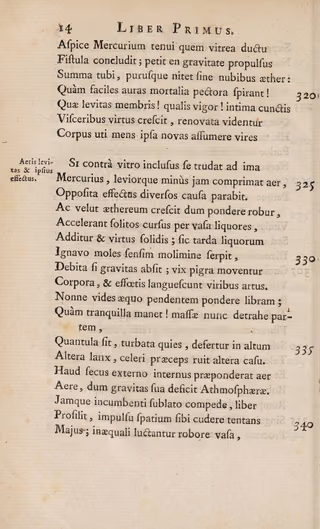
The lightness of the air and its effects. If, on the contrary, the mercury enclosed in the glass pushes itself
To the bottom, and the lighter air now compresses less,
An opposite cause will produce different effects.
And just as while the ethereal strength increases in weight,
The fluids accelerate their accustomed courses through the vessels,
And power is added to the solids; so the sluggish mass of fluids
Creeps along gradually with a lazy effort,
If the due weight be absent; sluggish bodies are scarcely
Moved, and the limbs languish with exhausted strength.
Do you not see a balance hanging with equal weight;
How tranquil it remains! now take away a part of the mass,
However small it may be, the rest is disturbed, one pan
Is carried up on high, the other rushes headlong with a swift fall.
Not otherwise does the internal air outweigh the external
Air, while its own weight fails the atmosphere.
And now, with the incumbent shackle removed, free,
It leaps forth, trying by its impulse to forge for itself
A larger space; the vessels struggle with unequal strength,
Aeris levitas & ipſius effectus. SI contrà vitro incluſus ſe trudat ad ima
Mercurius , leviorque minùs jam comprimat aer ,
Oppoſita effectus diverſos cauſa parabit.
Ac velut æthereum creſcit dum pondere robur ,
Accelerant ſolitos curſus per vaſa liquores ,
Additur & virtus ſolidis ; ſic tarda liquorum
Ignavo moles ſenſim molimine ſerpit ,
Debita ſi gravitas abſit ; vix pigra moventur
Corpora , & effœtis langueſcunt viribus artus.
Nonne vides æquo pendentem pondere libram ;
Quàm tranquilla manet ! maſſæ nunc detrahe par-
tem ,
Quantula ſit , turbata quies , defertur in altum
Altera lanx , celeri præceps ruit altera caſu.
Haud ſecus externo internus præponderat aer
Aere , dum gravitas ſua deficit Athmoſphæræ.
Jamque incumbenti ſublato compede , liber
Proſilit , impulſu ſpatium ſibi cudere tentans
Majus ; inæquali luctantur robore vaſa ,
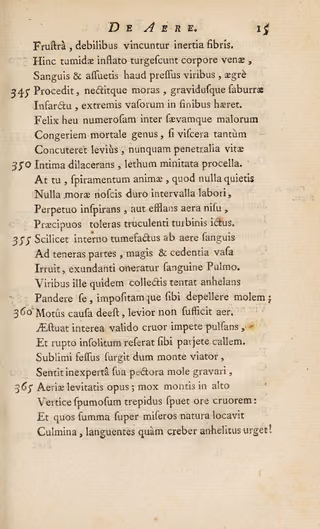
Part 2
In vain; inert, they are overcome because their fibers are weak.
Hence the tumid veins swell in the inflated body,
and the blood, not pressed by its accustomed forces, with difficulty
proceeds, and weaves delays, and heavy with an infarction
of saburra, sticks in the extreme ends of the vessels.
Fortunate, alas, among the numerous and savage heap
of evils would be the mortal race, if the storm that threatens death
only shook the viscera more lightly, never tearing apart
the innermost sanctuaries of life.
But you, breathing-passage of the soul, who know no intervals of rest,
none of delay in your hard labor,
inhaling or exhaling air with perpetual effort,
you endure the chief blows of the savage whirlwind.
For indeed the blood, swollen by the internal air,
rushes toward the tender parts and the more yielding vessels;
the lung is burdened with overflowing blood.
With gathered strength, indeed, panting it tries
to expand itself, and to drive off the mass imposed upon it;
the cause of motion is lacking, the lighter air does not suffice.
Meanwhile the gore boils, beating with a strong impulse,
and having burst the wall, unlocks an unaccustomed path for itself.
While the weary traveler climbs up a lofty mountain,
he feels his chest weighed down by an unaccustomed mass,
the work of aerial lightness; soon on the high summit
of the mountain, trembling he will spit foamy gore from his mouth:
and those wretched ones whom nature has placed upon the highest
peaks, how frequent a panting urges them as they languish!
Fruſtrà, debilibus vincuntur inertia fibris.
Hinc tumidæ inflato turgeſcunt corpore venæ,
Sanguis & aſſuetis haud preſſus viribus, ægrè
Procedit, nectitque moras, graviduſque ſaburræ
Infarctu, extremis vaſorum in finibus hæret.
Felix heu numeroſam inter ſævamque malorum
Congeriem mortale genus, ſi viſcera tantùm
Concuteret leviùs, nunquam penetralia vitæ
Intima dilacerans, lethum minitata procella.
At tu, ſpiramentum animæ, quod nulla quietis
Nulla moræ noſcis duro intervalla labori,
Perpetuo inſpirans, aut efflans aera niſu,
Præcipuos toleras truculenti turbinis ictus.
Scilicet interno tumefactus ab aere ſanguis
Ad teneras partes, magis & cedentia vaſa
Irruit, exundanti oneratur ſanguine Pulmo.
Viribus ille quidem collectis tentat anhelans
Pandere ſe, impoſitamque ſibi depellere molem;
Motûs cauſa deeſt, levior non ſufficit aer.
Æſtuat interea valido cruor impete pulſans,
Et rupto inſolitum reſerat ſibi parjete callem.
Sublimi feſſus ſurgit dum monte viator,
Sentit inexpertâ ſua pectora mole gravari,
Aeriæ levitatis opus; mox montis in alto
Vertice ſpumoſum trepidus ſpuet ore cruorem:
Et quos ſumma ſuper miſeros natura locavit
Culmina, languentes quàm creber anhelitus urget!
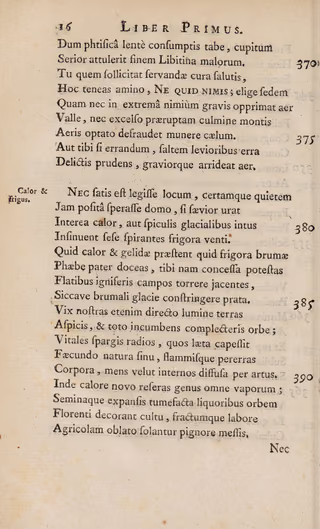
Part 3
Until, to those slowly consumed by a phthisical wasting, a wished-for
End of their ills is brought too late by Libitina.
You, whom the care of preserving health concerns,
Hold this in mind, NOTHING IN EXCESS; choose an abode
Which neither too heavy an air oppresses in the deepest
Valley, nor, perched on the lofty summit of a mountain,
Does the sky defraud of the wished-for gift of air.
Or if you must err, at least err prudently with lighter
Faults, and let a heavier air smile upon you.
Heat & cold. NOR is it enough to have chosen a place, and to have hoped for sure rest
Once your home is built, if meanwhile a fiercer heat
Burns, or winds breathing cold insinuate themselves
Within with icy darts.
What heat and what the colds of freezing winter effect,
Father Phoebus, may you teach; for to you is granted the power
To scorch the prostrate fields with fiery blasts,
Or to bind the dry meadows with wintry ice.
For scarcely do you look upon our lands with direct
Light, and leaning down embrace them with your whole orb,
Than you scatter vital rays, which joyful nature receives
In her fertile bosom, and with flames you wander through
Bodies, like a mind diffused through the internal limbs.
Thence with new warmth you unlock every kind of vapor;
And seeds swollen with expanded fluids adorn the world
With flowering attire, and console the farmer, broken by labor,
With the offered pledge of a harvest.
Dum phtiſicâ lentè conſumptis tabe, cupitum
Serior attulerit finem Libitina malorum.
Tu quem ſollicitat ſervandæ cura ſalutis,
Hoc teneas amino, NE QUID NIMIS; elige ſedem
Quam nec in extremâ nimiùm gravis opprimat aer
Valle, nec excelſo præruptam culmine montis
Aeris optato defraudet munere cælum.
Aut tibi ſi errandum, ſaltem levioribus erra
Delictis prudens, graviorque arrideat aer.
Calor & frigus. NEC ſatis eſt legiſſe locum, certamque quietem
Jam poſitâ ſperaſſe domo, ſi ſævior urat
Interea calor, aut ſpiculis glacialibus intus
Inſinuent ſeſe ſpirantes frigora venti.
Quid calor & gelidæ præſtent quid frigora brumæ
Phæbe pater doceas, tibi nam conceſſa poteſtas
Flatibus igniferis campos torrere jacentes,
Siccave brumali glacie conſtringere prata.
Vix noſtras etenim directo lumine terras
Aſpicis, & toto incumbens complecteris orbe;
Vitales ſpargis radios, quos læta capeſſit
Fæcundo natura ſinu, flammiſque pererras
Corpora, mens velut internos diffuſa per artus.
Inde calore novo reſeras genus omne vaporum;
Seminaque expanſis tumefacta liquoribus orbem
Florenti decorant cultu, fractumque labore
Agricolam oblato ſolantur pignore meſſis.
Part 4
Nor less, as soon as the vernal breeze, with Zephyrs breathing,
Has brought forth new leaves and soft grasses,
Now sheep, herds, wild beasts, the whole race of living
creatures
Rush into passion and flames; the heat is the same in all;
Love urges them with goads, and burns them with potent shafts,
Restoring the exhausted body, and instilling green
Youth; the wanton troop of birds tunes tender loves
In song, and fishes beneath the wave
Conceive a flame kindled in their soft breast.
If, on the contrary, you depart with an oblique star, the earth
Contracts, the woods are stripped of their green mantle,
The rivers bristle, congealed with frost and rigid
Ice, and nature grows torpid in sluggish lethargy.
Then the sad animals languish, hidden in the retreats
Of the woods; then mother nature doubles the fleeces for the sheep,
The feathers for the winged creatures, and mortals try
To drive away the cold by placing wood upon the fire.
Thus, with sense alone as judge, we know by experience
The alternating cold and varying heat of the air;
Yet more often the sense is deceitful, and the very same things
Are cold to one who is warm, which you, when chilled, judge to be boiling.
You whom it delights to explore by reason the naked recesses
Of nature, do not trust too much to heat;
Consult the thermometer, it will disclose the truth of things to you.
The Italian Sanctorius first forged this magical
Art, and filled vessels with a fiery liquor;
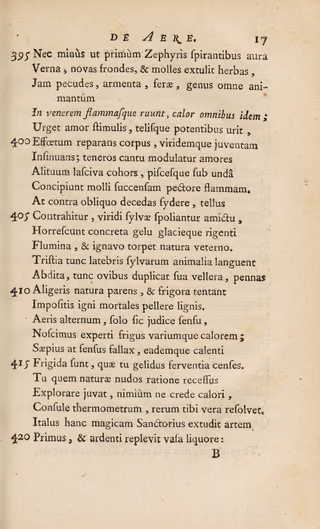
Nec minùs ut primùm Zephyris ſpirantibus aura
Verna, novas frondes, & molles extulit herbas,
Jam pecudes, armenta, feræ, genus omne ani-
mantûm
In venerem flammaſque ruunt, calor omnibus idem;
Urget amor ſtimulis, teliſque potentibus urit,
Effœtum reparans corpus, viridemque juventam
Inſinuans; teneros cantu modulatur amores
Alituum laſciva cohors, piſceſque ſub undâ
Concipiunt molli ſuccenſam pectore flammam.
At contra obliquo decedas ſydere, tellus
Contrahitur, viridi ſylvæ ſpoliantur amictu,
Horreſcunt concreta gelu glacieque rigenti
Flumina, & ignavo torpet natura veterno.
Triſtia tunc latebris ſylvarum animalia languent
Abdita, tunc ovibus duplicat ſua vellera, pennas
Aligeris natura parens, & frigora tentant
Impoſitis igni mortales pellere lignis.
Aeris alternum, ſolo ſic judice ſenſu,
Noſcimus experti frigus variumque calorem;
Sæpius at ſenſus fallax, eademque calenti
Frigida ſunt, quæ tu gelidus ferventia cenſes.
Tu quem naturæ nudos ratione receſſus
Explorare juvat, nimiùm ne crede calori,
Conſule thermometrum, rerum tibi vera reſolvet.
Italus hanc magicam Sanctorius extudit artem
Primus, & ardenti replevit vaſa liquore:
Part 5
Enclosed in a tube, it scarcely perceives the warm breeze;
Swelling as the heat is admitted, it gradually rarefies,
And climbs on high, while, condensed by the icy cold,
It slips downward and hides in the bottom of the little tube.
Yet this glory of speculation scarcely touches the physician;
Such leisure does not suit afflicted circumstances:
Instead, the machine is ruled by sensation, which alone tempers
The reins, and loosens it or binds it with a fetter.
Behold how vastly the fields of Libya differ in their diverse aspect
From the Hyperborean Geloni, and by how great a distinction
Both the lands vary, and all the bodies of living creatures
Vary as well. If first we visit the thirsty Africans,
The blood, overly inflamed and more acrid for the loss of its
Soothing fluid, bathes the blackening limbs as their moisture is exhausted
By the heat, and dyes them further with a new blackness.
Thence in a short time the solid parts are dried;
The fragile mass of fibers is stretched, and, overly deprived
Of juices, gives way; impatient of its accustomed labor,
And slackened, it brings on a sudden old age.
To be sure, the nature of their wit and the innate force of their mind
Are more vivid, their body lighter, and more agile than a swift arrow,
Accustomed to outstrip stags in running.
For their nerves are subtle, and from an acrid source
The blood supplies subtle vapors to the nerves.
Yet what do these gifts of nature avail the wretched?
Which a span of life all too contracted counterbalances.
Safer, yet not itself free from danger,
Ille tubo incluſus, calidam vix percipit auram;
Admiſſo ſenſim rareſcit turgidus igne,
Arduus & ſcandit, gelido dum labitur infra
Frigore denſatus, tubuloque reconditur imo.
At Medicum vix hæc ſpeculandi gloria tangit,
Non ea conveniunt afflictis otia rebus:
Machina ſed ſenſu regitur, qui ſolus habenas
Temperat, atque illam laxat vel compede vincit.
Aſpice Hyperboræis Lybiæ quantùm arva Gelonis
Diversâ diſtent facie, diſcrimine quanto
Et varient terræ, varient & cuncta animantûm
Corpora. Si primùm ſitientes viſimus Afros,
Succenſus nimiùm ſanguis, blandoque liquore
Acrior, exhauſto nigrantia membra calore
Alluit, ulteriùſque novâ nigredine tingit.
Inde brevi ſolidæ ſiccantur tempore partes;
Tenditur, & nimiùm ſuccis orbata labaſcit
Fibrarum fragilis moles, ſolitique laboris
Impatiens, ſubitam accerſit reſoluta ſenectam.
Ingenii natura quidem, & vis inſita menti
Vividior, levius corpus, celerique ſagittâ
Mobilius, ſolitum curſu prævertere Cervos.
Subtiles etenim nervi, nerviſque miniſtrat
Subtiles acri ſanguis de fonte vapores.
At quid naturæ miſeris hæc munera proſunt?
Quæ vitæ ſeries nimiùm contracta rependit.
TUTA magis, non ipſa tamen diſcriminis expers,
Part 6
is that land which lies closer beneath the icy north.
Here the skin stiffens, tightly constricted by the merciless
cold; the salty filth does not exude from the body.
Hence the blood, heavy with impurities and vapid from putrid saburra,
creeps with a sluggish motion through the viscera.
What more! The vessels too are constricted by the northern air,
and, compressed, refuse to admit the congealed fluids.
Alas! How many languors arise from this wretched source,
how immense a cohort of diseases! The obstructed pathway
of the blood, dire dropsy, scirrhus, and chronic tu-
mors,
and taint of the lymph, and diseases fierce with squalor.
BUT nature has looked upon you with a kindly countenance,
happy lands, to whom she has granted cold mixed with gentle
warmth, and seasons under an equable sky.
Happy above others, fruitful nurse of men,
Gaul, rich in resources, for whom the fields, soft with flowers,
smile in the new spring, for whom the stalk, heavy with ears of grain,
adorns the summer months, and Autumn presses out
the grapes, whence the cups shine with generous Bacchus,
nor does a too-heavy Winter rage out its fury, the nearest hope of Spring.
If the heat of Sirius does not inflame you with excessive
fires, and does not dye the faces of your citizens with a black
color; if Boreas does not press your fields with stiffening ice,
nor scatter horrid colds upon you with his blast;
you nevertheless, of wintry frost and summer heat,
Quæ propior tellus glaciali ſubjacet arcto.
Hîc cutis immiti validè conſtricta rigeſcit
Frigore, non ſalſæ exſudant è corpore ſordes.
Colluvie gravis inde cruor, putrique ſaburrâ
Vapidus, ignavo reptat per viſcera motu.
Quid! quod & Arctoo ſtringantur ab aere vaſa
Concretoſque negent admittere preſſa liquores.
Heu! quot languores miſero de fomite ſurgunt,
Morborum quàm immenſa cohors! obſtructa cruoris
Semita, dirus hydrops, ſcirrhus, chronicique tu-
mores,
Et lymphæ vitium, & morbi ſquallore feroces.
AT vos proſpexit vultu natura benigno,
Felices terræ, queis blando mixta calore
Frigora, & æquali conceſſit tempora cælo.
Felix ante alias, altrix fæcunda virorum
Gallia, dives opum, cui mollia floribus arva
Rident vere novo, gravidus cui culmus ariſtis
Æſtivos decorat menſes, Autumnus & uvas
Exprimit, unde nitent generoſo pocula Baccho,
Nec gravior deſævit Hyems, ſpes proxima Veris.
Si te non nimiis ſuccendit Sirius ardor
Ignibus, & nigro non civibus ora colore
Tingit; ſi glacie tua non premit arva rigenti,
Horrida nec ſpargit Boreas tibi frigora flatu;
Tu tamen hybernique gelu, æſtivique caloris
Part 7
do not spurn the alternating changes: a season for which a fickle
sky shines is notorious for frequent funerals.
For we are changed by opposites, and every earth-born
body is changed; steeped in ice and kindled
by rapid fire, the very stone is dissolved; Hannibal
is said to have shattered the burning Alps with vinegar.
Then how greatly will a body composed of a tender frame
feel the adverse blows of uncertain weather!
For when a changeable sky with sudden movement
condenses what was just now loose, and relaxes what was dense,
then the thinned blood enters into foreign passages,
and either bursts them, or wearies them with its sluggish mass:
but if a heavy stricture with sudden cold has struck
the fibers, then no power is given to flow back,
and the scarcely escapable dart of disease presses on.
Thence you see an immense offspring of diseases come forth
every year, and thence at the same time each season has its own
troops of ills, to mark the times of the year.
BEHOLD when the kindly parent earth, glowing with the vernal
glory of foliage, has raised herself up, and has felt
the warm breezes with the attendant Zephyrs, how the victorious sun
with flashing splendor scatters the sad shadows of winter,
and awakens the long-slumbering fires of nature.
And yet Libitina with her ruthless sickle scarcely ever slaughters
so many men in the primeval flower of youth.
For indeed the blood, congealed by winter's cold,
Alternas ne ſperne vices : famoſa frequenti
Funere tempeſtas cælum, cui mobile fulget.
Oppoſitis mutamur enim , mutatur & omne
Terrigenum corpus; glacie perfuſus & igne
Succenſus rapido lapis ipſe reſolvitur , Alpes
Annibal ardentes fregiſſe refertur aceto.
At tenerâ corpus conſtans compagine, quantùm
Sentiet adverſos incerti temporis ictus!
Namque ubi præcipiti motu variabile cælum
Denſat erant quæ laxa modò , & quæ denſa relaxat,
Tunc aliena ſubit tenuatus in oſtia ſanguis,
Illaque vel rumpit , vel inerti mole fatigat :
At ſtrictura gravis ſubito ſi frigore fibras
Impulerit , tunc nulla datur remeare poteſtas ,
Incumbitque mali vix eluctabile telum.
Morborum inde vides ſobolem prodire quot annis
Immenſam , inde ſimul ſunt & ſua cuique malorum
Agmina tempeſtati , anni quæ tempora ſignent.
ASPICE cum rutilans verno ſe frondis honore
Extulit , & tepidas Zephyris famulantibus auras
Alma parens ſenſit tellus , ſplendore coruſco
Ut triſtes hyemis ſol victor diſcutit umbras ,
Sopitoſque diù naturæ exſuſcitat ignes.
Attamen immiti vix unquam falce trucidat
Tot Libitina viros primævo in flore juventæ.
Scilicet hyberno concretus frigore ſanguis
Part 8
with the admission of heat, more quickly rarefies, and inflicts deep
ruin upon the viscera with repeated blows:
whether attacking the head, it obstructs the softest vessels
of the brain, whence come malignant fever, and deceitful lethargy,
and fainting, and all too furious phrenitis:
or whether driven with rapid motion to the wearied chest,
piercing with a dry cough, it shakes the praecordia,
and bursting the vessels, consumes them with cruel wasting:
or whether scattering dreadful fires through the windings of the belly,
the stomach, and the liver,
the bladder and the kidneys,
it attempts to devour the body with deadly flames.
BUT summer, the mother of crops, is born under a better
star, if, blown through by gentle winds, she scatters the vapors
which the putrid earth draws forth on high from her bosom,
and, soothing the fires of burning Cancer,
does not allow the exhalations to stagnate in sluggish quiet.
The thunderbolts, which, swept along by a violent whirlwind,
terrify minds and mingle empty rumblings,
nature does not hurl without design; with a kindly
coolness the wind bathes the overly hot air,
and stirs the whole atmosphere heavy with exhalations.
COLD and the seasons hostile to worn-out old age
are brought back by gloomy winter and changeable Autumn;
the gaping
Ignibus admiſſis citiùs rareſcit, & altam
Viſceribus labem repetitis ictibus infert :
Seu caput oppugnans, cerebri molliſſima vaſa
Obſtruat, unde maligna febris, fallaxque veternus,
Defectuſque animi & nimiùm furibunda Phrenitis :
Seu rapido pulſus defeſſa ad pectora motu
Concutiat ſiccâ pungens præcordia tuſſi,
Vaſaque diſrumpens crudeli tabe peredat :
Sive per anfractus ventris, ſtomachumque, jecur-
que,
Veſicam & renes, metuenda incendia ſpargens,
Mortiferis tentet flammis depaſcere corpus.
AT frugum genitrix meliori naſcitur æſtas
Sydere, ſi levibus ventis perflata, vapores,
Quos putris è gremio tellus educit in altum,
Spargit, & urentis mulcens incendia Cancri,
Non ſinit effluxus ſegni ſtagnare quiete.
Fulmina, quæ, venti violento turbine rapta,
Terrificant animos & inania murmura miſcent,
Non ſine conſilio vibrat natura ; benigno
Frigore perfundit calidum nimis aera ventus,
Halitibuſque gravem totam movet Athmoſphæram.
FRIGUS & effætæ revehunt infeſta ſenectæ
Tempora, triſtis hyems, ancepſque Autumnus ;
hiantes
Part 9
little tubes of the skin are constricted; and forced within
Are the excretions to be driven out by so many diverse ways; the sluggish
Mass of blood congeals at a lingering pace.
But for the youth, whose breast the blood beats with a strong
Stroke, and whose limbs are stretched with robust muscles,
Meanwhile strength increases, and by partly retaining
Those things which easily exhale from a vigorous body, robustness
Is added, and the glowing vigor retreats to the inmost parts.
THUS biting frost does harm, and heat too has its own damages;
Being wise, beware of extremes: if fiery Phoebus
Burns, and Sirius dries up the thirsty fields,
Let low-lying dwellings lie open, turned away from the Sun;
Sprinkle the house with lymph, and let urns full of water
Abound with soft herbs, and green mallow,
And tender lettuce, to which are added as companions the moist
Poplar, and damp dwarf-elder, and willow
boughs,
And as many plants as grow green in the shady earth.
The moisture exuding from the leaves mitigates the burning
Air, bathing the hall with pleasant dews.
Yet a hearth gleaming with a constant pile of wood,
And a window turned toward the midday rays of Phoebus
Will drive away the icy darts of winter's cold.
Nevertheless, do not, always shut up in a burning air,
Anxiously flee the cold with shameful fear;
Spurn the frost, O youth; in the open sky are strengthened
Stringuntur tubuli pellis; coguntur & intus
Tot variis pellenda viis excreta; cruoris
Concreſcit lento moles tardiſſima greſſu.
At juveni, valido pulſat cui pectora ſanguis
Ictu, & tenduntur robuſtis membra lacertis,
Interea creſcunt vires, partimque retentis
Quæ facilè exhalant vegeto de corpore, robur
Additur, atque calens decedit ad intima virtus.
SIC nocet acre gelu, ſunt & ſua damna calori;
Tu ſapiens extrema cave: ſi flammeus ardet
Phæbus, & exſiccat ſitientes Sirius agros,
Depreſſi pateant adverſo Sole Penates,
Sparge domum lymphis, plenæque liquoribus urnæ
Mollibus exultent herbis, Malvâque virenti,
Et tenui Lactucâ, queis comes additur uda
Populus, humeſcenſque Ebulus, frondeſque Sali-
gnæ,
Et quot in umbrosâ ſtirpes tellure vireſcunt.
Mitigat urentem manans è frondibus humor
Aera, jucundis perfundens roribus aulam.
At focus aſſiduâ lignorum mole coruſcans,
Et mediis Phæbi radiis obverſa feneſtra
Frigoris hyberni glacialia ſpicula pellent.
Non tamen ardenti ſemper concluſus in aurâ
Sollicitus turpi fugias formidine frigus;
Sperne gelu juvenis, Cælo firmantur aprico
Part 10
his limbs, though trembling old age may sit by the hearth,
Or seek lands lying beneath a nearer sun.
AND NOW you see that the excessive rigors of hot and cold
Air can be restrained by opposing arts.
Now another plague comes to be vanquished by you, all the
More grievous to the earth-born, the more secretly it creeps.
For who would believe that the thin air now drains
Dense fluids of lymph, now gives the same back again?
Indeed, its very nature and unsullied brightness seem
To deny it; yet the humid air sprinkles marble
With drops, and in rainy weather the wall of temples
Sweats, which, arid, is rough with dry dust
While the Sky glows with a cloudless star.
Let a grassy turf dry under the open Sky,
Scarcely a third part of its first weight remains; water is
Whatever flies away and departs, the other more fixed part remains.
Whither does so great an abundance of moisture vanish into the breezes?
Thus the dry Air drinks vapors from the whole
Earth, and is weighed down by a huge mass of moisture.
Yet it does not keep the burden; gradually the heap condenses,
With the veil of waters expanded into thin clouds:
Thence shortly the winds, whistling through the whole air,
Gather the clouds with their blasts, the Sky bristles
With darkness, the earth is submerged by an abundant wave,
And the groaning plowman sees his wished-for crops
And his fields overturned by a headlong whirlpool of water: Humidity.
Membra, foco licet aſſideat tremebunda ſenectus,
Aut propiore petat terras ſub ſole jacentes.
JAMQUE vides nimios calidi gelidique rigores
Aeris, oppoſitas cohiberi poſſe per artes.
Nunc tibi debellanda lues venit altera, tantò
Terrigenis gravior, quantò magis abdita ſerpit.
Nam tenuem denſos quis crederet aera lymphæ
Exhaurire modò latices, modò reddere eoſdem?
Abnuere ipſa quidem illius natura videtur
Illimiſque nitor; guttis tamen humidus aer
Marmora conſpergit, pluvioſo tempore ſudat
Templorum paries, ſicco qui pulvere ſquallet
Aridus, innubi rutilat dum ſydere Cælum.
Herboſus ceſpes Cælo ſicceſcat aperto,
Tertia vix primi ſupereſt pars ponderis, unda eſt
Quidquid abit volitans, pars fixior altera reſtat.
Copia quò tanta humorum evaneſcit in auras?
Sic bibit ex totâ ſiccus tellure vapores
Aer, ingentique humorum mole gravatur.
At non ſervat onus; ſenſim concreſcit acervus,
Expanſo in tenues nimbos velamine aquarum:
Inde brevì toto ſtridentes aere venti
Flatibus agglomerant nubes, caligine Cælum
Horret, abundanti tellus ſubmergitur undâ,
Ac videt optatas ſegetes gemebundus arator
Præcipitique undæ ſubverti vortice campos: Humiditas.
Part 11
Or more gently the sky pays its tribute,
And the vapor condensing in the nocturnal cold
Is dissolved into fine drops at the returning rising of the sun,
And bathes the joyful fields with fertile dews.
Do you not see, while the fiery sun rages with dry heat,
That lilies very often droop their sapless stem:
Scarcely does Aurora sprinkle new tears into the air,
When their ancient beauty is restored to them; moistened,
Their tops rise again, and, growing green, bear their branches on high.
Yet hay and grasses long dried by constant heat
Are consumed by waters, and conceive a heat from the received
Moisture; soon they will rot, dissolved into foul
Putridity, and ash will remain instead of foliage:
So great is the power granted to the ethereal moisture!
It has been able to lift heavy masses with swollen
Ropes, and to split apart huge millstones, immense rocks,
With expanded wedges of dry wood.
Nor does it any less vex mortal breasts with hidden
Blows, and drag with itself foul troops of evils.
Indeed, the atmosphere, heavy with immoderate liquid,
Obstructs the tiny tubules through which permeable bodies gradually
Perspire, and drives the watery filth
Inward; we are weighed down by an exhausted mass of juices.
For the slender fibers are relaxed by the accumulation of waters,
Nor does any strength remain in the solid parts, nor any strength in the burdened
Viscera; the limbs languish with exhausted powers.
Meanwhile, the most choice mass of the humors
Mitius aut ſolvit ſua vectigalia cælum,
Nocturnoque vapor concreſcens frigore, guttas
Solvitur in tenues redivivos ſolis ad ortus,
Lætaque fæcundis perfundit roribus arva.
Nonne vides, ſicco dum ſol furit igneus æſtu,
Sæpius exſuccum demittere lilia caulem:
Vix aurora novos conſpergit in aera fletus,
Redditur his decor antiquus, madefacta reſurgunt
Culmina, ſublimeſque gerunt viridantia ramos.
At fœnum aſſiduoque diù ſiccata calore
Gramina conſumuntur aquis, æſtumque recepto
Concipiunt latice; immundum mox illa putreſcent
In tabum reſoluta, cinis pro fronde manebit:
Tanta eſt æthereo latici conceſſa poteſtas!
Ille graves potuit tumefactis tollere moles
Funibus, ingenteſque molas, immania ſaxa
Expanſis ſicci clavis exſcindere ligni.
Nec minùs occultis mortalia pectora vexat
Ictibus, & ſecum trahit agmina tetra malorum.
Scilicet immodico gravis athmoſphæra liquore
Obſtruit exiles tubulos, queis pervia ſenſim
Corpora perſpirant, intus compellit aquoſam
Colluviem; effœtâ ſuccorum mole gravamur.
Nam tenues fibræ aggeſtu laxantur aquarum,
Nec ſolidis vis ulla manet, vis ulla gravatis
Viſceribus; languent exhauſtis viribus artus.
Interea humorum delibatiſſima moles
Part 12
is corrupted by admixed water, and moves in a sluggish
circuit, rolling vapid lymph instead of blood.
Thence comes swelling of the body, and cachexia pale with flaccid countenance,
and the belly distended by the outpoured waters:
the stomach is weak; the chest pants with a whistling
rattle, and casts up copious draughts of phlegm.
Yet not one way alone is given to the lymph; you would think mortal
bodies, liquefied, are gradually dissolved into thin
fluids: the nostrils drip, the bowels become looser,
and cruder urine is expelled in an overflowing stream.
Dire indeed are these things; yet worse symptoms
harass us,
if dark colds bind the frosty sky,
or damp heat cooks the surging atmosphere.
For while sharp frost presses the outer fibres and the passages of the skin
with its stings, the relaxed
fibre refuses its accustomed tasks, made softer by the admitted water.
Hence the flood of humours, diffused through the whole body,
cannot exhale through the fine tubules of the skin and the narrowed vessels,
and, no longer carried in a fixed order,
into various parts, into the limbs, into the viscera headlong
it rushes; hence the seeds of various diseases are born.
From no other source arise fixed pains,
sluggish rheumatism, swollen coryza of the head,
fluxion of the chest, and a piercing burning in the teeth.
Indeed, the revived wounds of an old battle renew their pain Cold humidity.
Admixtâ vitiatur aquâ, tardoque movetur
Circuitu, vapidam volvens pro ſanguine lympham.
Corporis inde tumor, laxoque cachexia vultu
Pallens, diſtentuſque effuſis venter ab undis:
Enervis ſtomachus; ſtridenti pectus anhelat
Stertore, & largos pituitæ projicit hauſtus.
Sed via non lymphæ una datur; liquefacta reſolvi
In tenues ſenſim latices mortalia credas
Corpora, diſtillant nares, fit mollior alvus,
Crudior exundanti urina expellitur alveo.
DIRA quidem hæc; pejora tamen ſymptomata
vexant,
Atra pruinoſum ſtringant ſi frigora cælum,
Aut calor undantem coquat uvidus athmoſphæram.
Externas etenim fibras, pelliſque meatus
Dum ſtimulis premit acre gelu, laxata labores
Fibra negat ſolitos, admiſsâ mollior undâ.
Hinc toto humorum diffuſus corpore gurges
Per tenues pellis tubulos, arctataque vaſa
Exhalare nequit, nec jam certo ordine raptus
In varias partes, in membra, in viſcera præceps
Irruit, hinc varii naſcuntur ſemina morbi.
Non alio fixi ſurgunt è fonte dolores,
Rheumatiſmus iners, capitis tumefacta gravedo,
Fluxio thoracis, pungenſque in dentibus ardor.
Quin veteris renovant pugnæ rediviva dolorem Humiditas frigida.
Part 13
wounds, and the troublesome scar of an ancient suffering
gives signs, and cruel gout torturing
the feet.
Vulnera, & antiquæ pænæ importuna cicatrix
Signa dat, excrucianſque pedes truculenta poda-
gra.