Hover or tap a word to see its match.
Part 1
Effects of gravity and elasticity. Yet those things which the mind of men turns to bloody
arts,
are turned by Paeonian command to new advantages,
and health has sprung from where death was preparing its realms.
While the common folk, an ignorant crowd, stand amazed with astonished eyes,
and drink in the new prodigy with attentive ears;
and while a band of men, bolder from success itself, surveys
the new arts—men whom the love of praise, fixed deep in their breast,
persuades to endure long and new labors
again with unremitting sweat;
a more useful glory stirs the watchful minds and hearts
of physicians, to see whether gravity can harm
bodies, or provide the beginnings to foul diseases.
Applaud, mortals, the reward of their labor is not in vain.
If the heavier air presses the earth with an incumbent weight,
or if elastic air urges with excessive force,
it also urges the breaths lurking within the internal body,
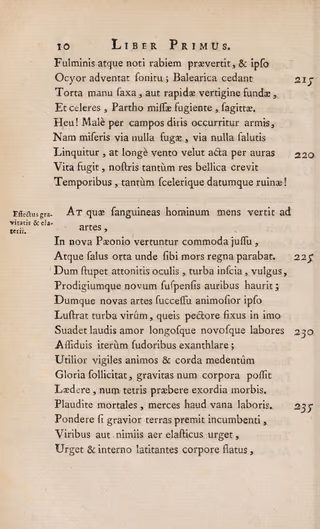
Effectus gravitatis & elaterii. AT quæ ſanguineas hominum mens vertit ad
artes,
In nova Pæonio vertuntur commoda juſſu,
Atque ſalus orta unde ſibi mors regna parabat.
Dum ſtupet attonitis oculis, turba inſcia, vulgus,
Prodigiumque novum ſuſpenſis auribus haurit;
Dumque novas artes ſucceſſu animoſior ipſo
Luſtrat turba virûm, queis pectore fixus in imo
Suadet laudis amor longoſque novoſque labores
Aſſiduis iterùm ſudoribus exanthlare;
Utilior vigiles animos & corda medentûm
Gloria ſollicitat, gravitas num corpora poſſit
Lædere, num tetris præbere exordia morbis.
Plaudite mortales, merces haud vana laboris.
Pondere ſi gravior terras premit incumbenti,
Viribus aut nimiis aer elaſticus urget,
Urget & interno latitantes corpore flatus,
Part 2
Nor does it allow the humors to proceed at an easy pace.
For an internal air is enclosed within the human
Body, which, cleaving to the solids and fluids in a close
Union, is swept along with the blood in a similar course,
And, intermingled, enters all the recesses through the vessels.
Balancing indeed with opposing forces against the external air,
It is wont to strive for an equalized rest;
But if the outer air exalts itself with excessive weight,
The inner yields, weighed down by the greater mass.
Thence the tiny tubes are constricted, and the compressed fluids
Can no longer easily complete their accustomed courses,
But break off their journey, and stick in the middle of the passages.
For the vessels creeping through the whole body
Are narrowed; both the visible ones that bedew the texture of the skin
In a manifold array, and the hidden ones that pour sweet
Juices—vital nourishment—into the viscera,
And those very many that adorn the coats of the lungs and the thin
Membranes of the lobes with winding networks.
Thus torments of pain vex the whole body,
But first that subtle machine, the Lung, is oppressed.
For since thousands of tiny vessels encircle the lungs,
Which you could not discern by sight alone,
The blood, slowed in its narrow path, is brought to a halt,
Nor does it allow the chest to be expanded under the imposed mass.
Hence arises a heaviness of the chest, and the difficult labor
Of drawing breath, and Asthma with its straining efforts.
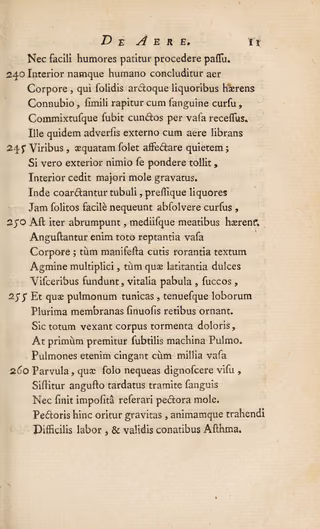
Nec facili humores patitur procedere paſſu.
Interior namque humano concluditur aer
Corpore, qui ſolidis arctoque liquoribus hærens
Connubio, ſimili rapitur cum ſanguine curſu,
Commixtuſque ſubit cunctos per vaſa receſſus.
Ille quidem adverſis externo cum aere librans
Viribus, æquatam ſolet affectare quietem;
Si vero exterior nimio ſe pondere tollit,
Interior cedit majori mole gravatus.
Inde coarctantur tubuli, preſſique liquores
Jam ſolitos facilè nequeunt abſolvere curſus,
Aſt iter abrumpunt, mediiſque meatibus hærent.
Anguſtantur enim toto reptantia vaſa
Corpore; tùm manifeſta cutis rorantia textum
Agmine multiplici, tùm quæ latitantia dulces
Viſceribus fundunt, vitalia pabula, ſuccos,
Et quæ pulmonum tunicas, tenueſque loborum
Plurima membranas ſinuoſis retibus ornant.
Sic totum vexant corpus tormenta doloris,
At primùm premitur ſubtilis machina Pulmo.
Pulmones etenim cingant cùm millia vaſa
Parvula, quæ ſolo nequeas dignoſcere viſu,
Siſtitur anguſto tardatus tramite ſanguis
Nec ſinit impoſitâ reſerari pectora mole.
Pectoris hinc oritur gravitas, animamque trahendi
Difficilis labor, & validis conatibus Aſthma.
Part 3
YET this heaviness can never inflict such great pains
By its mass, pressing upon sickly mortals,
Unless, burdensome with an immense weight, it crushes
The prostrate lands, and leans upon the world with unbridled forces:
Nay, on the contrary, if the sum has not reached all the way
To an excessive degree, it is able to increase exhausted powers,
And to strengthen vigorous might in a healthy body.
For just as when a river's channel is narrowed by banks
Drawn together, the waters roll in rapid waves,
And more quickly graze the shores in a swift current:
Not otherwise, when the veins are constricted by a due weight,
The blood is carried more quickly with a headlong pace, and enters
All the vessels, bedewing the parts with fruitful nectar.
Hence it comes about that the fluids, distinct in their varied mass,
Densely enter the entangled knots, their own strainers,
And separate from the blood with an easy motion.
This is the first origin of vigor, this the first origin of health.
For whatever humors sweep away impure filth from the body
More promptly drive it out through the offered openings.
Just so, while a river, wandering in winding curves of waves,
Is carried along a continuous path, it casts out filth
Here and there onto the banks among the grasses of a wet meadow,
And the unmuddied water gleams with a glassy brightness:
But water stagnating motionless among marsh rushes,
Or slowly creeping forward with sluggish movements,
Teeming with foul rot, and stained with a black color,
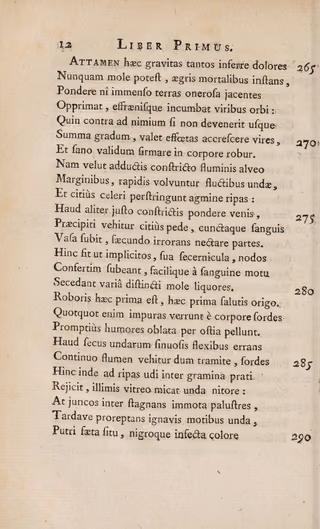
ATTAMEN hæc gravitas tantos inferre dolores
Nunquam mole poteſt , ægris mortalibus inſtans ,
Pondere nî immenſo terras oneroſa jacentes
Opprimat , effræniſque incumbat viribus orbi :
Quin contra ad nimium ſi non devenerit uſque
Summa gradum , valet effœtas accreſcere vires ,
Et ſano validum firmare in corpore robur.
Nam velut adductis conſtricto fluminis alveo
Marginibus , rapidis volvuntur fluctibus undæ ,
Et citiùs celeri perſtringunt agmine ripas :
Haud aliter juſto conſtrictis pondere venis ,
Præcipiti vehitur citiùs pede , cunctaque ſanguis
Vaſa ſubit , fæcundo irrorans nectare partes.
Hinc fit ut implicitos , ſua ſecernicula , nodos
Confertim ſubeant , facilique à ſanguine motu
Secedant variâ diſtincti mole liquores.
Roboris hæc prima eſt , hæc prima ſalutis origo.
Quotquot enim impuras verrunt è corpore ſordes
Promptiùs humores oblata per oſtia pellunt.
Haud ſecus undarum ſinuoſis flexibus errans
Continuo flumen vehitur dum tramite , ſordes
Hinc inde ad ripas udi inter gramina prati
Rejicit , illimis vitreo micat unda nitore :
At juncos inter ſtagnans immota paluſtres ,
Tardave proreptans ignavis motibus unda ,
Putri fæta ſitu , nigroque infecta colore
Part 4
Foul, it often spreads a poisonous mephitis.
Nor less meanwhile, as the motion of the fluids increases,
The blood, bidden to enter more frequently the windings of the brain
And its sinuous vessels, irrigates them with vital streams.
Here is the seat of the soul, here Nature has placed her throne,
From which, as from a lofty citadel, she might look out far and wide.
Here too, in a Daedalean network, from pure blood
A purer wave flows, which, roused by swift motion,
And lightly carried down through the canals of the nerves,
Nourishes the whole body and moves its parts, diffused through the limbs,
And through the eyes, and all the senses, through all the
viscera,
And by its diffused dew begets vital vigor.
But while the rich blood in abundant mass greets
The tracts of the brain and the organs of the nervous juice,
A more ample supply of fluid flows forth, with a kindly
Juice the viscera swell, and the whole body, moistened with potent
Dew, stands firm in strong vigor.
And at the same time, by the aerial mass with which it is surrounded on all sides,
The framework of fibers, strongly pressed, compacts
Itself, and from close contact takes on new strength.
Just like a heap of darts gathered into a dense circle
And bound tight by an encompassing bond,
Which you could break by no force, by no strength
Whatever, whereas once the bundles are loosed, at an easy blow
They leap apart one by one: therefore heavy air, with calm breezes,
Often produces healthful effects.
Sæpe venenatam diffundit tetra Mephitim.
Nec minùs interea, motu creſcente liquorum,
Crebriùs anfractus cerebri ſinuoſaque vaſa
Juſſus adire cruor, vitalibus irrigat undis.
Hîc ſedes animæ, hîc ſolium natura locavit,
Quo velut excelsâ late ſpectaret ab arce.
Hîc & Dedaleo nexu, de ſanguine puro
Purior unda fluit, celeri quæ concita motu,
Nervorumque levis devecta canalibus, omne
Corpus alit, parteſque movet, diffuſa per artus
Perque oculos, ſenſuſque omnes, per viſcera
cuncta,
Vitalemque parit diffuſo rore vigorem.
Sed cerebri tractus, nervoſique organa ſucci
Dives abundanti ſanguis dum mole ſalutat;
Copia dimanat liquidi magis ampla, benigno
Viſcera turgeſcunt ſucco, totumque valenti
Rore madens, valido firmum ſtat robore corpus.
At ſimul aeriâ, quâ cingitur undique, mole
Fibrarum validè compages preſſa, coarctat
Seſe, contactuque arcto nova robora ſumit.
Telorum veluti denſum glomeratus in orbem
Et circumducto nexu conſtrictus acervus,
Robore quem nullo poteris, non viribus ullis
Rumpere, dum facili reſolutis faſcibus ictu
Singula diſſiliunt: gravis ergo ſæpe ſalubres
Procreat effectus pacatis flatibus aer.
Part 5
Behold the mercury, which a glass pipe encloses
In its slender channel; lo! propelled by weight, it seeks
The top of the tube, and the pure ether shines without clouds:
What easy breezes mortal breasts breathe!
What lightness in the limbs! what vigor! an inmost
Power grows in all the viscera, and renewed, both
The body and the mind itself seem to take on new strength
Aſpice Mercurium tenui quem vitrea ductu
Fiſtula concludit ; petit en gravitate propulſus
Summa tubi, puruſque nitet ſine nubibus æther :
Quàm faciles auras mortalia pectora ſpirant !
Quæ levitas membris ! qualis vigor ! intima cunctis
Viſceribus virtus creſcit , renovata videntur
Corpus uti mens ipſa novas aſſumere vires