Hover or tap a word to see its match.
Part 1
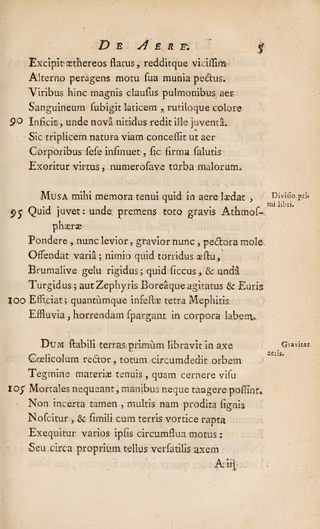
WHEN the ruler of the heaven-dwellers first balanced the lands
on a stable axis, he surrounded the whole globe
with a covering of thin matter, which mortals cannot
discern with their sight, nor touch with their hands.
Yet it is not uncertain, for betrayed by many signs
it is known, and swept along with the lands in a similar vortex,
flowing around them it executes various motions:
whether the turning earth around its own axis Weight of the air.
DUM ſtabili terras primùm libravit in axe
Cœlicolum rector, totum circumdedit orbem
Tegmine materiæ tenuis, quam cernere viſu
Mortales nequeant, manibus neque tangere poſſint.
Non incerta tamen, multis nam prodita ſignis
Noſcitur, & ſimili cum terris vortice rapta
Exequitur varios ipſis circumflua motus:
Seu circa proprium tellus verſatilis axem Gravitas
Part 2
separates the times of light and of silent night;
or whether, running through the annual signs along its accustomed path,
it divides the balanced year into twice six months.
Yet what cause could thus fix the wandering air to the earth,
so that, eternally keeping harmonious compacts,
it docilely never refuses to renew so many courses?
This is solely the work of gravity: for all bodies by an innate effort
are driven toward the innermost bowels
of the earth, and if it were permitted to overcome the obstacles
of opposing mass, they would now seek the center of the world with great impetus.
Hence you see stones hurled through the breezes by a mighty impulse,
their forces lost, reverse the path they had begun,
and fall down again with increased motion.
Nor is gravity proper only to solids: the fates allow
fluids to possess gravity; thus the air with balanced
weight sustains various columns of mercury and of water.
Yet this gravity, which lay manifest by proofs,
escaped the ancients; then a vain horror of a vacuum
clung deeply to their minds with fixed roots.
Madmen! For what could a vacuum produce?
Since the void is nothing, an empty name without a body.
Nurturing parent of heroes, Italian land most pleasing to the Muses,
you first unlock the secrets of nature,
and bathe astonished minds with a new light.
Behold, while the pump sucks up the reluctant waters,
the rustic is amazed that the water stops in the middle,
and that it surmounts four times eight feet, nor beyond
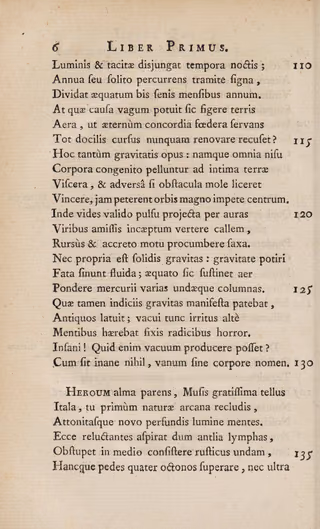
Luminis & tacitæ disjungat tempora noctis ;
Annua ſeu ſolito percurrens tramite ſigna ,
Dividat æquatum bis ſenis menſibus annum.
At quæ cauſa vagum potuit ſic figere terris
Aera , ut æternùm concordia fœdera ſervans
Tot docilis curſus nunquam renovare recuſet?
Hoc tantùm gravitatis opus : namque omnia niſu
Corpora congenito pelluntur ad intima terræ
Viſcera , & adversâ ſi obſtacula mole liceret
Vincere, jam peterent orbis magno impete centrum.
Inde vides valido pulſu projecta per auras
Viribus amiſſis incæptum vertere callem ,
Rursùs & accreto motu procumbere ſaxa.
Nec propria eſt ſolidis gravitas : gravitate potiri
Fata ſinunt fluida ; æquato ſic ſuſtinet aer
Pondere mercurii varias undæque columnas.
Quæ tamen indiciis gravitas manifeſta patebat ,
Antiquos latuit ; vacui tunc irritus altè
Mentibus hærebat fixis radicibus horror.
Inſani! Quid enim vacuum producere poſſet?
Cum ſit inane nihil , vanum ſine corpore nomen.
HEROUM alma parens , Muſis gratiſſima tellus
Itala , tu primùm naturæ arcana recludis ,
Attonitaſque novo perfundis lumine mentes.
Ecce reluctantes aſpirat dum antlia lymphas ,
Obſtupet in medio conſiſtere ruſticus undam ,
Hancque pedes quater octonos ſuperare , nec ultra
Part 3
To climb, however much the piston redoubles its
draught.
And now Torricelli, renowned in the art of Galileo,
Revolving the causes of the prodigy in his attentive mind:
What, says he, is the horror of a vacuum confined by a fixed
Limit, and does nature no longer fear a vacuum beyond it?
He spoke, and driving false beliefs from his mind, he now
Marvels at new mysteries of things, now he knows that the air
Is heavy, and that liquids raised by gravity alone
Stop at various limits according to their various weight.
Nor is there delay; he fills a glass tube with gleaming
Mercury; the mass of suspended metal is drawn up,
And having surpassed four times seven inches, vibrating it goes
And returns along the same path, and stands by its own bulk.
MESSENGER fame flies, and wandering through the whole world,
Spontaneously rouses the sluggish minds of the learned.
And now to the happy lands where the lilies reign
She had come: here first the hero Descartes,
With nature showing the way, had utterly overthrown
The laws of the Stagirite father; here men strong in sublime art
And genius, the renowned glory of the Gallic race,
Eagerly attempt to unfold the causes of things
Under great auspices, and compel all of nature
To present herself before their tribunal.
Scarcely does the light brought from Italian shores gleam,
And scarcely, glowing, Through the Gallic realms new rays
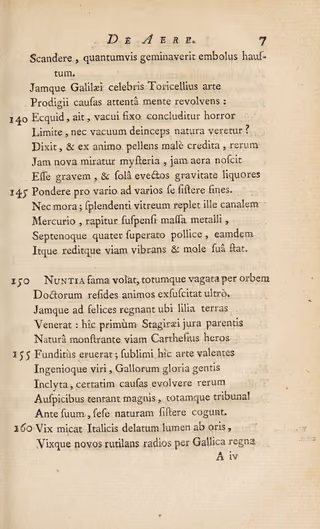
Scandere, quantumvis geminaverit embolus hauſ-
tum.
Jamque Galilæi celebris Toricellius arte
Prodigii cauſas attentâ mente revolvens :
Ecquid, ait, vacui fixo concluditur horror
Limite, nec vacuum deinceps natura veretur?
Dixit, & ex animo pellens malè credita, rerum
Jam nova miratur myſteria, jam aera noſcit
Eſſe gravem, & ſolâ evectos gravitate liquores
Pondere pro vario ad varios ſe ſiſtere fines.
Nec mora ; ſplendenti vitreum replet ille canalem
Mercurio, rapitur ſuſpenſi maſſa metalli,
Septenoque quater ſuperato pollice, eamdem
Itque reditque viam vibrans & mole ſuâ ſtat.
NUNTIA fama volat, totumque vagata per orbem
Doctorum reſides animos exſuſcitat ultrò.
Jamque ad felices regnant ubi lilia terras
Venerat : hîc primùm Stagiræi jura parentis
Naturâ monſtrante viam Cartheſius heros
Funditùs eruerat ; ſublimi hîc arte valentes
Ingenioque viri, Gallorum gloria gentis
Inclyta, certatim cauſas evolvere rerum
Auſpicibus tentant magnis, totamque tribunal
Ante ſuum, ſeſe naturam ſiſtere cogunt.
Vix micat Italicis delatum lumen ab oris,
Vixque novos rutilans radios per Gallica regna
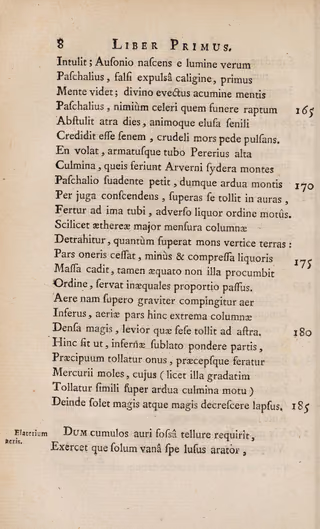
Part 4
brought in; the truth arising from the Ausonian light,
Pascal, having driven out the darkness of falsehood, is the first
to see with his mind; Pascal, elevated by the divine keenness of his mind,
whom a dark day carried off, snatched away by a too-swift death,
and death, striking with its cruel foot, deceived by his aged mind,
believed him to be an old man.
Behold, he flies, and armed with the tube, Périer seeks the high
peaks with which the mountains of Auvergne strike the stars,
at Pascal's urging, and while climbing over the steep
ridges of the mountain, he raises himself into the upper air,
the liquid is borne to the bottom of the tube, in an opposite order of motion.
Indeed, a greater measure of the ethereal column
is subtracted, by as much as the mountain surpasses the earth with its peak:
part of the weight ceases, and the less compressed mass of liquid
falls; yet it does not sink in an equal
order; the proportion keeps unequal paces.
For the lower air is heavily compressed by the upper air;
hence the lowest part of the aerial column is
more dense, while that which raises itself to the stars is lighter.
Hence it happens that, when the weight of the lower part is removed,
the principal burden is taken away, and the mass of mercury
is borne headlong, whose fall (although it be raised step by step
with a similar motion over the steep summits)
then usually decreases more and more.
Intulit; Auſonio naſcens e lumine verum
Paſchalius, falſi expulsâ caligine, primus
Mente videt; divino evectus acumine mentis
Paſchalius, nimiùm celeri quem funere raptum
Abſtulit atra dies, animoque eluſa ſenili
Credidit eſſe ſenem, crudeli mors pede pulſans.
En volat, armatuſque tubo Pererius alta
Culmina, queis feriunt Arverni ſydera montes
Paſchalio ſuadente petit, dumque ardua montis
Per juga conſcendens, ſuperas ſe tollit in auras,
Fertur ad ima tubi, adverſo liquor ordine motûs.
Scilicet æthereæ major menſura columnæ
Detrahitur, quantùm ſuperat mons vertice terras:
Pars oneris ceſſat, minùs & compreſſa liquoris
Maſſa cadit, tamen æquato non illa procumbit
Ordine, ſervat inæquales proportio paſſus.
Aere nam ſupero graviter compingitur aer
Inferus, aeriæ pars hinc extrema columnæ
Denſa magis, levior quæ ſeſe tollit ad aſtra.
Hinc fit ut, infernæ ſublato pondere partis,
Præcipuum tollatur onus, præcepſque feratur
Mercurii moles, cujus (licet illa gradatim
Tollatur ſimili ſuper ardua culmina motu)
Deinde ſolet magis atque magis decreſcere lapſus.