Hover or tap a word to see its match.
Part 1
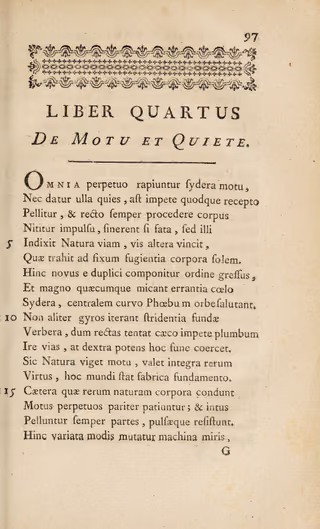
All stars are swept along in perpetual motion,
Nor is any rest given, but each body is driven by the impetus
Received, and ever strives to proceed in a straight
Impulse, if the fates would allow; yet to it
Nature has prescribed a path; another force prevails,
Which draws the fleeing bodies toward the fixed sun.
Hence a new course is compounded from a twofold order,
And whatever wandering stars gleam in the great sky
Salute the central Phoebus in a curved orbit.
Not otherwise do the whistling thongs of a sling repeat their circles,
While the lead strives with blind impetus to go along straight
Paths, yet a powerful right hand restrains it with the cord.
Thus Nature thrives by motion, the entire vigor of things
Prevails; upon this foundation stands the fabric of the world.
The other bodies that establish the nature of things
Likewise undergo perpetual motions; and within,
The parts are ever driven, and being driven resist.
Hence the machine, varied in wondrous ways, is changed,
OMNIA perpetuo rapiuntur ſydera motu,
Nec datur ulla quies , aſt impete quodque recepto
Pellitur , & recto ſemper procedere corpus
Nititur impulſu , ſinerent ſi fata , ſed illi
Indixit Natura viam , vis altera vincit ,
Quæ trahit ad fixum fugientia corpora ſolem.
Hinc novus e duplici componitur ordine greſſus ,
Et magno quæcumque micant errantia cœlo
Sydera , centralem curvo Phœbum orbe ſalutant.
Non aliter gyros iterant ſtridentia fundæ
Verbera , dum rectas tentat cæco impete plumbum
Ire vias , at dextra potens hoc fune coercet.
Sic Natura viget motu , valet integra rerum
Virtus , hoc mundi ſtat fabrica fundamento.
Cætera quæ rerum naturam corpora condunt
Motus perpetuos pariter patiuntur ; & intus
Pelluntur ſemper partes , pulſæque reſiſtunt.
Hinc variata modis mutatur machina miris ,
Part 2
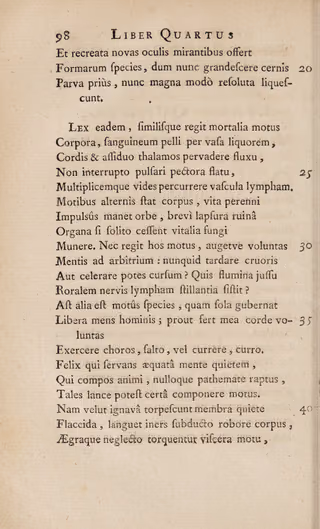
And renewed, it offers to wondering eyes new
Appearances of forms, while now you see grow large
What was small before, and now great things, recently dissolved, melt
away.
The same law and a similar motion govern mortal
Bodies; you see the bloody fluid driven through the vessels,
And pervading the chambers of the heart in a constant flow,
The chest beaten by an uninterrupted breath,
And the manifold lymph coursing through the small vessels.
By alternating motions the body stands; life remains in a perennial
Cycle of impulse, soon to collapse in ruin
Should the vital organs cease to perform their accustomed
Duty. Nor does the will govern or increase these motions
At the bidding of the mind: can you delay
Or hasten the course of the blood? Who by command stays
The streams distilling dewy lymph into the nerves?
Yet there is another kind of motion, which the free mind
Of man alone governs; just as the will in my heart inclines me
To practice dances, I leap, or to run, I run.
Happy is he who, preserving repose with a balanced mind,
Who, master of himself and swept away by no passions,
Can regulate such motions with a sure scale.
For just as flaccid limbs grow numb in slothful rest,
The sluggish body languishes with its strength withdrawn,
And the sickened viscera are tormented when motion is neglected,
Et recreata novas oculis mirantibus offert
Formarum ſpecies, dum nunc grandeſcere cernis
Parva priùs, nunc magna modò reſoluta liqueſ-
cunt.
LEX eadem, ſimiliſque regit mortalia motus
Corpora, ſanguineum pelli per vaſa liquorem,
Cordis & aſſiduo thalamos pervadere fluxu,
Non interrupto pulſari pectora flatu,
Multiplicemque vides percurrere vaſcula lympham.
Motibus alternis ſtat corpus, vita perenni
Impulsûs manet orbe, brevì lapſura ruinâ
Organa ſi ſolito ceſſent vitalia fungi
Munere. Nec regit hos motus, augetve voluntas
Mentis ad arbitrium : nunquid tardare cruoris
Aut celerare potes curſum? Quis flumina juſſu
Roralem nervis lympham ſtillantia ſiſtit?
Aſt alia eſt motûs ſpecies, quam ſola gubernat
Libera mens hominis; prout fert mea corde vo-
luntas
Exercere choros, ſalto, vel currere, curro.
Felix qui ſervans æquatâ mente quietem,
Qui compos animi, nulloque pathemate raptus,
Tales lance poteſt certâ componere motus.
Nam velut ignavâ torpeſcunt membra quiete
Flaccida, languet iners ſubducto robore corpus,
Ægraque neglecto torquentur viſcera motu,
Part 3
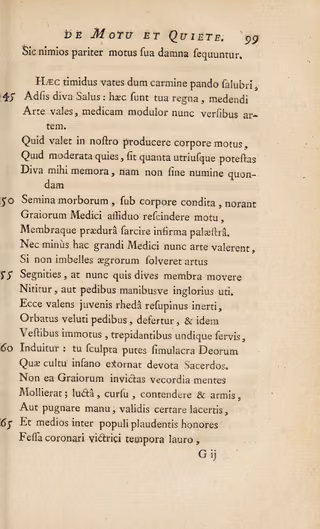
So likewise their own harms follow excessive motions.
Sic nimios pariter motus ſua damna ſequuntur.