Hover or tap a word to see its match.
Part 1
Excessive sleep. COME then, if excessive slumber seizes the sluggish
Limbs,
And the threads of the fibers are long relaxed by sleep,
Neither tone nor innate vigor will return to the feeble
Structure, just as a lyre, relaxed by rest,
Can no longer render clear sounds with its loosened strings:
Hence comes torpor of the body, and sloth to the sluggish limbs.
Blood creeping with a slow course through the soft vessels
Of the brain increases this; for while Morpheus
Loosens the body, and relaxes the pores of the skin as sleep is let in,
The limbs perspire with vapors of fluids diffused
On all sides; the blood, thicker now that its water has been breathed away,
Rolls with difficulty through the contracted circle of the fibers,
And stretches the easily yielding vessels with infarction.
Meanwhile, the very soft structure of the brain is pressed
First, and as the prone posture drives the ascent
Of the blood, it swells, and, burdened with distended fibers, it labors,
And is unable to drive away so great a mass.
Nay, on the contrary, the increased thickness of the blood gradually grows
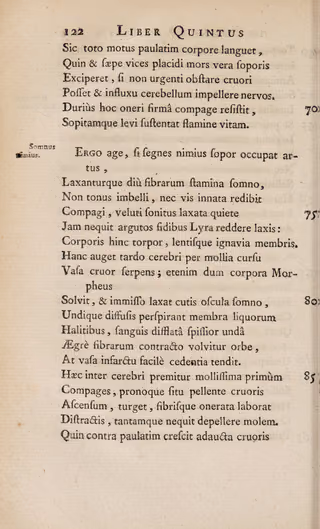
Somnus nimius. ERGO age, ſi ſegnes nimius ſopor occupat ar-
tus,
Laxanturque diù fibrarum ſtamina ſomno,
Non tonus imbelli, nec vis innata redibit
Compagi, veluti ſonitus laxata quiete
Jam nequit argutos fidibus Lyra reddere laxis:
Corporis hinc torpor, lentiſque ignavia membris.
Hanc auget tardo cerebri per mollia curſu
Vaſa cruor ſerpens; etenim dum corpora Mor-
pheus
Solvit, & immiſſo laxat cutis oſcula ſomno,
Undique diffuſis perſpirant membra liquorum
Halitibus, ſanguis difflatâ ſpiſſior undâ
Ægrè fibrarum contracto volvitur orbe,
At vaſa infarctu facilè cedentia tendit.
Hæc inter cerebri premitur molliſſima primùm
Compages, pronoque ſitu pellente cruoris
Aſcenſum, turget, fibriſque onerata laborat
Diſtractis, tantamque nequit depellere molem.
Quin contra paulatim creſcit adaucta cruoris
Part 2
thickness, and the head is weighed down, and as the nerves are relaxed,
the limbs languish the more, oppressed by sluggish lethargy.
Thus sleep begets sleep; hence bodies enervated by sleep
can scarcely keep heavy slumber from their eyes.
Yet with what great torments do wretched bodies pay for excessive
rest; sluggish Apoplexy with its icy exhalations hangs over
the head, a trembling paralysis threatens the limbs,
and they wither away, deprived of both sense and motion.
Add that the stomach, with its feeble fiber, can scarcely
dissolve the food given to it, but swells with a crude fluid;
nor do the lax vessels convert the chyliferous liquid
into true blood; hence the belly often swells with
a watery infarction, and pallor is suffused over the white face.
OTHER dangers must now be undergone by you,
if you attempt to pass whole nights wakeful without sleep.
Indeed, by alternating turns of motion and peaceful rest
abide whatever bodies flourish and enjoy
life: throughout the winter Flora seems to indulge
in sleep, nor do the trees have leaves at every season;
all animals love to restore their wearied body
with the wished-for rest of the night, and are able once more
to ply their labors; after the repose of winter the tree
sprouts forth leaves, and is adorned with tender foliage.
Nor is the mortal race, though it rules the whole world, Deficient
sleep.
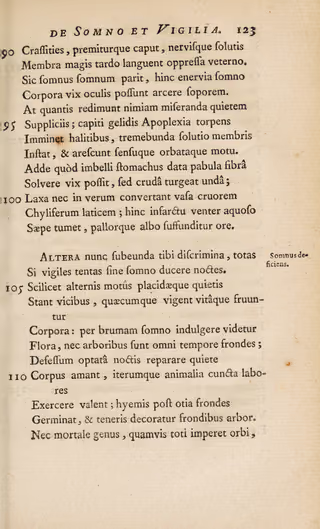
Craſſities, premiturque caput, nerviſque ſolutis
Membra magis tardo languent oppreſſa veterno.
Sic ſomnus ſomnum parit, hinc enervia ſomno
Corpora vix oculis poſſunt arcere ſoporem.
At quantis redimunt nimiam miſeranda quietem
Suppliciis; capiti gelidis Apoplexia torpens
Imminet halitibus, tremebunda ſolutio membris
Inſtat, & areſcunt ſenſuque orbataque motu.
Adde quòd imbelli ſtomachus data pabula fibrâ
Solvere vix poſſit, ſed crudâ turgeat undâ;
Laxa nec in verum convertant vaſa cruorem
Chyliferum laticem; hinc infarctu venter aquoſo
Sæpe tumet, pallorque albo ſuffunditur ore.
ALTERA nunc ſubeunda tibi diſcrimina, totas
Si vigiles tentas ſine ſomno ducere noctes.
Scilicet alternis motûs placidæque quietis
Stant vicibus, quæcumque vigent vitâque fruun-
Corpora: per brumam ſomno indulgere videtur
Flora, nec arboribus ſunt omni tempore frondes;
Defeſſum optatâ noctis reparare quiete
Corpus amant, iterumque animalia cuncta labo-
Exercere valent; hyemis poſt otia frondes
Germinat, & teneris decoratur frondibus arbor.
Nec mortale genus, quamvis toti imperet orbi, Somnus de-
Part 3
is able to scorn this sanctioned law with impunity.
Behold those whom unbridled pleasure rules without law,
who sacrifice all night long to Bacchus, to frivolous gaming, and to various dances:
how a languishing pallor seizes their faces,
how pustules disfigure their bloodless countenances!
What emaciation presses upon them, how a dry cough exhausts
their chests! Soon fever and lethal wasting will be at hand.
They indeed deserved to pay these penalties for their crime;
but those who have harmless candor beneath a pure breast,
who strive to bathe their minds in studies and the light
of truth, who rejoice to lay open the innermost secrets of nature,
captivated by a sincere love of sublime wisdom,
how many evils torment the wretches, in how great a host
do they harass them!
While they refuse to grant peaceful sleep to their
limbs.
For just as sleep relaxes the threads of the nerves,
so wakeful cares distend the delicate fibers and soft vessels of the brain;
stretched apart, the fiber wavers,
and, once slackened, does not preserve its former vigor.
Not otherwise is a rope, distended by a heavy weight,
weakened and unraveled as the coil of its fibers gradually slackens;
or a blade of steel, driven by violent forces,
yields inert, and, no longer elastic, is unable
to perform its movements as before: thus throughout the whole body
the viscera languish, sluggish with atonic fibers.
Hence first the enfeebled mind is punished, since, weighed down,
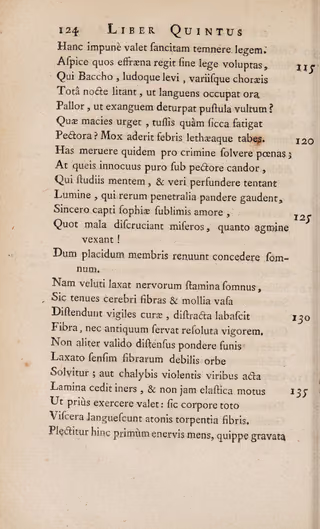
Hanc impunè valet ſancitam temnere legem.
Aſpice quos effræna regit ſine lege voluptas,
Qui Baccho , ludoque levi , variiſque choræis
Totâ nocte litant , ut languens occupat ora
Pallor , ut exanguem deturpat puſtula vultum ?
Quæ macies urget , tuſſis quàm ſicca fatigat
Pectora ? Mox aderit febris lethæaque tabes.
Has meruere quidem pro crimine ſolvere pœnas ;
At queis innocuus puro ſub pectore candor ,
Qui ſtudiis mentem , & veri perfundere tentant
Lumine , qui rerum penetralia pandere gaudent,
Sincero capti ſophiæ ſublimis amore ,
Quot mala diſcruciant miſeros , quanto agmine
vexant !
Dum placidum membris renuunt concedere ſom-
num.
Nam veluti laxat nervorum ſtamina ſomnus ,
Sic tenues cerebri fibras & mollia vaſa
Diſtendunt vigiles curæ , diſtracta labaſcit
Fibra , nec antiquum ſervat reſoluta vigorem.
Non aliter valido diſtenſus pondere funis
Laxato ſenſim fibrarum debilis orbe
Solvitur ; aut chalybis violentis viribus acta
Lamina cedit iners , & non jam elaſtica motus
Ut priùs exercere valet : ſic corpore toto
Viſcera langueſcunt atonis torpentia fibris.
Plectitur hinc primùm enervis mens, quippe gravata
Part 4
It lies prostrate, and cannot with its wonted vision
Embrace the spectacles of nature, or investigate hidden causes.
No longer does he measure the flames suspended in the ethereal vault,
And know their various positions and the stars,
Who previously often dared to bind the immense world
With unshaken laws; nor can he unfold the nature
Of the mind, and bring forth the passions of the soul in words,
Who once restrained excessive affections by reason,
And, ruling morals with a sure examination,
Gave laws to the peoples weighed in a faithful balance;
He has no power to utter words mighty in eloquence,
Whom, soothing ears with the learned flowers of his tongue,
The crowd admired with gaping mouth; nor could the wave
Of Castalia restore vigor to the bard,
Who sleepless beneath the silent night tried to climb
The ridges of Parnassus, captivated by the sweetness of song,
And did not set the bidden intervals to his hard labor;
Him the Graces have left, the jests have fled in fear of
A Muse foul with the thick smoke and reek of oil.
This purer offspring, breath of the divine spirit,
The mind, fastened to the earth by heavy sense, can scarcely
Now return to the ether; languishing beneath a weary body
It is oppressed, and, though a ruler, subdued it bears the yoke of a slave:
Or if strength remains to the soul, if all vigor has not
Deserted it, and it has the power to produce some movements,
How many discordant tumults with no order
Torment the mind! As the fibers are pulled apart by various impulses
Hæc jacet, & ſolito rerum ſpectacula viſu
Complecti, aut cauſas nequit indagare latentes.
Æthereo non jam ſuſpenſas vertice flammas
Metitur, varioſque ſitus & ſydera noſcit,
Qui priùs immenſum inconcuſſis legibus orbem
Sæpe coercere auſus ; non expandere mentis
Naturamque poteſt, animique pathemata dictis
Promere, qui quondam nimios ratione coegit
Affectus, certoque regens examine mores,
Jura dedit populis librâ trutinata fideli ;
Non valet eloquio pollentes reddere voces,
Quem doctis linguæ mulcentem floribus aures
Turba dehiſcenti mirata eſt ore ; nec unda
Caſtalidis vati potuit reparare vigorem,
Qui juga Parnaſſi inſomnis ſub nocte ſilenti
Scandere tentavit, captus dulcedine cantûs,
Nec poſuit duro juſſa intervalla labori;
Hunc Charites liquere, joci fugere paventes
Spiſſo olei tetram fumo & nidore Camœnam.
Purior hæc ſoboles, divini flaminis aura,
Terræ mens affixa gravi vix æthera ſenſu
Nunc remeare poteſt, feſſo ſub corpore languens
Opprimitur, princepsque jugum fert ſubdita ſervi :
Aut ſi vis animo ſupereſt, ſi non vigor omnis
Deſeruit, quoſdamque valet producere motus,
Quot mentem nullo diſcordes ordine turbæ
Diſcruciant! Vario diſtractis impete fibris
Part 5
the parts of the brain leap up, error arises in the senses,
Dissimilar ones rise up together, and tumults agitate
the mind; a deceitful image deludes the senses.
When the strings of the cithara are stretched to their proper limit,
it trembles with a harmonious tone, and when struck it gives back
pure songs from the gathered murmur of its fibers.
Then the sound soothes with equal sweetness, stirring the mind
with a pleasing resonance; thus by song of old
Orpheus led the listening oaks and following rocks,
while he wept for Eurydice on his charming lyre:
Thus with sweet melody Amphion is said to have drawn
the heavy crags, while he plies the plectrum with his thumb;
the flint rises on high, and strong citadels stand with their walls.
But let an ignorant hand stretch the disordered strings
in an unequal arrangement; then one looser chord will give
sluggish noises, another tighter chord shrill ones,
and discord shatters the ears with a clanging screech.
The same law governs the fibers of the brain: for indeed all
the phantasms, however many rise up in the ethereal mind,
become varied when the fibers of the brain are shaken:
Nor does a struck string of the lyre more unfailingly modulate
the same tones, than a similar image always
arises for the mind, when a fiber of the brain trembles.
But the form which rises up from a trembling fibril
is single and simple; thus to our mind a single
idea of the Deity is presented, thus rises the bare image
of the good, nor will the mind be able to join the two together.
Subſultant cerebri partes, fit ſenſibus error,
Diſſimiles ſimul exurgunt, animumque tumultus
Exagitant, fallax ſenſus deludit imago.
Cum Cytharæ juſto tenduntur limite nervi,
Concordi tremit illa tono, pulſataque puros
Reddit fibrarum collecto murmure cantus.
Tunc ſonus æquali mulcet dulcedine, grato
Sollicitans ſtrepitu mentem; ſic carmine quondam
Auritas quercus & ſaxa ſequentia duxit,
Dum blandâ Eurydicen Orpheus teſtudine fleret:
Sic dulci traxiſſe graves modulamine cautes
Dicitur Amphyon, dum tractat pollice plectra,
Surgit in alta ſilex, validæ ſtant mœnibus arces.
Aſt ignara manus turbatos ordine nervos
Tendat inæquali; tum laxior altera lentos,
Strictior argutos ſtrepitus dabit altera chorda,
Stridore aures clangoſo diſcordia frangit.
Lex eadem cerebri fibras regit: omnia quippe
Quotquot in æthereâ exurgunt Phantaſmata mente
Concuſſis cerebri fiunt variantia fibris:
Nec meliùs percuſſa lyræ modulatur eoſdem
Semper chorda tonos, quàm menti ſemper imago
Exoritur ſimilis, cerebri cum fibra tremiſcit.
At quæ fibrillâ conſurgit forma tremente
Unica ſimplexque eſt; noſtræ ſic unica menti
Numinis offertur ſpecies, ſic ſurgit imago
Nuda boni, nec mens poterit conjungere utramque.
Part 6
Now if these harmonious fibers should vibrate together
in due order, this concord captivates the mind, joins those same
forms in wedlock, and there is presented the image
of a Deity who often shows mercy to an undeserving world.
If, on the contrary, the fibers be moved with an unequal vibration,
a discordant appearance arises, the one clashes with the other;
and you see the mind disjoin the presented forms.
Hence, no sane person can simultaneously join the idea of the Deity
and of the unjust, for each fiber is moved
by a discordant vibration. Now if, with order disturbed and fibers
lax or overstretched, the harmony of the brain should collapse,
phantasms agitate the delirious mind, it associates
dissimilar forms, disjoins similar ones, and the mind
forges empty ideas: this wisdom of which the human race is so proud,
alas, perishes more quickly than fragile glass.
Thus wakeful cares disturb the innermost recesses of the mind,
while the tense nerves of the brain leap in no order.
And just as a mechanism put together with a curved train
of wheels, which revolves in a complex circle of motion,
if a wheel should fail, if a slender hook is broken,
crippled, cannot be driven by its wonted motions, and stands still;
in no other way does the machine of the body fall, driven by swift
ruin, if the wonted order of the brain is subverted.
Thence you see, when the pulsations of the nerves are disturbed, how many
evils torment the whole body, how many vex the viscera,
since the parts thrive and are firm only by such a support.
Without delay, that which bathes the whole body with auspicious nectar
Nunc ſimul hæ juſto concordes ordine fibræ
Subſultent , animum trahit hic concentus , eaſdem
Connubio jungit formas , offertur imago
Numinis , immerito quod ſæpe indulgeat orbi.
Quin contra fremitu moveantur diſpare fibræ ,
Diſcors exoritur ſpecies , huic illa repugnat ;
Oblataſque vides mentem disjungere formas.
Numinis hinc , ideamque ſimul conjungere iniqui
Sanus nemo poteſt , nam fibra movetur utraque
Diſcordi fremitu. Nunc turbato ordine laxis
Diſtractiſve ruat cerebri concordia fibris ,
Deliram exagitant mentem Phantaſmata , formas
Diſſimiles ſociat , ſimiles disjungit , inanes
Mens ideas conflat : quâ gens humana ſuperbit ,
Heù fragili citiùs perit hæc ſapientia vitro.
Sic vigiles turbant animi penetralia curæ ,
Dum cerebri nullo ſaliunt tenſi ordine nervi.
Ac veluti curvo moles conflata rotarum
Agmine , quæ motûs complexo volvitur orbe ,
Si rota deficiat , tenuis ſi rumpitur uncus ,
Manca nequit ſolitis impelli motibus , & ſtat ;
Corporis haud aliter celeri cadit acta ruinâ
Machina , ſi ſolitus cerebri ſubvertitur ordo.
Nervorum inde vides turbatis pulſibus , omne
Quot mala diſcrucient corpus, quot viſcera vexent,
Cùm tali vigeant firmæ fulcimine partes.
Nec mora , qui totum felici nectare corpus
Part 7
bathes, and with scattered dews makes all the limbs
fruitful, the blood is now moved by an uncertain law,
and now by its effort it cannot enter the contracted vessels,
now it is carried on a swift course, and forced by a rapid
impetus, the blood enters the innermost parts in a foaming vortex.
Hence the blood presses against the vessels, and by a strong counter-effort
is driven back; from the friction the praecordia grow hot, just as
an axle growing hot from long motion catches fire,
or a mass of iron, sparkling from the rapid blow of a flint,
is poured forth and, dissolved into glass, melts.
Thus heat arises from motion; soon another cause increases
the heat, and ruins the blood with an implanted taint.
For indeed, the blood, snatched in a swift whirlpool through the viscera,
is gradually dissolved, its structure broken; exhausted,
it takes on an acrid quality, and with its goads wearies
the innermost parts of the vessels, nor does it now with soothing sweetness
restore the worn-out parts, and supply to the limbs
the nourishment which, exhausted by long labor, they have deserved;
but it pricks the slender fibers, and mangles them with troublesome
blows, whence heat clings to the consumed limbs.
And now a glowing fever is kindled with rapid fire,
and gradually feeds upon the dry viscera; emaciation
thins the whole body, and the bared bones with their swelling
protuberance scarcely support the trembling corpse.
Alas, death will soon be present, unless sleep restores strength
to the panting, and, sending rest through the languid limbs,
placidly binds fast the nourishment given to the mangled vessels.
Alluit , & cunctos diſperſis roribus artus
Fæcundat , cruor incertâ jam lege movetur ,
Et modò vaſa nequit niſu contracta ſubire ,
Nunc celeri vehitur curſu , rapidoque coactus
Impete , ſpumoſo ſubit intima vortice ſanguis.
Nititur hinc in vaſa cruor , validoque reniſu
Pellitur ; affrictu fervent præcordia , longo
Non ſecus ac motu fervens incenditur axis ,
Aut ſilicis rapido ſcintillans funditur ictu
Inque vitrum ferri moles reſoluta liqueſcit.
Sic calor a motu , mox altera cauſa calorem
Auget , & infixâ peſſumdat labe cruorem.
Quippe cito ſanguis per viſcera gurgite raptus
Paulatim ruptâ compage reſolvitur , acrem
Induit effœtus dotem , ſtimuliſque fatigat
Intima vaſorum , nec jam dulcedine blandâ
Attritas reficit partes , membriſque miniſtrat
Pabula , quæ longo meruere exhauſta labore ;
Sed tenues pungit fibras , laceratque moleſtis
Ictibus , unde calor conſumptis artubus hæret.
Jamque febris rapido fervens accenditur igne ,
Siccaque paulatim depaſcit viſcera , totum
Attenuat macies corpus , nudata tumenti
Tubere vix tremulum ſuſtentant oſſa cadaver.
Heu citò mors aderit , vires nî reddat anhelis
Somnus , & immiſsâ per languida membra quiete
Compingat placidè laceris data pabula vaſis.
Part 8
But just as sleep very often provokes excessive lethargy,
so Morpheus often refuses to scatter his wished-for flowers
upon weary limbs, when long-sleepless nights
have brought foul fires into the blood.
For the bodily frame is altered by prolonged strain,
and the eyes cannot recall the banished rest.
Moreover, to check the heat of scorched blood,
neither the citron, nor ever golden apples with their sour
juices,
nor sweet milk with thin whey, nor cold medicines
have power, nor the water-lily excelling in its icy juice.
Yet this plant is said to break one's strength for the struggles of Venus;
by it the unwedded companions of Diana
once kept the honors of their virginity unharmed.
For Cupid, hostile to the Goddess, had taken up his arms,
and hurling his darts, tried to strike the bared
breast of Diana: the avenging shaft cuts the air,
and seeks the virgin breast with its flaming point.
Yet it did not touch it; with a movement the Goddess avoids the blow,
but the arrow stuck fixed beneath the tender heart of a companion,
and violated the Nymph with a fiery wound.
She burns, and nursing the fires in her silent limbs,
she feels her breast tormented by an unexperienced poison.
What should she do? From this side blind desire drags her against her will,
from that side modesty holds the wretched girl back; before her mind stand
the honor of virginity, and the base infamy of her flame.
Often in her anxiety the cruel laws of chastity
At veluti ſomnus nimium perſæpe ſoporem
Provocat, optatos ſic feſſis ſpargere membris
Sæpe negat flores Morpheus, dum tetra cruori
Induxere diù vigiles incendia noctes.
Immutatur enim diuturno machina niſu,
Et pulſam nequeunt oculi revocare quietem.
Quid quod & ambuſti compeſcere ſanguinis æſtum
Non citrus, atque acidis nunquam mala aurea ſuc-
cis,
Non tenui lac dulce ſero, non frigida poſſunt
Pharmaca, nec gelido præſtans Nymphæa liquore.
Hæc tamen ad Veneris certamina frangere vires
Dicitur, hac illæſos virginitatis honores
Innuptæ quondam comites tenuere Dianæ.
Quippe Deæ infenſus ſua ſumpſerat arma Cupido,
Telaque contorquens nudata ferire Dianæ
Pectora tentabat : vindex ſecat aera telum,
Virgineumque petit flammanti cuſpide pectus.
Nec tamen hoc tetigit, motu Dea præcavet ictum,
Sed tenero comitis ſub corde infixa ſagitta
Hæſit, & ignito violavit vulnere Nympham.
Uritur hæc, tacitiſque fovens incendia membris,
Sentit inexperto torqueri pectora viru.
Quid faceret? Trahit hinc nolentem cæca cupido,
Inde pudor miſeram retinet, ſtant obvia menti
Virginitatis honos, turpiſque infamia flammæ.
Sæpe pudicitiæ crudeles anxia leges
Part 9
she upbraids, and with a groan detests the unjust yoke;
More often she tries to drive out the deep-fixed loves,
And groaning, condemns the headlong frenzy of her mind.
Wakeful by night, she turns over sad cares within her breast,
And by day fills the whole grove with tearful complaints.
"O modesty, peerless glory of a Nymph, O to me the chief
Divinity, never to be violated by any fault,
If my conscious mind sins through a crime committed,
My body still remains pure; may this victim move you,
And may the wave wash away the conceived guilt with its pure stream."
Thus she speaks: and turning her weeping eyes toward the stars,
She casts herself headlong with her whole body into the waves.
All the Nymphs groaned beneath the deep whirlpool,
The chorus of Dryads groaned, Diana herself groans,
Nor does she suffer the wretched girl to be plunged undeservedly beneath the eddy.
For the tender body of the Nymph, floating upon the waters,
Is turned into a snow-white flower with a shining crown,
Which large leaves surround far and wide with a green rampart,
And which the waves around venerate with a gentle murmur.
Then the Goddess bestowed the memorable name of Nymphaea
Upon the flower, and willed it to become famous for a new gift.
For just as the pitiable girl had prudently extinguished
The fiery heats of Cupid with the icy water of the streams;
Increpat, & gemitu juga deteſtatur iniqua;
Sæpius infixos expellere tentat amores,
Præcipitemque animi damnat gemebunda furorem.
Nocte vigil triſtes verſat ſub pectore curas,
Flebilibuſque die complet nemus omne querelis.
O pudor, egregium Nymphæ decus, ô mihi nu-
men
Præcipuum, nullâque unquam violabile noxâ,
Si mea commiſſo mens conſcia crimine peccat,
Corpus adhuc purum manet, hæc te victima flec-
tat,
Conceptumque ſcelus puro luat unda liquore.
Sic ait: humenteſque oculos ad ſydera vertens,
Præcipitem toto ſe corpore mittit in undas.
Ingemuere omnes alto ſub gurgite Nymphæ,
Ingemuitque chorus Dryadum, gemit ipſa Diana,
Nec miſeram immerito patitur ſub vortice mergi.
Nam tenerum Nymphæ fluitans ſuper æquora cor-
pus
Vertitur in niveum ſplendenti culmine florem,
Grandia quem viridi latè folia aggere cingunt,
Quem placido circum venerantur murmure fluc-
tus.
Tum Dea Nymphææ nomen memorabile flori
Impoſuit, voluitque novâ clareſcere dote.
Nam velut ignitos miſeranda Cupidinis æſtus
Rivorum gelidâ prudens extinxerat undâ;
Part 10
So the water-lily, with its juice and thin liquid, is able
To suppress the burning goads of Venus and blind fury,
And, as if for those touched by a Circean spell,
To take away their strength for the games and joys of Venus.
Hence the deceit and the arts of conquered Cupid have perished:
Nor do the Nymphs now fear your cruel darts, Cupid;
Your torch avails you nothing, nothing profits that quiver,
By which you once reigned as victor in the whole world,
Which the Thunderer himself fears, though defended by highest Olympus.
Behold, a slight plant protects unwarlike maidens,
So greatly does the wondrous power of herbs prevail!
NOW by what measure, by what limit to circumscribe
Sleep,
How many waking hours it is helpful to pass, in words
I shall unfold, if only auspicious Apollo favors the poet.
For this is a heavy labor, and to untie the hard
knot
Renowned Machaon with his skillful art could scarcely manage.
Indeed, as many as the stars that sparkle in the pure sky,
As many as the sands rolled by the wave on the Libyan shore,
So many are the varied natures of men, and far different
Their bodies, no otherwise than an unequal image of the face is given.
Thence you see by how varied a limit the times of sleep
Must be established by you, and altered with a sagacious mind. Limits of sleep.
AT FIRST, enclosed in the tender womb of the mother,
Sic ſucco tenuique poteſt Nymphæa liquore
Ardentes Veneris ſtimulos, cæcumque furorem
Comprimere, & veluti Circæo carmine tactis
Ad Veneris ludos & gaudia tollere vires.
Hinc dolus, & victi periere Cupidinis artes:
Nec jam ſæva timent Nymphæ tua tela, Cupido,
Nil te tæda juvat, nil proficit illa pharetra,
Quâ toto quondam regnabas victor in orbe,
Quam timet ipſe tonans ſummo defenſus Olympo.
En levis imbelles tutatur planta puellas,
Uſque adeo valet herbarum miranda poteſtas!
NUNC quâ menſurâ, quo circumſcribere ſom-
num
Limite, quot vigiles juvet horas ducere, dictis
Expediam, faveat modo vati fauſtus Apollo.
Nam gravis hic labor eſt, durumque reſolvere
nodum
Solerti celebris poſſet vix arte Machaon.
Quippe quot in puro ſcintillant ſydera cælo,
Littore quot Lybico fluctu volvuntur arenæ,
Tot naturæ hominum variæ, diverſaque longè
Corpora, non ſecus ac diſpar datur oris imago.
Inde vides vario quàm limite tempora ſomni
Sint ſtatuenda tibi, atque animo mutanda ſagaci. Limites ſomni.
PRINCIPIO matris tenerâ concluſus in alvo,
Part 11
Softer and nearly resembling a trembling jelly in its body,
The infant scarcely wakes; sleep bathes its growing limbs,
And nature veils her begun work in peaceful quiet,
Until she sends it forth perfected into the air.
Then some times are for tears, and others for sleep,
Yet in such a way that the limbs are cherished by a long slumber.
Sleep is the beginning of life, and we seem to be born
So that death may delude us, wretched ones, with the image of sleep.
But when the parts are hardened in a strengthened body,
Then sleep demands that shorter times be granted to it;
And as old age bends the rigid limbs,
Morpheus no longer wreathes the now hoary temples with the poppy.
Indeed, the fibers of infants, and the threads of the nerves
Softened by lymph, are easily relaxed, and take on
A deep slumber in the tender structure of the brain;
Whereas, on the contrary, the callous threads of old men, almost unable to be bent,
Cannot admit soothing sleep.
Hence let sleep be longer for a boy, and all the more so as his age is softer
In a tender body; for a youth, with growing years,
Let it be shorter, and finally let Morpheus scarcely
Seize the eyes of the old man: the innate voice of nature established
This first law; led by just reason, let us follow it.
NOW if you weigh the female limbs and the members of men,
From this a second law of sleep is given to you.
For indeed, with a smooth body, tender skin, and a shrill voice,
Mollior & tremulum referens ferè corpore gluten ,
Vix infans vigilat , creſcentes irrigat artus
Somnus, & incæptum placidâ natura quiete
Velat opus, donec perfectum emittat in auras.
Altera tunc lacrymis , ſunt altera tempora ſomno ,
Sic tamen ut longo foveantur membra ſopore.
Principium vitæ ſomnus, naſcique videmur ,
Ut miſeros ſomni deludat imagine lethum.
Aſt ubi firmato durantur corpore partes ,
Tunc breviora ſibi concedi tempora ſomnus
Poſtulat, & rigidos artus curvante ſenectâ,
Tempora non cingit jam cana papavere Morpheus.
Scilicet infantûm fibræ , mollitaque lymphâ
Stamina nervorum facilè laxantur , & altum
Concipiunt tenerâ cerebri compage ſoporem ;
Quin contra calloſa ſenum, fere neſcia flecti
Stamina , mulcentem nequeunt admittere ſomnum.
Longior hinc puero, & tenero quo mollior ætas
Corpore , ſit ſomnus ; juveni creſcentibus annis
Sit brevior , tandemque ſenis vix lumina Mor-
pheus
Occupet : hanc primam vox naturæ inſita legem
Condidit , hanc æquâ ducti ratione ſequamur.
NUNC ſi fæmineos artus , & membra virorum
Perpendas , datur inde tibi lex altera ſomni.
Corpore quippe levi, tenerâ cute , voce ſtrepenti
Part 12
the softer woman recalls in her face the unwarlike features
of an infant, whereas the darkened limbs of men grow rigid,
and their hairy arms display strong muscles.
Thence let rarer sleep occupy the strengthened limbs of men,
but let the woman lie relaxed in gentle slumber,
lest torments harass her slender nerves,
and nature rage, driven by shifting pains.
Moreover, according to the varied difference of circumstances,
the nature of a healthy man, or the broken strength of a sick one,
sleep must often be confined within different limits.
That man exhibits overflowing lymph in a relaxed body;
his nerves, oppressed beneath the weight of the waters,
can scarcely impel the viscera with their accustomed motion;
all his limbs lie torpid in a deep lethargy,
and he can scarcely withdraw his eyes from encroaching sleep.
Yet sleep would loosen his already relaxed limbs more and more,
and soften his nerves with surging phlegm.
Let him therefore carefully beware of indulging in too much slumber,
and not be carried whither depraved Nature rushes.
This drier man, on the other hand, whom the fiber fatigues with its tremulous
thread, whom viscera boiling with rapid flame
torture, can scarcely indulge in peaceful slumber,
or give his agitated limbs to tranquil rest:
he would easily prolong the sleepless hours of the night,
and wakeful, scarcely feels his eyes loosened by sleep.
Yet when sleep fails, bodies are dried up,
and the nerves twitch all the more with their overstretched thread.
Mollior imbelles infantis fœmina vultus
Ore refert, at membra virûm fuſcata rigeſcunt,
Brachiaque oſtentant validos villoſa lacertos.
Rarior inde virûm firmatos occupet artus
Somnus, at imbelli jaceat reſoluta ſopore
Fœmina, ne graciles nervos tormenta laceſſant,
Mobilibuſque furat natura doloribus acta.
Quin & pro vario rerum diſcrimine, ſani
Pro naturâ hominis, fractis pro viribus ægri,
Sæpe coercendus diverſo limite ſomnus.
Ille redundantem laxato corpore lympham
Exhibet; oppreſſi undarum ſub pondere nervi
Viſcera vix ſolito poſſunt impellere motu;
Cuncta jacent alto torpentia membra veterno,
Vixque poteſt gliſcenti oculos ſubducere ſomno.
At magis atque magis reſolutos ſolveret artus
Somnus, & undanti molliret phlegmate nervos.
Sedulus hinc caveat nimio indulgere ſopori,
Nec quò depravata ruit Natura, feratur.
Siccior hic contra, tremulo quem fibra fatigat
Stamine, quem rapidâ ferventia viſcera flammâ
Excruciant, placido vix indulgere ſopori,
Tranquillæque valet dare concita membra quieti:
Hic facilè inſomnes noctis produceret horas,
Atque vigil ſomno vix ſentit lumina ſolvi.
Deficiente tamen ſiccantur corpora ſomno,
Diſtractoque magis ſubſultant ſtamine nervi.
Part 13
Hence let him more often as a suppliant invoke
the fleeing deities of the night, and summon rest with a praying voice.
For indeed Morpheus can soften dry bodies with slumber,
and strengthen the nerves with remarkable vigor.
And you, whom the torments of a long illness torture,
whose body is broken by emaciation, for whom no traces
of ancient strength remain, to you alone a sure hope
of health is given, when Sleep bedews your languishing limbs
and restores the body with infused strength.
But let the times of sleep be prolonged for you; for indeed,
if Morpheus diffuses his gifts to healthy bodies,
all the more does he deign to scatter his poppies upon
infirm limbs, and restore their ancient strength.
AND NOW you see how much it helps to rule the hours and fixed
times of sleep
with prudence; hence a secure hope of health
arises, while you stand safe within the middle limit.
Happy is he who, observing these moderations of things, so
rules his sleep,
that he restores his limbs with due slumber,
and yet does not lie relaxed in unmanly torpor.
Flourishing in strength and cautious, he does not refuse
to grant seven hours to pressing sleep, rarely
does he pass to an eighth, and scarcely ever, even when compelled,
does he dare to pluck away the sixth hour from gentle sleep.
Thus the tranquil inner chambers of the mind shine with pure
Sæpius hinc noctis fugientia numina ſupplex
Invocet, orantique accerſat voce quietem.
Arida quippe poteſt Morpheus mollire ſopore
Corpora, & inſigni nervos firmare vigore.
Et tu quem longi cruciant tormenta doloris,
Cui fractum macie corpus, cui nulla ſuperſunt
Roboris antiqui veſtigia, ſola ſalutis
Spes tibi certa datur, languentes cum irrigat artus
Somnus, & immiſſo reſtaurat robore corpus.
At ſomni producta tibi ſint tempora; quippe,
Si ſua corporibus diffundit munera ſanis
Morpheus, infirmis magis ille papavera membris
Spargere, & antiquum dignatur reddere robur.
JAMQUE vides quantùm juvet horas, certaque
ſomni
Tempora conſilio regere; hinc ſecura ſalutis
Spes oritur, medio tutus dum limite ſiſtis.
Felix qui rerum hæc ſervans moderamina, ſom-
num
Sic regit, ut juſto reſtauret membra ſopore,
Nec tamen imbelli jaceat torpore ſolutus.
Viribus ille valens ſeptem non abnegat horas
Urgenti cautus ſomno concedere, rarò
Tranſit ad octavam, vix & quandoque coactus
Horam audet leni ſextam decerpere ſomno.
Sic tranquilla nitent puro penetralia mentis
Part 14
light, the vigorous body stands in constant strength,
Pale emaciation does not feed upon the dry limbs,
And the gross members do not swell with excessive fatness.
YET Morpheus cannot bestow so many advantages,
Unless he keeps the times appointed for himself, never
Attempting to break through the bounds which Nature gave.
For Phoebus sprinkles the sky with golden light,
And illuminates mortals with his fiery star,
So that they may be awake, and again after the repose of the peaceful night
May now briskly indulge in their accustomed labor.
Moreover, on the other hand, tranquil Night covers the silent lands
With thick shadows, and conceals the sky with dark
Gloom, so that mortals may refresh with peaceful rest
Their limbs overly wearied by the daytime motion.
Thus Nature commanded that its own times be given to sleep,
And appointed for animals the waking hours in the day.
Scarcely does Aurora, rising from the bedchamber of her aged husband,
Scatter rosy flowers when the veil is driven away,
Than the birds fill the breezes with melodious harmonies,
And salute the rising day with a festive voice:
Mourning Philomela renews her ancient complaints,
And the Dove declares her fervent loves to her mate.
Then the wild beast rushes to its prey, and the Boar traverses
The recesses of the woods, the Wolf lies in wait for the timid sheepfold,
And the Dog pursues the Wolf, and presses him with barking. The time suitable for sleep.
Lumine, ſtat vegetum conſtanti robore corpus,
Pallida non ſiccos macies depaſcitur artus,
Craſſaque non turgent nimiâ pinguedine membra.
HAUD tamen hæc conferre poteſt tot commoda
Morpheus,
Nî ſignata ſibi ſervarit tempora, nunquam,
Quas Natura dedit, metas perrumpere tentans.
Scilicet aurato conſpergit lumine cælum
Phœbus, & ignifero mortales ſydere luſtrat,
Ut vigilent, placidæque iterum poſt otia noctis
Jam poſſint alacres ſolito indulgere labori.
Quin ſpiſſis contra terras tranquilla ſilentes
Nox operit tenebris, tegit & caligine cælum
Obſcurâ, ut nimiùm motu defeſſa diurno
Mortales placidâ recreent ſua membra quiete.
Sic juſſit Natura dari ſua tempora ſomno,
Indixitque die vigiles animalibus horas.
Vix, ſenis e thalamo ſurgens aurora mariti,
Diffundit roſeos pulſo velamine flores,
Argutis volucres implent concentibus auras,
Surgentemque diem feſtivâ voce ſalutant:
Antiquas renovat mœrens Philomela querelas,
Ferventeſque Columba mari declarat amores.
Tum ruit ad prædam fera, ſylvarumque receſſus
Luſtrat Aper, timido Lupus inſidiatur ovili,
Inſequiturque Lupum Canis, & latratibus urget. Tempus ſomno aptum.
Part 15
Then the tender lambs play in the soft grass,
And breathe the fragrant breeze through their wide nostrils.
Then the bull is forced to submit his neck to the heavy plow,
And the hardy rustic returns to his fields.
Meanwhile, an artless maiden with a surpassing figure,
Whom modesty and simple Nature adorn, does not fear
To expose her peerless limbs to the warm sun,
Nor does she veil a brow marked by no guilt.
Phoebus admires the rustic features of the unadorned maiden,
And her native grace, and her hair shining with no
Art, and caressing the pure face of the girl with his rays,
He silently pours a rosy bloom over her cheeks.
And now the loving sun would wish to halt in mid-course,
And hidden in dark mist, to behold the Nymph
Dancing late through the meadows in a light round.
But the fates do not allow it; night brings back leisure to the earth:
The rustic crowd returns to its cottage and ancestral hearth,
And soon relieves with sleep their bodies, wearied by long labor;
Now all animals yield to rest,
Now every grove is silent; only the water resounds with a sweet
Murmur, and the Owl sighing with its unpleasant song.
Thus the docile farmers keep the innate laws of nature,
And bear a rugged strength in a healthy body.
But the softer inhabitant, shut within the peaceful walls of the city,
Keeps neither the fixed times of night nor of day;
Wakeful by night, he is accustomed to yield to rest
When Phoebus bathes the sky in shining light;
Tunc herbis ludunt molles in mollibus Agni,
Et patulis ſpirant fragrantem naribus auram.
Tum ſua colla gravi taurus ſubmittere aratro
Cogitur, & durus repetit ſua ruſticus arva.
At rudis interea præſtanti corpore virgo,
Quam pudor & ſimplex decorat Natura, calenti
Non timet egregios artus exponere ſoli,
Nec velat nullo ſignatam crimine frontem.
Ruſtica miratur neglectæ virginis ora
Phœbus, nativumque decus, nullâque nitentem
Arte comam, & radiis lambens ſincera puellæ
Ora, genis roſeum tacitè perfundit honorem.
Et jam vellet amans medio ſol ſiſtere calle,
Saltantemque levi ſerò per prata choræâ
Aſpicere obſcurâ tectus caligine Nympham.
At non fata ſinunt, revehit nox otia terris:
Ruſtica turba caſam repetit, patrioſque penates,
Moxque levat ſomno, longo defeſſa labore
Corpora, jam indulgent animalia cuncta quieti,
Jam ſilet omne nemus, dulci ſola obſtrepit unda
Murmure, & ingrato ſuſpirans Noctua cantu.
Inſita ſic dociles naturæ fœdera ſervant
Agricolæ, ſanoque gerunt rude corpore robur.
Mollior at placidis concluſus mœnibus urbis
Incola, nec ſervat noctis, nec certa diei
Tempora, nocte vigil, ſolet indulgere quieti,
Cum nitido cælum perfundit lumine Phœbus;