Hover or tap a word to see its match.
Part 1
Properties of urine. NOR does he any less diligently weigh the properties of urine and its diverse signs,
whoever strives to drive away diseases,
and attempts to penetrate to the innermost nature of things.
And just as a prudent sailor, having observed a star, directs his course
while traversing an unknown sea,
in no other way to discern the silent blemishes of the body
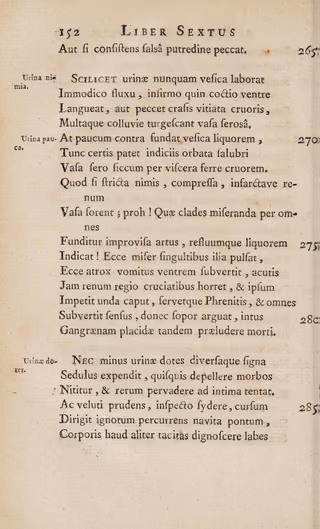
Urinæ dotes. NEC minus urinæ dotes diverſaque ſigna
Sedulus expendit , quiſquis depellere morbos
Nititur , & rerum pervadere ad intima tentat.
Ac veluti prudens , inſpecto ſydere , curſum
Dirigit ignotum percurrens navita pontum ,
Corporis haud aliter tacitas dignoſcere labes
Part 2
More often by the fluid excreted from the kidneys the physician
Attempts to discern, and guides his remedies by a sure sign.
Should that thicker, muddy fluid resemble dregs,
Now by an undoubted sign it is clear that through the vessels the blood,
Thickened, creeps forward gradually with a sluggish flow;
Whether hard foods have thickened the overly unconcocted
Fluids; or whether by swift motion, or excessive heat,
The dry viscera are defrauded of their health-giving juice.
Moreover, fiery urine portends acute diseases
For you, which, shining and inflamed with a reddish color,
Indicates that the body is burning with internal heats.
But on the contrary, urine swelling with serous mucus
Will give signs that a weak stomach breaks down the given foods
With difficult digestion, that the languid viscera with relaxed fibers
Have gradually lost their innate heat,
Or that overly crude lymph distends the veins;
Nor is this enough: for to wretched mortals hope yields
In vain, and a miserable fate remains to be awaited,
If at the same time both muddy and fatty in a copious stream
The urine flows out, foul with an oily film:
And now shortly, loosened by dreadful emaciation, the limbs
Melt away, the body falls, consumed by a languishing decay,
Until consumption at last releases the wretched life.
THENCE you see how much it very often matters to the health
Of the body, that the fluid of the kidneys should always flow
With a just regulation, and its abundance correspond to the drink taken in,
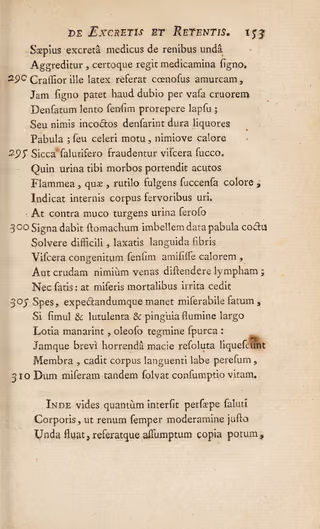
Sæpius excretâ medicus de renibus undâ
Aggreditur , certoque regit medicamina ſigno.
Craſſior ille latex referat cœnoſus amurcam,
Jam ſigno patet haud dubio per vaſa cruorem
Denſatum lento ſenſim prorepere lapſu ;
Seu nimis incoctos denſarint dura liquores
Pabula ; ſeu celeri motu , nimiove calore
Sicca ſalutifero fraudentur viſcera ſucco.
Quin urina tibi morbos portendit acutos
Flammea , quæ , rutilo fulgens ſuccenſa colore ,
Indicat internis corpus fervoribus uri.
At contra muco turgens urina ſeroſo
Signa dabit ſtomachum imbellem data pabula coctu
Solvere difficili , laxatis languida fibris
Viſcera congenitum ſenſim amiſiſſe calorem ,
Aut crudam nimiùm venas diſtendere lympham ;
Nec ſatis : at miſeris mortalibus irrita cedit
Spes, expectandumque manet miſerabile fatum ,
Si ſimul & lutulenta & pinguia flumine largo
Lotia manarint , oleoſo tegmine ſpurca :
Jamque brevì horrendâ macie reſoluta liqueſcunt
Membra , cadit corpus languenti labe pereſum ,
Dum miſeram tandem ſolvat conſumptio vitam.
INDE vides quantùm interſit perſæpe ſaluti
Corporis, ut renum ſemper moderamine juſto
Unda fluat, referatque aſſumptum copia potum,
Part 3
so that the crasis is never faulty, nor the nature of the urine ever faulty through a thick character, but, healthy and well-concocted, it displays the firm health of the viscera and the vigor of the kidneys.
Free of sediment, it is wont to shine with a citron brightness,
or it bears a fleecy cloud with a thin veil,
which, seeking the upper parts of the chamber pot, quickly tapers upward in a cone.
Healthy urine.
Happy is he who, rising in the morning after the repose of a peaceful night,
can pass such urine with moderate effort,
and sees his firm health endure.
He does not feel his belly swollen with the weight of feasts,
heavy from yesterday's gluttony; he properly digests
the food given to him, and rejoices in the constant strength of his stomach.
Then the vessels, beating with a strong wall,
subdue the various humors; then the crasis of the blood is optimal,
and a noble strength flourishes in the sinewy body.
Now the third principal secretion remains to be treated
by me in verse; it must be told in song how much
a good perspiration either ruins or strengthens the powers.
Among the various fluids which flow everywhere through the whole body
from a manifold origin, this one greatly
alters the bodily strength by its diffused stream.
Indeed, the moisture trickling through the countless passages of the skin,
which mortal eyes cannot perceive by sight, Perspiration.
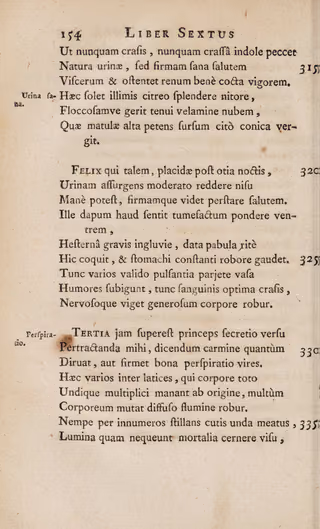
Ut nunquam craſis , nunquam craſſâ indole peccet
Natura urinæ , ſed firmam ſana ſalutem
Viſcerum & oſtentet renum benè cocta vigorem.
Hæc ſolet illimis citreo ſplendere nitore ,
Floccoſamve gerit tenui velamine nubem ,
Quæ matulæ alta petens ſurſum citò conica ver-
git.
FELIX qui talem, placidæ poſt otia noctis ,
Urinam aſſurgens moderato reddere niſu
Manè poteſt, firmamque videt perſtare ſalutem.
Ille dapum haud ſentit tumefactum pondere ven-
trem ,
Heſternâ gravis ingluvie , data pabula ritè
Hic coquit , & ſtomachi conſtanti robore gaudet.
Tunc varios valido pulſantia parjete vaſa
Humores ſubigunt , tunc ſanguinis optima craſis ,
Nervoſoque viget generoſum corpore robur.
TERTIA jam ſupereſt princeps ſecretio verſu
Pertractanda mihi, dicendum carmine quantùm
Diruat, aut firmet bona perſpiratio vires.
Hæc varios inter latices , qui corpore toto
Undique multiplici manant ab origine, multùm
Corporeum mutat diffuſo flumine robur.
Nempe per innumeros ſtillans cutis unda meatus ,
Lumina quam nequeunt mortalia cernere viſu , Perſpiratio.
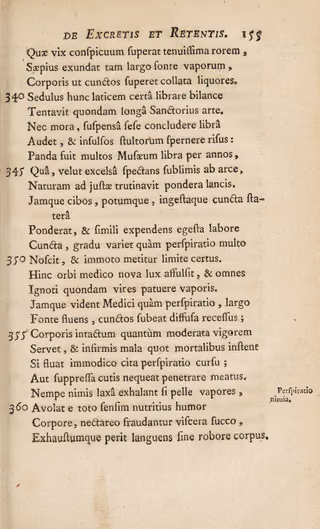
Part 4
Which, most subtle, scarcely surpasses a visible dew,
Often overflows in so abundant a fountain of vapors,
That, when compared, it surpasses all the fluids of the body.
Once the diligent Sanctorius, with long-practiced skill,
Attempted to weigh this fluid in an accurate balance.
Without delay, he dares to enclose himself in a suspended scale,
And to spurn the foolish laughter of fools:
For many years the curved balance was his study,
In which, gazing on high as if from a lofty citadel,
He weighed Nature according to the weights of a just scale.
And now he weighs food, and drink, and all things ingested
On the steelyard, and weighing with similar labor all things
Excreted, he learns by how great a degree perspiration varies,
And, certain, measures it by an unmoved limit.
Hence a new light shone upon the medical world, and all
The powers of the once unknown vapor were laid bare.
And now Physicians see how perspiration, flowing from a copious
Fountain, spreads out and enters all recesses;
How much, when moderate, it preserves intact the vigor of the body,
And how many evils threaten infirm mortals
If swift perspiration flows in an immoderate course;
Or if, suppressed, it cannot penetrate the passages of the skin.
Indeed, if vapors exhale through an overly lax skin,
The nutritive humor gradually flies away from the whole
Body, the viscera are cheated of their nectareous juice,
And the exhausted body perishes, languishing without strength. Excessive perspiration.
Quæ vix conſpicuum ſuperat tenuiſſima rorem ,
Sæpius exundat tam largo fonte vaporum ,
Corporis ut cunctos ſuperet collata liquores.
Sedulus hunc laticem certâ librare bilance
Tentavit quondam longâ Sanctorius arte.
Nec mora , ſuſpensâ ſeſe concludere librâ
Audet , & inſulſos ſtultorum ſpernere riſus :
Panda fuit multos Muſæum libra per annos ,
Quâ , velut excelsâ ſpectans ſublimis ab arce ,
Naturam ad juſtæ trutinavit pondera lancis.
Jamque cibos , potumque , ingeſtaque cuncta ſta-
Ponderat , & ſimili expendens egeſta labore
Cuncta , gradu variet quàm perſpiratio multo
Noſcit , & immoto metitur limite certus.
Hinc orbi medico nova lux affulſit , & omnes
Ignoti quondam vires patuere vaporis.
Jamque vident Medici quàm perſpiratio , largo
Fonte fluens , cunctos ſubeat diffuſa receſſus ;
Corporis intactum quantùm moderata vigorem
Servet , & infirmis mala quot mortalibus inſtent
Si fluat immodico cita perſpiratio curſu ;
Aut ſuppreſſa cutis nequeat penetrare meatus.
Nempe nimis laxâ exhalant ſi pelle vapores ,
Avolat e toto ſenſim nutritius humor
Corpore , nectareo fraudantur viſcera ſucco ,
Exhauſtumque perit languens ſine robore corpus. Perſpiratio nimia.
Part 5
Suppressed perspiration. If, on the contrary, the perspiring stream, its channel constricted,
Is suppressed, or exhales but little in a scant vapor;
A more acrid humor is shut up within the weary
Body, which ought to be driven out through the open pores of the skin,
Corrodes the viscera, and with putrefaction corrupts the various parts
On every side; hence diseases in a numerous troop
Rise up, and a pitiable cohort of evils is born.
And now the vessels, too overwhelmed with putrefying
Filth, overflow, and the obstructed viscera swell with
Infarction of liquid; thus arises scirrhus, thus a cruel Iliad
Of pains, and death creeping forth on a silent path:
Or if by a fortunate effort the seeds of diseases
You, victorious Nature, sometimes drive outside,
Now the skin is rough with scabies and foul prurigo,
And unsightly marks disfigure the misshapen face.
So great a store of evils can it alone bring upon the wretched,
If swift perspiration does not fly off in a constant
Flow, or sticks fast in the constricted pores of the skin.
So many evils the physician attempts to drive away by his auspicious
Art, and, prudently aiding mortal bodies with salutary
Counsel, by just regulation he so governs
The regimen, that perspiration may not pass beyond fixed
Bounds, but, kept moderate, may preserve firm health.
Hence, if it is your intention to preserve strong powers in a healthy
Body, do not agitate your limbs with excessive
Violence, and do not wish to unburden your body of overly warm
Clothing; the skin relaxes the numerous
Perſpiratio ſuppreſſa. Si contra aſtricto perſpirans unda canali
Supprimitur , modicove exhalat pauca vapore ;
Acrior interiùs laſſo concluditur humor
Corpore , per patulos pellis pellendus hiatus ,
Viſcera corrodit , variaſque putredine partes
Undique corrumpit ; numeroſo hinc agmine morbi
Exſurgunt , oriturque cohors miſeranda malorum.
Jamque putreſcenti nimis obruta vaſa redundant
Colluvie , infarctoque tument obſtructa liquore
Viſcera , ſic oritur Skirrus , ſic ſæva dolorum
Ilias , & tacito prorepens tramite funus :
Aut ſi morborum felici ſemina niſu
Tu victrix quandoque foras Natura propellis ,
Jam ſcabie & fædâ pellis prurigine ſquallet ,
Turpiaque informem deturpant ſtigmata vultum.
Tantùm ſola poteſt miſeris inferre malorum ,
Si non aſſiduo cita perſpiratio fluxu
Avolat , aut ſtrictis in pellis hiatibus hæret.
Tot mala felici medicus depellere tentat
Arte , ſalutiferoque juvans mortalia prudens
Corpora conſilio , juſto moderamine victum
Sic regit , ut certos non perſpiratio fines
Tranſeat , at firmam ſervet moderata ſalutem.
Inde tibi validas ſano ſi corpore vires
Servare eſt animus , nimio non impete membra
Exagites , calidoque nimis non corpus amictu
Exonerare velis ; pellis numeroſa relaxat
Part 6
pores, and can summon sweat,
which a sad languor follows in the wearied body.
Behold the girls dancing with studied art,
how with swift movement they lift themselves into the air,
how they beat the ground with agile foot, how shines the ardent
vigor of their limbs, and strength in their youthful bodies!
But soon from the relaxed fibers abundant sweat flows
on all sides, and weakens their vigor with its trickling dew:
the girls who previously bloomed with glowing faces
display a bloodless color on their pale brows,
their languid eyes grow dull with a sickly gaze,
and their exhausted limbs are scarcely dragged along with painful movement;
while, on the contrary, a gentle sweat trickling from the warmed skin
refreshes the strength and restores vigor.
NOR do fur garments less enervate the body and relax
the fibers,
and the various arts unknown to our ancestors,
by which the slothful age of their descendants now
attempts to drive away the cold with regal luxury.
How could our bodies exhale their fluids in a moderate
flow, while the limbs are kept warm
with fleeces, and long burn by vast furnaces?
Yet I would not wish you to expose a bared chest to the freezing
North Wind, or, having cast off your clothing, rashly
offer yourself naked to the wintry blasts, which
Oſcula, ſudoremque poteſt accerſere motus,
Quem triſtis ſequitur defeſſo corpore languor.
Aſpice compoſitâ ſaltantes arte puellas,
Quàm celeri ſeſe tollunt ſuper aera motu,
Quàm pulſant agili terram pede, quàm micat ar-
dens
Membrorum vigor, & juvenili corpore robur!
At modò laxatis largus fluit undique fibris
Sudor, & infringit ſtillanti rore vigorem:
Quæ priùs ignito florebant ore puellæ
Exanguem referunt pallenti fronte colorem,
Languida torpeſcunt morboſo lumina viſu,
Et motu defeſſa ægro vix membra trahuntur;
Dum contra recreat vires, redditque vigorem
Pacatus ſtillans tepefactâ de cute ſudor.
NEC minùs enervant corpus, fibraſque rela-
xant
Pelliceæ veſtes, variæque parentibus artes
Ignotæ, queis nunc ætas ignava nepotum
Frigora regali tentat propellere luxu.
Corpora quî poſſent moderato noſtra liquores
Exhalare ſuos fluxu, dum membra foventur
Velleribus, vaſtiſque diù fornacibus ardent?
Te tamen algenti nudatum exponere pectus
Non vellem Boreæ, aut poſito velamine nudum
Incautè hybernis offerre aquilonibus, omne
Part 7
Which with sudden cold could constrict the entire body,
And check too much the fluids that ought to be driven outward.
Yet our improvident age knows not how to keep the mean,
And while the parents glow too much with the heat of the hearth,
The naked boy often courts the wintry colds:
Such great madness has seized the Parisian race!
You, who are master of your mind, whose innermost thoughts
The love of novelty has not disturbed, who do not without rule,
As a rival, sedulously pursue the arts of the English,
Hold this in mind, NOTHING IN EXCESS, for all
Extremes harm the earth-born, and can pervert the course
Of the healthful flow through the little tubes of the skin.
But if you rule a peaceful life with just moderation
In such a way that the belly with easy effort digests the food
Given to it, that the limbs flourish with moderate labor,
And diverse passions do not disturb the mind too much,
A due perspiration will flow well in a gentle course,
And the body will easily exhale its harmful dregs.
Other excretions. WHY should I mention the other excrements that flow
From the whole body by a manifold path, or the thin saliva,
Or the thick serum which the nostrils pour forth from a
Many-chambered fountain, or the tears which sad eyes in ample
Streams distill with a groan, and the yellow earwax
Frigore qui ſubito poſſent conſtringere corpus,
Pellendoſque foras nimiùm cohibere liquores.
At ſervare modum ætas noſtra improvida neſcit,
Dumque foci nimiùm fervent ardore parentes,
Nudus ſæpe puer brumalia frigora captat:
Tanta Pariſiacam cepit dementia gentem!
Tu compos animi, cui non penetralia mentis
Turbavit novitatis amor, qui non ſine normâ
Æmulus Anglorum ſectaris ſedulus artes,
Hoc teneas animo, NE QUID NIMIS, omnia nam-
que
Terrigenis extrema nocent, fluxûſque ſalubris
Per tubulos pellis poſſunt pervertere curſum.
Quod ſi pacatam juſto moderamine vitam
Sic regis, ut facili venter data pabula niſu
Concoquat, ut vigeant moderato membra labore,
Nec nimiùm turbent diverſa pathemata mentem,
Juſta fluet placido benè perſpiratio curſu,
Et facilè corpus nocuam exhalabit amurcam.
Alia excreta. CÆTERA quid referam, quæ toto e corpore ma-
nant
Multiplici excrementa viâ, tenuemve ſalivam,
Aut quod multicavo nares e fonte profundunt
Pingue ſerum, aut lacrymas amplis quas triſtia ri-
vis
Lumina cum gemitu ſtillant, flavumque cerumen
Part 8
with which diligent Nature has anointed the open ears,
and the sebum bedewing the skin with a viscous glue;
which, if secreted in an excessive flood, thin out
the body, and dry up the viscera by their ample flow,
while if suppressed they can bring on grave diseases.
Yet if sometimes these liquids from a copious fountain
flow headlong out of various viscera, prudently
you should never check the torrent with a strong medicine.
Often by a salutary effort Nature attempts
to relieve the viscera oppressed by overly thickened juices,
and by a crisis to forestall present diseases.
A follower of nature and a faithful servant, the physician
should never attempt to disturb her work, but for her
it is enough to lend aid with a helping hand.
Nor do the sick encounter fearful dangers, if blood
should flow, or liquids stream from an ample fountain.
Only the weakness of the patient, with strength relaxed, remains
to be feared, gradually to be removed with easy effort;
while on the contrary, humors retained by a deceitful art
very often corrupt the viscera languishing with a heavy taint,
and destroy the body with a slow death.
NOW long enough have we followed the austere Muses through the pathless places
of Pindus in a difficult song, and traversed the gloomy recesses,
seeking sweet remedies for wretched matters:
behold, before my eyes, ever more beautiful, of her own accord
she presents herself, and captivated by her form and pleasing charm, Venus.
Sedula quo patulas aures Natura perunxit,
Irroranſque cutem viſcoſo glutine ſebum;
Quæ nimio ſecernuntur ſi gurgite, corpus
Extenuant, amploque exſiccant viſcera fluxu,
Dum ſuppreſſa graves poſſunt accerſere morbos.
Hi quandoque tamen largo ſi fonte liquores
Præcipites vario manant e viſcere, prudens
Torrentem valido nunquam medicamine ſiſtas.
Sæpe ſalutari tentat Natura labore
Spiſſatis nimium ſuccis oppreſſa levare
Viſcera, præſenteſque criſi prævertere morbos.
Aſſecla naturæ medicus, fiduſque miniſter
Hujus opus nunquam tentet turbare, ſed ipſi
Auxiliatrici ſatis eſt ſuccurrere dextrâ.
Nec metuenda adeunt ægri diſcrimina, ſanguis
Si fluat, aut amplo dimanent fonte liquores.
Sola timenda manet, reſolutis viribus, ægri
Debilitas, facili ſenſim tollenda labore;
Dum contra perſæpe gravi languentia labe
Viſcera corrumpunt, & lento funere corpus
Conficiunt fallaci humores arte retenti.
JAM ſatis auſteras Pindi per devia Muſas
Carmine difficili ſequimur, triſteſque receſſus
Luſtramus, miſeris quærentes dulcia rebus
Subſidia: ecce mihi ante oculos ſe pulchrior ultro
Objicit, & formâ captûm gratoque lepore Venus.
Part 9
leads into the hidden sanctuaries of nature.
I follow you, nourishing mother; you who for sickly mortals
prepare joy, and true triumphs without slaughter;
who renew races collapsed in cruel death
with sacred fire, and kindling hearts with pure flames.
You, progenitrix, you gentle mother, sole hope of faltering
nature, divine Venus, by whose supreme divinity
all bodies worn down by sad old age are reborn,
and unstable Nature always endures;
you, who rule all living creatures by a pleasant law,
and, powerful Queen, give laws throughout the whole world;
you alone can soothe rabid Tigers, you alone can
submit the fierce necks of Lions to a docile rein,
behold, they stand by your sacred feet, and trembling lick them:
the Birds venerate you as mistress, the monsters through the
sea
have recognized you beneath the icy wave by your untamed fires;
but while you execute the gentle commands of nature,
and while mothers worship your divinity with pure incense,
indignant you flee those who dare to bring you impious gifts,
inflamed with promiscuous lust,
and to profane your altars with lascivious worship;
those alone, modest Venus, with true sweetness
you soothe, who in purity pursue chaste loves.
Abdita naturæ Venus in penetralia ducit.
Te ſequor, alma parens; tu quæ mortalibus ægris
Lætitiam, veroſque paras ſine clade triumphos;
Quæ renovas ſævo collapſas funere gentes
Igne ſacro, & puris accendens pectora flammis.
Tu genitrix, tu blanda parens, ſpes una labantis,
Diva Venus, naturæ, cujus numine ſummo
Cuncta renaſcuntur triſti detrita ſenectâ
Corpora, & inſtabilis ſemper Natura perennat;
Tu, quæ cuncta regis jucundâ animantia lege,
Et totum, Regina potens, das jura per orbem;
Tu rabidos lenire Tigres, tu colla Leonum
Effera ſola potes docili ſubmittere fræno,
En ſacris aſtant pedibus, lambuntque trementes:
Te dominam venerantur Aves, te monſtra per
æquor
Ignibus indomitis gelidâ agnovere ſub undâ;
At tu naturæ dum mollia juſſa capeſſis,
Dumque colunt matres puro tua numina thure,
Illos indignata fugis tibi qui impia dona
Audent vulgivagâ incenſi tentigine ferre,
Et tua laſcivo temerare altaria cultu;
Hos tantùm, pudibunda Venus, dulcedine verâ
Mulces, qui caſtos puri ſectantur amores.