Hover or tap a word to see its match.
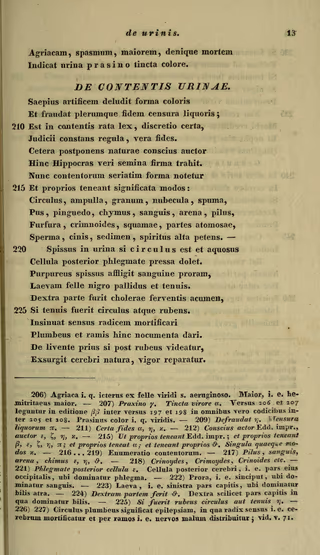
Very often the appearance of color deceives the practitioner,
And the assessment of the liquor mostly cheats trust;
In the contents there is an established law, a certain distinction,
A constant rule of judgment, a true faith.
Setting the rest aside, the author conscious of nature,
Hippocrates, draws from here the firm seeds of truth.
Now let the form of the contents be noted in order
And let the signs hold their proper modes:
Circle, bubble, grain, little cloud, foam,
Pus, fat, chymus, blood, sand, hair,
Bran, crimnoides, scales, atomous parts,
Sperm, ash, sediment, spirit seeking the heights. —
If the *circle* in the urine is thick and watery
The posterior cell, pressed by phlegm, aches.
A thick purple one afflicts the prow with blood,
A pale and thin one the left side with black gall.
On the right side rages the sharpness of boiling choler,
If the circle is thin and red.
It implies that the root of sense is mortified
A leaden one, and from here harms are given to the branches.
If after a previously livid one a red one is seen,
The nature of the brain rises up, vigor is restored.
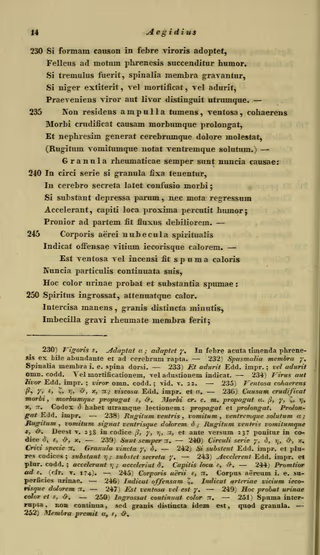
If it adopts the form of greenness in a *causon* fever,
The bilious humor is kindled to the movement of *phrenesis*.
If it is trembling, the spinal members are weighed down,
If it appears black, it either mortifies or burns,
Preceding greenness or lividness distinguishes the two. —
A non-settling, swelling, windy, cohesive *bubble*
Makes the cause of the disease crude and prolongs the disease,
And generates *nephresis* and troubles the brain with pain,
(It denotes rumbling and vomiting and a loose belly.) —
*Granules* are always the messengers of a rheumatic cause:
If granules are held fixed in the series of a circle,
A secret confusion of disease lies hidden in the brain;
If they remain slightly depressed, and, when moved, do not
Accelerate their return, the humor strikes the places nearest to the head;
The flux becomes more prone to the weaker part. —
A spiritual *cloudlet* of the airy body
Indicates the defect of an injury and the heat of the liver. —
A *foam* is windy or becomes of kindled heat
The messenger, continued in its own particles,
The color of the urine and the substance of the foam prove this:
Spirit thickens, and heat thins.
Remaining broken up, distinguished by minute grains,
It strikes the weak members with heavy rheum;
It indicates an icteric person or portends that the liver is being burned
If it is black or green or as if dyed with saffron. —
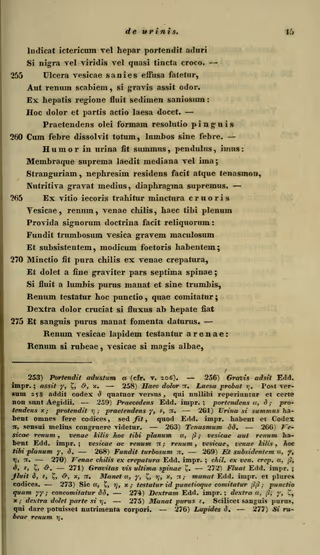
Pus poured out reveals ulcers of the bladder,
Or scabies of the kidneys, if a heavy smell is present.
From the region of the liver flows purulent sediment:
Pain and the impaired action of the part teach this. —
Presenting the form of oil, a *fatty* resolution
With fever dissolves the whole [body], the loins without fever. —
*Humor* in the urine becomes highest, suspended, lowest:
And it harms the highest, middle, or lowest members;
Settling, it causes strangury, nephritis, and tenesmus,
The middle burdens the nutritive organs, the highest the diaphragm. —
From a defect of the liver is drawn a urination of blood
Of the bladder, of the kidneys, of the vena cava; this provident doctrine
Of the remaining signs makes [it] full for you:
The bladder pours it out full of clots, heavy, spotted
And subsiding, having a little foul smell;
Urination becomes pure from a rupture of the vena cava,
And the seventh part of the spine from the end hurts heavily;
If it flows from the loins it emanates pure and without clots,
A pricking of the kidneys, which accompanies it, testifies to this;
Pain torments on the right if the flow occurs from the liver
And pure blood emanates, which was to give nourishment. —
*Sands* testify to a stone of the kidneys [or] of the bladder:
Of the kidneys if they are red, of the bladder if they are rather white,
The shape of the contained becomes a rival to its container. —
A shape similar to a *hair* will either be a shedding of flesh,
Or a part of humor dried by the file of heat,
Thence you may prove harm to the kidneys or to the whole. —
Through thin *scales* and voided *bran* is noted
Scabies of the bladder, or if fever accompanies
The integrity of the whole flows away, the body is thinned. —
Certain faith through *crimnoides*, that the third fever
Is a species of ethic inserted in the lowest recesses. —
Gout is indicated to reign through *small white particles*;
If it is a woman, neither of the two will be lacking to you,
But that either conception is present or an inept languor.
A dry matrix, sleeping venus, retention of the flux,
Discolored state, vomiting, compression of the rod,
Thickness of the breasts and disturbance of the belly
From hydromel, are proven signs of conception.
The splendor of the face insinuates the conception of a male,
Smoothness of the limbs, concretion of thick milk
And a round swelling of the belly on the right side,
Contrary signs figure the female sex. —
Urine inscribed with *spermatic* marks confesses
The enticements of coitus, that the genital members are weighed down
By the ferment of venus, vain mockeries of sleep
Or gonorrhoea or the resolved force of the member.
Little bodies pressed downwards under the form of ash
indicate that the lowest members are burdened by the weakness of disease,
they appear more often from the swelling of an *attrix*, of a hemorrhoid, and of the spleen,
or when the menstrual humor
does not know its outlets at determined times.
Color and substance, time,
shape, and place characterize the *sediment*: The color is white; the substance
is made continuous by its *gumphi*; its shape figures a cone;
the lower bottom is the place; constancy the time:
If the sediment becomes white, continuous, settling, constant, and pine-cone shaped,
digestion becomes good, virtue
is strong, the action of nature thrives by a threefold movement:
It whitens, cleanses, accumulates, condenses, and unites,
heat thins out the windiness, and absorbs the vapor,
virtue retains what is good, what is bad it repels,
nor does nature cut or interrupt her acts:
By these signs the certain showing of health is clear,
the fever becomes *eucrita*, brief is the resolution of the disease. —
Any movement discordant with the former ones and varying, making distinctions,
harms and makes the sediment raw:
If, the rest being preserved, it should hang or seek the height
by a windy breath, digestion is proven impaired;
the right of place being safe, the law of color being preserved,
a windy force moves the sediment, its structure being loosed.
Because the somewhat red consists of watery blood
it is worse than the red, although closer to the white;
the red designates that the *eucrita* fever will be long,
Since the son of nature, humor, is the cause of the disease,
Light and concocted, resolvable and moderate. —
A sediment of a black sort ruins the work of nature
And more deeply overturns the peak of its vigor;
That which holds the top or the middle is less faulty,
Yet this one offends in more ways, that one in one:
A black cloud sins more in number, but not for that reason more [severely],
A black sediment sins more [severely], but not more in number,
The violence of the cause compensates for the lack of number,
And bad circumstance aggravates and compounds the fault. —
Saepius artificem deludit forma coloris
Et fraudat plerumque fidem censura liquoris;
Est in contentis rata lex, discretio certa,
Judicii constans regula, vera fides.
Cetera postponens naturae conscius auctor
Hinc Hippocras veri semina firma trahit.
Nunc contentorum seriatim forma notetur
Et proprios teneant significata modos:
Circulus, ampulla, granum, nubecula, spuma,
Pus, pinguedo, chymus, sanguis, arena, pilus,
Furfura, crimnoides, squamae, partes atomosae,
Sperma, cinis, sedimen, spiritus alta petens. —
Spissus in urina si *circulus* est et aquosus
Cellula posterior phlegmate pressa dolet.
Purpureus spissus affligit sanguine proram,
Laevam felle nigro pallidus et tenuis.
Dextra parte furit cholerae ferventis acumen,
Si tenuis fuerit circulus atque rubens.
Insinuat sensus radicem mortificari
Plumbeus et ramis hinc nocumenta dari.
De livente prius si post rubeus videatur,
Exsurgit cerebri natura, vigor reparatur.
Si formam causon in febre viroris adoptet,
Felleus ad motum phrenesis succenditur humor.
Si tremulus fuerit, spinalia membra gravantur,
Si niger extiterit, vel mortificat, vel adurit,
Praeveniens viror aut livor distinguit utrumque. —
Non residens *ampulla* tumens, ventosa, cohaerens
Morbi crudificat causam morbumque prolongat,
Et nephresim generat cerebrumque dolore molestat,
(Rugitum vomitumque notat ventremque solutum.) —
*Granula* rheumaticae semper sunt nuncia causae:
In circi serie si granula fixa tenentur,
In cerebro secreta latet confusio morbi;
Si substant depressa parum, nec mota regressum
Accelerant, capiti loca proxima percutit humor;
Pronior ad partem fit fluxus debiliorem. —
Corporis aërei *nubecula* spiritualis
Indicat offensae vitium iecorisque calorem. —
Est ventosa vel incensi fit *spuma* caloris
Nuncia particulis continuata suis,
Hoc color urinae probat et substantia spumae:
Spiritus ingrossat, attenuatque calor.
Intercisa manens, granis distincta minutis,
Imbecilla gravi rheumate membra ferit;
Indicat ictericum vel hepar portendit aduri
Si nigra vel viridis vel quasi tincta croco. —
Ulcera vesicae sanies effusa fatetur,
Aut renum scabiem, si gravis assit odor.
Ex hepatis regione fluit sedimen saniosum:
Hoc dolor et partis actio laesa docet. —
Praetendens olei formam resolutio *pinguis*
Cum febre dissolvit totum, lumbos sine febre. —
*Humor* in urina fit summus, pendulus, imus:
Membraque suprema laedit mediana vel ima;
Stranguriam, nephresim residens facit atque tenasmon,
Nutritiva gravat medius, diaphragma supremus. —
Ex vitio iecoris trahitur minctura cruoris
Vesicae, renum, venae chilis, haec tibi plenum
Provida signorum doctrina facit reliquorum:
Fundit trumbosum vesica gravem maculosum
Et subsistentem, modicum foetoris habentem;
Minctio fit pura chilis ex venae crepatura,
Et dolet a fine graviter pars septima spinae;
Si fluit a lumbis purus manat et sine trumbis,
Renum testatur hoc punctio, quae comitatur;
Dextra dolor cruciat si fluxus ab hepate fiat
Et sanguis purus manat fomenta daturus. —
Renum vesicae lapidem testantur *arenae*:
Renum si rubeae, vesicae si magis albae,
Aemula contenti fit forma suo retinenti. —
Forma *pilo* similis vel erit decisio carnis,
Aut pars humoris lima siccata caloris,
Inde probes renum vel totius nocumentum. —
Per *squamas* tenues et *furfura* mincta notatur
Vesicae scabies, aut si febris comitatur
Totius fluit integritas, corpus tenuatur. —
Certa fides per *crimnoides*, quod tertia febris
Est ethicae species imis inserta latebris. —
Innuitur gutta regnare per *alba minuta*;
Si mulier fuerit, non alterutrum tibi deerit,
Quin vel conceptus assit vel languor ineptus.
Matrix sicca, venus sopita, retentio fluxus,
Discolor affectus, vomitus, compressio virgae,
Mammae grossities et perturbatio ventris
Ex mellicrato, conceptus signa probantur.
Conceptum maris insinuat splendor faciei,
Membrorum laevitas, spissi concretio lactis
Atque tumor ventris in dextra parte rotundus,
Foemineum sexum contraria signa figurant. —
*Spermaticis* inscripta notis urina fatetur
Illecebras coitus, genitalia membra gravari
Fermento veneris, ludibria vana soporis
Sive gonorrhoeam vel membri vim resolutam.
Sub forma cineris corpuscula pressa deorsum
Infima membra notant morbi languore gravari,
Ex attricis haemorrhoidis splenisque tumore
Saepius apparent, vel quando menstruus humor
Temporibus certis sua respiracula nescit.
Informat *sedimen* color et substantia, tempus,
Forma, locus: Color est albus; substantia gumphis
Continuata suis; conum sua forma figurat;
Inferior fundus locus est; constantia tempus:
Album, continuum, residens, constans, pineatum
Si sedimen fiat, bona fit digestio, virtus
Fortis, naturae triplici viget actio motu:
Albificat, mundat, cumulat, condensat et unit,
Ventosum calor extenuat, sorbetque vaporem,
Virtus, quae bona sunt, retinet, quae prava repellit,
Nec natura suos secat aut interpolat actus:
His claret signis ostensio certa salutis,
Eucrita fit febris, brevis est discussio morbi. —
Laedit et incrudat sedimen quicunque priorum
Dissonus et varius faciens discrimina motus:
Servatis reliquis si pendeat aut petat altum
Flamine ventoso, digestio laesa probatur;
Salvo iure loci servata lege coloris
Vis ventosa movet sedimen compage soluta.
Subrubeum quoniam de sanguine constat aquoso
Est peius rubeo, quamvis vicinius albo;
Designat rubeum, quod longa sit eucrita febris,
Cum sit causa mali naturae filius humor
Levis et excoctus resolubilis et moderatus. —
Naturae funestat opus culmenque vigoris
Altius evertit sedimen nigrae speciei;
Quod summum tenet aut medium minus est vitiosum,
Hoc tamen offendit in pluribus, illud in uno:
Plus numero peccat nephelis nigra, non ideo plus,
Plus peccat sedimen nigrum, sed non numero plus,
Defectum numeri causae violentia pensat,
Aggravat et cumulat mala circumstantia culpam. —