Hover or tap a word to see its match.
*Psylliticum* fights against choler in the first contest,
It strikes salty phlegm with the second blow:
Finally, in the encounter it conquers adust choler.
It storms the forces of choler with the javelin of scammony,
Which an equal kinship of form draws to the choler,
A similar union of nature, a sisterly power.
Since the knot of friendship, a formal bond, preserves
Unharmed things firm under stable strength,
Why does scammony put choler to flight, why does an unjust enemy
Pursue what is similar to itself, which crasis,
And a similar taste, and an agreeing substance had together allied to it?
A torch is the food of fire, oil is the spur and stimulus
Of a lamp, the drinking of wine is the nourisher of fever,
Inebriation the kindling of luxury; bilious matter grows
From pungent feasts, blood from sweetness,
The humor of phlegm overflows from insipid things;
The wave of wandering Tethys, spread out in a capacious bosom,
Collects the coming rivers in a placid embrace:
The rule of nature, which wanders through other things by a common law,
And suffers no pebble, but guides its chariot on a level path,
Fails, discolored, in the case of bile,
Which scammony—indignant that a thing similar to itself should be shut up
Together with it in the same prison like a rebel—
Destroys, and cruel and inhospitable, drives out its companion.
This reasoning does not hold, and, not resting on a firm course,
The false opinion limps with an uncertain step:
It does not follow, because a thing is harmonious with another, that it
Owes to it the favor of augmentation, as if bound by an oath.
A greater grace obtains the advance of augmentation,
A fuller assent, a union of nature implanted from many forms,
And the power of converting;
A single form does not plead that a transition be made.
For metamorphosis, the daughter of the changing power,
Transforms the species of things, proceeding by a threefold
Order of motion: for when harmonious matter is laid beneath it
With a concordant peace of favor,
Flattering its artificer, whom a harmonious line of nature
Joins and assimilates to the materialized thing:
The power, transformed by so great a love of the serving matter,
Prolongs its act no further:
It seeks no further truces; already it applies itself to it,
Conquered by its compliance, and now it refines it,
Moves it and transposes the middle parts to the lowest,
Draws the depressed parts to the middle, elevates the middle ones,
Treads the highest parts into the middle ones, the lateral ones into the highest:
It exterminates and banishes the unstable and overly wandering forms,
And the foreign handmaidens of nature.
With substantive forms there is a great struggle
And a difficult wrestling; these, more strongly attached
To general nature and joined by a friendly pact,
With the body of the subject and the character of its right intact,
The converting power cannot entirely subvert.
For thus the being of a thing amicably conspires with its form
And thus its form is wedded to the subject:
Such a great connection of a relative knot binds these,
Which, when established, establish themselves, and when destroyed, remove themselves;
Each depends upon the other, flourishes, and subsists;
Which brings about the being of a thing, which confirms the thing and
Establishes the species itself; when the form leaves its subject,
The substance, passing out of existence, suffers its corruptible fall
And sprouts forth again with another origin.
Which, although clothed from its first origin with many
Inner garments of forms, and wedded to its own proper form,
And endowed with a necklace as a sign of chastity,
Nature compelling, ungirt with a loosened bosom,
Seeks other embraces, seeks new kisses,
Prostitutes itself and joins itself as an adulteress to an external form,
And unfaithful to the marriage bed, with the first spouse despised,
Stripped bare, marries a new husband as a new bride.
Such espousals multiply the powers of cholera,
When a similar food or drink, or the nearest humor,
When it generates the form of cholera by the power of heat.
*Scamonea* cannot do this, since it claims the function
Of medicine alone, to which no harmony of a material knot
Binds a humor or a member.
The power of rhubarb, the seeds of fumitory,
A small root of oak, covered with small beds,
Mimicking the shape of a fern, arm *Psylliticum*:
With these arms, the potent medicine pursues the cholera
With salty phlegm, which burning heat has blackened
And compelled to mimic the form of an Ethiopian.
In fevers, which leap forth from cholera or salty phlegm,
It will be able to provide a celebrated remedy,
In which there are truces, in which a breeze intermixed with storms
Is pleasing, in which a sweet calm among the clouds
Alternates through various turns, in which an hour of rest
Pleasant, though interrupted, it succeeds heavy labor,
and compensates for the penalty of the affliction and redeems the pain:
To simple tertians, and those which doubled matter has created,
it imparts aid and ministers a cure:
But beware, lest a languishing thinness, destitute of humor,
press bones against the skin, lest old age, the herald of death,
plough the body with wrinkles, lest a small and languid strength,
orphaned of spirits, labor like a beggar,
lest heat burn the liver, lest cold freeze the body,
and lest the burning heat of the weather stir up excessive fires.
If the strength is stable, the constitution fuller, the age
sound and complete with a firm tenor of powers:
If the weather corresponds to the rest in a certain order
and the liver remains healthy, a suitable purgation for the said causes
will be accomplished by the Psyllitic medicine,
which no other anxiety of suspected evil stirs, no
unreliable anxiety of a future event shakes. —
Synochus shuns Psylliticum, and causon profanes it:
The continuous tertian abhors its approach,
which unceasing labor and the continuation of the penalty
deny to be a tertian, but a sharper attack and the fiercer anger of heat,
which the third day stirs and repeats and brings back around,
prove to be a tertian.
Psylliticum draws its movement of rancor, its anger of sharpness
from the addition of sharp and harsh scammony.
If the overly daring license of a physician, deviating from right
judgment, grants this use to a wretched patient,
whom an acute disease born of cholera torments,
it sharpens the disease, it feeds the feverish burning heats,
And it further kindles the vessels widely kindled by febrile heat
and adds fire to fires
and disturbs critical movements from their certain order.
The location of the humor, not its form, causes this, because to the form
of the humor of choler the virtue of scammony corresponds:
But the place rejects and detests this same [virtue],
the region of the vessels boiling with the putrefaction of choler.
When bilious force rages in the veins and alone pours in
the matter of the disease, and no humor of phlegm
meets it from outside to bridle the sharpness of the choler,
the course of the disease becomes shorter, the onslaught of burning
ascends on high, the fierce force of sharp heat
suddenly brings in the cause of a suspected crisis:
Whence nature demands a medicine to be given to herself,
which drives out not the matter but only the sharpness,
which helps and restores, and cools that very burning,
which lubricates and loosens with mild control the belly
bound by the burning heat of the febrile dyscrasia.
A minor hemitritaeus, which the turbid cold of winter,
and a kindred region similar to winter delays,
and forces to grow sluggish with the torpor of a slow crasis,
lest it scatter the wealth of its host, lest the prodigal guest
squander the goods of nature, lest a slower enemy
enervate the vigor of the body with slow warfare—
nature, having struggled long, exhausted by long labor,
with many attempts previously carried out in vain,
must on the eighteenth day be helped
by a psyllitic medicine, lest she fail.
For choler, if there is time, and the abundant matter of the disease
and its digestion should be evident by their signs,
a soothing and mild light decoction is to be given,
suitable to the nature of the disease, from which once or twice
on the eighteenth day a purgation may be made;
Which if by chance its movements, with nothing previously accomplished
Should the troublesome fever, having been calmed by good things, return,
And threaten new battle lines and second wars:
To *Psylliticum*, so that it may complete the cure with a successful act,
Let the dispute of the old complaint be entrusted to be decided,
And let it settle the case and reform the lost rights.
Although perplexing due to the peril of a doubtful outcome,
This custom of healing with celebrated rite, the provident
Land of Salerno cultivates and worthily venerates,
A city sacred to Phoebus, zealous nurse of Minerva,
Fount of physics, champion of good constitution, cultivator of medicine,
Attendant of nature, bridesmaid of life, of health
Matron of honor, a more faithful sister to Lachesis, an enemy to Atropos,
Destruction of disease, heavy adversary of death:
Which, because it waged a perpetual duel with death,
And cannot lead a sluggish life without war,
So that it might claim for itself the material for contest and labor
And rest in no torpor of peace:
It sits in a death-bearing region under the warming sun,
Lofty and near to heaven with star-bearing cliffs,
Which doubtless climb the aether with a bold ridge:
It wards off and excludes the breathings of the cold wind,
Constrained by its site: hanging from the sloping hill
It leans over the sea, which grazes its walls
And leaps against its projecting houses with playing waves.
Shielded behind by towering mountains, vapors
And thick fogs and only the south wind it drinks in,
And it gathers the foul contagions of the corrupted sky:
But of medicines, which the mountainous places supply to it,
The city thrives armed with darts: powerfully with death
It struggles: it extirpates diseases and blunts the fates:
It relieves nature, and reties the broken threads:
It presses the kingdoms of death, with which, although
It cannot come to terms, it seeks truces and prolongs life,
And those it does not remove, it delays as future perils.
Which if it were not so fruitful and thrived with such great
Counsels, if the Delphic spirit of the physical art
Did not inspire it, swallowed up by the whirlpool of death
And unable to boil its course, it would perish pitiably.
But an enemy fighting well makes you fight well,
Greater skill prevails in adverse circumstances,
Endurance of a miserable fate compels the seed
Of genius to grow, poverty fertilizes the senses,
Nor does disturbance of the mind allow its strength to languish;
The more it is afflicted and burdened by the army of diseases,
And is drawn by various blows, the more bravely it resists
And devises strong arts of fighting,
And pierces diseases with sharp *Psylliticum*.
O if only it thrived as much in arms as in virtue,
As much as it excels in the art of healing, so in fighting:
It would not be able to tremble at the barbarity of Teutonic
Fury: it would fear neither swords nor wars.
Divisives having been given beforehand, which the humor demands,
If a potion of *Psylliticum* is given in the springtime,
It preserves bodies healthy from future disease,
Which dominating cholera might arrange, the accustomed humor
Of phlegm having endured the fellowship of hostile cholera:
If by chance it wishes to purge remote parts,
Under a solid form, which the confection provides it,
If a light indignation of the belly should provoke vomiting,
So that sleep may approach, you should administer it in the middle of the night:
If the stomach is heavy toward vomiting, if through the medicine
It is expedient that the places bordering the belly be purged,
Lest its power perish, excluded by the peace of sleep,
It must be administered in the morning dissolved in a tepid liquid. —
The rule of reason forbids giving *Psylliticum* with cold
A rule, which the more solemn custom of the ancients celebrates;
This public opinion holds a solemn course,
That no medicine ought to be given with cold water,
Which the harsh force of fierce scammony sharpens:
For while the ascetic power of cold water entangles the scammony
In the villi of the stomach and prevents it from being dissolved,
It generates tortures, fevers, and excessive pains
And makes the intestines bloody with the flux of dysentery.
If the bilious humor, with the mouth of its cyst closed,
Should seethe, deforming the limbs with a jaundiced color:
If a tertian should be kindled, or if there should dominate
The fiery force of excessive cholera without fever:
If the blood should adopt the force of bile through the heat of the liver,
It is established that *Psylliticum* confers friendly help. —
Until the sun has twice traversed the zodiacal circle,
*Psylliticum* is able to preserve its vigor unimpaired.
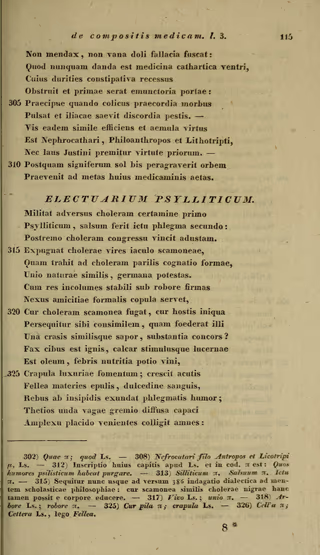
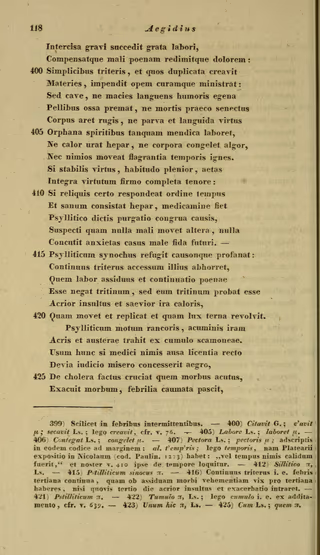
Militat adversus choleram certamine primo
Psylliticum, salsum ferit ictu phlegma secundo:
Postremo choleram congressu vincit adustam.
Expugnat cholerae vires iaculo scamoneae,
Quam trahit ad choleram parilis cognatio formae,
Unio naturae similis, germana potestas.
Cum res incolumes stabili sub robore firmas
Nexus amicitiae formalis copula servet,
Cur choleram scamonea fugat, cur hostis iniqua
Persequitur sibi consimilem, quam foederat illi
Unà crasis similisque sapor, substantia concors?
Fax cibus est ignis, calcar stimulusque lucernae
Est oleum, febris nutritia potio vini,
Crapula luxuriae fomentum; crescit acutis
Fellea materies epulis, dulcedine sanguis,
Rebus ab insipidis exundat phlegmatis humor;
Thetios unda vagae gremio diffusa capaci
Amplexu placido venientes colligit amnes:
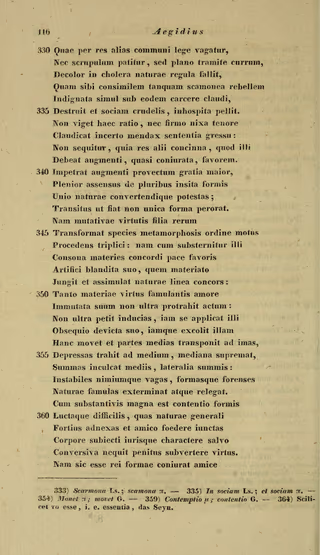
Quae per res alias communi lege vagatur,
Nec scrupulum patitur, sed plano tramite currum,
Decolor in cholera naturae regula fallit,
Quam sibi consimilem tanquam scamonea rebellem
Indignata simul sub eodem carcere claudi,
Destruit et sociam crudelis, inhospita pellit.
Non viget haec ratio, nec firmo nixa tenore
Claudicat incerto mendax sententia gressu:
Non sequitur, quia res alii concinna, quod illi
Debeat augmenti, quasi coniurata, favorem.
Impetrat augmenti provectum gratia maior,
Plenior assensus de pluribus insita formis
Unio naturae convertendique potestas;
Transitus ut fiat non unica forma perorat.
Nam mutativae virtutis filia rerum
Transformat species metamorphosis ordine motus
Procedens triplici: nam cum substernitur illi
Consona materies concordi pace favoris
Artifici blandita suo, quem materiato
Jungit et assimulat naturae linea concors:
Tanto materiae virtus famulantis amore
Immutata suum non ultra protrahit actum:
Non ultra petit inducias, iam se applicat illi
Obsequio devicta suo, iamque excolit illam
Hanc movet et partes medias transponit ad imas,
Depressas trahit ad medium, mediana supremat,
Summas inculcat mediis, lateralia summis:
Instabiles nimiumque vagas, formasque forenses
Naturae famulas exterminat atque relegat.
Cum substantivis magna est contentio formis
Luctaque difficilis, quas naturae generali
Fortius adnexas et amico foedere iunctas
Corpore subiecti iurisque charactere salvo
Conversiva nequit penitus subvertere virtus.
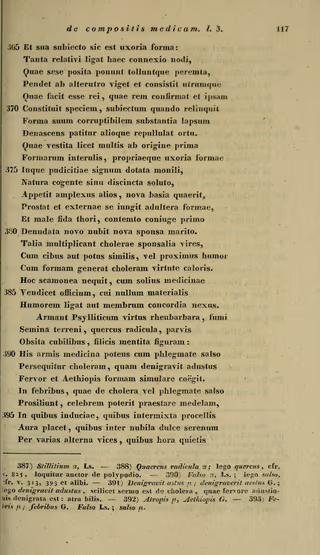
Nam sic esse rei formae coniurat amice
Et sua subiecto sic est uxoria forma:
Tanta relativi ligat haec connexio nodi,
Quae sese posita ponunt tolluntque peremta,
Pendet ab alterutro viget et consistit utrumque
Quae facit esse rei, quae rem confirmat et ipsam
Constituit speciem, subiectum quando relinquit
Forma suum corruptibilem substantia lapsum
Denascens patitur alioque repullulat ortu.
Quae vestita licet multis ab origine prima
Formarum interulis, propriaeque uxoria formae
Inque pudicitiae signum dotata monili,
Natura cogente sinu discincta soluto,
Appetit amplexus alios, nova basia quaerit,
Prostat et externae se iungit adultera formae,
Et male fida thori, contemto coniuge primo
Denudata novo nubit nova sponsa marito.
Talia multiplicant cholerae sponsalia vires,
Cum cibus aut potus similis, vel proximus humor
Cum formam generat choleram virtute caloris.
Hoc scamonea nequit, cum solius medicinae
Vendicet officium, cui nullum materialis
Humorem ligat aut membrum concordia nexus.
Armant Psylliticum virtus rheubarbara, fumi
Semina terreni, quercus radicula, parvis
Obsita cubilibus, filicis mentita figuram:
His armis medicina potens cum phlegmate salso
Persequitur choleram, quam denigravit adustus
Fervor et Aethiopis formam simulare coëgit.
In febribus, quae de cholera vel phlegmate salso
Prosiliunt, celebrem poterit praestare medelam,
In quibus induciae, quibus intermixta procellis
Aura placet, quibus inter nubila dulce serenum
Per varias alterna vices, quibus hora quietis
Intercisa gravi succedit grata labori,
Compensatque mali poenam redimitque dolorem:
Simplicibus triteris, et quos duplicata creavit
Materies, impendit opem curamque ministrat:
Sed cave, ne macies languens humoris egena
Pellibus ossa premat, ne mortis praeco senectus
Corpus aret rugis, ne parva et languida virtus
Orphana spiritibus tanquam mendica laboret,
Ne calor urat hepar, ne corpora congelet algor,
Nec nimios moveat flagrantia temporis ignes.
Si stabilis virtus, habitudo plenior, aetas
Integra virtutum firmo completa tenore:
Si reliquis certo respondeat ordine tempus
Et sanum consistat hepar, medicamine fiet
Psyllitico dictis purgatio congrua causis,
Suspecti quam nulla mali movet altera, nulla
Concutit anxietas casus male fida futuri. —
Psylliticum synochus refugit causonque profanat:
Continuus triterus accessum illius abhorret,
Quem labor assiduus et continuatio poenae
Esse negat tritinum, sed eum tritinum probat esse
Acrior insultus et saevior ira caloris,
Quam movet et replicat et quam lux terna revolvit.
Psylliticum motum rancoris, acuminis iram
Acris et austerae trahit ex cumulo scamoneae.
Usum hunc si medici nimis ausa licentia recto
Devia iudicio misero concesserit aegro,
De cholera factus cruciat quem morbus acutus,
Exacuit morbum, febrilia caumata pascit,
Vasaque febrifico late succensa calore
Amplius accendit atque ignibus adiicit ignem
Et creticos certo disturbat ab ordine motus.
Hoc situs humoris, non forma facit, quia formae
Congruit humoris cholerae virtus scamoneae:
Sed locus hanc reprobat et detestatur eandem
Vasorum regio cholerae putredine fervens.
Cum furit in venis vis fellea solaque morbi
Materiam infundat, nullusque forinsecus humor
Phlegmatis occurrit, cholerae qui fraenet acumen,
Fit morbi brevior cursus, conscendit in altum
Impetus ardoris, vis saeva caloris acuti
Suspecti subito causam discriminis infert:
Unde sibi natura dari poscit medicinam,
Quae non materiam sed solum expugnet acumen,
Quae iuvet et recreet, ipsumque refrigeret aestum,
Quae dyscrasiae febrilis caumate strictum
Lubricet et solvat blando moderamine ventrem.
Parvus hemitriteus hyemis quem turbidus algor,
Et similis regio brumae germana retardat,
Et lentae craseos torpore pigrescere cogit,
Hospitii ne spargat opes, ne prodigus hospes
Naturae bona dilapidet, ne segnior hostis
Corporis enervet lento cum Marte vigorem,
Colluctata diu longo defessa labore,
In vanum multis conatibus ante peractis,
Octavo decimoque die medicamine debet
Psyllitico ne deficiat natura, iuvari.
Ad choleram, si tempus erit, foecundaque morbi
Materies pateatque suis digestio signis,
Mulcebris et blanda levis est decoctio danda
Congrua naturae morbi, de qua semel aut bis
Octavo decimoque die purgatio fiat;
Quam si forte suos motus nihil ante peractis
Tranquillata bonis febris importuna revolvat,
Atque novas acies et bella secunda minetur:
Psyllitico, ut curam felici compleat actu,
Mandetur veteris lis decidenda querelae
Et causam dirimat et perdita iura reformet.
Quamvis perplexum dubiae discrimine sortis
Hunc celebri ritu medicandi provida morem
Excolit et digne veneratur terra Salerni,
Urbs Phoebo sacrata, Minervae sedula nutrix,
Fons physicae, pugil eucrasiae, cultrix medicinae,
Assecla naturae, vitae paranympha, salutis
Pronuba, fida magis Lachesis soror, Atropos hostis,
Morbi pernicies, gravis adversaria mortis:
Quae quia perpetuum gessit cum morte duellum,
Nec segnem sine Marte potest deducere vitam,
Ut sibi materiam certaminis atque laboris
Vendicet et nullo pacis torpore quiescat:
Letifera regione sedet sub sole calenti
Rupibus astriferis celsum coeloque propinquum,
Audaci nimirum scandentibus aethera dorso:
Arcet et excludit gelidi spiramina venti
Castigata situ: pendens de colle supino
Incumbit pelago, sua quod muralia radit
Exstantesque domos ludentibus assilit undis.
Montibus excelsis retro clipeata vapores
Et nebulas pingues et solum combibit austrum
Foedaque corrupti carpit contagia coeli:
Sed medicinarum, sibi quas montana ministrant,
Urbs iaculis armata viget: cum morte potenter
Dimicat: exstirpat morbos et fata retundit:
Naturam relevat, et stamina rupta renodat:
Mortis regna premit, cum qua componere quamvis
Non valeat, petit inducias et protrahit aevum,
Et quae non aufert, ventura pericula differt.
Quae nisi tam foecunda foret tantisque vigeret
Consiliis, illam physicae nisi Delphicus artis
Spiritus implueret, absorpta voragine mortis
Nec cursum bullire valens miseranda periret.
Sed bene ut pugnes bene pugnans efficit hostis,
Pollet in adversis maior solertia rebus,
Ingenii semen miserae tolerantia sortis
Crescere compellit, sensum foecundat egestas,
Nec languere sinit animi turbatio vires;
Agmine morborum quo plus afflicta gravatur,
Et variis trahitur plagis, hoc ipsa resistit
Fortius et validas pugnandi cogitat artes,
Et cum Psyllitico morbos transfigit acuto.
O si tantum armis, quantum virtute vigeret,
Bellandi quantum medicandi praeminet arte:
Non ea Teutonici posset trepidare furoris
Barbariem: non haec gladios nec bella timeret.
Ante datis divisivis, quae postulat humor,
Potio Psyllitici si detur tempore veris,
Corpora praeservat a morbo sana futuro,
Quae dominans cholera disponat solitus humor
Phlegmatis, hostilis cholerae consortia passus:
Quae si forte velit partes purgare remotas,
Sub solida, quam praestat ei confectio, forma,
Si vomitum moveat levis indignatio ventris,
Ut sopor accedat, media de nocte propines:
Si gravis ad vomitum stomachus, si per medicinam
Expediat loca purgari contermina ventri,
Ne sua vis pereat exclusa pace soporis,
Mane propinanda est tepido resoluta liquore. —
Psylliticum dare cum gelida prohibet rationis
Regula, quam veterum celebrat sollemnior usus;
Publica sollemnem tenet haec sententia cursum,
Cum gelida quod nulla dari debet medicina,
Aspera quam saevae vis exacuit scamoneae:
Nam gelidae virtus ascetica dum scamoneam
Inviscat stomachi villis prohibetque resolvi,
Torturas, febres generat, nimiosque dolores
Et dysenteriae fluxu intestina cruentat.
Ore suae cystis clauso si felleus humor
Aestuet icterico deformans membra colore:
Si succendatur triteus, vel si dominetur
Ignea vis cholerae superexcedens sine febre:
Si fervore hepatis sanguis vim fellis adoptet,
Constat Psylliticum conferre iuvamen amicum. —
Donec signiferum sol bis peragraverit orbem,
Psylliticum valet incolumem servare vigorem.