Hover or tap a word to see its match.
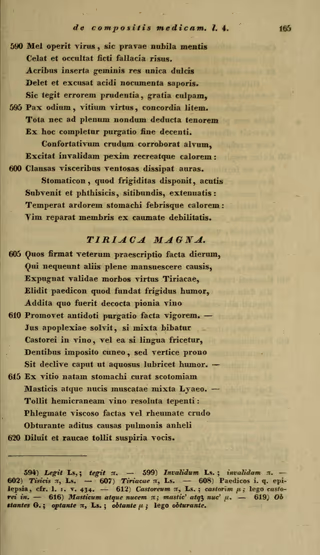
Those diseases which the prescription made in ancient days confirms,
Which are unable to fully submit to other methods,
The virtue of potent *Tiriaca* conquers;
It crushes *paedicon*, which a cold humor pours out,
To which, if peony boiled in wine has been added,
The resulting purgation promotes the vigor of the antidote. —
It dissolves the power of apoplexy, if it is drunk mixed
In the wine of castoreum, or if the tongue is rubbed with it,
With a wedge placed between the teeth, but with the crown of the head face down
Let the head be inclined so that the watery humor may slide out. —
It cures *scotomia* born from a defect of the stomach
When mixed with the Lyaeus of mastic and nutmeg. —
It removes hemicrania when dissolved in warm wine:
Created by viscous phlegm or by raw rheum
Obstructing the passages, the causes of a panting lung
It dilutes, and removes the sighs of a hoarse voice.
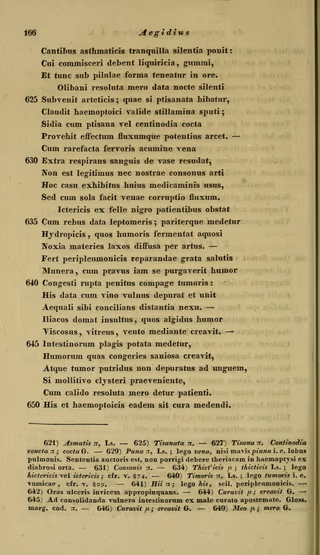
It imposes tranquil silences upon asthmatic wheezing:
With which licorice and gum ought to be mixed,
And then let it be held in the mouth in the form of a pill.
Given in the silent night dissolved in unmixed wine of olibanum,
It aids the arthritic; which, if drunk prepared as a ptisana,
Powerfully shuts off the drippings of haemoptoic sputum;
Pomegranate rind cooked with ptisana or knotweed
Advances the effect and more potently wards off the flux. —
When the vein, rarefied by the sharpness of heat,
Breathing outward, the blood sweats out from the vessel,
The use of this medicine exhibited in this case
Is not legitimate, nor consonant with our art,
But when the corruption of the vein alone causes the flux.
It opposes those suffering jaundice from black bile,
When given with leptomeric things; and equally it cures
The dropsical, whom the noxious matter of watery humor
Ferments, diffused through loose limbs. —
It brings to peripneumonics the pleasing gifts of restoring
Health, when the depraved humor has already purged itself
After the structure of the congested tumor has been entirely broken:
Given to these with wine, it depurates and unites the wound,
Reconciling distant parts to itself in an equal bond. —
It subdues iliac assaults, which a cold humor,
Viscous, glassy, with wind mediating, has created. —
Drunk, it cures lesions of the intestines,
Which a sanious congestion of humors has created,
And a putrid tumor not perfectly depurated,
If, with a mollifying clyster preceding,
It is given to the patient dissolved in warm, unmixed wine.
For these and for haemoptoics let there be the same care of healing.
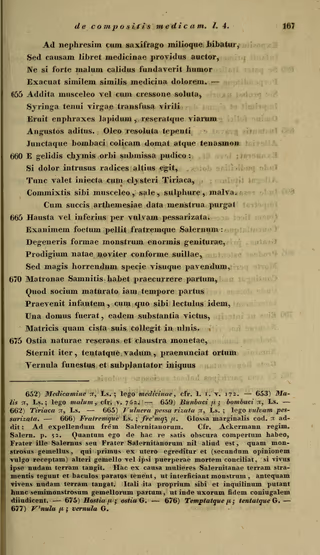
For kidney disease let it be drunk with saxifrage and millet,
But let the prudent author of the medicine weigh the cause,
Lest if by chance a hot humor has founded the malady
A similar medicine might exacerbate a similar pain.
Added to *musceleum* or dissolved with cress,
Transfused by a thin syringe into the male organ
It roots out obstructions of stones, and unlocks
The narrow approaches of the passages. Dissolved in warm oil
And joined to cotton, it subdues colic and tenesmus
From cold humors, when placed beneath the pudendal sphere:
If the intrusive pain has driven its roots deeper,
Then Theriaca is effective when injected with a clyster,
With *musceleum*, salt, sulfur, and mallow mixed with it.
Given with the juices of artemisia it purges the menses,
Drunk or applied below as a pessary through the vulva.
It drives out a lifeless fetus and the Salernitan brother:
A monster of degenerate form, of enormous engendering,
A prodigy shaped like a newly born piglet,
But more horrendous in appearance and fearsome to see,
It is wont to precede the childbirth of the Samnite matron,
Which, when the time of birth is already matured,
Precedes the companion infant, with whom it had the same little bed,
One house, and the same substance of food,
Which the chest of the womb collected in its arms.
Unlocking the doors of nature and the closures of the mint,
It lays out the path, and tests the ford, it announces the birth
A deadly little slave and an unjust supplanter
Exposed to the light, it anticipates the sweet breezes,
snatching the prize of the first birth from the infant.
The Italian father proves himself a parent by this herald,
and considers the now true prognostics of his offspring:
thus he proves the merit of his wife, and with such a seal
he impresses and signs the pact of devoted love.
The matron rejoices in the happy omen, nor does
the pressure of impending pain from childbirth burden her:
a joyful mind alleviates the evil, and unburdens the weight
of labor; what a calm will sustains becomes light.
Thence she claims the gifts of chastity, and the title
of unblemished modesty; the tear of a prior fault
which perhaps clings to her beauty is thence repaired:
by this alone she obtains pardon and redeems her guilt.
Although an approaching foreign Frank may grind her
and a wandering merchant, more pleasing to the woman, may shake her,
as long as such a portent comes forth from the private threshold
of birth, she crowns herself with the praise of morals.
The mother perishes by sudden death, if the deformed beast
should touch the bare earth with its bare body:
wherefore the floor of the house is strewn with various cloths,
and they kill the received animal with sticks and logs,
so that by its death her continuing life may be saved.
This flaw of nature, so detestable a disgrace
of human fate, an anger sent down from heaven,
the vengeance of an offended deity, an infamous tribute,
the Beneventan people strive to transfer to Salerno,
so that it may have partakers and allies in its shame,
and it condemns an unmeriting people with its own crime.
Far be it that such a mark should pollute the excellent city
whose beauty shines widely diffused through the world
Which medical reason, which physical order
Inhabits and governs, which the provident cultivation of our art,
The odoriferous globe of spices embalms.
If the corruption of sperm gave rise to this monster,
Or the eating of herbs, or an abundant menstrual humor,
Or an intemperance of the womb, or the vengeance of the supreme
Judgment inflicted for the merits of ancestors,
Medicine through spices, herbs, and aromatics would destroy
The whole flaw, and remove the cause of the evil:
And Saint Matthew, appeased by constant incense,
Taking pity on the people, would turn away the wrath of heaven.
Drunk, and smeared upon them, it destroys venomous bites
And counters poisons taken by mouth,
Mixed with dittany, mint, and aristolochia. —
Drunk with the juice of mint, it checks leprosy,
For since through it it drives out poison by its power,
It destroys the foul contagions of the venomous disease.
Joined with warm Falernian wine, it resolves a true quartan
And a typical fever from glassy phlegm;
But unless a laxative medicine precedes it,
An easy conversion of a simple into a double [fever] will occur.
For while the heat of the antidote is introduced into raw
And unresolved humors, it exhausts the watery parts,
Drinks up the airy ones, whose substance is soft,
Slippery, more apt for fluid things to undergo the command
Of heat, which being absorbed and the thick ones left behind
A harder form of solid appearance results,
Which is at once the daughter of fire and earth, although
It often owes its origin to an earthly mass.
Thus the fever, standing on an unaccustomed foundation, rages
More fiercely in its attack, and greater in number and duration:
Hence let the pharmacists of Montpellier beware for themselves,
Verbose, empty, deceitful Quintilians,
Whom poverty makes into artificers of a shameless brow,
Whom gluttony, whom the greedy ambition of deceitful coin
Stimulates and compels to belch out a Salernitan poem,
Whom neither the love of the art, nor fame, but the venal favor
Of ambitious profit incites and pricks:
Let them not wickedly presume to attempt this kind of healing,
In which art is worth more than the headlong die of chance.
Frigidly and suddenly putting the limbs to sleep with a deadly cold,
And stealthily causing silent deaths in the wound,
Which provoke the hasty crises of a rapid disease,
Their hidden swords, which another's death,
Long desired by malignant vows, lifts on high,
The power of valid Theriac overcomes the given poisons,
And compels the little fire of life, thrust back in its genial seat,
Already almost extinguished, to live again.
The partial daylight of the heart, previously apt to undergo
An eclipse of light, the shadow of darkness having been driven away,
As the heat of the antidote has clung to the vital limbs,
Now radiates whole and shines with full light.
But make haste! The violence of the cause denies a truce,
Immediate care diminishes the evil, delay strengthens it;
While the cause of harm is new, while raw, while very young,
It succumbs to immediate care; when fully grown, it resists.
While it is tender, its roots not yet driven into solid ground,
The disease ought to be destroyed in its first seed:
Given in a drink with cold water and added to the painful limb,
While it does not yet produce a febrile act.
It destroys the carbuncle, to which the mixture supplies power
Of blood and black bile with red gall,
But blood having first been drawn from the matrix vein,
If strength favors, if age does not oppose,
A synochal crasis, if the rule of long-standing custom,
A rival to nature, has ordered this to be done.
Six lustra maintain a stable vigor for it.
The highest dose is of three drachms, and to be given only to those
Whom a more severe affliction and extreme cause troubles.
A single drachm is the smaller dose, a doubled one the second. —
Tinned and leaden vessels hold this more safely;
Earthenware ones corrupt it, unless those whose hollowed surfaces,
Covered with lead, feign the honor of lead;
Or, simulating tin, cancels out the formations of earth.
Quos firmat veterum praescriptio facta dierum,
Qui nequeunt aliis plene mansuescere causis,
Expugnat validae morbos virtus Tiriacae,
Elidit paedicon quod fundat frigidus humor,
Addita quo fuerit decocta pionia vino
Promovet antidoti purgatio facta vigorem. —
Jus apoplexiae solvit, si mixta bibatur
Castorei in vino, vel ea si lingua fricetur,
Dentibus imposito cuneo, sed vertice prono
Sit declive caput ut aquosus lubricet humor. —
Ex vitio natam stomachi curat scotomiam
Masticis atque nucis muscatae mixta Lyaeo. —
Tollit hemicraneam vino resoluta tepenti:
Phlegmate viscoso factas vel rheumate crudo
Obturante aditus causas pulmonis anheli
Diluit et raucae tollit suspiria vocis.
Cantibus asthmaticis tranquilla silentia ponit:
Cui commisceri debent liquiricia, gummi,
Et tunc sub pilulae forma teneatur in ore.
Olibani resoluta mero data nocte silenti
Subvenit arteticis; quae si ptisanata bibatur,
Claudit haemoptoici valide stillamina sputi;
Sidia cum ptisana vel centinodia cocta
Provehit effectum fluxumque potentius arcet. —
Cum rarefacta fervoris acumine vena
Extra respirans sanguis de vase resudat,
Non est legitimus nec nostrae consonus arti
Hoc casu exhibitus huius medicaminis usus,
Sed cum sola facit venae corruptio fluxum.
Ictericis ex felle nigro patientibus obstat
Cum rebus data leptomeris; pariterque medetur
Hydropicis, quos humoris fermentat aquosi
Noxia materies laxos diffusa per artus. —
Fert peripleumonicis reparandae grata salutis
Munera, cum pravus iam se purgaverit humor
Congesti rupta penitus compage tumoris:
His data cum vino vulnus depurat et unit
Aequali sibi concilians distantia nexu. —
Iliacos domat insultus, quos algidus humor
Viscosus, vitreus, vento mediante creavit. —
Intestinorum plagis potata medetur,
Humorum quas congeries saniosa creavit,
Atque tumor putridus non depuratus ad unguem,
Si mollitivo clysteri praeveniente,
Cum calido resoluta mero detur patienti.
His et haemoptoicis eadem sit cura medendi.
Ad nephresim cum saxifrago milioque bibatur,
Sed causam libret medicinae providus auctor,
Ne si forte malum calidus fundaverit humor
Exacuat similem similis medicina dolorem.
Addita musceleo vel cum cressone soluta,
Syringa tenui virgae transfusa virili
Eruit enphraxes lapidum, reseratque viarum
Angustos aditus. Oleo resoluta tepenti
Junctaque bombaci colicam domat atque tenasmon
E gelidis chymis orbi submissa pudico:
Si dolor intrusus radices altius egit,
Tunc valet iniecta cum clysteri Tiriaca,
Commixtis sibi musceleo, sale, sulphure, malva.
Cum succis arthemesiae data menstrua purgat
Hausta vel inferius per vulvam pessarizata.
Exanimem foetum pellit fratremque Salernum:
Degeneris formae monstrum enormis geniturae,
Prodigium natae noviter conforme suillae,
Sed magis horrendum specie visuque pavendum,
Matronae Samnitis habet praecurrere partum,
Quod socium maturato iam tempore partus
Praevenit infantem, cum quo sibi lectulus idem,
Una domus fuerat, eadem substantia victus,
Matricis quam cista suis collegit in ulnis.
Ostia naturae reserans et claustra monetae,
Sternit iter, tentatque vadum, praenunciat ortum
Vernula funestus et subplantator iniquus
Expositus luci dulces praeconcipit auras,
Infanti primae bravium rapiens geniturae.
Se pater Italicus probat hoc praecone parentem,
Perpenditque suae iam vera prognostica prolis:
Sic probat uxoris meritum, talique sigillo
Imprimit et signat devoti foedus amoris.
Omine felici gaudet matrona, nec ipsam
Instantis gravat ex partu pressura doloris:
Alleviat mens laeta malum, pondusque laboris
Exonerat; leve fit, quod sustinet aequa voluntas.
Inde pudicitiae dotes, salvique pudoris
Allegat titulum; quae formae forsan inhaeret
Inde resarcitur culpae scissura prioris:
Impetrat hoc solo veniam redimitque reatum.
Quam licet accedens intermolat advena Francus
Concutiatque vagus mercator plus mulieri
Gratus, privato dum partus limine tale
Prodeat ostentum, morum se laude coronat.
Morte perit subita mater, si corpore nudo
Contingat nudam deformis bestia terram:
Unde domus variis substernitur area pannis,
Interimunt baculis animal lignisque receptum,
Eius ut interitu salvetur vita perennis.
Naturae hoc vitium, tam detestabile sortis
Dedecus humanae, demissam coelitus iram,
Numinis offensi vindictam, infame tributum
Gens Beneventana satagit transferre Salernum,
Ut cum participes habeat sociosque pudoris,
Immeritamque suo condemnat crimine gentem.
Absit ut egregiam talis nota polluat urbem
Cuius forma nitet late diffusa per orbem
Quam medicinalis ratio, quam physicus ordo
Incolit atque regit, quam nostrae providus artis
Cultus, odoriferus specierum inbalsamat orbis.
Si daret huic monstro corruptio spermatis ortum,
Herbarumve esus, vel menstruus humor abundans,
Aut intemperies matricis, sive superni
Ultio iudicii meritis inflicta priorum,
Physica per species, herbas et aromata totum
Deleret vitium, causamque mali removeret:
Sanctus et assiduo placatus thure Mathaeus
Compatiens populo coeli converteret iram.
Pota venenatos et se super illita morsus
Delet et occurrit susceptis ore venenis,
Diptamno, mentha mixtis et aristolochia. —
Lepram cum succo menthae potata coërcet,
Nam quoniam per eum pellit virtute venenum,
Foeda venenosi dirimit contagia morbi.
Veram quartanam tepido sociata Falerno
Et typicam solvit vitreo de phlegmate febrem;
Sed laxativa nisi praeveniat medicina
Simplicis in duplicem facilis conversio fiet.
Nam calor antidoti dum crudis nec resolutis
Inseritur chymis, partes exhaurit aquosas,
Combibit aërias, quarum substantia mollis,
Lubrica, fluxilibus magis apta subire caloris
Imperium, quibus absorptis grossisque relictis
Durior et solidae speciei forma resultat,
Quae simul est ignis et terrae filia, quamvis
Saepe suum massae terrestri debeat ortum.
Sic febris insolito constans fundamine saevit
Acrius insultu numeroque et tempore maior:
Unde sibi caveant Montani pharmacopolae
Verbosi, vacui, fallaces Quintiliani,
Quos facit artifices attritae frontis egestas
Quos gula, quos stimulat et cogit avara dolosi
Ambitio nummi carmen ructare Salernum,
Quos non artis amor, non fama, sed ambitiosi
Incitat et pungit venalis gratia quaestus:
Non male praesumant genus hoc tentare medendi,
In quo plus valet ars, quam praeceps alea casus.
Frigore letali subito quae membra soporant,
Et furtim tacitas faciunt in vulnere mortes,
Quae rapidi festina movent discrimina morbi,
Occulti illorum gladii, quos tollit in altum
Mors aliena diu votis optata malignis,
Expugnat validae data toxica vis Tiriacae,
Et vitae igniculum geniali sede retrusum
Jam pene extinctum rursus viviscere cogit.
Particulata dies cordis, prius apta subire
Luminis eclipsim, pulsa caliginis umbra,
Ut calor antidoti membris vitalibus haesit,
Integra iam radiat et pleno lumine fulget.
Sed properes! negat inducias violentia causae,
Instans cura malum minuit, dilatio firmat;
Dum nova, dum rudis, dum primula causa nocendi,
Instanti curae succumbit, adulta resistit.
Dum tener est, nondum in solidum radicibus actis,
Interimi debet in primo semine morbus:
In potu data cum gelida membroque dolenti
Addita, dum nondum febrilem prodit in actum.
Destruit anthracem, cui vim mixtura ministrat
Sanguinis et cholerae nigrae cum felle rubenti,
Sanguine sed primum vena ex matrice minuto,
Si faveat virtus, si non occurrerit aetas,
Synochina crasis, si iusserit id faciendum
Aemula naturae longaevi regula moris.
Continuant illi stabilem sex lustra vigorem.
Summa trium dosis est dragmarum, dandaque solis,
Quos gravior casus extremaque causa molestat.
Unica dragma dosis minor est, duplicata secunda. —
Tutius hanc stannata tenent et plumbea vasa;
Terrea corrumpunt, nisi quorum concava plumbo
Tecta superficies plumbi mentitur honorem;
Vel stannum simulans terrae figmenta resignat.