Hover or tap a word to see its match.
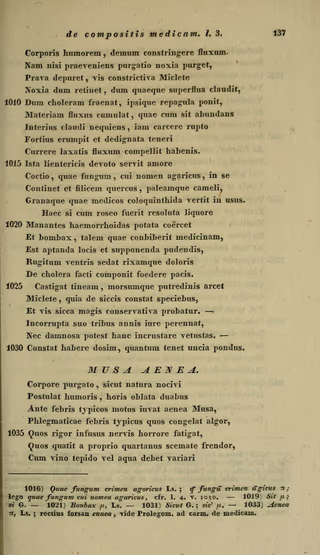
When the body is purged, just as the nature of the noxious
humor demands, offered two hours
before the typical movements of a fever, *Musa Aenea* helps
those whom the typical coldness of a phlegmatic fever freezes,
whom the stiffness infused into the nerves wearies with shivering,
whom the quartan gnashing shakes from its own pattern;
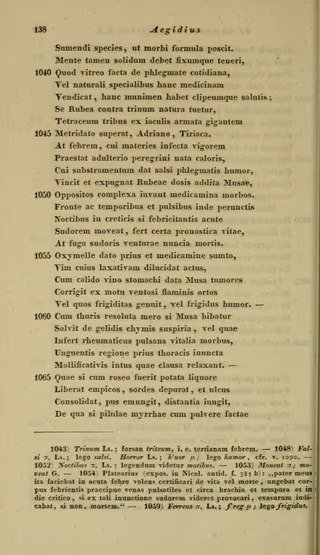
it ought to be varied with warm wine or water
the species to be taken, as the formula of the disease demands.
However, it must be held solid and fixed in the mind,
That a quotidian fever arising from glassy phlegm,
Or from natural [phlegm], claims this medicine
By special [properties], has this as a defense and shield of health;
By *Rubea* nature protects itself against the trinal,
Armed with three javelins, it overcomes the tetracean giant
With *Metridatum*, *Adrianum*, and *Tiriaca*.
But a fever, to which infected matter supplies vigor,
Born from the adultery of foreign heat,
To which the humor of salty phlegm provides a substrate,
An added dose of *Rubea Musa* conquers and subdues,
Embracing opposites, medicines cure diseases.
When the forehead, temples, and pulses have been anointed with it
On critical nights, if it provokes sweat in one suffering from an acute fever,
It brings certain prognostics of life,
But the flight of sweat is a messenger of approaching death.
With oxymel having been given first and the medicine taken,
Whose laxative power its action elucidates,
Given with warm wine, *Musa* corrects swellings of the stomach
Arising from the movement of a windy blast
Or which coldness has generated, or a cold humor. —
If *Musa* is drunk dissolved in unmixed wine of frankincense
It relieves sighs from cold chymes, or those which
A rheumatic disease pulsating the vitals brings on,
The region of the thorax having first been anointed with ointments
That are mollifying, which relax what is closed within. —
If it is drunk with rose liquor
It frees those with empyema, purges filth, and
Consolidates an ulcer, draws out pus, joins separated parts,
From which if pills are made with the powder of myrrh
If they are given, they will be no less able to resolve this disease.
If you mix it with fine-particled substances, whose virtue is diuretic,
The same, when drunk, is proven to calm
Dropsical and splenetic swellings:
Thus it dissolves the gathered heap of sand,
Frees the course of urine and unseals the passage
Which a ball of viscous matter has obstructed.
With it dissolved in the juice of watercress
And with a pan applied to the fire retaining the heat
Let the entire region of the pubes be anointed and bound over,
But first let fomentations steam the sick person's lower parts
From branches of purslane, from mercury,
From mallows boiled in water with wine and with salt,
And from watercress, which, a nursling of the cold spring,
Always inhabits watery places, although the nature of heat
Conciliates it to itself and power defends it in it,
And the virtue of a hot *crasis* claims it for itself,
And if a sitting is made over these herbs by them
While the hot vapor exhales and the neighboring parts
Are wrapped in them, it will help by a sure rationale. —
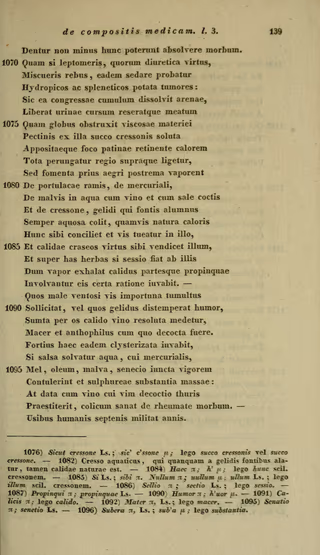
Those whom the troublesome force of a windy tumult badly
Troubles, or whom a cold humor distempers,
Taken by mouth, dissolved in hot wine, it cures,
With which macer and cloves have been boiled down.
More strongly this same thing will help when given as a clyster,
If it is dissolved in salted water, to which mercury,
Honey, oil, mallow, groundsel joined together have contributed
Vigor, and the substance of a sulfurous mass:
But given with wine to which a decoction of frankincense
Has furnished strength, it cures colic disease arising from rheum. —
It serves human uses for seven years.
Corpore purgato, sicut natura nocivi
Postulat humoris, horis oblata duabus
Ante febris typicos motus iuvat aenea Musa,
Phlegmaticae febris typicus quos congelat algor,
Quos rigor infusus nervis horrore fatigat,
Quos quatit a proprio quartanus scemate frendor,
Cum vino tepido vel aqua debet variari
Sumendi species, ut morbi formula poscit.
Mente tamen solidum debet fixumque teneri,
Quod vitreo facta de phlegmate cotidiana,
Vel naturali specialibus hanc medicinam
Vendicat, hanc munimen habet clipeumque salutis;
Se *Rubea* contra trinum natura tuetur,
Tetraceum tribus ex iaculis armata gigantem
*Metridato* superat, *Adriano*, *Tiriaca*.
At febrem, cui materies infecta vigorem
Praestat adulterio peregrini nata caloris,
Cui substramentum dat salsi phlegmatis humor,
Vincit et expugnat *Rubeae* dosis addita *Musae*,
Oppositos complexa iuvant medicamina morbos.
Fronte ac temporibus et pulsibus inde perunctis
Noctibus in creticis si febricitantis acute
Sudorem moveat, fert certa pronostica vitae,
At fuga sudoris venturae nuncia mortis.
Oxymelle dato prius et medicamine sumto,
Vim cuius laxativam dilucidat actus,
Cum calido vino stomachi data *Musa* tumores
Corrigit ex motu ventosi flaminis ortos
Vel quos frigiditas genuit, vel frigidus humor. —
Cum thuris resoluta mero si *Musa* bibatur
Solvit de gelidis chymis suspiria, vel quae
Infert rheumaticus pulsans vitalia morbus,
Unguentis regione prius thoracis inuncta
Mollificativis intus quae clausa relaxant. —
Quae si cum roseo fuerit potata liquore
Liberat empicos, sordes depurat, et ulcus
Consolidat, pus emungit, distantia iungit,
De qua si pilulae myrrhae cum pulvere factae
Dentur non minus hunc poterunt absolvere morbum.
Quam si leptomeris, quorum diuretica virtus,
Miscueris rebus, eadem sedare probatur
Hydropicos ac spleneticos potata tumores:
Sic ea congressae cumulum dissolvit arenae,
Liberat urinae cursum reseratque meatum
Quam globus obstruxit viscosae materiei
Pectinis ex illa succo cressonis soluta
Appositaeque foco patinae retinente calorem
Tota perungatur regio supraque ligetur,
Sed fomenta prius aegri postrema vaporent
De portulacae ramis, de mercuriali,
De malvis in aqua cum vino et cum sale coctis
Et de cressone, gelidi qui fontis alumnus
Semper aquosa colit, quamvis natura caloris
Hunc sibi conciliet et vis tueatur in illo,
Et calidae craseos virtus sibi vendicet illum,
Et super has herbas si sessio fiat ab illis
Dum vapor exhalat calidus partesque propinquae
Involvantur eis certa ratione iuvabit. —
Quos male ventosi vis importuna tumultus
Sollicitat, vel quos gelidus distemperat humor,
Sumta per os calido vino resoluta medetur,
Macer et anthophilus cum quo decocta fuere.
Fortius haec eadem clysterizata iuvabit,
Si salsa solvatur aqua, cui mercurialis,
Mel, oleum, malva, senecio iuncta vigorem
Contulerint et sulphureae substantia massae:
At data cum vino cui vim decoctio thuris
Praestiterit, colicum sanat de rheumate morbum. —
Usibus humanis septenis militat annis.