Hover or tap a word to see its match.
Pellitory is hot and dry, and the fourth in these
Is its degree: if a cold humor should shake the teeth,
Let the patient chew this: and hold it longer in the mouth,
And it helps if it is gargled with vinegar mixed in.
And in this way it represses a tongue swollen from phlegm,
Thus it relieves the uvula pressed by the weight of humor,
And thus it comes to the aid of many other ailments of the mouth.
Taken with honey, it is of no small benefit to epileptics,
And thus it is wont to relieve the disease that weakens the limbs.
Hung around the neck, it is believed to benefit epileptic boys:
And it is said to help by its scent alone.
If you anoint the body with the oil in which it is boiled down,
Before the onset of a fever: it will diminish it, or remove the shivering.
Such an ointment often drives away a heavy pain of the kidneys.
A paralytic anointed with it feels a wondrous effect,
If he has been rubbed often, not lightly, with the hands
With the ointment: if you soothe the whole body with this
Copious sweat will proceed through the opened pores,
And it is wont to settle any numbness of the limbs,
And it can aid the body, kept safe from cold,
And torpor will be dissolved by this medicine.
It is just as beneficial if you dissolve the crushed plant in olive oil.
And thus, by rubbing, you may anoint the place you wish to heal.
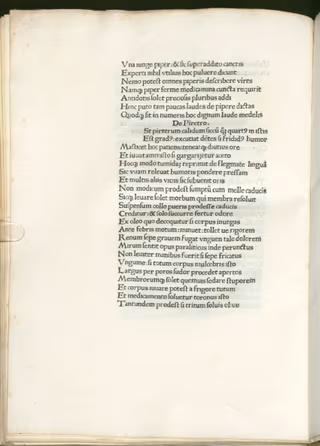
St piretrum calidum ſiccū qꝫ quartꝰ in iſtis
Eſt gradꝰ: excutiat dētes ſi frigidꝰ humor
Maſticet hoc patiens: teneatꝙ diutius ore
Et iuuat ammiſto ſi gargarizetur aceto
Hocꝙ modo tumidaꝫ reprimit de flegmate linguā
Sic vuam releuat humoris pondere preſſam
Et multis aliis viciis ſic ſubuenit oris
Non modicum prodeſt ſumptū cum melle caducis
Sicꝙ leuare ſolet morbum qui membra reſoluit
Suſpenſum collo pueris prodeſſe caducis
Creditur: & ſolo ſuccurre fertur odore
Ex oleo quo decoquitur ſi corpus inungas
Ante febris motum: minuet: tollet ue rigorem
Renum ſepe grauem fugat vnguen tale dolorem
Mirum ſentit opus paraliticus inde perunctus
Non leuiter manibus fuerit ſi ſepe fricatus
Vnguine: ſi totum corpus mulcebris iſto
Largus per poros ſudor procedet apertos
Membrorumꝙ ſolet quemuis ſedare ſtuporem
Et corpus iuuare poteſt a frigore tutum
Et medicamento ſoluetur torporus iſto
Tantundem prodeſt ſi tritum ſoluis oliuo
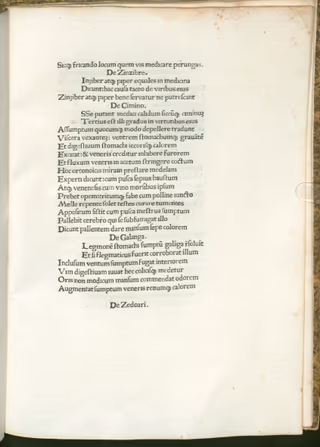
Sicꝫ fricando locum quem vis medicare perungas.