Hover or tap a word to see its match.
The herb which we commonly call catnip,
Physicians call this by the Greek name calamint.
Its virtue is dry and hot, and to it the third
Degree in both belongs; dried, with warm mead
Taken, it is accustomed to relax the whole body in sweat.
With oil in which it has been boiled, anoint by rubbing
Him who fears the chill of an approaching fever;
Not only the chill, but it will drive away the fevers from there.
To him who suffers from sciatica, apply it over the hip;
Crushed green, it is said to burn the skin,
And thus by drying the humors, putting the pains to flight.
By its application and drink, it quickly purges the menses.
There is a kind of leprosy and it is called elephantiasis,
Which seems to stand out as greater than the rest,
Just as the elephant stands out as greater than all animals.
This disease, in its beginning, a drink of calamint
With wine cures, by thinning the humors.
Crushed and applied over them, it will not allow the bites of serpents
To do harm, and taken with wine it drives out poisons.
Its juice, drunk and injected, kills intestinal worms:
And it kills worms in all the limbs.
If honey is joined to this with salt, it works more effectively.
If a pregnant woman drinks this or inserts it crushed, she aborts.
It purges the jaundiced; and taken with wine it mitigates
Those whom physicians call by the Greek name asthmatics,
And diseases of the liver; with wine it cures the breathless.
And in this way it helps an old pain of the side.
And black scars, crushed and applied over them,
By purging, it returns to their natural color.
Boiled in wine, this makes a better poultice.
Taken with wine, it restrains stomach pain.
Its smoke drives serpents out of houses.
Drunk with wine, it is said to remove hiccups.
And drunk frequently in this way, it checks the bowels.
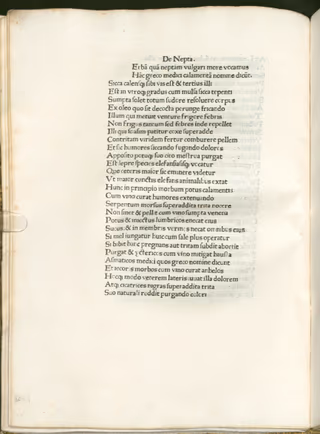
Erbā quā neptam vulgari more vocamus
Hāc greco medici calamentā nomine dicūt.
Sicca calenſqꝫ ſibi vis eſt & tertius illi
Eſt in vtroqꝫ gradus cum mulſa ſicca tepenti
Sumpta ſolet totum ſudore reſoluere corpus
Ex oleo quo ſit decocta perunge fricando
Illum qui metuit venture frigore febris
Non frigus tantum ſed febres inde repellet
Illi qui ſciaſim patitur coxe ſuperadde
Contritam viridem fertur comburere pellem
Et ſic humores ſiccando fugando dolores
Appoſito potuqꝫ ſuo cito meſtrua purgat
Eſt lepre ſpecies elefanſiaſiſqꝫ vocatur
Que ceteris maior ſic eminere videtur
Vt maior cunctis elefans animalibus extat
Hunc in principio morbum potus calamentis
Cum vino curat humores extenuando
Serpentum morſus ſuperaddita trita nocere
Non ſinet & pellit cum vino ſumpta venena
Potus & iniectus lumbricos enecat eius
Sucus: & in membris vermes necat omnibus eius
Si mel iungatur huic cum ſale plus operatur
Si bibit hanc pregnans aut tritam ſubdit abortit
Purgat & yctericos cum vino mitigat hauſta
Aſmaticos medici quos greco nomine dicunt
Et iecoris morbos cum vino curat anhelos
Hocqꝫ modo veterem lateris iuuat illa dolorem
Atqꝫ cicatrices nigras ſuperaddita trita
Suo naturali reddit purgando colori
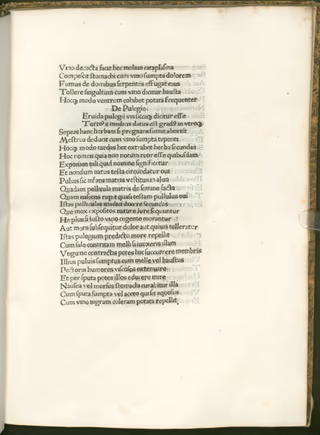
Vino decocta facit hec melius cataplaſma
Compeſcit ſtomachi cum vino ſumpta dolorem
Fumus de domibus ſerpentes effugat eius
Tollere ſingultum cum vino dicitur hauſta
Hocqꝫ modo ventrem cohibet potata frequenter
