Hover or tap a word to see its match.
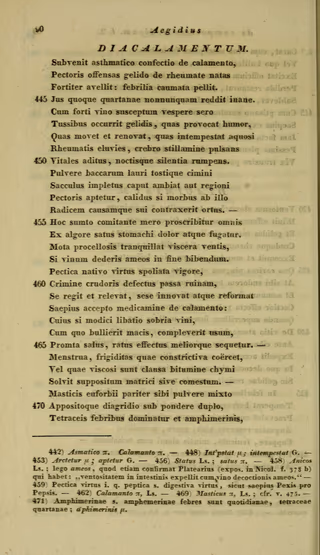
The preparation of calamint comes to the aid of the asthmatic;
it forcefully plucks out the troubles of the chest born from cold rheum:
it drives off the burning heats of fever.
Sometimes it also renders the power of a quartan void.
Taken with strong wine late in the evening,
it counters cold coughs, which humor provokes,
which the inundation of watery rheum moves and renews, which it agitates,
beating upon the vital passages with a frequent dripping,
and breaking the silences of the night.
Let a small bag filled with the powder of laurel berries and roasted cumin
surround the head, or let it be fitted to the region
of the chest, if a hot disease has drawn from it
the root and cause of its origin.
When this is taken, accompanied by unmixed wine, every
pain of the stomach springing from cold is banished and put to flight.
It calms bowels stirred up by stormy winds,
if, at the end, you give wine of ammi to be drunk.
The pectic virtue, robbed of its native vigor,
having suffered the ruin of failure through the fault of crudity,
governs and relieves itself, renews and reforms itself,
when the medicine of calamint is frequently taken:
and if a sober libation of a little wine,
with which mace has been boiled, completes its use,
prompt health, and a certain and better outcome will follow.
The menses, which constricting coldness represses,
or which are shut in by the pitch of viscous humor,
it releases, whether applied as a suppository to the womb or eaten. —
When the powder of mastic and euphorbium is equally mixed into it,
and diagrydium is added in double weight,
it rules over tetracean and amphimerine fevers,
And it holds the office of a laxative medicine
If, once the humors are well digested, before the febrile
Attack you give it, by five or four hours,
Mastic allies euphorbium to itself by the weight of a scruple:
Scammony overcomes that same thing by a doubled scruple. —
This is not able to cross the boundary of the second year.
Subvenit asthmatico confectio de calamento,
Pectoris offensas gelido de rheumate natas
Fortiter avellit: febrilia caumata pellit.
Jus quoque quartanae nonnunquam reddit inane.
Cum forti vino susceptum vespere sero
Tussibus occurrit gelidis, quas provocat humor,
Quas movet et renovat, quas intempestat aquosi
Rheumatis eluvies, crebro stillamine pulsans
Vitales aditus, noctisque silentia rumpens.
Pulvere baccarum lauri tostique cimini
Sacculus impletus caput ambiat aut regioni
Pectoris aptetur, calidus si morbus ab illo
Radicem causamque sui contraxerit ortus.
Hoc sumto comitante mero proscribitur omnis
Ex algore satus stomachi dolor atque fugatur.
Mota procellosis tranquillat viscera ventis,
Si vinum dederis ameos in fine bibendum.
Pectica nativo virtus spoliata vigore,
Crimine crudoris defectus passa ruinam,
Se regit et relevat, sese innovat atque reformat
Saepius accepto medicamine de calamento:
Cuius si modici libatio sobria vini,
Cum quo bullierit macis, compleverit usum,
Promta salus, ratus effectus meliorque sequetur.
Menstrua, frigiditas quae constrictiva coërcet,
Vel quae viscosi sunt clausa bitumine chymi
Solvit suppositum matrici sive comestum. —
Masticis euforbii pariter sibi pulvere mixto
Appositoque diagridio sub pondere duplo,
Tetraceis febribus dominatur et amphimerinis,
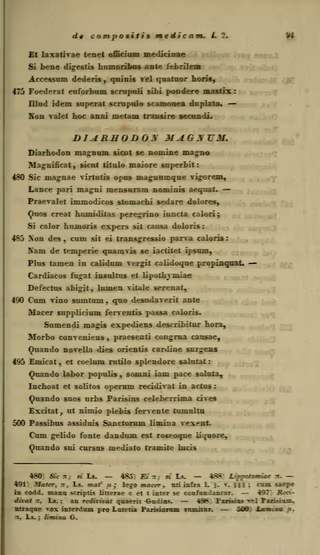
Et laxativae tenet officium medicinae
Si bene digestis humoribus ante febrilem
Accessum dederis, quinis vel quatuor horis,
Foederat euforbum scrupuli sibi pondere mastix:
Illud idem superat scrupulo scamonea duplato. —
Non valet hoc anni metam transire secundi.