Hover or tap a word to see its match.
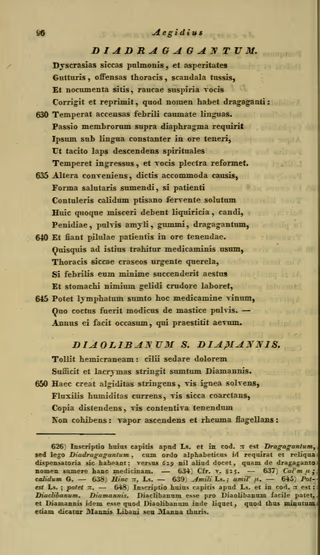
Dry dyscrasias of the lungs, and roughnesses
Of the throat, afflictions of the chest, provocations of cough,
And the harms of thirst, the sighs of a hoarse voice
That which has the name of dragagantum corrects and represses:
It tempers tongues kindled by feverish cauma.
An affliction of the members above the diaphragm requires
It to be held constantly in the mouth under the tongue,
So that descending with a silent glide it might temper
The spiritual entrances, and reform the strings of the voice.
Another suitable, health-giving form of taking it,
Accommodated to the said causes, is if you should bestow it
Warm upon the patient, dissolved in boiling ptisana.
To this also ought to be mixed licorice, candi,
Penidiae, powder of starch, gum, dragagantum,
And let pills be made, to be held in the patient's mouth.
Whoever is drawn to the use of this medicine,
With the complaint of a dry crasis of the chest urging,
If feverish heat should not kindle him at all
And he should labor with the indigestion of a too cold stomach,
Let him drink diluted wine after this medicine has been taken,
In which a moderate powder of mastic has been cooked. —
A year brings an end to it, which furnished its lifespan.
Dyscrasias siccas pulmonis, et asperitates
Gutturis, offensas thoracis, scandala tussis,
Et nocumenta sitis, raucae suspiria vocis
Corrigit et reprimit, quod nomen habet dragaganti:
Temperat accensas febrili caumate linguas.
Passio membrorum supra diaphragma requirit
Ipsum sub lingua constanter in ore teneri,
Ut tacito lapsu descendens spirituales
Temperet ingressus, et vocis plectra reformet.
Altera conveniens, dictis accommoda causis,
Forma salutaris sumendi, si patienti
Contuleris calidum ptisano fervente solutum
Huic quoque misceri debent liquiricia, candi,
Penidiae, pulvis amyli, gummi, dragagantum,
Et fiant pilulae patientis in ore tenendae.
Quisquis ad istius trahitur medicaminis usum,
Thoracis siccae craseos urgente querela,
Si febrilis eum minime succenderit aestus
Et stomachi nimium gelidi crudore laboret,
Potet lymphatum sumto hoc medicamine vinum,
Quo coctus fuerit modicus de mastice pulvis. —
Annus ei facit occasum, qui praestitit aevum.