Hover or tap a word to see its match.
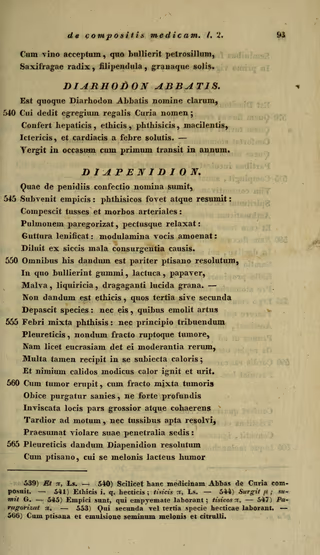
The confection that takes its names from *penidia*,
Relieves empyemics: soothes and restores phthisics:
Restrains coughs and arterial diseases:
Palliates the lung, and relaxes the chest:
Soothes the throat: sweetens the modulations of the voice:
Washes away the evils arising from dry causes.
To all these it must be given equally dissolved in *ptisana*,
In which gum, lettuce, poppy,
Mallow, licorice, and clear grains of tragacanth have boiled. —
It must not be given to hectics, whom the third or second
Species consumes: nor to those whose limbs
Phthisis mixed with fever softens: nor is it to be administered at the beginning
To pleuritics, when the tumor is not yet broken and burst,
For although the moderation of the ingredients gives it eucrasia,
It nevertheless receives into itself many underlying elements of heat;
And a moderate heat ignites and burns those who are excessively hot.
When the tumor has burst, when the *sanies* is purged mixed
With the broken barrier of the tumor, lest perhaps the thicker and cohesive part,
Entangled in deep places,
Slower to move, and not fit to be resolved by coughs,
Should presume to violate the inner sanctums of its seat:
*Diapenidion* is to be given to pleuritics dissolved
With *ptisana*, to which the milky fluid of melon
And has mixed itself with crushed seeds of citrul. —
It thrives in this first year, and perishes in the second.
Quae de penidiis confectio nomina sumit,
Subvenit empicis: phthisicos fovet atque resumit:
Compescit tusses et morbos arteriales:
Pulmonem paregorizat, pectusque relaxat:
Guttura lenificat: modulamina vocis amoenat:
Diluit ex siccis mala consurgentia causis.
Omnibus his dandum est pariter ptisano resolutum,
In quo bullierint gummi, lactuca, papaver,
Malva, liquiricia, dragaganti lucida grana. —
Non dandum est ethicis, quos tertia sive secunda
Depascit species: nec eis, quibus emolit artus
Febri mixta phthisis: nec principio tribuendum
Pleureticis, nondum fracto ruptoque tumore,
Nam licet eucrasiam det ei moderantia rerum,
Multa tamen recipit in se subiecta caloris;
Et nimium calidos modicus calor ignit et urit.
Cum tumor erupit, cum fracto mixta tumoris
Obice purgatur sanies, ne forte profundis
Inviscata locis pars grossior atque cohaerens
Tardior ad motum, nec tussibus apta resolvi,
Praesumat violare suae penetralia sedis:
Pleureticis dandum Diapenidion resolutum
Cum ptisano, cui se melonis lacteus humor
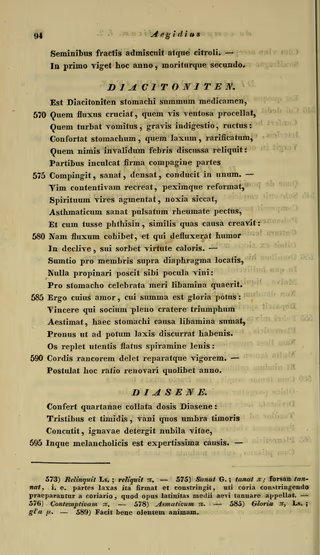
Seminibus fractis admiscuit atque citroli. —
In primo viget hoc anno, moriturque secundo.