
Hover or tap a word to see its match.
Our people called it *arubium*, the Greeks *parsior*.
Physicians relate that this herb is dry and hot
In the second degree. The decoction of the whole herb,
Or a draught of its seed, wonderfully helps consumptives;
This drink suppresses various diseases of the chest.
And it is more beneficial if iris is joined to it;
Taken thus, it helps asthmatics and drives away a cough.
The same accelerates childbirth and expels the afterbirth.
If honey is joined to horehound, it cleanses wounds,
And in this way it cures wounds that gnaw the flesh.
Drunk, this is said to soothe pain of the side.
Its dried juice will be beneficial for all these things.
Its juice, joined with wine and honey,
Is beneficial to eyes weakened by dimness.
The same, injected into the nostrils, thus helps the jaundiced,
And they say it soothes severe pain of the ear,
If you pour it inside, mixed with rose oil.
They say the use of horehound is not healthy
For those who suffer from disease of the bladder and kidneys.
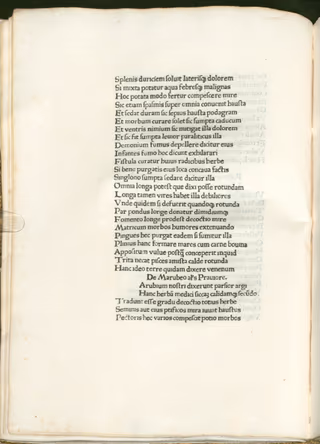
Arubium noſtri dixerunt parſior argi
Hanc herbā medici ſiccaꝫ calidamqꝫ ſecūdo.
Tradunt eſſe gradu decoctio totius herbe
Seminis aut eius ptiſicos mire iuuat hauſtus
Pectoris hec varios compeſcit potio morbos
Et melius prodeſt yris ſi iūgitur illi
Aſmaticos ſic ſumpta iuuat tuſſimqꝫ repellit
Accelerat partus eadem pellitqꝫ ſecundas
Si mel marubeo iungatur vulnera purgat
Hocqꝫ modo curat que rodunt vulnera carnem
Dicitur hoc bibitum lateris ſedare dolorem
Omnibus his ſucus ſiccatis proderit eius
Illius ſucus cum vino melleqꝫ iunctus
Prodeſt luminibus caligine debilitatis
Sic iuuat hictericos iniectus naribus idem
Auriculeqꝫ grauem dicunt ſedare dolorem
Hunc miſtum roſeo ſi fundas intus oliuo
Vſum marubii non dicunt eſſe ſalubrem
Hiis qui veſice morbo renumqꝫ laborant