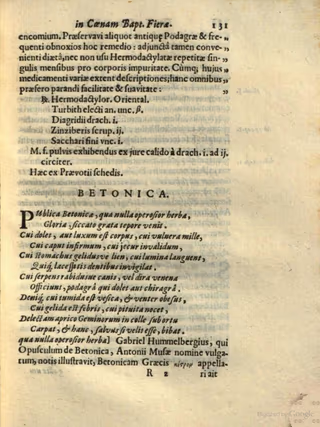
B E T O N I C A.

Poet
Baptista Fiera
Form
Elegiac couplet
Open the page in the book
The page this poem fills. Each opens in the Coena, sive De cibariorum virtutibus reader.

Hover or tap a word to see its match.

The public glory of Betony, than which no herb is more active,

Comes pleasing with a dried warmth.

He whose body aches, or is sprained, he who has a thousand wounds,

He who has a weak head, he who has an invalid liver,

He who has a cold stomach or spleen, he whose eyes grow faint,

And he who stays awake with tormented teeth.

He whom a snake or rabid dog, or dire poisons

Harm, he who suffers from gout or chiragra.

Finally, he whose bladder is swollen, and whose belly is obese,

He who has a cold fever, he whom pituita harms,

Let him pluck it, chosen on a sunny hill under the rising of Gemini,

And let him drink this, if he wishes to be well.

PUblica Betonicæ, qua nulla operoſior herba,

Gloria, ſiccato grata tepore venit.

Cui dolet, aut luxum eſt corpus, cui vulnera mille,

Cui caput infirmum, cui jecur invalidum,

Cui ſtomachus gelidusve lien, cui lumina languent,

Quiq; laceſſitis dentibus invigilat.

Cui ſerpens rabidusve canis, vel dira venena

Officiunt, podagrâ qui dolet aut chiragrâ.

Deniq; cui tumida eſt veſica, & venter obeſus,

Cui gelida eſt febris, cui pituita nocet,

Delectam aprico Geminorum in colle ſub ortu

Carpat, & hanc, ſalvus ſi velit eſſe, bibat.
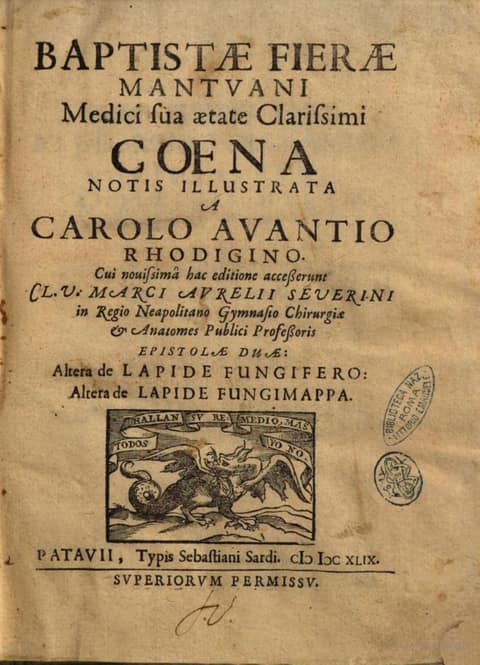
Title page of Coena, sive De cibariorum virtutibus
Title page of Coena, sive De cibariorum virtutibus , 1649

About this text

Provenance

This digital edition is derived from the Internet Archive copy of Battista Fiera's 1649 _Coena, sive De cibariorum virtutibus_, a Latin medical dinner poem with Carlo Avanzi's notes and related material.

Methodology

Each scan is treated as a page-level unit. The page image remains the authority for the edition. Local Kraken OCR used the Reichenau Latin early-print model as a reading aid, then Gemini generated scan-grounded Latin transcription and scholarly English translation from the images, the OCR aid, and the approved glossary. Word links connect the English translation to the Latin transcription and locations on the scans. 32 uncertain word-link decisions remain unlinked. Some links highlight only the text because the source word could not be located on the scan.

Rights

The Internet Archive metadata and IIIF manifest record the digital surrogate under the Creative Commons Public Domain Mark 1.0. Poet Doctor's presentation adds generated OCR, transcription, translation, navigation metadata, and editorial context.

Original scans: Internet Archive / Google Books ( Public Domain Mark 1.0 ).

Historian’s note. This text records the medicine of its own time, and later evidence has replaced most of it. It is not medical advice. We read it as history, and we ask what, if anything, connects it to medicine today. More on how we read old medical books