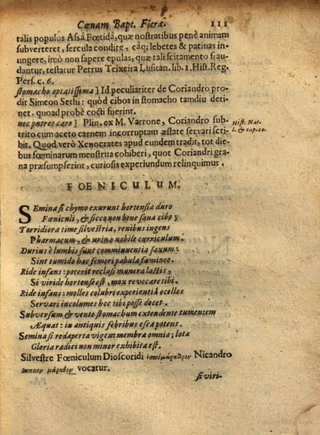
F O E N I C U L U M.

Poet
Baptista Fiera
Form
Elegiac couplet
Open the page in the book
The page this poem fills. Each opens in the Coena, sive De cibariorum virtutibus reader.

Hover or tap a word to see its match.

If the garden seeds burn with a harsh juice,

of fennel, and being dry, are not very healthy as food;

Fear the wild ones as more parching, for the kidneys a mighty

drug, and a noble course for urine.

They break up the harder stone from the loins:

let these be nourishment for a swollen female thigh.

Smile, infant: the gifts of released milk it will be able,

if it is green garden fennel, soon to recall for you.

Smile, infant: your tender little eyes, by the experience of the snake,

it teaches can be kept safe for you by this.

An upset stomach and one swelling with distending wind

it settles: a potent food in inveterate fevers.

If the seeds are opened anew, all the limbs thrive; to the washed

root no less glory has been shown.

SEmina ſi chymo exurunt hortenſia duro

Fœniculi, & ſicca non bene ſana cibo;

Torridiora time ſilveſtria, renibus ingens

Pharmacum, & urinæ nobile curriculum.

Durius è lumbis ſunt comminuentia ſaxum:

Sint tumido hæc femori pabula fœmineo.

Ride infans: poterit recluſi munera lactis,

Si viride hortenſe eſt, mox revocare tibi.

Ride infans: molles colubri experientiâ ocellos

Servari incolumes hoc tibi poſſe docet.

Subverſum & vento ſtomachum extendente tumentem

Æquat: in antiquis febribus eſca potens.

Semina ſi redaperta vigent membra omnia; lotæ

Gloria radici non minor exhibita eſt.
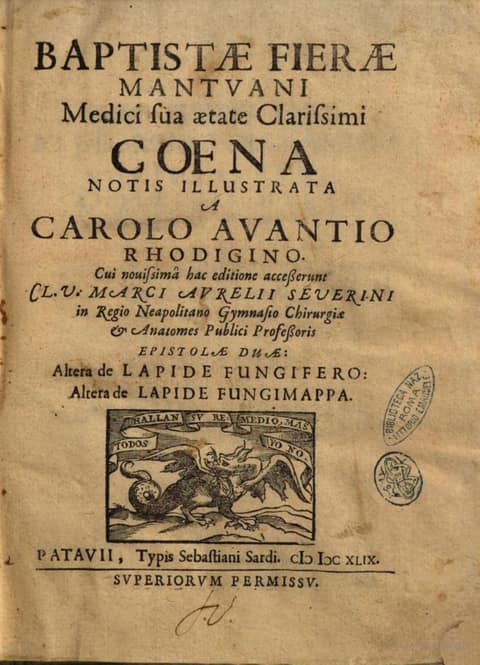
Title page of Coena, sive De cibariorum virtutibus
Title page of Coena, sive De cibariorum virtutibus , 1649

About this text

Provenance

This digital edition is derived from the Internet Archive copy of Battista Fiera's 1649 _Coena, sive De cibariorum virtutibus_, a Latin medical dinner poem with Carlo Avanzi's notes and related material.

Methodology

Each scan is treated as a page-level unit. The page image remains the authority for the edition. Local Kraken OCR used the Reichenau Latin early-print model as a reading aid, then Gemini generated scan-grounded Latin transcription and scholarly English translation from the images, the OCR aid, and the approved glossary. Word links connect the English translation to the Latin transcription and locations on the scans. 32 uncertain word-link decisions remain unlinked. Some links highlight only the text because the source word could not be located on the scan.

Rights

The Internet Archive metadata and IIIF manifest record the digital surrogate under the Creative Commons Public Domain Mark 1.0. Poet Doctor's presentation adds generated OCR, transcription, translation, navigation metadata, and editorial context.

Original scans: Internet Archive / Google Books ( Public Domain Mark 1.0 ).

Historian’s note. This text records the medicine of its own time, and later evidence has replaced most of it. It is not medical advice. We read it as history, and we ask what, if anything, connects it to medicine today. More on how we read old medical books