Hover or tap a word to see its match.
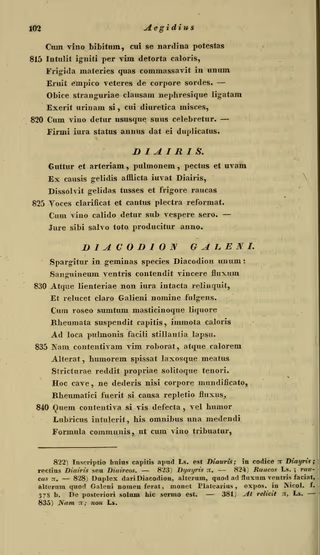
One *Diacodion* is divided into twin species:
it strives to conquer a bloody flux of the belly
and does not leave the laws of lientery intact,
and it shines, gleaming with the famous name of Galen.
Taken with a rosy and mastic liquor
it suspends rheums of the head, dripping with an easy fall
to the unmoving places of heat of the lung.
For it strengthens the retentive power, and alters
the heat, thickens the humor, and returns loose passages
to their proper stricture and customary tenor.
Beware this, that you do not give it unless the body has been cleansed,
if repletion has been the cause of the rheumatic flux,
which, if a failing retentive power, or a slippery
humor has brought it on, for all these there is one common
formula of healing, that it be administered with wine,
With which frankincense, roses, and mastic have been decocted.
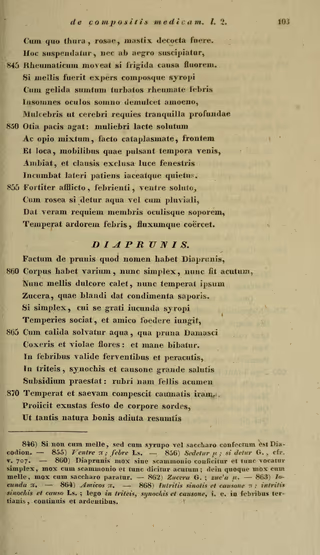
Let this be withheld, and not be taken by the sick person,
If a cold cause should set in motion a rheumatic flow.
If it is devoid of honey and composed of syrup,
Taken with cold water, it soothes with pleasant sleep the sleepless
Eyes troubled by the rheumatic flux of fever,
So that the soothing and tranquil rest of the brain may spend
Its deep leisure of peace: dissolved in woman's milk
And mixed with opium, having been made into a poultice, let it surround
The forehead and the places that throb with mobile veins at the temples,
And with the light shut out by closed windows
Let the patient lie upon his side and rest quietly.
For one severely afflicted, feverish, with loose bowels,
If it is given with rose water or with rain water,
It gives true rest to the limbs and sleep to the eyes,
Tempers the heat of the fever, and restrains the flux.
Spargitur in geminas species Diacodion unum:
Sanguineum ventris contendit vincere fluxum
Atque lienteriae non iura intacta relinquit,
Et relucet claro Galieni nomine fulgens.
Cum roseo sumtum masticinoque liquore
Rheumata suspendit capitis, immota caloris
Ad loca pulmonis facili stillantia lapsu.
Nam contentivam vim roborat, atque calorem
Alterat, humorem spissat laxosque meatus
Stricturae reddit propriae solitoque tenori.
Hoc cave, ne dederis nisi corpore mundificato,
Rheumatici fuerit si causa repletio fluxus,
Quem contentiva si vis defecta, vel humor
Lubricus intulerit, his omnibus una medendi
Formula communis, ut cum vino tribuatur,
Cum quo thura, rosae, mastix decocta fuere.
Hoc suspendatur, nec ab aegro suscipiatur,
Rheumaticum moveat si frigida causa fluorem.
Si mellis fuerit expers composque syropi
Cum gelida sumtum turbatos rheumate febris
Insomnes oculos somno demulcet amoeno,
Mulcebris ut cerebri requies tranquilla profundae
Otia pacis agat: muliebri lacte solutum
Ac opio mixtum, facto cataplasmate, frontem
Et loca, mobilibus quae pulsant tempora venis,
Ambiat, et clausis exclusa luce fenestris
Incumbat lateri patiens iaceatque quietus.
Fortiter afflicto, febrienti, ventre soluto,
Cum rosea si detur aqua vel cum pluviali,
Dat veram requiem membris oculisque soporem,
Temperat ardorem febris, fluxumque coërcet.