Hover or tap a word to see its match.
If *Rubea trochiscata* is given with barley water,
A rheumatic cough of the mouth is resolved in wine.
Taken in an equal kind, it helps a fallen uvula. —
It restrains and suddenly binds bloody sputum,
Loosened in whatever way, with the juice of mint.
Hematite, gum, cinnamon, myrtle, mastic,
The mucilage of plantain [and] of tragacanth,
Mixed with a dose of *Rubea*, let them take the shapes
Of a pill-like form: you will give eleven to the sick person to be held in the mouth.
This is a very special cure for those suffering from hemoptysis. —
It stops anatropa when drunk with the juice of plantain,
And catatropa when taken under a similar guise.
When drunk, it firmly represses the pain of the head
Caused by bile, associated with rose liquid.
Camphor, henbane, opium, lettuce, poppy,
The root of mandrake, prepared with rose oil,
When they thus keep the fellowship of a mixture with *Rubea*,
Smeared on the temples, with the region of the forehead anointed,
They refresh sleepless eyes and lightly induce sleep,
Which the fierce force of pain forces to keep the night watches. —
It calms the little eyes badly disturbed by phrenesis,
It soothes, and refreshes, and feeds them with pleasant sleep,
If, made into pills with the seeds of white poppy
And simultaneously of lettuce, it is given to the patient in the evening,
While the phrenesis boils, while it rages in the citadel of the brain
Bilious matter, while the anger of heat rages on,
While the deluded sight errs among various figures,
While wandering mobility seizes the eyes in no order,
While the head and hands, while individual limbs are moved,
And while words, stamped by no coin of the mind,
Are tossed about, full of disputes and various complaints,
No dose of *Rubea*, simple or mixed,
Will dare to touch the hidden seats within the body.
When the whirlwind is calmed, with the storm of phrenesis waning,
If any sleeplessness remains, hostile to slumber,
It demands the help of *Rubea*; nor does it disdain to explore
The faith of a friend, whose assistance it seeks by art.
It fights against the tertian, which with rebellious front
It bravely withstands, given in the preceding hours,
If it is taken with warm water or with *Rhodostomate*.
When the fever draws vigor from modest strength,
And a very small humor supplies matter for itself,
When the pattern anticipates and with accelerated motion
The onset rises more fiercely, greater in time,
When, with sweat completely removed, the mass of humors,
Easily kindled, resists the burning heat less,
When the puncture of typical rigor is less biting,
With the law of the pattern broken, when imperious heat now
Alone holds the vapor subjected to it and thins it,
Which, with its grossness taken away, burns more tranquilly,
The color of the urine ascends, and with its thinness left behind,
The form of the concocted liquor is turned into thickness,
When the mature fever is proven by its proper signs,
And at last the humor is recognized as well digested:
In this case, *Rubea*, combined with the former species,
With the pulse, temples, and nostrils then anointed,
But first with a suitable medicine having been offered,
Destroys and extirpates the fever, and the gift of health
It achieves [this], repairs lost strength, and restores it.
Mixed with a "sword", it overthrows a false quartan fever
And conquers a fever born from salty phlegm.
A mixed medicine is given for compound causes,
A simple one for simple [causes]: a mixed humor born from
adulteration requires the use of a mixed medicine.
Given at certain times according to the measure of reason,
As the course of the disease demands, any opiate
Performs a threefold duty, for it strengthens the limbs
Broken and loosened by the *cauma* of the fever:
It consumes the remains of bad matter,
And closes the evil vents of putrid smoke.
I judge that a fourth must be added to the aforesaid:
Lest relapsing traces of the evil disease occur,
Lest a suspected crisis, with some rancor left behind,
Stir up the extinguished complaint in a relapsing dispute. —
In continuous fevers, the use of this medicine
Is harmful, and therefore reprobate and greatly to be feared. —
A lustral boundary completes its proper lifespan.
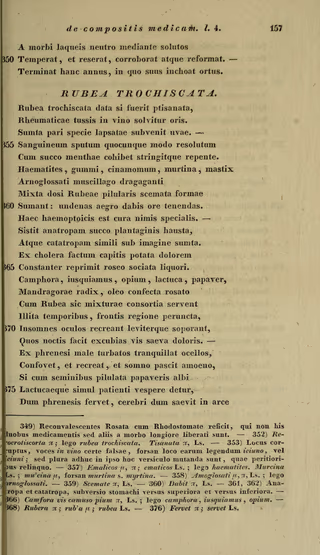
Rubea trochiscata data si fuerit ptisanata,
Rheumaticae tussis in vino solvitur oris.
Sumta pari specie lapsatae subvenit uvae. —
Sanguineum sputum quocunque modo resolutum
Cum succo menthae cohibet stringitque repente.
Haematites, gummi, cinamomum, murtina, mastix
Arnoglossati muscillago dragaganti
Mixta dosi Rubeae pilularis scemata formae
Sumant: undenas aegro dabis ore tenendas.
Haec haemoptoicis est cura nimis specialis. —
Sistit anatropam succo plantaginis hausta,
Atque catatropam simili sub imagine sumta.
Ex cholera factum capitis potata dolorem
Constanter reprimit roseo sociata liquori.
Camphora, iusquiamus, opium, lactuca, papaver,
Mandragorae radix, oleo confecta rosato
Cum Rubea sic mixturae consortia servent
Illita temporibus, frontis regione peruncta,
Insomnes oculos recreant leviterque soporant,
Quos noctis facit excubias vis saeva doloris. —
Ex phrenesi male turbatos tranquillat ocellos,
Confovet, et recreat, et somno pascit amoeno,
Si cum seminibus pilulata papaveris albi
Lactucaeque simul patienti vespere detur,
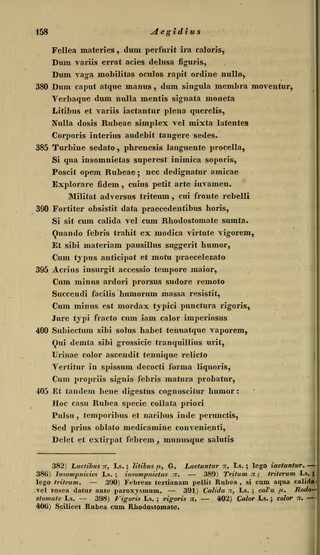
Dum phrenesis fervet, cerebri dum saevit in arce
Fellea materies, dum perfurit ira caloris,
Dum variis errat acies delusa figuris,
Dum vaga mobilitas oculos rapit ordine nullo,
Dum caput atque manus, dum singula membra moventur,
Verbaque dum nulla mentis signata moneta
Litibus et variis iactantur plena querelis,
Nulla dosis Rubeae simplex vel mixta latentes
Corporis interius audebit tangere sedes.
Turbine sedato, phrenesis languente procella,
Si qua insomnietas superest inimica soporis,
Poscit opem Rubeae; nec dedignatur amicae
Explorare fidem, cuius petit arte iuvamen.
Militat adversus triteum, cui fronte rebelli
Fortiter obsistit data praecedentibus horis,
Si sit cum calida vel cum Rhodostomate sumta.
Quando febris trahit ex modica virtute vigorem,
Et sibi materiam pausillus suggerit humor,
Cum typus anticipat et motu praecelerato
Acrius insurgit accessio tempore maior,
Cum minus ardori prorsus sudore remoto
Succendi facilis humorum massa resistit,
Cum minus est mordax typici punctura rigoris,
Jure typi fracto cum iam calor imperiosus
Subiectum sibi solus habet tenuatque vaporem,
Qui demta sibi grossicie tranquillius urit,
Urinae color ascendit tenuique relicto
Vertitur in spissum decocti forma liquoris,
Cum propriis signis febris matura probatur,
Et tandem bene digestus cognoscitur humor:
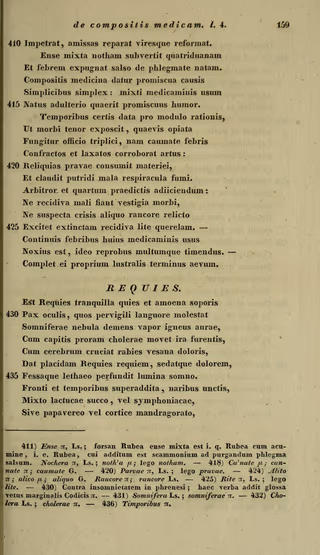
Hoc casu Rubea specie collata priori
Pulsu, temporibus et naribus inde perunctis,
Sed prius oblato medicamine convenienti,
Delet et extirpat febrem, munusque salutis
Impetrat, amissas reparat viresque reformat.
Ense mixta notham subvertit quatriduanam
Et febrem expugnat salso de phlegmate natam.
Compositis medicina datur promiscua causis
Simplicibus simplex: mixti medicaminis usum
Natus adulterio quaerit promiscuus humor.
Temporibus certis data pro modulo rationis,
Ut morbi tenor exposcit, quaevis opiata
Fungitur officio triplici, nam caumate febris
Confractos et laxatos corroborat artus:
Reliquias pravae consumit materiei,
Et claudit putridi mala respiracula fumi.
Arbitror et quartum praedictis adiiciendum:
Ne recidiva mali fiant vestigia morbi,
Ne suspecta crisis aliquo rancore relicto
Excitet extinctam recidiva lite querelam. —
Continuis febribus huius medicaminis usus
Noxius est, ideo reprobus multumque timendus. —
Complet ei proprium lustralis terminus aevum.