Hover or tap a word to see its match.
*Requies* is tranquil rest and a pleasant peace of sleep
For the eyes, which a fiery vapor, taking away
The cloud of sleep-bringing air, troubles with wakeful languor,
When the anger of raging choler moves the prow of the head,
When the mad rage of pain tortures the brain,
*Requies* gives placid rest, and soothes the pain,
And bathes the tired eyes in Lethean sleep.
Added to the forehead and temples, with the nostrils anointed
With the mixed juice of lettuce, or of henbane,
Or of poppy, or with the bark of mandrake,
With all or only the seeds well ground,
prepared from the white of an egg, and well mixed.
*Requies* dissolved in a syrup made from violets
and drunk better fulfills the effect of its name,
and more perfectly accomplishes its soporific purpose.
To the strong and hot its substance is given, to the delicate
the strained liquid: the discordant strength of the patient
alters and varies the form and measure of the dose.
For the one whose brain the fiery force of the crasis of choler, the lively virtue,
and the innate power dispose with certain signs
which prove it hot, whom a stronger age full of vigor
carries forward to the peak of strength:
to this one, when choler vexes the head, and a heavy sting of pain
arises, disturbing the sweet allurements
of slumber, when no presence of sleep is at hand,
when fantastic error already opens the eyes:
in this case *Requies* taken internally, bringing about
sleep, conciliating the eyes, soothes them with the opium of pity:
it relieves the limbs with rest and with the breathing of sleep
it refreshes nature: it tempers the sharpness of raging choler
and represses the sensation and movement of pain.
The cause of the evil having been first decimated and lightly loosened,
as the rule of the disease commands and dictates to be done,
it aids the effect of the medicine to be taken afterwards,
and causes it to fulfill its proper action more speedily.
Since *Requies* is the coldest of all opiates,
it must not be given to an old man, to a boy, never to a woman
nor to a youth, whom the series of signs designates as phlegmatic
by manifest reason and with a reliable character,
whose seed is fluid, head cold, nostril moist,
sensation sluggish, intellect dull, movement lazy,
A tasteless palate, an abundance of sputum, of flesh
Softness, heaviness of sleep, sluggishness of mind;
If it is given to this one, whom my description
Expresses and paints as such, in whom a small force of heat
Lies hidden in the veins, implanted from the first causes,
It congeals the humors by the soporific virtue of opium,
Stagnates the bloody streams and closes the passages,
And renders the nerves stupefied with lethal cold:
It condemns the languid eyes to perpetual sleep. —
To the one whose bilious humor, drawn to the prow of the brain,
Induces phrenesis, in whom a slow or burning fever
Dwells in the veins, I advise that it not be taken
Internally, lest by debilitating the innate heat
It impede the critical motions, the virtue being weighed down:
Externally, the use of a poultice is permitted to be applied,
But beware that it is not applied in the critical hours.
For the vain opinion of the empiric Rigordus is
To be reprobated by my judgment, damnable, worthy
Of every cross, and to be darkened by the title of its patron,
Who offers *Requies* to monks in acute fevers
And makes their rest eternal, and gorges the dark
Orcus, capable of a moderate amount, with black monks. —
A doubled year will give it its full period of maturity.
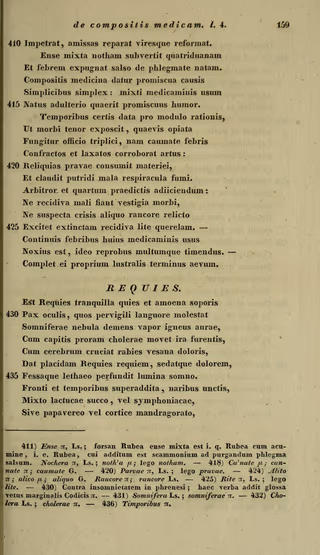
Est Requies tranquilla quies et amoena soporis
Pax oculis, quos pervigili languore molestat
Somniferae nebula demens vapor igneus aurae,
Cum capitis proram cholerae movet ira furentis,
Cum cerebrum cruciat rabies vesana doloris,
Dat placidam Requies requiem, sedatque dolorem,
Fessaque lethaeo perfundit lumina somno.
Fronti et temporibus superaddita, naribus unctis,
Mixto lactucae succo, vel symphoniacae,
Sive papavereo vel cortice mandragorato,
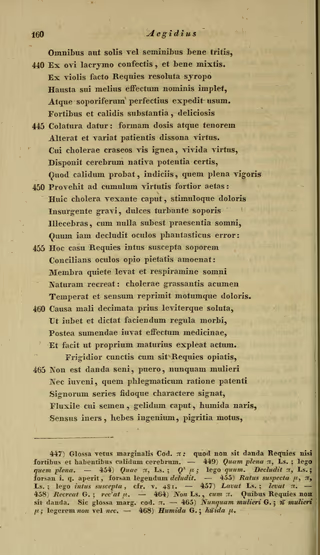
Omnibus aut solis vel seminibus bene tritis,
Ex ovi lacrymo confectis, et bene mixtis.
Ex violis facto Requies resoluta syropo
Hausta sui melius effectum nominis implet,
Atque soporiferum perfectius expedit usum.
Fortibus et calidis substantia, deliciosis
Colatura datur: formam dosis atque tenorem
Alterat et variat patientis dissona virtus.
Cui cholerae craseos vis ignea, vivida virtus,
Disponit cerebrum nativa potentia certis,
Quod calidum probat, indiciis, quem plena vigoris
Provehit ad cumulum virtutis fortior aetas:
Huic cholera vexante caput, stimuloque doloris
Insurgente gravi, dulces turbante soporis
Illecebras, cum nulla subest praesentia somni,
Quum iam decludit oculos phantasticus error:
Hoc casu Requies intus suscepta soporem
Concilians oculos opio pietatis amoenat:
Membra quiete levat et respiramine somni
Naturam recreat: cholerae grassantis acumen
Temperat et sensum reprimit motumque doloris.
Causa mali decimata prius leviterque soluta,
Ut iubet et dictat faciendum regula morbi,
Postea sumendae iuvat effectum medicinae,
Et facit ut proprium maturius expleat actum.
Frigidior cunctis cum sit Requies opiatis,
Non est danda seni, puero, nunquam mulieri
Nec iuveni, quem phlegmaticum ratione patenti
Signorum series fidoque charactere signat,
Fluxile cui semen, gelidum caput, humida naris,
Sensus iners, hebes ingenium, pigritia motus,
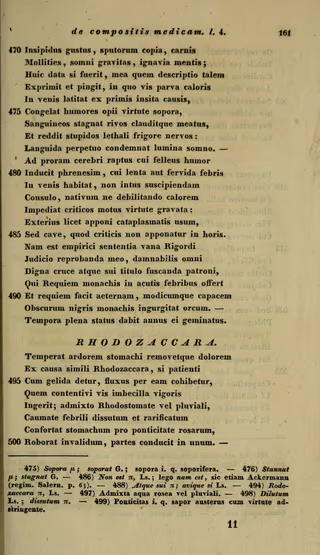
Insipidus gustus, sputorum copia, carnis
Mollities, somni gravitas, ignavia mentis;
Huic data si fuerit, mea quem descriptio talem
Exprimit et pingit, in quo vis parva caloris
In venis latitat ex primis insita causis,
Congelat humores opii virtute sopora,
Sanguineos stagnat rivos clauditque meatus,
Et reddit stupidos lethali frigore nervos:
Languida perpetuo condemnat lumina somno. -
Ad proram cerebri raptus cui felleus humor
Inducit phrenesim, cui lenta aut fervida febris
In venis habitat, non intus suscipiendam
Consulo, nativum ne debilitando calorem
Impediat criticos motus virtute gravata:
Exterius licet apponi cataplasmatis usum,
Sed cave, quod criticis non apponatur in horis.
Nam est empirici sententia vana Rigordi
Judicio reprobanda meo, damnabilis omni
Digna cruce atque sui titulo fuscanda patroni,
Qui Requiem monachis in acutis febribus offert
Et requiem facit aeternam, modicumque capacem
Obscurum nigris monachis ingurgitat orcum. -
Tempora plena status dabit annus ei geminatus.