Hover or tap a word to see its match.
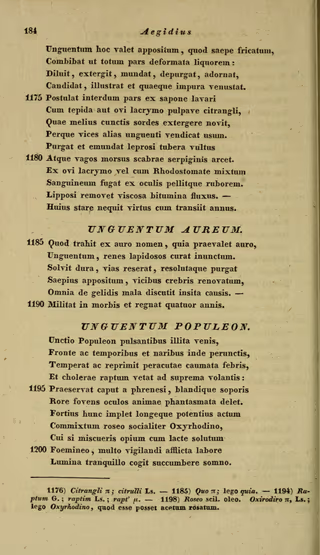
The Populeon unction, smeared on the pulsating veins,
with the forehead and temples and nostrils then thoroughly anointed,
tempers and represses the burning heat of a peracute fever,
and forbids the violent rush of choler flying to the highest parts:
It preserves the head from delirium, and fostering the eyes
with the dew of mild sleep, it destroys the phantasms of the soul.
It fulfills this act more strongly and far more powerfully
when sociably mixed with rosy *Oxyrhodinum*,
to which if you have mixed opium dissolved with woman's
milk, it compels eyes afflicted by much labor of waking
to succumb to tranquil sleep.
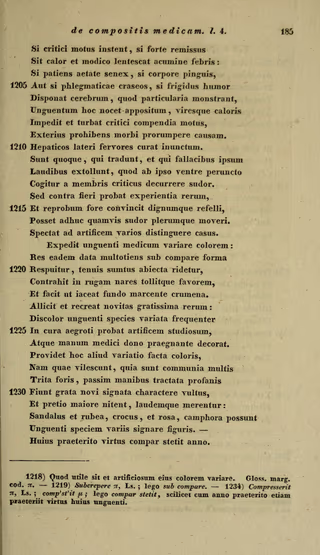
If critical movements are imminent, if by chance the heat
Should be relaxed and the fever should become milder with a moderate sting:
If the patient is an old man in age, if he is fat in body,
Or if of a phlegmatic crasis, if cold humor
Disposes the brain, which particular signs show,
This ointment is harmful when applied, and it impedes
The forces of heat and disturbs the shortcuts of the critical movement,
Preventing the cause of the disease from breaking out externally.
Applied as an ointment, it cures hepatic heats in the side.
There are also those who teach, and who extol it with
Deceptive praises, that from the belly itself being anointed
A critical sweat is forced to run down from the limbs.
But the experience of things proves that the opposite happens,
And proves that it is false and worthy of being refuted,
Although sweat could still be moved for the most part.
It belongs to the physician to distinguish the various cases.
It is expedient for the physician to vary the color of the ointment:
The same thing given many times under a similar form
Is rejected, and being thrown away as a slight expense is laughed at,
It draws the nose into a wrinkle and removes favor,
And it causes the purse to lie at the withering bottom.
The most pleasing novelty of things attracts and refreshes:
A different-colored appearance of the ointment, frequently varied
In the care of the sick person, proves the physician to be zealous,
And decorates the hand of the physician with a pregnant gift.
The variation made in color provides this other thing,
For those things which become cheap, because they are common to many,
Worn out outdoors, handled everywhere by profane hands,
Become pleasing when marked with the character of a new face,
And shine with a greater price, and deserve praise:
Sandalwood and madder, saffron, and rose, and camphor can
Mark the appearance of the ointment with various figures. —
Its virtue stood equal to the past year.
Unctio Populeon pulsantibus illita venis,
Fronte ac temporibus et naribus inde perunctis,
Temperat ac reprimit peracutae caumata febris,
Et cholerae raptum vetat ad suprema volantis:
Praeservat caput a phrenesi, blandique soporis
Rore fovens oculos animae phantasmata delet.
Fortius hunc implet longeque potentius actum
Commixtum roseo socialiter Oxyrhodino,
Cui si miscueris opium cum lacte solutum
Foemineo, multo vigilandi afflicta labore
Lumina tranquillo cogit succumbere somno.
Si critici motus instent, si forte remissus
Sit calor et modico lentescat acumine febris:
Si patiens aetate senex, si corpore pinguis,
Aut si phlegmaticae craseos, si frigidus humor
Disponat cerebrum, quod particularia monstrant,
Unguentum hoc nocet-appositum, viresque caloris
Impedit et turbat critici compendia motus,
Exterius prohibens morbi prorumpere causam.
Hepaticos lateri fervores curat inunctum.
Sunt quoque, qui tradunt, et qui fallacibus ipsum
Laudibus extollunt, quod ab ipso ventre peruncto
Cogitur a membris criticus decurrere sudor.
Sed contra fieri probat experientia rerum,
Et reprobum fore convincit dignumque refelli,
Posset adhuc quamvis sudor plerumque moveri.
Spectat ad artificem varios distinguere casus.
Expedit unguenti medicum variare colorem:
Res eadem data multotiens sub compare forma
Respuitur, tenuis sumtus abiecta ridetur,
Contrahit in rugam nares tollitque favorem,
Et facit ut iaceat fundo marcente crumena.
Allicit et recreat novitas gratissima rerum:
Discolor unguenti species variata frequenter
In cura aegroti probat artificem studiosum,
Atque manum medici dono praegnante decorat.
Providet hoc aliud variatio facta coloris,
Nam quae vilescunt, quia sunt communia multis
Trita foris, passim manibus tractata profanis
Fiunt grata novi signata charactere vultus,
Et pretio maiore nitent, laudemque merentur:
Sandalus et rubea, crocus, et rosa, camphora possunt
Unguenti speciem variis signare figuris. —
Huius praeterito virtus compar stetit anno.