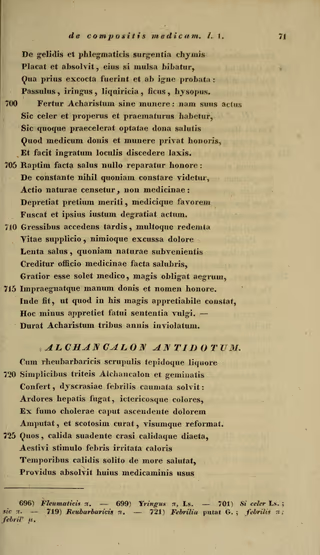
ALCHANCALON ANTIDOTUM.

Poet
Aegidius Corboliensis
Form
Hexameter
Open the page in the book
The pages this poem fills. Each opens in the Aegidii Corboliensis carmina medica reader.

Hover or tap a word to see its match.

With scruples of rhubarb and a warm liquor,

*Alchancalon* is beneficial for simple and double tertians, it resolves the burning heats of a febrile dyscrasia: it puts to flight the burnings of the liver, and jaundiced colors, cuts off the pain from the smoke of choler ascending to the head, cures dizziness, and restores vision.

Those whom, by the urging of a hot temperament and a hot diet, a fever provoked by the sting of summer heat greets in hot seasons in its customary manner, the prudent use of this medicament delivers

Anticipating, it removes the harms of future evil,

And breaks the sociable love of fever for the body. —

Compounded with honey, it serves for two years;

With only syrup added, it maintains itself for one.

Cum rheubarbaricis scrupulis tepidoque liquore

Simplicibus triteis Alchancalon et geminatis

Confert, dyscrasiae febrilis caumata solvit:

Ardores hepatis fugat, ictericosque colores,

Ex fumo cholerae caput ascendente dolorem

Amputat, et scotosim curat, visumque reformat.

Quos, calida suadente crasi calidaque diaeta,

Aestivi stimulo febris irritata caloris

Temporibus calidis solito de more salutat,

Providus absolvit huius medicaminis usus

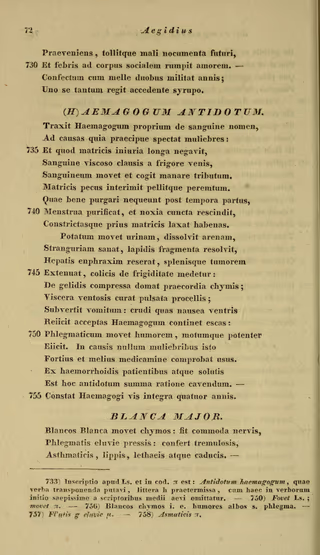
Praeveniens, tollitque mali nocumenta futuri,

Et febris ad corpus socialem rumpit amorem. —

Confectum cum melle duobus militat annis;

Uno se tantum regit accedente syrupo.
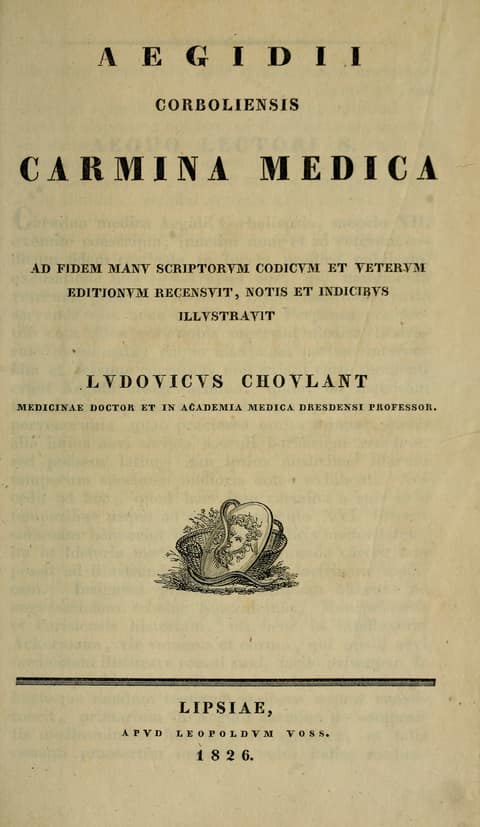
Title page of Aegidii Corboliensis carmina medica
Title page of Aegidii Corboliensis carmina medica , 1826

About this text

Provenance

This digital edition is derived from the Internet Archive copy of Ludwig Choulant's 1826 edition of Aegidii Corboliensis carmina medica, preserving medieval Latin medical poems attributed to Aegidius Corboliensis.

Methodology

Each scan is treated as a page-level unit. The page image remains the authority for the edition. Local Kraken OCR was used as a Latin-print reading aid, then Gemini generated scan-grounded Latin transcription and English translation from the images, the OCR aid, and the approved glossary. Word links connect the English translation to the Latin transcription and locations on the scans. 9 uncertain word-link decisions remain unlinked. Some links highlight only the text because the source word could not be located on the scan.

Rights

The source work is in the public domain by publication age. The local rights evidence points to a Public Domain Mark record for the Internet Archive-derived file. Poet Doctor's presentation adds generated OCR, transcription, translation, navigation metadata, and editorial context.

Original scans: Countway Library / Medical Heritage Library copy via Internet Archive ( Public Domain Mark 1.0 ).

Historian’s note. This text records the medicine of its own time, and later evidence has replaced most of it. It is not medical advice. We read it as history, and we ask what, if anything, connects it to medicine today. More on how we read old medical books