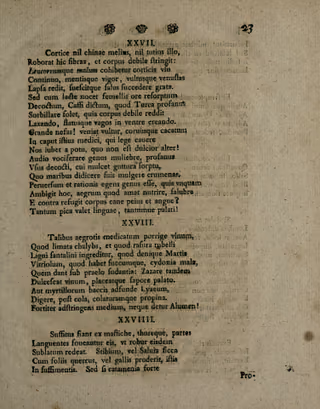
XXVIII.

Poet
Christian Tobias Ephraim Reinhard
Book
Medicus poeta , 1762
Form
Not identifiable from book
Open the page in the book
The page this poem fills. Each opens in the Medicus poeta reader.

Hover or tap a word to see its match.

XXVIII.

To such sick women offer medicated wine,

Into which filed steel, and the shavings of reddish

Sandalwood enter, and finally vitriol of Mars,

And which has the juice that quinces

Sweating under the press give forth: at last with Zazare

Let the wine be sweetened, and please the palate with its flavour.

Or pour wine upon bilberries,

Digest it, afterwards strain it, and give the strained liquor to drink.

And let no strongly astringent medium, nor alum, be given!

Talibus aegrotis medicatum porrige vinum,

Quod limata chalybs, et quod rasura rubelli

Ligni santalini ingreditur, quod denique Martis

Vitriolum, quod habet succumque, cydonia mala,

Quem dant sub praelo sudantia: Zazare tandem

Dulcescat vinum, placeatque sapore palato.

Aut myrtillorum baccis adfunde Lyaeum,

Digere, post cola, colaturamque propina.

Fortiter adstringens medium, neque detur Alumen!
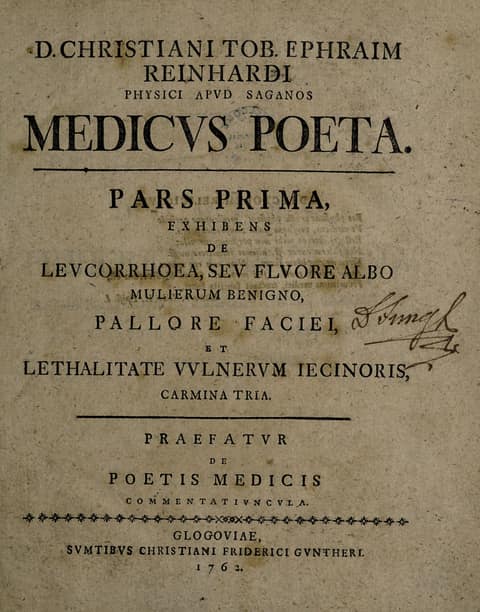
Title page of Medicus poeta
Title page of Medicus poeta , 1762

About this text

Provenance

This edition uses the Wellcome Collection copy, catalogued as _Medicus poeta. Pars prima, exhibens de leucorrhoea, pallore faciei, et lethalitate vulnerum jecinoris, carmina tria_ (b30503395). Scans 1 to 4 are the front cover and flyleaves with handwritten notes. Scan 5 is the title page. Scans 75 to 80 are blank leaves and the back cover.

Rights

The work is in the public domain by age. Wellcome Collection marks this copy with Public Domain Mark 1.0. Credit Wellcome Collection. Poet Doctor is a non-commercial site.

Original scans: Wellcome Collection ( Public Domain Mark 1.0 ).

Historian’s note. This text records the medicine of its own time, and later evidence has replaced most of it. It is not medical advice. We read it as history, and we ask what, if anything, connects it to medicine today. More on how we read old medical books